Skip to content

Korea Blog: Park Kwang-su’s “Chilsu and Mansu” (1988)

Chil-su and Man-su (칠수와 만수) opens with an air raid drill, a regular occurrence in the life of postwar Seoul even after the country turned from military dictatorship to ostensible democracy in 1987. The movie came out the following year, when modern South Korea made its debut on the world stage by hosting the 1988 Summer Olympics. Korea-inexperienced Westerners who came to watch the games, especially Americans primed by episodes of M*A*S*H, found, by most accounts, a more developed, more orderly, and — why mince words — more Westernized country than they’d expected. But even those who left having bought the narrative of the phoenix risen from the ashes could glimpse another story playing out on the margins of the scene, that of those barely touched, let alone elevated, by the economic Miracle on the Han River.

Park Kwang-su took two of the players in that other story and made them the title characters of his directorial debut. Chil-su, a 22-year-old dreamer employed as a theater movie-poster painter (very much a developing-world industry, though one still just barely alive in the late 1980s), quits his job in a fit of righteous rage against his stingy, hostile boss, declaring that he shouldn’t have to take his abuse in a democratic nation. Even more strapped for cash than usual and eager to woo a girl for whom he’s fallen after spotting her working at Burger King, he talks his way into a partnership with Man-su, an older sign-painter who at first treats him dismissively but to whom he nevertheless looks up.

And so, on one level, we have a comedy of two working-class guys trying to make it in the big city, but with an undercurrent of darkness that deepens as the story plays out. The jovial Chil-su lies compulsively: he tells everyone who will listen of his wholly fabricated plan to emigrate to Miami Beach and join his nonexistent brother and lets the object of his affection, whom he sketches at work while nursing a single Coca-Cola, believe that he attends art school. He does have a sister, but she vanished after their father threw her out of the house for consorting with American soldiers. The father himself remains in the family hometown, remarried after the death of Chil-su’s mother and slowly, bitterly pickling himself in soju.

Read the whole thing at the Los Angeles Review of Books.
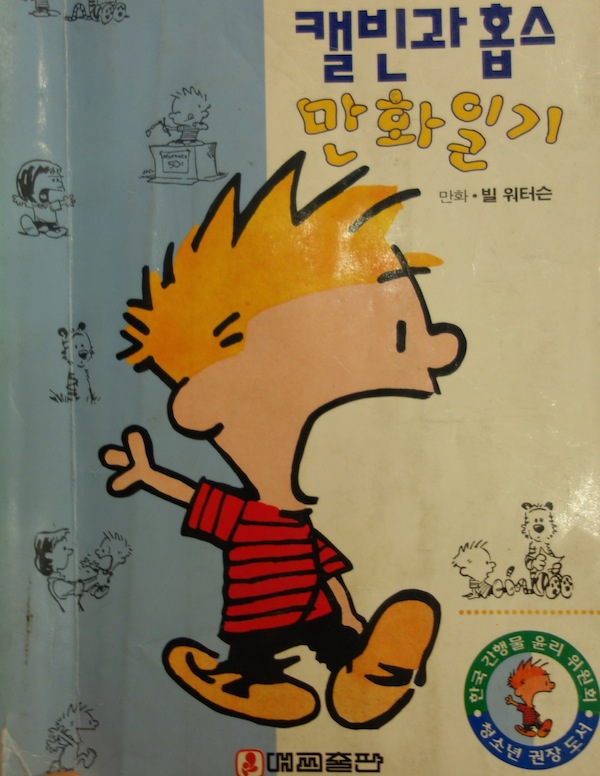
Korea Blog: Reading Calvin and Hobbes in Korea

KB - C&H - 1

The Sunday funny pages may now seem, even by current print standards, like the blandest, most marginal cultural forum imaginable, but they’ll always feature prominently in my own life story as the place I learned to read. Each week, I’d go from the basic, often slapsticky, sometimes entirely nonlinguistic humor of Garfieldto the more artistically, emotionally, and verbally advanced likes ofPeanuts to — if I could put in the time — the forbidding heights of Doonesbury and Zippy, with their detailed images and wordy mixtures of irony and earnestness, or the often mystifying, rarely attempted “serious” comics like Mary Worth and Apartment 3-G. Each week, I grasped a little more of their stories, their messages, their jokes.

In adulthood, I’ve come around to rediscover the delight of learning to read English in learning foreign languages. It has something to do with the immediate and perceptible (or at least theoretically immediate and perceptible) return on effort: learn a little more of a language, and you can then and there have that much more of a conversation, watch that much more of a movie, read that much more of a book, navigate that much more of a new environment. Since we learn our native languages in some sense unconsciously, without much in the way of deliberate effort, I didn’t get any particular charge — not that I remember, anyway — from learning to speak English. But later, when I opened up the comics each and every Sunday while learning to read English, a deliberate project indeed, I could feel both the rich satisfaction of making progress and the equally rich frustration of sometimes making less progress than I’d expected to.

And so it’s gone with the work of mastering Korean, though since I live in Korea, the evaluation comes not once a week but every day, unavoidably, over and over again. Still, it occurred to me somewhere along the way that I could again use comics as a learning tool much as I used them over a quarter-century ago. On my first visit to Seoul, having come across a bursting-at-the-seams basement secondhand bookstore not only still open at almost midnight but manned by an eccentric owner who served us instant coffee (all of which, by itself, probably sold me on Korea as a place to live), I had good reason to snap up the book of Calvin and Hobbes strips translated into Korean I found wedged into the middle of one of the countless floor-to-ceiling piles.

Read the whole thing at the Los Angeles Review of Books.

Korea Blog: A Walk Deep Into Seoul with an Expert on the Korean Built Environment

“Things in Seoul don’t have anything to do with each other.” We members of the Royal Asiatic Society Korea Branch (왕립아세아학회한국지부) heard this important principle for understanding the Korean capital early in the day from our guide, Robert Fouser. A noted American scholar of linguistics and architecture, he’d come to town to promote a couple new books he has out. He wrote them in Korean, a language that, during the years he spend living in Japan, he also taught — in Japanese. Just as none can doubt his experience with east Asian languages, none can doubt his experience with east Asian architecture, or at least his experience with traditional Korean houses, known as hanok (한옥), one of which he spent serious time and effort restoring to not just sound but fully authentic condition.

The word “authentic” came up more than a few times on the walk, which took us deep into Seoul, beginning at the Jongmyo Shrine. Between its construction in the late 14th century and its arrival on UNESCO’s list of World Heritage Sites in 1995, the place has seen some hard times, up to and including destruction during the Japanese invasions of 1592 and 1598. Rebuilt in 1601, the Jongmyo Shrine counts as one of the oldest building complexes in Seoul, a city where most historical structures have been torn down and put back up again much more recently, in the 19th, 20th, or even 21st centuries. But which can make the claim to greater authenticity: those rebuilt longer ago, or those rebuilt more recently with closer adherence to their original architectural plans?

People disagree about that question in Korea, but only recently has the debate risen to a high profile. For a long time after the Korean War, anything old suffered from shameful associations with poverty, backwardness, and underdevelopment; even in the 1980s, when Fouser first arrived in Korea as a student, tourists could roam sites like the Jongmyo Shrine more or less freely. But on our walk, we found sign after sign telling us where we couldn’t go, and watchful supervisors ready to let us have it the moment we set foot on any now-forbidden stone. The Joseon Dynasty (조선 시대), the kingdom of the united Korea that lasted from the late 14th until the late 19th century has, it seems, become fashionable.

Read the whole thing at the Los Angeles Review of Books.

Korea Blog: “The Empire of Light” on Stage

Ki-yong, the middle-aged protagonist of Kim Young-ha’s Your Republic Is Calling You, lives at the apparent height of South Korean normality, complete with a wife, a teenage daughter, a film importing business in Seoul, and a strong enthusiasm for soccer and beer. Then, one morning, comes an encrypted message with an unambiguous order: drop everything, dismantle your life, and get back to the North immediately. Ki-young, we soon find out, has lived for over twenty years in the South as a Northern sleeper agent, theoretically awaiting orders while accruing all the accoutrements of life in the peninsula’s more prosperous half. The novel follows what happens to him, his family, his colleagues, and his pursuers over the next 24 hours.

I first wrote about Your Republic Is Calling You in the LARB back in a 2013 profile of Kim’s novels in English translation, of which he has more and higher-profile than the average Korean novelist under fifty. (More recently, I’ve written about his literary podcast and Read, his latest book of essays, here on the Korea Blog.) In that piece, I quoted a reader-on-the-street description of the book as “a Korean version of Ulysses,” owing, no doubt, to its single-day time frame (a storytelling technique laid out in Aristotle’s Poetics, about which Kim writes in Read) as well as the way it moves through the city of Seoul as Ulysses moves through the city of Dublin.

These qualities make for compelling reading, but how to translate them to the stage? Taking on that very challenge, we have the French-Korean production The Empire of Light, a live adaptation of Kim’s novel from the National Theater Company of Korea, years in the making and now running in the heart of Seoul’s busiest shopping district at the Myeongdong Art Theater. That English directly translates 빛의 제국, Your Republic is Calling You‘s original (and, I might add, superior) Korean title, itself borrowed from René Magritte’s series of canvases L’Empire des lumières — the title under which the play will appear when it opens at the Center Dramatique National Orleans in May.

Read the whole thing at the Los Angeles Review of Books.

Korea Blog: Lee Seung-U’s “The Private Lives of Plants”

I once heard the Korean filmmaker Lee Sang-woo make a remark that shed a lot of light on the expectations of an international “art” filmmaker. He named Titanic as his personal favorite movie and claimed to want to do nothing more than make a silly romantic comedy, yet to that point had a filmography full of grim microbudget features set among Korea’s more desperate classes with names likeFather Is a Dog (아버지는 개다) and Mother Is a Whore (엄마는 창녀다). He’d made them, he said, because film festivals go for them; they want to see the “dark side” of the places their movies come from, so he’d obligingly darkened it up every time. (He said it at a Q&A following his latest picture, a high-school story of drugs, prostitution, cancer, and sex addiction.)

Lee Seung-u’s The Private Life of Plants (식물들의 사생활), which opens with its narrator driving around looking for working girls for his disfigured brother who, without regular sexual activity, goes into thrashing, terrifying fits — and this as an alternative to the brother’s former practice of having his mother carry him on her back to the brothels — at first struck me as an example of the same phenomenon. If world cinema has this festival-driven bias toward extravagant misery, might smaller and more “serious” publishers have incentivized the same thing in world literature? But the more I read, the more the novel deviated from my expectations — and the more pleasingly strange it became.

We learn that the narrator, Ki-hyeon, feels responsible for the loss of his brother Woo-hyeon’s legs. It happened due to an explosion during a military training exercise, and he got sent off to the military as a punishment for have taken the wrong pictures during his brief time as an avid photographer. “I remember the days when my brother was always on the streets with his camera,” remembers Ki-hyeon. “It was a time when Seoul often teemed with demonstrators and the air was filled with tear gas. His eyes watering and nose running, he devotedly clicked his shutter. He took photos of the police throwing tear gas bombs and wielding their clubs wile charging against protesters. He snapped shots of protesters throwing firebombs against the police shields, and photos of grimacing passerby, running for safety to avoid exploding tear gas bombs.”

Read the whole thing at the Los Angeles Review of Books.
Saturday, April 2: I Interview Three Young Award-Winning Korean Writers at the Seoul Book and Culture Club

April 2 Book Club

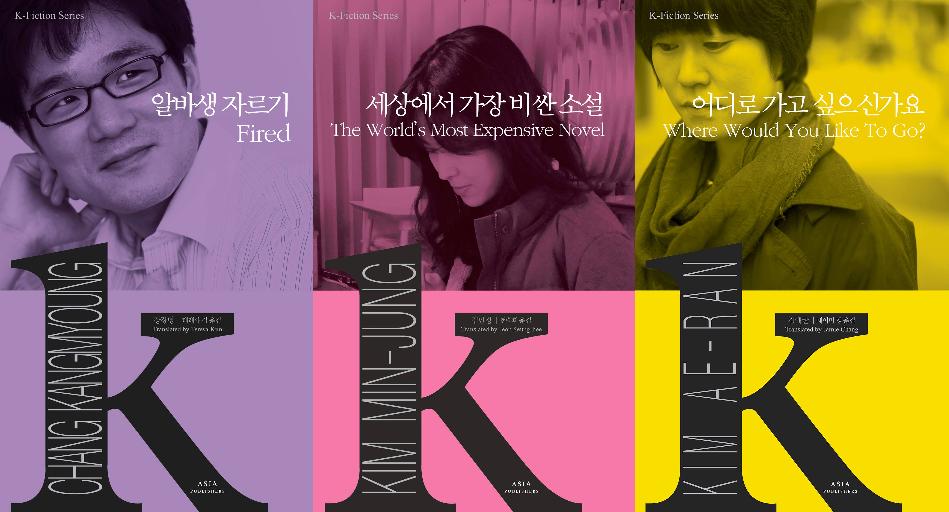
On the afternoon of Saturday April 2nd, I’ll moderate a free, bilingual Seoul Book and Culture Club talk with three young award-winning Korean writers, Kim Ae-ran, Chan Kangmyoung, and Kim Min-jung. Details from the event’s Facebook page:

Meet three of the brightest young imaginative voices in Korean fiction on April 2nd in central Seoul. These three exceptional Korean writers will read their work and be interviewed (in English & Korean!) at Seoul Global Cultural Centre in Myeong-dong. You will also be able to ask them questions in the Q and A session, buy new bilingual editions of some of their most celebrated stories and get them signed. The event will be moderated by renowned journalist and broadcaster Colin Marshall and is co-organised with ASIA Publishers – publishers of some of the most exciting Korean literature in print.

한국 소설계의 주목을 받은 상상력이 넘치는 우수한 신인 작가분들 세 분을 만나 이야기를 들어보는 시간! 4월 2일 토요일 명동의 서울글로벌센터내 해치홀에서 함께합니다. 이날 만나게될 세분의 특별한 한국인 작가분들은 직접 작품의 일부를 관객들에게 읽어주실 것이고 인터뷰에 응해주실 것입니다. (한국어와 영어로 동시 진행!) 관객으로 참석하시게된 모든 분들께 작가분들께 직접 질문드리는 기회도 드리며 작가분들의 작품성을 인정받은 소설작품의 바이링구얼 에디션을 현장에서 구매하고 바로 사인도 받을 수 있습니다. 본 이벤트는 유명한 저널리스트이자 방송인이신 콜린 마샬 씨께서 진행해주실 것이며 흥미로운 한국 문학 작품들을 출판하기로 유명한 도서출판 아시아와 공동 개최합니다.

The authors are:
함께할 작가들은 다음과 같습니다.

Kim Ae-ran – ‘Where Would You Like to Go?’
김애란 – ‘어디로 가고 싶으신가요?’

Chang Kangmyoung – ‘Fired’
장강명 – ‘알바생 자르기’

Kim Min-jung – ‘The World’s Most Expensive Novel’
김민정 – ‘세상에서 가장 비싼 소설’

Date: Saturday 2nd April.
날짜: 4월 2일 토요일

Time: 4:00pm to 6:00pm.
시간: 오후 4시부터 6시

Admission fee: FREE
참가비: 무료

Place: Haechi Hall in Seoul Global Cultural Center (5th Floor M Plaza in Myeong-dong)
Full directions are here.

장소: 서울글로벌문화체험센터 해치홀 (명동 M플라자 5층)
오시는 길은 다음 링크를 참조하시기 바랍니다.
www.seoultourism.kr/2013/eng/center/center3.asp

Korea Blog: Learning from the Korean City

Few books have changed the way I see cities Eastern or Western as much as Barrie Shelton’s Learning from the Japanese City. Were I an urban-planning academic, I’d want to write its counterpart for the Korean city myself. But until some urban-planning academic does take it upon themselves to write such a book, I actually recommend to those who arrive in and struggle to understand Seoul, or any less colossal Korean City, Shelton’s original. As I spend more time in Korea — punctuated by visits to its neighbor across the water, where I happen to sit writing this very post — the exercise of spotting the differences between it and Japan has become an exercise of spotting their ever-rarer similarities.

A great deal of work has gone into scrubbing away the imprint of the Japanese colonial rule, which lasted in Korea between 1910 and the end of the Second World War, including the demolition of structures built (no matter how well) during that time. Consequently, you don’t see much architectural similarity between, say, Seoul and Tokyo, but you do see a fair extent of overall urban similarity, beginning with the feelings both cities provoke in first-time Western visitors. “I was baffled, irritated and even intimidated by what I saw,” writes Shelton of his own early exposure to Japanese urban environments. “Yet at the same time, I found myself energized, animated and indeed inspired by them. The effect was liberating and my intuition was quick to suggest that further exploration of their chaotic vitality might be extremely rewarding.”

Tokyo and Seoul have long made this kind of unfavorable first impression, at least since, “to the ‘Enlightened’ Western eye of the latter half of the nineteenth century, the cities appeared drab, featureless and insubstantial,” and the observing Westerners, “almost without exception, could not see beyond the flimsiness of the individual buildings and the collective monotony of the cities.” Shelton even quotes the late nineteenth-century traveler Isabella Bird Bishop (about whose travels through Korea more in a later post) describing Tokyo as “‘a city of “magnificent distances” without magnificence’ meaning that it was an amorphous amalgam of grey featureless patches in a seemingly endless urban landscape.”

Read the whole thing at the Los Angeles Review of Books.

Korea Blog: The Real Life of Seoul, as Seen by Street Photographer Michael Hurt

How do you convince someone to spend their limited travel time and money in Seoul? The officials tasked with promoting South Korea abroad have racked their brains over that very question for years and years, coming up with little in the way of sure-fire selling points for their capital city. Even aside from the formidable challenge of competing against name brands like New York, London, and Paris, Seoul struggles to positively distinguish itself, even in broad strokes, from the other metropolises of Asia. The integration of a deep-rooted culture with advanced technology? Tokyo has long had that image sewn up. Rapid change? Beijing changes faster now, for better or worse. Cheap food and a pleasurable nightlife? Sure, if you’ve never heard of Bangkok. Ease of communication? Don’t get any given tourist started.

They don’t really come to Seoul for its the renowned cultural institutions or its distinguished architecture, and certainly not for its history or diversity. What, then, makes this city so very compelling? I’ve had plenty of similar conversations about Los Angeles, another city which provokes in me (and a select but growing number of others) a fascination bordering on obsession, but whose appeal doesn’t always present itself to the first-, second-, or even third-time visitor. In the cases of both Los Angeles and Seoul, the answer always comes down, unsatisfyingly though it may sound, to a kind of unromantic vitality: though the basic elements of both cities can seem dull, dysfunctional, and even dangerous, the life lived among them, filled with boundless amounts of energy often flowing at cross purposes, offers a bottomless and ever self-refreshing subject of study.

In Seoul, few see this as clearly as Michael Hurt, a Korean-American photographer who grew up in Ohio and first came here to live in 1994 as part of the Fulbright English Teaching Assistant Program. After completing a graduate program in comparative ethnic studies at UC Berkeley in 2002, he returned to Korea and spent the next few years taking his camera to the streets in a serious way, capturing whatever struck him as the real visual and social texture of life in the city. Street photography had already established itself in Los Angeles and other cities across America and Europe, but in Seoul, apart from a cameraman named Kim Ki Chan who documented neighborhood activity in the 1960s and 70s, it remained a virtually unknown tradition.

Read the whole thing at the Los Angles Review of Books.

Korea Blog: Han Kang’s “The Vegetarian”

Friends, friends of friends, and acquaintances often ask me if they should make a trip to South Korea, and I wholeheartedly recommend it to all of them — all of them except, perhaps, the vegetarians. I do know a handful of non-meat-eaters living here, all either foreigners or Koreans who grew up abroad, all living proof that a vegetarian can technically find a way to get by in this country. But the all-important social culture here, centered in large part on rounds and rounds of pork, beef, and squid grilled over an open flame, offers few points of entry to those who those who would stick to carrots and tempeh. (And as for the accompanying rounds and rounds of cheap liquor, teetotalers will find this a difficult land as well.) Once, I tried to explain veganism to a lady I met at in language-exchange group. “Oh,” she replied, in less a tone of judgment than of sheer bewilderment, “I think I cannot be friends with someone like that.”

But it’s one thing for a vegetarian foreigner to try living in Korea, where the locals know us by our often baffling lifestyle choices, and quite another for a Korean to decide to stop eating animals. Just such a conversion sets in motion the events of Han Kang’s The Vegetarian (채식주의자), first published in South Korea as a cycle of three novellas starting in 2007, and just this month published as a single volume in English in the United States. The book has sold publication rights in twenty countries and in the Anglosphere received, especially by the standard of Korean novels in translation by authors unknown outside the homeland, a staggering amount of press, all of it positive, and much of it struggling for the right words to describe what, exactly, makes it so very compelling. “I was convinced,” as one character observes, “that there was more going on here than a simple case of vegetarianism.”

Those words come from the plainspoken, unambitious husband of the titular vegetarian, a similarly nondescript-seeming woman in her thirties called Yeong-hye. “I’d always thought of her as completely unremarkable in every way,” he says at the beginning of the novel. “To be frank, the first time I met her I wasn’t even attracted to her. Middling height; bobbed hair neither long nor short; jaundiced, sickly-looking skin; somewhat prominent cheekbones; her timid, sallow aspect told me all I needed to know.” But “if there wasn’t any special attraction, nor did any particular drawbacks present themselves, and therefore there was no reason for the two of us not to get married.” And so their featureless union smoothly goes, until the morning he finds her taking the hundreds of dollars’ worth of meat in their refrigerator out and bagging it up for the garbage.

Read the whole thing at the Los Angeles Review of Books.

Los Angeles, the City in Cinema: the Lawn

Created for Los Angeles Times architecture critic Christopher Hawthorne’s Third Los Angeles Project event “Turf Battles: the Lawn in Los Angeles,” held on February 17, 2016. You can watch the whole evening here.