 A friend who’s big in L.A. book culture once advised me that my literary habits, “bounded on one side by Harry Mathews and on the other by Rikki Ducornet,” might not allow me to connect with the broad reading public I’d like to. While I don’t wall myself off quite like that — I’m only now cracking Mathews, and I have yet to seriously explore Ducornet — my personal novelist pantheon does include types at least as far from the mainstream as Alexander Theroux, Kobo Abe, and Jean-Philippe Toussaint. I responded with the concealed weapon in the arsenal that is my literary life: Richard Yates. Linear! Realistic! Midcentury! Actively hostile to experimentation! Yet I can’t stop returning to his well.
After Revolutionary Road, The Easter Parade, both books of short stories, and now Young Hearts Crying, I hazard the guess that I’ll continue my slow but steady progress through the Yates oeuvre in search of more descriptions of elaborate self-deception, of bitterly semi-private shame, and of the humiliating word salads we spout when we teeter on the edge of the yawning gap between our real and our (long-, loudly, and tiresomely discussed) actual intentions. This strikes me as the core of his craft, especially when he writes them on the part of fellow members of America’s “Greatest” World War II generation who flail against unabating feelings of fraudulence and inadequacy. Every generation fights the same private battles, I suppose, but none of them have used the phrase “son of a bitch” so well (or so often).
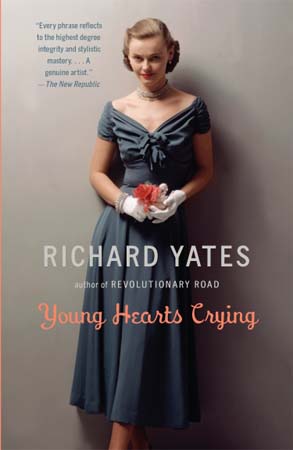
Yates’ second-to-last novel and one even his fans don’t discuss much these days, Young Hearts Crying seems like a bit of an oddity, especially since what little people do write about it nevertheless sounds like great acclaim. It follows the development and consequences of an early marriage, right out of university, between Michael and Lucy Davenport. He an aspiring poet, she a millionaire heiress, their future looks bright until the compromises start piling up. Sensing potential emasculation by Lucy’s fortune, Michael insists upon working by day at a chain store trade journal to support the family while struggling to write his “real” work. Under these circumstances, the couple eventually finds themselves, plus a daughter, living in the misshapen cottage on a private estate way out in upstate New York where their marriage will dissolve.
Unlike Revolutionary Road, this novel doesn’t end with the troubled union it examines. Yates spends most of its chapters covering the next twenty-odd years of Michael and Lucy’s separate lives, and their behavior in this stretch bears one important resemblance to Frank and April Wheeler’s in the earlier novel: they long for “creative” lives, lives lived in “the arts,” lives they seem far too weak and unimaginative — and far too unaware of their weakness and lack of imagination — ever to construct. (“Well, if she’s not a painter, maybe she wasn’t a writer, either, or an actress, either,” a friend says late in the book to the academia-stranded Michael of Lucy’s many wan attempts at creativity, “and look, I know this may sound harsh, but there’s an awful lot of women running around trying things.”) Most of Yates’ protagonists I’ve read about so far suffer from just this condition, which gives Yates ample opportunity to write in luxurious detail that self-delusion I so celebrate.
If forced to pin down Yates’ main psychological theme, I’d call it the unbearable contrast between his characters’ dimly envisioned goals and the punishingly mundane problems that actually dominate their lives. In response, some of his characters turn to booze, some crack up, some fall into the arms of variously unsuitable partners, some lay complicated self-sabotage traps, some attempt at-home abortions — and some, like the former Davenports, run through combinations thereof. (Except no at-home abortions this time out.) Always balancing on the wall of cruelty, Yates dangles before the young Michael and Lucy several couples who appear to be living the artistic dream, only to release them into their own forms of mediocrity decades later. “I thought you were fucking enchanted,” the aged but still damagingly impulsive Michael laments to his former idol of painterly bohemianism, now brought similarly low by a workaday teaching gig.
Young Hearts Crying puts a new wrinkle in the Yates cloth with its direct gaze onto a particularly sad — and, in life, sadly common — tendency in its characters’ lives. Though Michael and Lucy and even several secondary players here might like to think of their struggles in grand artistic terms — to write a poem that captures the experience of a psychotic break, to truly embody the role of Blance DuBois, to atmospherically explore a woman’s consciousness in a novel — their actual struggles, for which Yates starkly accounts on the page, come mostly from the desperate search and attempt to retain one more reasonably suitable man or woman with whom to go to bed. Even when they attain the equanimity to do their “real” work, they find they’ve been chiseled to resigned rubble by all this fruitless romantic turbulence. That’s assuming they had the wherewithal to create anything lasting to begin with, which Yates leaves that very much in doubt.
Post a Comment