Skip to content

Just one week left to support my venture in crowdfunded interactive urbanist-travel-cultural journalism on Byline

With one week left in the funding drive for “Where Is the City of the Future?”, my experiment in crowdfunded interactive urbanist-travel-cultural journalism here on Byline, allow me to address a seemingly simple question: why search for the city of the future in the first place?

As I’ve previously explained, for each $2000 raised by this funding campaign, “Where Is the City of the Future?” will produce an in-depth report one world city along the Pacific Rim, beginning with Los Angeles and Seoul and moving on to cities chosen by you, the supporters, from a selection ranging from Tokyo to Sydney, Vancouver to Jakarta, Hong Kong to Honolulu. (Those who support the project at the highest level can also name a Pacific Rim city, even one not already on the list, for inclusion.)

We’ve raised just over $500 so far — about a quarter of the budget for the first city in the series — but still have a whole week in which to put together the kind of amount that will make it interesting. That would require a comparison of at least three or four Pacific Rim cities, meaning a total budget of at least $6000 or $8000 — but of course, the bigger the budget, and thus the more cities the project can cover, the better.

Each city report from “Where Is the City of the Future?” will take a long form, running over the course of weeks and making use of not just writing and photography but other audiovisual media as well — videos offering a glimpse into the on-the-street experience in these cities, audio interviews with those who know them best, and a host of other possibilities besides — in order to get as deep as possible into as many aspects of these cities as possible: their architecture, their geography, their food, their urban design, their technology, their languages, their transit… the list goes on.

That very quality, above all others, strikes me as the reason to search for the city of the future: cities aren’t just subjects, but nexuses of all subjects. Whatever fires up your curiosity, you can explore, discuss, and learn about in the context of cities. And now that most of the world’s population has come to live in cities, they’ve become perhaps the most important context you can explore, discuss, and learn about most of these subjects in.

But you no doubt have particular things you’d like to know about each city, specific neighborhoods (whether real or metaphorical) you’d like to see explored. As a supporter of “Where Is the City of Future?” you can make your preferences heard: maybe in the ongoing conversation of the project’s Supporters’ Cafe here on Byline, maybe in a Skype or Google Hangout session with me directly, or maybe even face-to-face over the choicest food and drink in the Pacific Rim city of your choice.

Other benefits of supporting “Where Is the City of the Future?” include postcards I’ll send you from each of the Pacific Rim cities the project will cover; membership on the “Where Is the City of the Future?” mailing list, with regular updates on my urban travels for the series as well as a roundup of interesting news stories pertaining to the cities in the series; and a complete print collection of the “Where Is the City of the Future?” reports after the series has concluded.

But first, over the next seven days, we’ve got to get this thing funded! Thanks very much indeed for your time, attention, and, if I’ve done anything at all here to convince you of the project’s interestingness, support — which you can provide on the “Where Is the City of the Future?” page on Byline. I’ll see you on the Pacific Rim.
Diary: This American Road, Ozark

Cross-country 2015 - 42

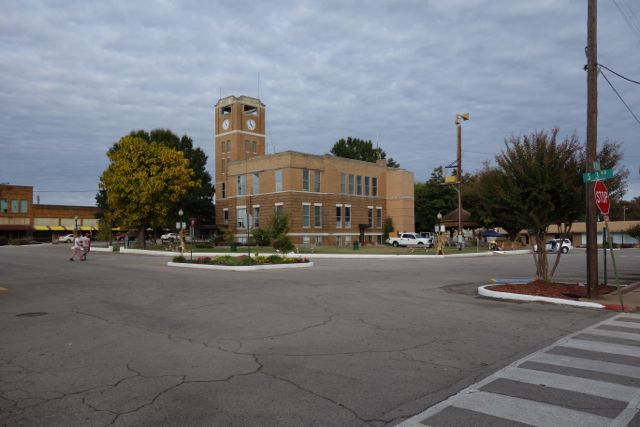
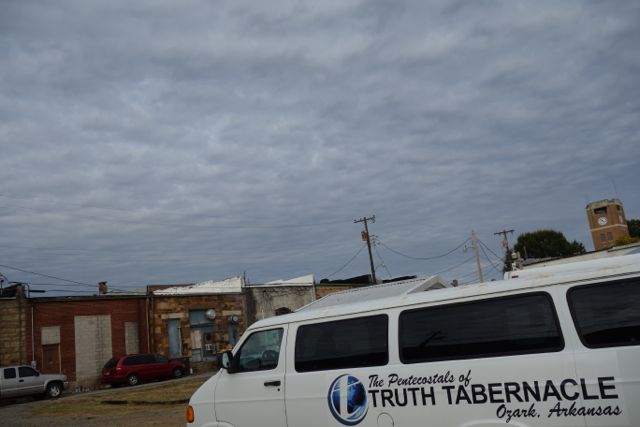
Ozark, Arkansas — it sounds like the name of a freeway exit you’d take pains to avoid using, or the name of one of those forbidding small towns in movies where the main character’s car breaks down and Bad Things Happen but you ultimately kind of blame the victim because, come on, Ozark, Arkansas. But we took the Ozark offramp with the greatest deliberateness, aiming for an early dinner at Rivertowne Barbecue, which came recommended to us by a genuine Arkansas native back in Los Angeles. You’ll notice I linked to Rivertowne’s web site, the fact of whose existence alone I found reassuring: it’s okay, they know about the internet, this is modern, literate, non-lawless Ozark of the 21st century.

ozark square

Still, I had low expectations, less in the Deliverance sense than that I’d envisioned Rivertowne, which first opened in 2000, located in a dreary, auto-oriented strip the likes of which I’ve already seen more than enough of sprouting off and alongside Interstate 40, maybe between a Wal-Mart on one side and a Sam’s Club on the other. But we found it in a traditional, almost classical town square that looked to have hosted an event involving quite a few tents, trucks, and stands just an hour or two before. There, hung in the back of one of the trucks whose owners hadn’t yet finished packing up their wares, I noticed the first Stars and Bars of the trip so far. I wondered how wary I should feel at finally spotting this ultimate signal of Confederate pride, or whether it should pleasantly surprise me that I’d spotted so few so far, or whether any of it meant anything at all.

Cross-country 2015 - 41

Mostly I just felt hungry, and ever more grateful for the presence of Rivertowne with each downtown Ozark business, all already closed for the day by late afternoon, we passed along the way. When we sat down to eat, we found that the bustle inside the restaurant balanced out the utter quiescence of the town around it. Artifacts of vintage Arkansas life, including old street signs off the main drag of Commercial Street and a large metal oval mounted above our booth proudly advertising Grapette soda (with “IMITATION GRAPE FLAVOR”) surrounded us, with nary a banner of Dixie to be seen. A framed portrait hanging by the bathroom immortalized Rivertowne’s first paying customer. A high-heeled teenager in bright purple jeans came in with her family, the heavy makeup and first-place sash she wore attesting to a fresh beauty-pageant victory.

Cross-country 2015 - 43

In the unlikely event that I need to come by Ozark again, I’ll make a point of returning to Rivertowne. We speak often — especially often in election season — of the existence of not one but multiple Americas, each of which lives in ignorance and misunderstanding of all the others. I knew this road trip would take us through a host of Americas about which I personally have, to this point, lived in ignorance and misunderstanding, and the likes of Rivertowne, at the hour or indeed in the era when the emptied-out town square retains the form but no longer fulfills the function, provides a visually and sonically (they have accents here!) rich observatory of this particular America in action. And it also offers an equally satisfying plate of brisket, pork, ribs, and “Texas toast” superior, I might add, to the Texas toast I had at our last barbecue stop — in Amarillo, Texas.

Diary: This American Road, Oklahoma City

Cross-country 2015 - 33

I’d looked forward to our arrival in Oklahoma City, less because I knew anything about it than because it came after an eight-hour, three-state-spanning drive from Albuquerque, through what I mostly remember as a sense-deadeningly repetitive pastoral punctuated by vast fields of windmills. After that, I felt just about ready to settle forever in any place with “City” in its name. But National Geographic Traveler did also name Oklahoma City among the “20 go-now destinations” on its “Best Trips 2015” list, which fueled my suspicions that we’d find something genuinely worthwhile there.

Cross-country 2015 - 34

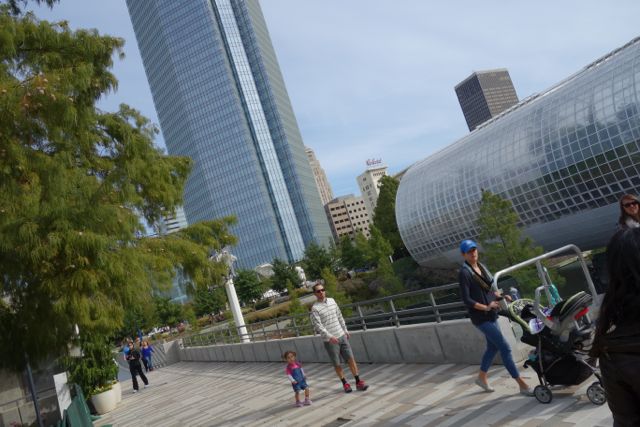
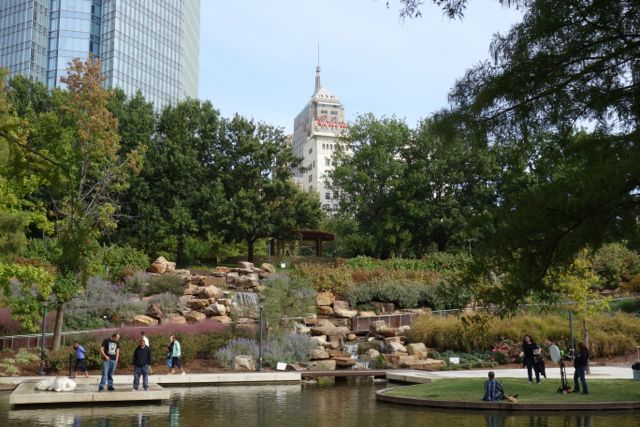
We found, on our first morning, the genuinely worthwhile Myriad Botanical Gardens, an acclaimed (and, coming from California, shockingly bum-free) public space in downtown Oklahoma City just across the street from the Devon Energy Center, the recently built 50-story skyscraper that, so far out of scale with any other nearby structure, pretty much constitutes the skyline by itself. On the opposite side of the gardens, a children’s pumpkin festival had got into full swing, providing perhaps the highest concentration of wholesomeness I’ve ever beheld first-hand. At every intersection, electronic voices offered — and repeated, and repeated — detailed descriptions of which streets we could cross and when. Professional downtown guides zipped by, their canary-yellow uniforms in perfect color coordination with their Segways.

Cross-country 2015 - 36

We passed through a few torn-up streets, but they’d been torn up, so the signs informed us, in the name of Project 180, a $176 million pedestrianization scheme, reaching the edge of a neighborhood called MidTown (yes, capitalized T). There we sat down, across the corner from a tempting ramen joint, for a cappuccino, hot chocolate, and “sparkling cold brew” among the bearded baristas, MacBooks Air, and Macklemore haircuts of Elemental Coffee. They’d even put up a stand of tools with which to tune up your bicycle while awaiting your drink (which will sometimes require, as the beards put it, a serious “time investment”). But you won’t have to worry about that if you use Spokies, the city’s bike share system, which has placed one of its stations right in Elemental’s parking lot. Clearly, the center of Oklahoma City, in common with many other greater downtown areas across America (some of which we’ve experienced on this very trip), has a revival going on.

Cross-country 2015 - 37

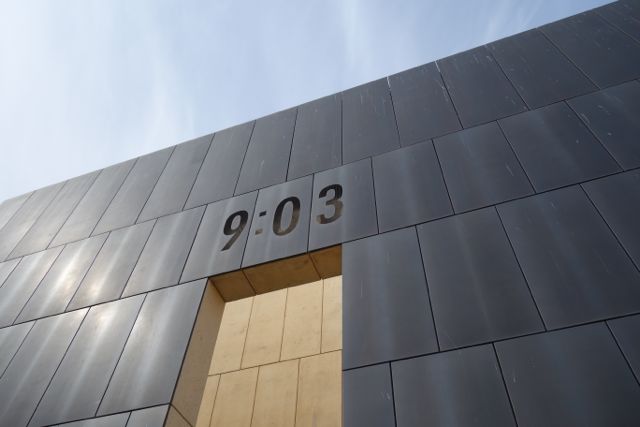
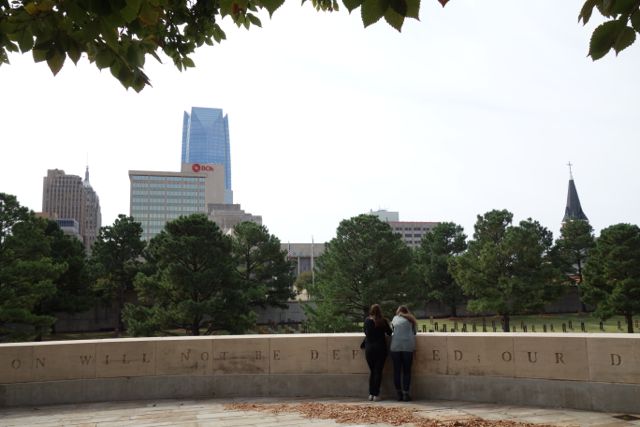
Still, mention the name Oklahoma City to anyone outside it — and surely some inside it — and they think of one thing and one thing only: the 1995 bombing of the Alfred P. Murrah Federal Building. Though only ten years old and in Seattle at the time, I still remember the day it happened, and from then on the disaster, for me as for so many others, stood for the city. I didn’t imagine then that I’d ever have occasion to visit Oklahoma City myself, much less the memorial grounds to be one day built on the Murrah building’s cleared footprint. But there I ultimately went, and there I saw the bronze gates, one representing the minute before the explosion, one representing the minute after. Between them stretches a shallow reflecting pool (dotted, dispiritingly, with pennies), and beside that stand 168 sculptural empty chairs. It ranks high among the massacre sites I’ve seen, lacking either the sinister feeling of Tlatelolco or the whole city of Hiroshima’s faint air of unreality. (The giant weeping Jesus across the street does go a bit far, but a Methodist church built it on their own property.)

Cross-country 2015 - 38

On a length of chain-link fence hang stuffed animals (the building’s day care center having infamously absorbed some of the blast and most of the news coverage) and photos of the victims. One studio portrait stood out for its now strikingly retro hair and lighting, and then for the dates below: 1971-1995, 24 years old, hardly more than a girl but not much younger than the bomber himself. The violence of the event haunts me less than the question of how Timothy McVeigh, clearly an intelligent young man of iron resolve and philosophical consistency, somehow arrived, through a seemingly coherent set of principles, at what he saw as the necessary step of car-bombing a federal building. (Incidentally, he did his planning in Kingman, Arizona, where we happened to stop earlier this trip for lunch at a barbecue place called Redneck’s.)

Cross-country 2015 - 35

I don’t want to overstate this point, but I’ve spent a great deal of this time behind the wheel trying to understand something more of America, and from that perspective I see McVeigh as not just a “domestic terrorist,” but a thoroughly American terrorist. Brought up on this country’s mythology, more than a few of us entertain the fantasy that we, too, might one day grow into tyrant-toppling outlaw. Many more of us harbor an inherent distrust and even perpetual suspicion of any visible center of power, especially one as colossal as the federal government of the United States: we think of the state as not Us, but Them. McVeigh certainly regarded it as Them, and as malevolent a Them as They come, insisting on describing his act in Oklahoma City as “morally equivalent” to the recklessness of the U.S. government not just at home (he framed his bombing as “counter-attack” in a war initiated by the United States at Ruby Ridge and Waco) and abroad: “Remember Dresden? How about Hanoi? Tripoli? Baghdad? What about the big ones — Hiroshima and Nagasaki?”

Cross-country 2015 - 39

Few Americans, I suspect, feel active guilt about the Dresdens, Hanois, Tripolis, Baghdads, Hiroshimas, and Nagasakis of the world, due to a tribally instinctive categorization of the foreigners there, even noncombatants, as Them rather than Us. (I admit to feeling no guilt myself at Hiroshima, less because I regard wartime Japanese as Them than because I regard the Americans who ordered the bombs dropped as an even more alien Them.) McVeigh abandoned that particular concept of Us and Them (to say nothing of “two wrongs don’t make a right”), and so the death of innocents in one place looked as unjustifiable, and so as justifiable, to him as the death of innocents in another — a sentiment with which all 21st-century American liberals would surely agree. For most of us, the less we think in terms of Us and Them, the more humane individuals we become. Timothy McVeigh, on the other hand, became the deadliest mass-murderer in American history.

Diary: This American Road, Tucumcari

Cross-country 2015 - 24

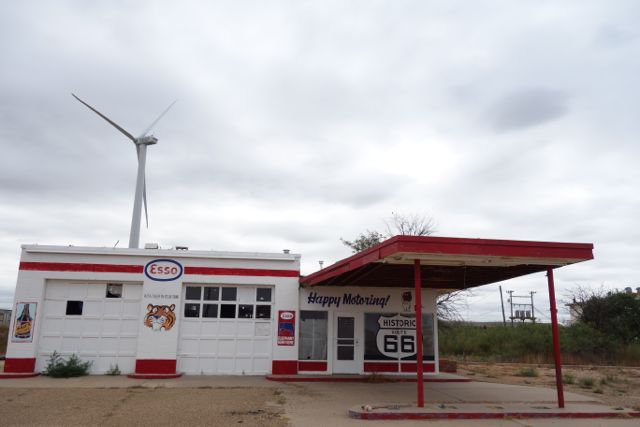
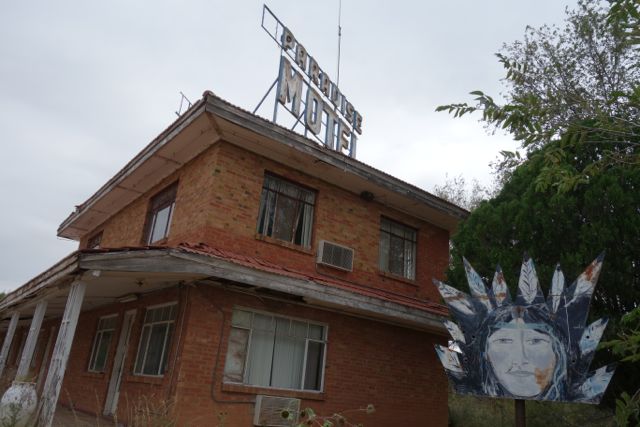
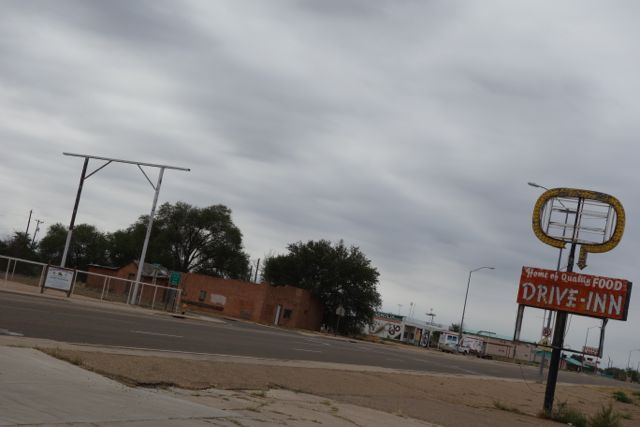
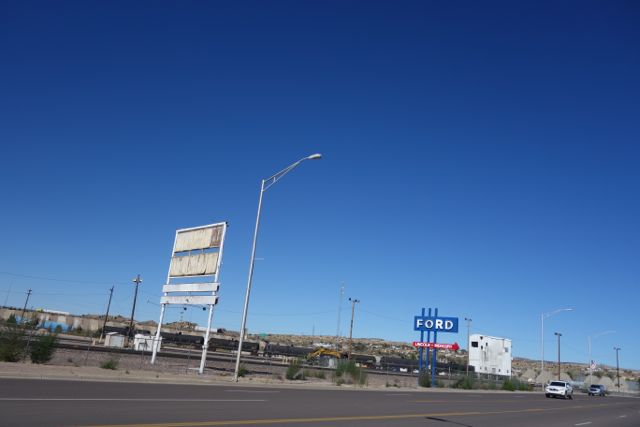
If Gallup exemplifies the struggling Route 66 town, Tucumcari exemplifies the kind that has simply laid down. We pulled in off the 40 to check out an expresso bar with an airplane permanently parked next to it that my dad told us about, but between there and the freeway exit we passed many more dilapidated, abandoned, or collapsed buildings than structurally or economically sound ones. The plane has stayed in place and the espresso bar still stands, built into the end of one of Tucumcari’s just-hanging-on motels (though lord knows what kind of white-trash crimes were occurring in them even as we passed), but it had closed for the day, as every day, at 11:00 a.m. “That must be check-out time,” Jae said — and why bother holding out hope for customers after that?

Cross-country 2015 - 28

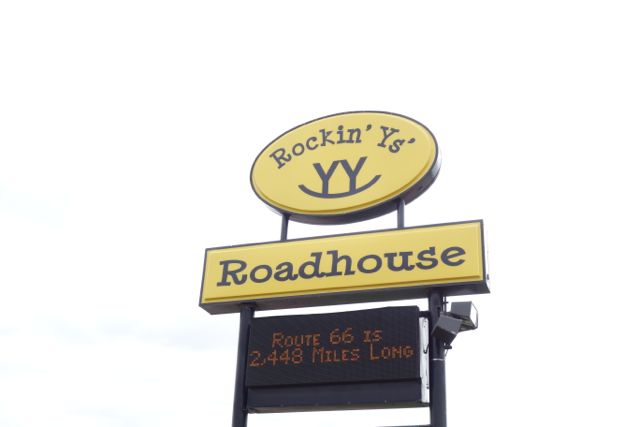
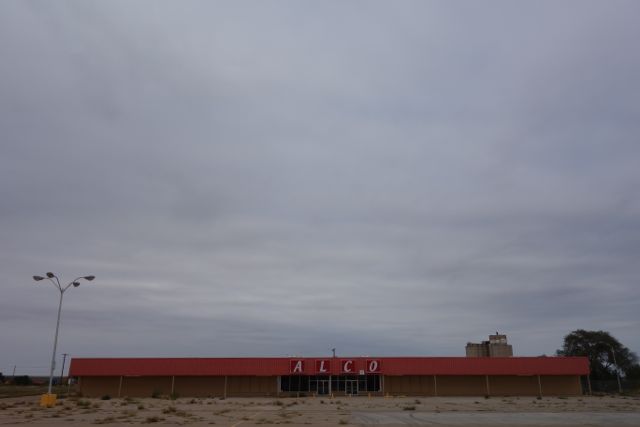
Besides the occasional motel, the still-operational establishments on Tucumcari’s stretch of Route 66 include a Jehovah’s Witnesses Kingdom Hall and — by far the busiest spot in town — Rockin’ Y’s Roadhouse, where we bought restroom privileges by stopping in for a couple of fried hard-shell tacos and scoops of ice cream. We ate quickly, since I couldn’t wait to get back out on the street and take some pictures. Though I like a good dead mall as as anyone (mostly out of hope that anything other than a mall will replace them), I don’t really count myself as a ruin-porn enthusiast. Still, who could resist the haunting specter of this modern-day ghost town?

Cross-country 2015 - 26

Wide patches of barren land surround most of Tucumcari’s empty buildings, so you can just drive right up to most of them and snap away. Actually, I should qualify that statement, since some of the ones we drove right up to we found not quite empty, glimpsing through open doors and broken windows the telltale random stockpiles of a squat. But we saw neither hide nor hair of the squatters themselves, and so felt like the only humans alive for miles. With Route 66’s glory days sixty years behind it, barely even saw any other moving cars.

Cross-country 2015 - 30

Having geared up in recent years to leave the United States, I’ve more and more frequently explained my departure by comparing aspects of this country (especially its infrastructure) to the third world — unfavorably. The crumbling desolation of Tucumcari might at first seem like yet another glaring signal of the de-developed America in which we find ourselves, but I haven’t even seen anyplace like it in the third world itself. In Latin America or southeast Asia, a town like this would be full of people — poor, for sure, probably even poorer than the people of Tucumcari, but in sufficient numbers and possessed of enough of an improvisational spirit to keep the place looking alive.

Cross-country 2015 - 27

If this trip has taught me anything important about America so far, it’s taught me, viscerally, about the country’s sheer size. A Korean friend of mine perpetually entertains a fantasy about driving through North Dakota — always North Dakota — with nothing on either side of her for miles and miles (or rather, kilometers and kilometers), I would guess for no reason other than that she’d have a hard time doing the same in Korea. Indeed, I’ve found that in America, you might easily spend two or three hours just trying to get through the blank expanse between one hamlet and another. And given how much space lies between them, some of those hamlets just get forgotten.

Diary: This American Road, Albuquerque

Cross-country 2015 - 14

Even just 800 miles into this trip, I don’t care if I never see another “unspoiled” landscape again. Spend enough hours driving through rolling hills or dry scrub or big skies or whatever, and you — or at least I — start to long for any sign of civilization, no matter how unpromising, even just a billboard telling you you’re going to hell. And so I met the modest Albuquerque skyline, the pyramidical tops of the Albuquerque Plaza towers jutting stubbily but distinctively into the air, with something like rapture. Finally, back in a city — maybe only the 34th largest in America, but a city nonetheless!

Cross-country 2015 - 15

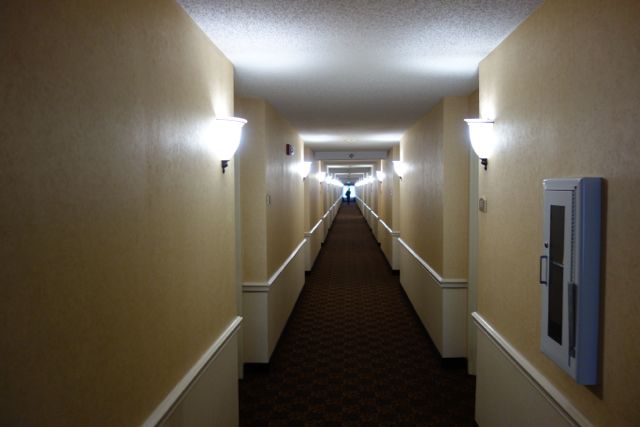
There we stayed in what I consider one of America’s truly, fascinatingly generic spaces: a Holiday Inn Express. I’ve only stayed in about a dozen Holiday Inn Expresses in my time, but even that has led me to expect that, when you stand inside one, you stand in no particular neighborhood, no particular city, and indeed no particular country: you stand in a Platonic hotel realm, standardized to perfection. The Holiday Inn Express realizes, to bring it back to A Single Man, George’s vision of America, in which a “hotel room isn’t a room in a hotel, it’s the room, definitively, period. There is only one: The Room. And it’s a symbol — an advertisement in three dimensions, if you like — for our way of life. And what’s our way of life? A building code which demands certain measurements, certain utilities and the use of certain apt materials; no more and no less. Everything else you’ve got to supply for yourself.”

Cross-country 2015 - 17

And so, despite spending two nights in Albuquerque’s Holiday Inn Express, I perhaps spent even less time in Albuquerque than I thought. I often laugh at those New York Times “36 Hours in…” travel guides, but the country-crossing exigencies of this trip put me in a psychological position where I’d kill for 36 hours in one city. But their “36 Hours in Albuquerque” didn’t include what, for me, ranks as a destination of paramount importance: Burt’s Tiki Lounge, which Thrillist’s guide to the tiki bars of America describes as “like stepping into a TGI Friday’s that married a dive bar in Oahu, then wandered off into the desert to raise their weird kids.” Alas, my desperate need for such a dive went unfulfilled; we turned up at 8:30, when every reliable source said they’d open in the evening, but its doors stayed locked, its neon stayed unlit. The on-the-ground impression I take from New Mexico’s largest city thus amounts to not much more than brightly colored freeways and metal sculptures of various desert creatures real and imaginary.

Cross-country 2015 - 18

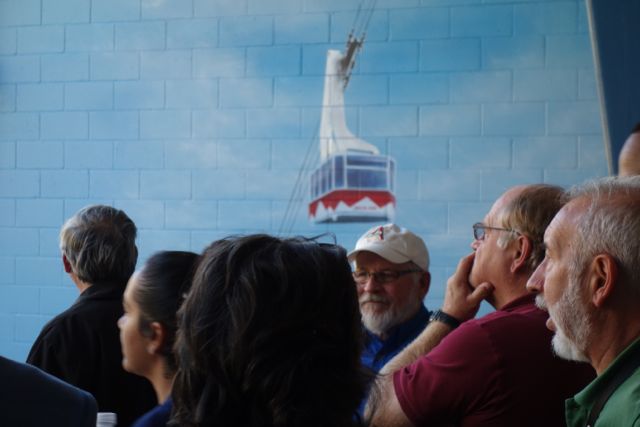
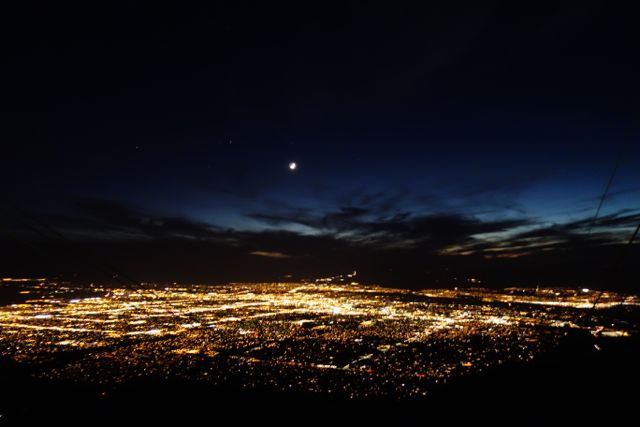
But we got a much more vivid impression from the air by taking the Sandia Peak Tramway, which offers a fifteen-minute ride up a cable to a restaurant from whose vantage you can take in a full nine percent of the state of New Mexico while drinking margaritas. (IF YOU GO, as the travel articles would put it, don’t forget to order them in plastic cups so you can take them out to the deck.) This being the 21st century, a great many of the tram’s riders held their phones to the window as we ascended. I had my camera too, but I couldn’t figure out a non-obvious shot to take, so I just waited until the sun went down and the lights came on, snapping the kind of shot from the tramway’s boarding platform that almost never works. But this time it worked.

Diary: This American Road, Gallup

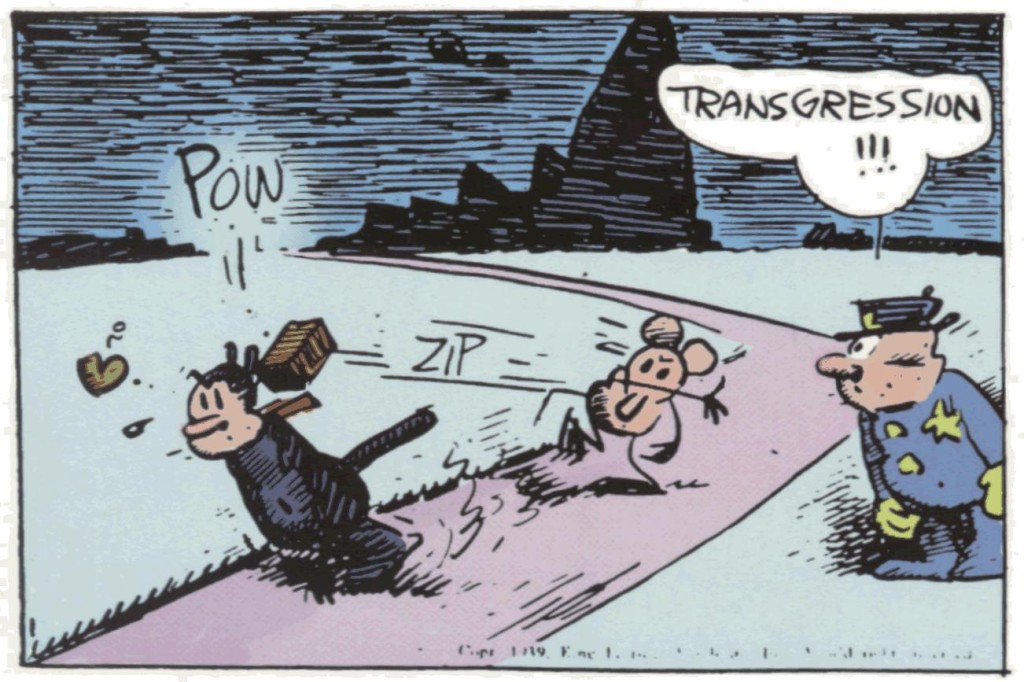
krazy kat transgression

Living in southern California, one gets to Arizona every now and then, but to get to New Mexico requires something like volition — which means I certainly hadn’t set foot in New Mexico before. Nor had I ever actually driven over the California-Arizona border, the point at which the landscape goes all Krazy Kat. Having read collections of that strip over and over again in childhood (I got deep into prewar newspaper comics for a while there, which seemed to speak to me of a better, more nonsensical time), I remembered that George Herriman drew a great deal of aesthetic inspiration from the American southwest, but I’d forgotten that its setting of Coconino County takes its name from an actual county in western Arizona.

Cross-country 2015 - 11

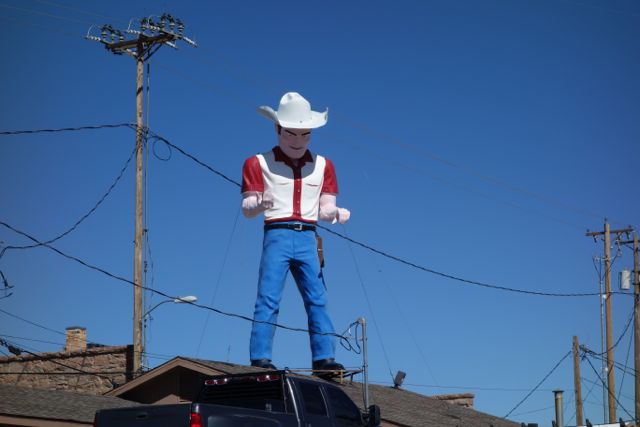
But New Mexico looks even more Coconino County than Coconino County. After what felt like a few hours of admiring the landscape, we made our first New Mexican stop in Gallup, a town along Route 66. Those on the Krazy Kat tour of the southwest — or, indeed, anyone with a certain idea of America — will want to spent some time attempting to get their kicks on Route 66, but all I’ve seen of it suggest that few kicks remain to be had. Countless other observers of American life have said this better, but most towns serviced primarily by the withered bloodstreams of the railroads or the old U.S. Highway System, rather than the mighty arteries of the Interstate Highway System, have become towns on life support.

Cross-country 2015 - 13

And so at least half of Gallup’s businesses along Route 66 have permanently shuttered, some of them what looks like decades ago. Of those that remain, many have posted loud “BUYING PIÑONS” notices in their windows. Piñons, it turns out, are nuts that grow on local pine trees, and though a surprisingly robust economy appears to have grown around them, nothing about it strikes me as a good sign. But just a block or two off the forlorn Main Street of America, we found a café in continuous operation since 1970 that gave us a heartening dose of New Mexican cuisine. And by New Mexican cuisine, I mean one comestible above all: the sopaipilla.

Cross-country 2015 - 12

I first learned about sopaipillas from Adam Cadre’s novel Ready, Okay!, whose protagonist delivers what I recall as a rapturous monologue in praise of their deliciousness. Still, it took me years to actually try one since, at the time, something about the spelling — particularly that “I” in the middle — struck me as unnecessary, show-offy. But these lightly fried, unsweetened pillows of steam-filled dough have nothing excessive about them, and despite the importance of cutting back on one’s food intake while on the road, I find myself able to put away two or three of them at a sitting without even realizing it. Some of this gluttony I put down to a simple when-in-Rome enjoyment of place and the culinary culture thereof. Some of it I explain away as a desire to put a little more money into a local economy clearly in dire need of it. And besides, where am I going to get a decent sopaipilla in Seoul?

Diary: This American Road, Flagstaff

Cross-country 2015 - 10

The impetus for this road trip across America came from my dad’s move across America, from Huntington Beach to Raleigh. He’s driving the moving truck full of the last load of boxes, furniture, and such, and we’re driving his newly purchased Kia Sorento. I’ll probably have driven more in these two weeks than I’ve driven in the past decade, or than I will drive in the next decade — after this, I won’t want to drive for about a decade — and my perpetual out-of-touchness with the driving experience keeps me astonished whenever I see, much less use, the features built standard into automobiles these days. I mean, you don’t even need keys anymore!

outrun

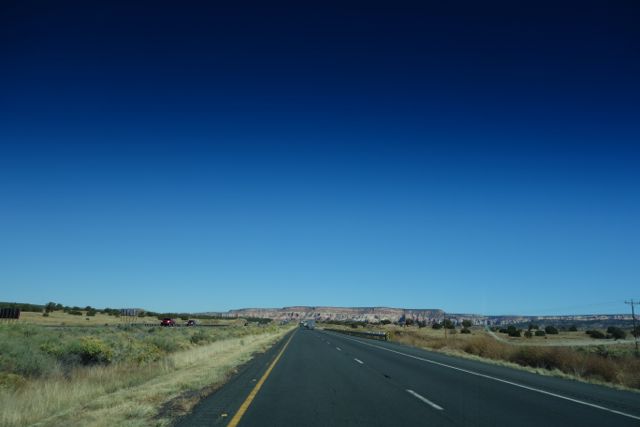
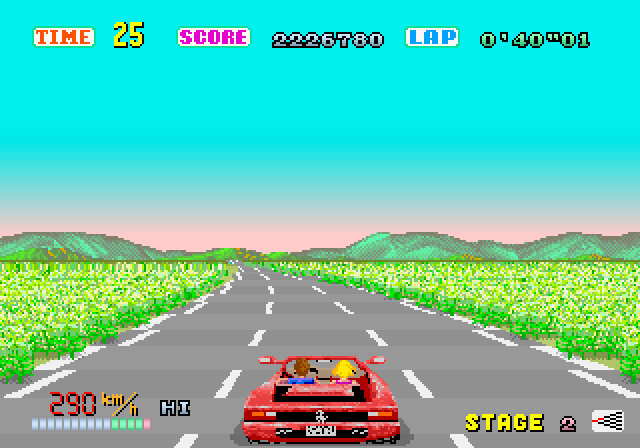
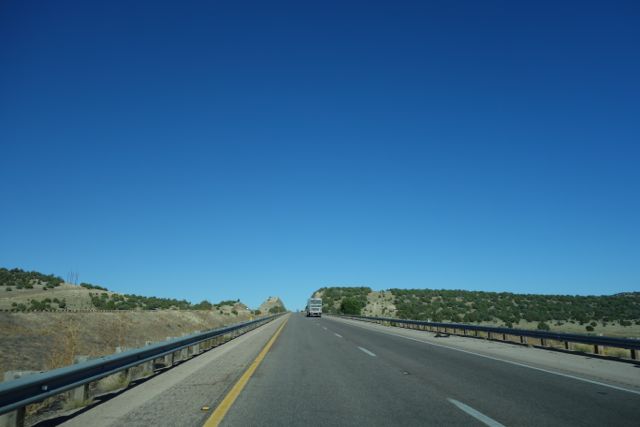
These days, one hears a lot about the approaching debut of self-driving cars on the market, but I sense that non-self-driving cars are themselves asymptotically approaching the condition of the self-driving car. I sense it with special strength while rolling down Interstate 40 at a both climate- and cruise-controlled 85 miles per hour, glancing at the navigation system’s screen every few hours in order to find out where to exit next. When it displays that, it even assembles a reasonable graphical approximation of the scenery outside the windows, images reminiscent of the backgrounds in Sega’s OutRun, the very first video game I ever owned (albeit in a conversion for a Radio Shack PC clone).

Cross-country 2015 - 07

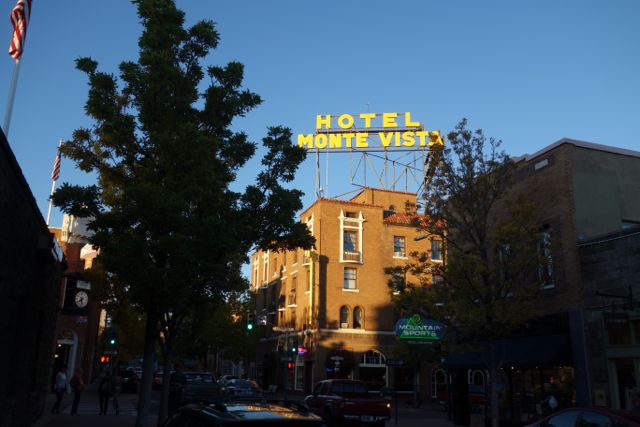
I always liked that OutRun‘s creator Yu Suzuki insisted on describing it not as a racing game, but as a “driving game.” Now, 25 years later, it feels like all those hours I spent playing it in the basement have paid off, since the essential tasks of this real-live driving experience differ not at all from those of the driving game: go forward, occasionally choose which way at a fork in the road, get to the next destination on time, and try not to run into other cars. But in real life, I have a much more appealing lady in the passenger’s seat (though the way the Outrun girl would point accusatorially at the driver after each and every crash — or really, the way adults laughed when they saw it — told me all I needed to know about male-female relations in this world), and we passed today not into some pixelated Japanese fantasy of a Californian beach or alpine Mitteleuropa, but Flagstaff, Arizona.

Cross-country 2015 - 08

Going to Arizona after a string of sweltering days even in California seems like a bad Idea, I realize, but Flagstaff, due to its high altitude and maybe some other environmental factors I’m not going to look into, gets cold, at least at night. And what better way to pre-emptively warm up than drinks at my coffee cocktail spot of choice in town, the Flagstaff Coffee Company? Actually, it ranks as my coffee cocktail spot of choice in any town, since I’ve never encountered anyplace else that specializes in mixing coffee and alcohol, especially not in at least eighteen different configurations. I went with the classic Irish coffee (which I suppose I could have had in Los Angeles, where we live four miles from The House of Irish Coffee), but Jae got an ideal last-minute suggestion of an off-menu item from some regular sitting nearby that involved matcha, whiskey, and almond milk.

Cross-country 2015 - 10

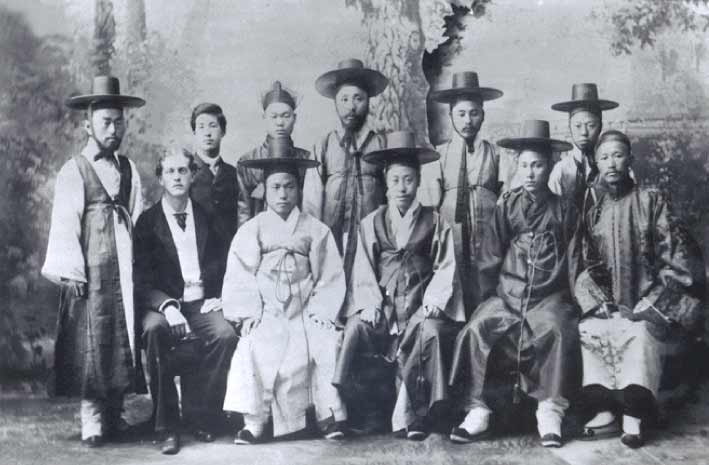
After night fell and the Flagstaff chill set in, we ascended to the Lowell Observatory and saw the city from above as we waited in line to look through the telescope in the 120-year-old observatory building once used by Percival Lowell himself (and now standing mere feet from his mausoleum). One of the complex’s warmer indoor exhibits devoted to Lowell’s life and discoveries displayed an 1883 photo of him in a group of Koreans. “Lowell’s past before becoming an astronomer is also rather interesting, as he lived in in Japan for a number of years in the 1880s and 1890s, before returning home for good in 1893,” writes (past Notebook on Cities and Culture guest) Matt VanVolkenburg. “In 1883 he was invited to accompany Korea’s first trade mission to the US,” on which trip he posed for the picture in question.

percival lowell koreans

“Upon returning to Korea in late 1883, he stayed several months in Korea, where he witnessed the 1884 coup d’etat, which he wrote about in the November 1886 issue of The Atlantic Monthly (which can be found here). He also took a number of photos of Korea at that time, which can be found here (click’ search’). Lowell also published Choson, Land of the Morning Calm: A Sketch of Korea in 1886, as well as a number of books on Japan, such as The Soul of the Far East and Noto: an Unexplained Corner of Japan.” And so, 7,250 feet above sea level, I seem to have paid inadvertent tribute to one of my predecessors.

Diary: This American Road, Barstow

Cross-country 2015 - 4

The second phase of our farewell tour of America (if a Cher-style farewell tour, with little pretense of actual long-term retirement and plans for future performance more or less already locked in) has begun. The first phase took us north, up the West Coast from Los Angeles to Alameda, Ashland, Portland, Seattle, Vancouver, and back down through Eugene, Sunnyvale, and Santa Barbara. This much more ambitious phase has us crossing the U.S. of A in the other direction, starting from Huntington Beach and ending up, theoretically, in Raleigh, North Carolina — coast to coast. First stop: Barstow, a town I (as I assume many do) know only from the first line of Fear and Loathing in Las Vegas: “We were somewhere around Barstow on the edge of the desert when the drugs began to take hold.”

Cross-country 2015 - 3

With or without the drugs, I do get the sense that Barstow, now as then, serves primarily as a waypoint to Vegas, the fork in the road at which you must choose whether you really want to commit to the Sin City experience. Part of that came from the all-foreigner crowd around me in the breakfast room offered by our lodging for the night, one of many such establishments along what looked like Barstow’s motel mile: the silent young Germans, the gregarious old Brits. (Actually, I observed the highest level of gregariousness in the motel’s Indian owner, who told of his life’s previous chapter in Johannesburg and had probably insisted on the place’s most memorable touch, each and every room’s towels having been folded into little elephants.)

Cross-country 2015 - 5

Even before launching into this ultimate American experience, I came up with a theory about the homeland of which I’ll soon take leave: America, as I see it, mashes up the forbiddingly eccentric with the frictionlessly generic. Part of that impression comes from the folksy roadside attractions that captivate so many visiting non-Americans (In these two weeks, I will live Wim Wenders’ dream). Another part comes from my favorite passage of my favorite Los Angeles novel, Christopher Isherwood’s A Single Man, whose English expat protagonist berates his countrymen for failing to understand how America has “reduced the things of the material plane to mere symbolic conveniences,” and that “until the material plane has been defined and relegated to its proper place, the mind can’t ever be truly free.”

Cross-country 2015 - 2

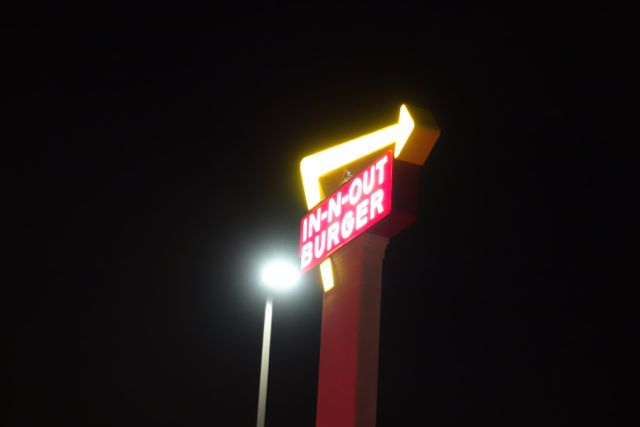
We Americans, he says, “sleep in symbolic bedrooms, eat symbolic meals, are symbolically entertained and that terrifies them” — those “groveling little materialist” Europeans” — “fills them with fury and loathing because they can never understand it.” Experiencing America therefore means experiencing its generic spaces, and as we headed toward not Las Vegas but Flagstaff, Arizona, we experienced one of its finest: In-N-Out Burger, a reassuringly guaranteed presence alongside southern California’s freeways. We’d meant to end our last road trip with a protein-style hamburger and animal-style cheeseburger, but it didn’t happen, and so with a protein-style hamburger and animal-style cheeseburger our latest road trip begins.

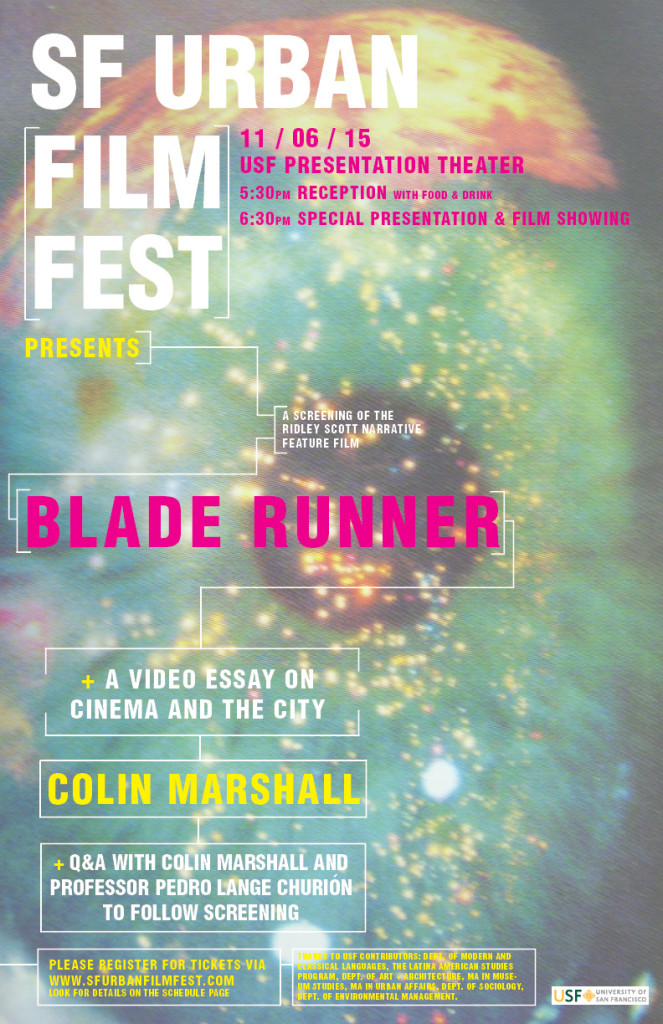
See me introduce Blade Runner and talk dystopia in San Francisco on November 6th

FILM_FEST_POSTER.final

The second annual San Francisco Urban Film Festival happens this November from the 3rd through the 8th, taking as its theme the idea of going “beyond dystopia.” In line with that, they’re screening Ridley Scott’s Blade Runner, whose vision of 2019 Los Angeles has, for nearly 35 years, endured as a vision of the urban future. Its crowded streets and Babel of languages beneath constant rain and the glow of skyscraper video screens once stood for dystopia itself, but might Blade Runner urbanism still have something to teach our cities, San Francisco included?

I’ll appear at the screening, in any case, to talk about just that, giving a presentation to introduce the film and doing a Q&A with professor Pedro Lange-Churion afterward. You can find all the details here and follow the San Francisco Urban Film Festival on Twitter @SFUrbanFilmFest. And if you’d like a piece of preparatory viewing before you come, might I suggest my City in Cinema video on Blade Runner?

The Los Angeles Review of Books Podcast: Amelia Gray

Colin Marshall talks with Amelia Gray, author of AM/PM, Museum of the Weird, Threats, and the new short story collection Gutshot, which showcases her writing at its most grotesque, its most hypernormal, its most speculative, and its most darkly funny. The book offers a portrait of her very own America, a country populated by Greyhound bus riders, compulsive vomiters, Camaro IROC-Z drivers, cruelly fetishistic conscious-consuming vegans, and victims of every sort of personality disorder.

You can stream the conversation just above, listen to it on the LARB’s site, download it on iTunes.