Skip to content

Notebook on Cities and Culture S2E11: Authenticity v. Utopia with Jonathon Keats

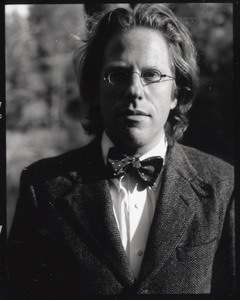
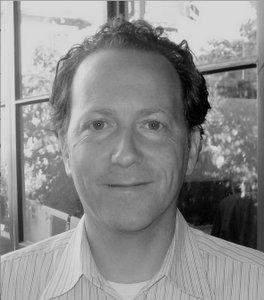
Colin Marshall sits down somewhere in between San Francisco’s Chinatown, Nob Hill, and Russian Hill with conceptual artist, experimental philosopher, and writer Jonathon Keats, author of the upcoming book Forged: Why Fakes Are the Great Art of Our Age. They discuss his own role as, above all, a fake; his attempt to epigenetically clone such celebrities as Lady Gaga, Michael Phelps, and Barack Obama; Forged, forgery, pursuit of simulacra, and Wim Wenders’ Notebook on Cities and Clothes; content’s ongoing release from form, and how it sends out the concept of forgery even as it brings it back in; the enthusiastically forged paintings of Jean-Baptiste-Camille Corot, and Thomas Kinkade’s massively replicated, “master highlighted” images; authenticity as it relates to spaghetti and meatballs; San Francisco’s intriguing tension between the claims of its own authenticity and its vision of itself as an experimental utopia — or, in his words, its simultaneous tendencies toward the “incredibly smug” and “very insecure”; why Europeans love San Francisco, and whether that has anything to do with the city’s ultimate derivation from their own; his thought experiments’ usefulness as “curiosity amplifiers,” generating larger questions than the ones they came from; the difference between doing experimental philosophy in San Francisco and in other countries, like Italy; and the exhilarating American freedom that also numbs.

Download the interview from Notebook on Cities and Culture’s feed or on iTunes.

(Photo: Jen Dessinger)

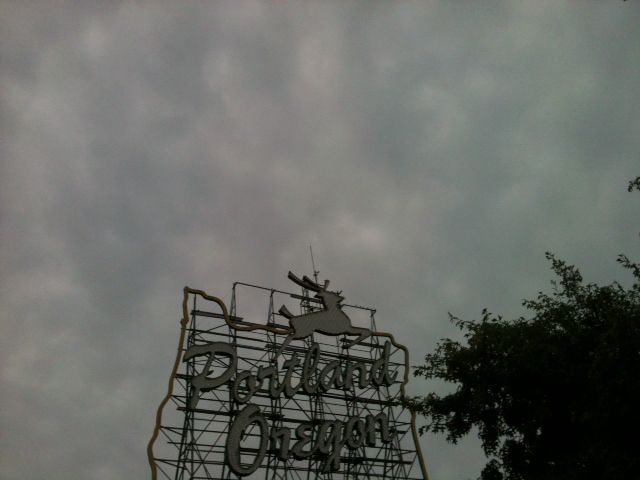
Portland Diary II

“You from one of those… Ivy league places?” A Scatman Crothers-ish TSA agent asked me this, half-accusingly, as I passed through his station, thus continuing the long tradition of my being attributed to regions I’ve never even visited. Not really, I haltingly responded, and the man softened. “Hey, that’s alright,” he said. Ain’t nothing wrong with that.”

Geoff Dyer writes that Friedrich Nietzsche “loved what he called ‘brief habits’ but so hated ‘enduring habits’ that he was grateful even to the bouts of sickness or misfortune that caused him to break free of the chain of enduring habit. (Though most intolerable of all, he went on, would be ‘a life entirely devoid of habits, a life that would demand perpetual improvisation. That would be my exile and my Siberia.’)” The passage comes in Dyer’s essay “Otherwise Known as the Human Condition”, in which he describes his perpetually restarting quest, in each city he lives in or visits, to find the ideal cappuccino and donut for his “elevenses.” (That’s a British thing.) Even these few short days in Portland have me reveling in Nietszcheanly brief habits of my own, the most enjoyable of which finds me waking up early, hopping on my bicycle, and riding across one of the Willamette River’s many bridges (I still haven’t counted them) for coffee on the east side of town. Theoretically I could continue this habit in Los Angeles, heading east for a cafe de olla or something, but the Los Angeles River, for all its neglected Repo Man charm, doesn’t offer quite the same experience.

Pulling up a map, I see that eight bridges connect one half of Portland to the other. My first cycle trips across these proved glorious enough that I decided to ride across them all. After interviewing bicycle planning consultant Mia Birk, I immediately rented a Jamis and commenced two-wheeled exploration. This strikes me as the way to most thoroughly figure out a city, even the bicycle-unfriendly ones; hell, almost everything I’ve figured out about Los Angeles, I’ve figured out while biking. A purely psychological advantage accompanies the navigational one. David Byrne, who in part inspired me to do this, writes in Bicycle Diaries that, on a bike, “your unconscious is free to kind of mull over what it is you’ve got to deal with that day or whatever creative stuff you’re working on. Sometimes the problems get a little closer to being solved by the time you get to where you’re going.” Or as Douglas Coupland said, albeit about driving, it’s “the only place where you’re legally allowed to not deal with your problems. It’s enforced meditation and this is good.”

So if you want to start cycling-as-everyday-transport anywhere in North America, start it in Portland. Alas, the city’s relatively astonishing density of cycle-related infrastructure and amenities quickly inflated to ludicrous proportions my expectations for same. Then came the night that I blindly attempted to cross the Fremont Bridge, which is pretty much the 405. That went… ingloriously.

I’ll recommend another city exploration strategy, if you can swing it: adhere to a schedule not dictated by where you feel like going or where you think you “should” go, but where your interviewees can conveniently meet you. Coming to my Notebook on Cities and Culture guests has taken me to neighborhoods, and often those neighborhoods’ finest coffee shops, that I never would have otherwise considered visiting. In Portland specifically, I’ve tended to meet people way out east, right up to 82nd Avenue — past which, as one guest assured me, the really troubling meth crimes begin.

Sitting down for drinks with those friends and guests who happen to be interviewers, full-time or occasional themselves, I’ve picked up several useful techniques lately. (For this is how I live my life: my interests include literature, film, food, cycling, drinking, cities, making friends, and cycling to city bars to have drinks with friends where we eat and talk about film and literature.) One mentioned starting off with explicit follow-up questions  to those asked by previous interviewers. Another described how, given his interest in architecture, he thinks about conversation as a means of discovering the structures — intellectual, aesthetic, social, commercial — his interlocutors see themselves operating within. (Yeah, I totally get off on ideas like that.) Another praised Jon Stewart’s technique of setting down his hand on the  table before him to subtly signal that he has a question about what his guest’s saying at that moment. I’ve been trying these out here in Portland. They work!

Only bring up Portlandia when absolutely necessary: I set this policy before even leaving Los Angeles. Yet most of the Portlanders I talk to bring up the show before I do, and they seem of a surprisingly unified mind about it. Yes, Fred Armisen and Carrie Brownstein exaggerate the place, but only just. And yes, everyone has real-life stories to tell that could appear, with little alteration, as Portlandia sketches. I can report that the dream of the nineties is alive in Portland. Though that dream has much to recommend it, I never myself dreamt it. (By the same token, Portland girls really do look like that, and then some, but I go for something quite different.) The line about this city being “where young people go to retire” carries a chilling truth, and it seems to me that what happens in Portland tends to stay here. Portland has created its own reality, and pleasingly so, but how seriously are you  supposed to take someone who lives in their own reality?

As my friend Adam, dozen-year Portland resident, said, “Yeah, Portlandia‘s a great show about this city. Next season they should do a satire.”

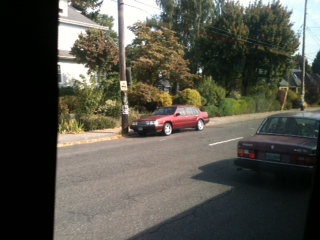
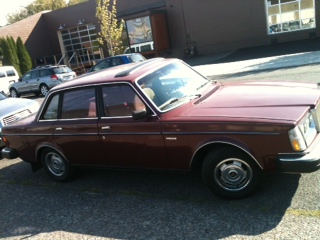
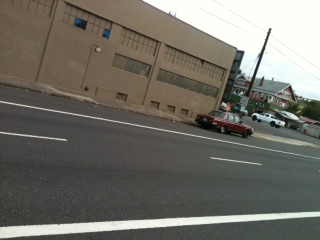
But Portlanders really do drive Volvos. More specifically, Portlanders drive maroon Volvos and early-eighties Volvos. More specifically still, Portlanders drive maroon early-eighties Volvos. Because my ex-girlfriend drove just  such an automobile, I assumed that my familiarity with them prompted me to notice each one that passed by. But then I realized that I noticed one every hour or two. This gave me a useful organizing photographic principle; I took many more maroon early-eighties Volvo shots than you see here. Snapping one in motion remains my white whale. My girlfriend girlfriend, by contrast, drives a green Mini, of which I have seen exactly one in Portland. But it wasn’t the right shade of green. (British thing.)


[Previous diaries: San Francisco 2012, Mexico City 2011]

Portland Diary I

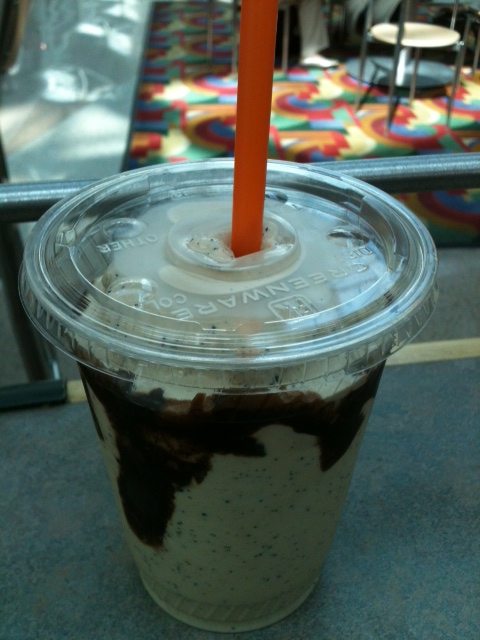
“Black Tiger milkshakes!” This my girlfriend exclaimed after I brought up my imminent trip to Portland. “It would probably be an exaggeration to say that a Black Tiger shake is made with vanilla ice cream, eight shots of espresso, and two pounds of ground coffee beans,” food writer Matthew Amster-Burton says about the drink about which she enthused. “But that’s what it tastes like.” Promising that night to pound one as soon as I landed in Portland, I proceeded to do just that a mere quarter-mile from my arrival gate. (Portland’s airport has at least one Coffee People stand right in there.) I worried that the cashier would look at me funny when I demanded a hypercaffeinated milkshake at 10:00 in the morning, but figured the same suspension of social rules applies to airport Coffee Peoples as to airport bars: who knows what time zone you’re coming from? (The very same one, in my case.) In the event, she looked at me a little funny.

Waking up at 4:00 a.m., I downed a French press of coffee to ensure alertness enough to catch my flight. On the plane itself, I accepted at least one further cup of coffee. Then the Black Tiger attacked soon after I set foot on Portlandian soil. I promptly made my way to an interview, at a coffee shop, where I naturally purchased an iced coffee to keep me on my game. A couple years back, Brian Eno gave a lecture at Long Beach State, and during it — apropos what, I can’t remember — he told of the severe panic attacks he used to experience. It turned out that they’d simply been brought on by his ever-intensifying coffee habit. This struck me as faintly implausible at the time, but on this particular day I internalized exactly what he meant. Watching my hands shake, it suddenly felt inexplicably urgent that I make sure the same lady who recommended I down the bulk of this caffeine megadose was still alive back home. I had no reason to believe she wasn’t (although I did find myself shaken earlier upon witnessing horrific auto wreck, featuring a corpse still slumped in an exploded-looking vehicle, on the still-dark highway to LAX), but she was off camping, out of cellphone range, which only fed the flames.

Lesson learned: Brian Eno is never wrong. Lesson reinforced, I mean.

Traveling solo, I demand little in the way of creature comforts: hostel bed, hostel shower, transit pass, and a decent density of wi-fi enabled coffee shops (which can make a cappuccino worth a damn) in which to work. Never one to eat at a real “sit-down restaurant” alone, I tend to limit myself to the fruits of trucks, stands, and whatever the sandwichcraft of those wi-fi enabled coffee shops can muster. Validatingly, a friend who lives half his year in Japan swears by that country’s convenience stores as a food source, and the frequency of my Los Angeles lunchtime visits to Nijiya, Marukai, and Famima! have set me in good stead to pick up that habit. In Portland, I have thus far relied upon the town’s recently famous food carts, not-especially-mobile trailers clustered into a series of parking lot-based “pods” throughout the city. The one near O’Bryant Square offered up a pulled pork sandwich on my first night. On my second, a tired-looking lady from the Philippines (“It’s been a long day”) served me up a heap of chicken adobo and whatever pancit she could find around. I have heard tell of Thai pumpkin curry. I have heard tell of poutine.

The caffeine disaster combined with the displacement of an early-morning flight combined with the mental bandwidth consumption of my still-forming interviewing schedule did, briefly, strike the fear into me that absolutely everything — everything — had gone to shit. You have known this feeling, surely, and you know that it tends to pass. But don’t you sometimes wonder if it simply comes as a function of diet, fresh air, and exercise? As soon as I’d had a night’s sleep, eaten something leafier than a milkshake, and rented a bike to ride around, I could hardly remember what had so distressed me before. We vainly pin our malaise on grander concerns, even as the evidence of terribly mundane physiology mounts behind it all.

(My traditional visit(s) to Voodoo Doughnut will therefore have to wait until my final day in the city. As for that poutine cart… I’ll try, sans promises, to hold it down.)

Hands shaking, words barely forming, I interviewed cartoonist and film critic Mike Russell mere hours after landing in Portland. Two weeks ago, he happened to make an illustrated blog post about travel; specifically, about having found and read “the Angst-Journal I Kept During A Eurail Vacation 20 Years Ago.” He draws ten lessons from this harrowing journey into his youthful mind, and I find number six particularly resonant:

Look around. Observe. Get outside yourself. I was disappointed during the re-read to learn that I spent most of my angst-journal dumping my sensitivities on the page instead of, you know, writing down the names and addresses and stories of the people I met and the incredible vistas I was seeing. “Feeling” might be less important than “looking,” as it turns out.

Having never done the traditional young American’s extended trips — Eurail zig-zagging, Southeast Asia backpacking, Central America-traversing — I often wonder if I’ve missed out on important formative experiences abroad. Then again, I avoided those prescribed excursions precisely because of the age-related expectation. I just couldn’t bear the idea of being another Freshly College-Graduated Early-Twentysomething (or worse, Freshly High-School Graduated Late-Teenage) American in Europe. All told, now that making up for lost travel time has become the order of the day, I suppose I prefer doing so as a late-twentysometing: one who has at least scraped together a serviceable amount of maturity, one who has shed the armor plates of identity that enable what Russell calls the “I-get-artfully-drunk-and-write-Linklater-scripted-poetry-in-my-journal, Ethan Hawke brand of angst,” and one who has awfully serious interviewing work to do. We get to know ourselves at this age, however tentatively, and as such — pace those C8H10N4O2 freakouts  — we don’t get so worked up and upset, not like before. It’s a good time to start things.

Despite expressing great general satisfaction with the city, nearly every Portlander I’ve talked to admits mild to great dissatisfaction with its lack of diversity. Los Angeles, by contrast, offers diversity as an advantage and perhaps little else. But damn, what an advantage.


[Previous diaries: San Francisco 2012, Mexico City 2011]

Notebook on Cities and Culture S2E10: Eco Chamber with Ethan Nosowsky

Colin Marshall sits down in San Francisco’s Mission with Ethan Nosowsky, Editorial Director at McSweeney’s. They discuss security breaches at the McSweeney’s office by overenthusiastic fans seeking a physical connection to their favorite publisher of physical books; his tendency to act as “the Joe Lieberman of publishing” in his editorial career, carrying unchanging tastes through changing times; Geoff Dyer, the writer with whom he has worked the longest, and how the subject-independence of Dyer’s writing parallels the subject-independence of his editing; the counterintuitively un-self-indulgent qualities of “Dyeristic” prose; memoir booms vampire booms, and the eternal bad-book boom; how he finds the real action in hybrids of fiction and essay, and how those forms provide the surprises that all art should; his life in New York publishing before his homecoming to the San Francisco Bay area, and how he has come to regard the ecosystem/echo chamber of the New York literary scene at a distance; the dominance of food and technology over books in Bay Area culture; David Byrne‘s new How Music Works, and other books that you want certain authors to write; and the potential usefulness of the authorly switcheroo, as when Dyer planned to write a book about tennis but wrote a book about Andrei Tarkovsky’s Stalker.

Download the interview from Notebook on Cities and Culture’s feed or on iTunes.

My U.S. landmark takedown on 11 Points Countdown


Above you’ll find my triumphant return to Sam Greenspan’s 11 Points Countdown. This time, he sat me down for a morning Boddington’s-in-hand discussion of the United States’ eleven most overrated landmarks, as voted by his viewership. He’d been to all of them; I’d been to none of them but, bizarrely, EPCOT Center. Had we done the top fifteen most overrated, I would have told all my childhood Space Needle stories. Hell, I think I nearly did anyway.

Other recent press and guest appearances:

Notebook on Cities and Culture S2E9: Beautiful Abstractions with Josh Kornbluth

Colin Marshall sits down at downtown San Francisco’s Contemporary Jewish Museum with monologist Josh Kornbluth. They discuss the proper pronunciation of the word “monologist”; his simultaneous return to the practice of oboe-playing and late entry into things Jewish; the question of whether Andy Warhol is “good for the Jews,” and how he spun it into a monologue; the qualities of faith shared by Judaism and the communism of his childhood, which still releases endorphins when he thinks about it; the difficulty of dragging beautiful, pure abstractions of any kind into the concrete human sphere; Haiku Tunnel, the “FUBU of office workers”; the implicit premise of perhaps most monologues that everything ultimately connects to everything; how to show you’ve put in the hours on a performance by presenting its artifice just right; building a career in the San Francisco Bay Area, and how the place ratchets the average New York Jew’s stress level down from eleven to ten; New York as his own personal primordial ooze; how San Francisco tends to push out its aspirers, especially where theater is concerned; the outsider’s longing to understand music, Judaism, or both, and how he’s come to experience both as practices; and the wonder of trying, failing, and trying again at one’s craft within a community.

Download the interview from Notebook on Cities and Culture’s feed or on iTunes.

Podthoughts: It Came from Japan

Vital stats:
Format: modern Japanese rock and modern Japanese rock talk
Episode duration: 35m-2h
Frequency: monthly

My friends who taught English in Japan in the nineties insist that the glory days have gone. They describe having stood in the blast radius of the last and most exciting flowering of Japanese popular culture, that which burnt out with the twentieth century. Of course, older Japanese scholars I meet insist that, on the contrary, the country stopped generating exciting works of art around the end of the sixties. I’ve never met him, but somewhere, a supercentenarian Japanophile surely insists that nothing of note has come out of Japan since before the Second World War. Each of these laments applies to a different facet of the culture: the music twenty years ago, the film and literature fifty years ago, and eighty years ago… oh, I don’t know, netsuke?

None of this rearguard action for the mind or minds behind It Came from Japan [iTunes], the music podcast of the eponymous music agency. It Came from Japan itself has the unusual and highly geographically specific mission of, and I quote, “bring the freshest, creamiest Japanese bands to the UK.” Rock bands, specifically. And yes, the UK, specifically. An unusual pairing, you might think, but upon reflection the countries have much in common: small, islands, bound by a vast and often tacit superstructure of position and obligation, valuing politeness yet incubating youth cultures of studied rudeness. In both lands over the past half-century, these last have tended to execute their rebellion in one form especially: rock music.

Read the whole thing at Maximum Fun.

Notebook on Cities and Culture S2E8: Paris Legitimizes with Daniel Levin Becker

Colin Marshall sits down in San Francisco’s Castro with Daniel Levin Becker, member of the experimental literary group Oulipo, reviews editor at the Believer, and author of Many Subtle Channels: In Praise of Potential Literature. They discuss whether Oulipo membership impresses the ladies; his earlier, long pre-Oulipo days, when he would make mixtapes consisting entirely of songs without the letter “e” in the title; his fascination with taking mundane patterns, applying enough work to them, and making something pretty incredible; palindromes, beau présent, homophones, metro poems, mathematical constraints, and Greimas squares; his Fulbright-enabled stay in Paris to organize Oulipo’s junk, which led to his writing a book on the group, and then to their offer of membership even before he thought he had accrued the necessary literary steez; whether Paris retains its status as a literary-minded young American’s dream, and its status as a “literary mindfuck” nevertheless; what Paris legitimizes, including but not limited to sexy Orangina animals; “gamification,” in the artistic, urban, and Silicon Valley senses; the possible use of Oulipian restrictions in Many Subtle Channels itself; what makes Oulipo distinctively French, and what its irony about the canon may have in common with the irony of D.A.R.E. shirts worn in the United States; the Believer as a representative of west coast United States literary culture, and how the scrappiness of Chicago stands in contrast; and when he suspends his Chicagoan-ness, and how much of that involves not eating spicy meats.

Download the interview from Notebook on Cities and Culture’s feed or on iTunes.

Notebook on Cities and Culture S2E7: Corporate Refuge with Christin Evans and Praveen Madan

Colin Marshall sits down in a back room in San Francisco’s Haight-Ashbury with Christin Evans and Praveen Madan, owners and transformers of The Booksmith, and now Kepler’s in Menlo Park. They discuss being deemed “corporate refugees” by their employees for their tech consulting past; creating a positive, aspirational experience that doesn’t make bookstores seem like broccoli; what they learned from spending date nights in other cities, having dinner and then visiting the local independent bookstores; the importance of offering serendipity, deeply knowledgeable service, and a multisensory browsing experience; how they’ve come to hold 200 events a year, including their popular bookswaps, born of customers’ desire to meet people in places other than bars; what makes Haight-Ashbury something more than a neighborhood where a lot of fun stuff happened a long time ago, and how they made it a first priority to connect with the local community; the parallel non-profit functions of community bookstores, including public education; what makes bookstores businesses, but not normal businesses; “matchmaking” books to readers such as Dwight, lover of Russian history; how they create an addiction to books, bearing in mind that half of America doesn’t read a book afer high school; what the controversy about Yann Martel’s Beatrice and Virgil illustrates about The Booksmith’s “high-touch” business model; the abstraction of life in corporate consulting, and the total lack of abstraction of life in bookselling; bookstores as social networks when you want to unplug from social networks; and the mind-expanding books that running The Booksmith has brought into both of their lives.

Download the interview from Notebook on Cities and Culture’s feed or on iTunes.

San Francisco Diary III

A formerly closeted middle-aged gay man in the seventies: that’s what I felt like when I made peace with my desire and began seriously drinking coffee. I’d avoided it until about age 25, having feared falling into obsessive source- and preparation-related obscurantism and that tiresome pissing contest over who can drink it the least sweet. Now the pursuit and consumption of coffee, in its various forms — with an eye toward preparation, of course, and never sweetened — underlies much of my psychology of place. The brightest dots on my mental map of Los Angeles indicate coffee shops of reliable quality. San Francisco convinced me, after two or three days, that I could trust it to provide a respectable cup within a block or two of wherever I happened to alight. Having hit up a few local operations, I can recommend Four Barrel for espresso and Philz, which operates under an ethos so pure that they refuse even to introduce espresso, for iced coffee.

San Franciscans told me about Blue Bottle. I tried to heed their word. Oh, the stories about Blue Bottle’s rendition of iced coffee, brewed with chicory and so strong that they all but require you to accept their offer of milk added. The perpetual blackness of my coffee arises not from my need to feel like a Real Man — as for how I do act on that need, the less said, the better — but my lack of trust in myself to correctly add a non-ruinous amount of milk, cream, or sugar. My final interview of this trip took place at 6:00 on Sunday near the Ferry Building, which I heard contains a Blue Bottle stand. On the BART trip up there from Bernal Heights, I knew only anticipation. Imagine my surprise when I found that seemingly every business within ten blocks southwest of the Embarcadero closes on evenings and weekends — even Starbucks, of which I saw sixteen, fifteen darkened, not to mention all the Peetses. As for the evening of a weekend, well, that gave me a sense of what downtown Los Angeles must have felt like at its nadir. I would tell South Beach (for they call this shuttered neighborhood that) to get on the stick, but in San Francisco, you have only to walk a mile, and everything changes.

Certain friends of mine, not coincidentally some of the most hard-traveling ones, have a look I call “omni-racial.” Most of the places they go, they could potentially pass as a native, at least visually. (Even the most omni of them often tends to break the illusion when they open their mouths, though some are adept polyglots.) I have whatever look is exactly the opposite of this; locals approach me as a foreigner everywhere, especially where I live. Strangers standing nearby routinely lean over and ask where I’m from, or even, when I’m speaking English, “what language that is.” A security guard approached me the other week with a tentative “Bonjour?” I say this all by way of recommending Everett & Jones, a barbecue place in North Berkeley, where one of the cooks asked me where I come from. Los Angeles, I proudly replied. He reacted with pure disappointment: “Aw, man, I thought you’d say maybe Switzerland, Sweden, someplace like that.”

Literature, cinema, music, conversation, the ladies: all of these provide their own flavors of mental stimulation, each one essential in its own way. But as yet I have discovered no more high-bandwidth source of mental stimulation than taking a chunk of time and using it to simply wander around an unfamiliar city, alone, with no defined destination. You’ll find the practice sets your mind off in so many directions, few of them expected, dredging up and creatively repurposing sunken memories all along the way. Modern novels suggest the presence of more adherents than me. Think of the genre-disregarding books of W.G. Sebald; think of Vertigo‘s second story: “In Vienna, I found that the days proved inordinately long, now they were not taken up by my customary routine of writing and gardening tasks, and I literally did not know where to turn. Every morning I would set out and walk without aim or purpose through the streets of the inner city.” Think of Sebald’s living heirs, like Teju Cole; think of the first page of Open City, about the New York walks that “steadily lengthened, taking me farther and farther afield each time, so that I often found myself at quite a distance from home late at night, and was compelled to return home by subway.” I was compelled to return by BART and Muni — certainly not by cable car — but hey, same difference.

From Adam Cadre’s (recommended) writeup of The City & The City: “Because I’m never looking for a McDonald’s, I don’t bother to slot the ones that I see into my mental map. [ … ] When I moved to New York City, I left my car in California, figuring that it would be more of a hindrance than an asset; I spent the subsequent year getting around town by subway and by foot, and thought I got to know the city pretty well. Then I fetched my car to help with the move to Massachusetts, and discovered that I had no idea how to drive around New York. My sense of where things were was oriented to the subway map. I thought my favorite pizza place was far from my apartment, because I lived along the F line and the pizza place was on the Q, and getting there meant a long horseshoe trip through downtown Brooklyn. It turned out that it was a five-minute drive away, in the opposite direction from the train. And when I went there I felt like I was driving through some city I’d never been to before, because even though I recognized most of the locales I passed through, they weren’t coming in the right order.”

When navigating unfamiliar cities, it helps, in a sense, to have in hand an iPhone or similarly “smart” GPS-equipped mobile device. I say “in a sense” because, in the presence of a signal (and, in San Francisco, I learned precisely what all those who bitch about AT&T’s coverage mean), getting truly lost becomes impossible. The moments of disorientation I experienced in my relatively recent pre-smartphone life struck me as valuable, especially in Mexico City, which put other layers of foreignness above and beneath my geographical confusion, and Washington D.C., where the lostness, though mild, would tend to occur in the middle of the night and last hours. With luck, I won’t figure out how to make my iPhone work in Japan.

Can you feel total despair in San Francisco? Sure, some of the addicts, burnouts, and runaways on the streets surely do from time to time — though I suspect a percentage of them self-medicate, a practice which may contribute to their condition — but nothing in my experience of the city, on this trip or any other, suggests that a normal San Franciscan life would ever involve the starker varieties hopelessness or alienation. Only with great difficulty can I imagine any life in Los Angeles not involving routine bouts with the starkest varieties of hopelessness and alienation. San Francisco feels like a domed land, one that has insistently built its own reality, and isn’t that why people so love to visit? Isn’t that why I so love to visit? One never, or at least rarely, needs to face the silent void in San Francisco; Los Angeles sits upon the silent void. This sounds like I’m about to pull up stakes from Koreatown and drop them right back down into the Mission, but no. Speeding back toward downtown on the LAX shuttle, I understood what I’d already known: for all the malaise it can potentially inflict, no American city fills me with exhilaration they way Los Angeles does, and none fascinates me more. But some come close.