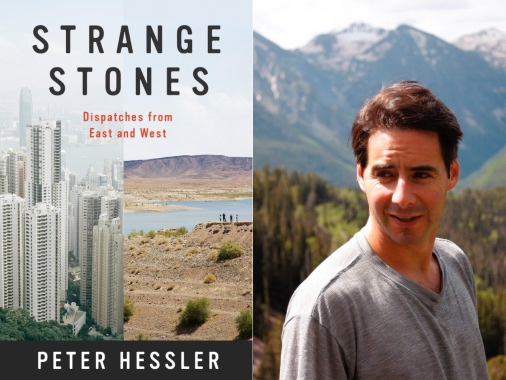
From Los Angeles, California, which has become both my home and main subject, I connected with Peter Hessler in Cairo, Egypt, which has become both his home and main subject. He moved there with his wife, journalist Leslie T. Chang, and twin daughters after a stint living in and writing about southwestern Colorado, which itself succeeded his years based in and observing China. Though by now a relatively distant era in his career, Hessler’s China period, and the books River Town, Oracle Bones, and Country Driving which sprang from it, made his name. Roughly half my Middle Kingdom-savvy friends, casually polled, credit him with firing up or bringing a new clarity to their own interest in the region, and the announcement of his 2011 MacArthur Fellowship cited his keen observation of “such rapidly changing societies as Reform Era China.” But with little desire to become a writer of place associated with only one place, let alone an old China hand, he has, in the past decade, cast his eye outward. For a bridge between his observations of the East and the West, we readers can cross his new essay collection, Strange Stones.
Almost all written under the aegis of the The New Yorker, the book’s pieces find Hessler bushwhacking along the Great Wall, patronizing the dueling rat restaurants of Luogang, keeping up with a hard-drinking Tokyo crime reporter, seeking out Yao Ming’s Houston barber, and assessing the legacy of uranium mining and role of the independent pharmacist in Colorado’s small towns. This gave us an array of colorful subjects to discuss, but then, Hessler also had a revolution to cover; we spoke in mid-July, not long after the forcible unseating of Muslim Brotherhood-affiliated President Mohammed Morsi, Egypt’s first democratically elected head of state. Had things quieted down enough over there for us to settle into a conversation? “Last night there were like seven people killed, street fighting,” Hessler told me. “It’s still going on.” In the heat of the Cairo protests, Open City author and observer of Lagos Teju Cole had this to tweet: “’Hope this one will be a good coup’ is a pretty accurate summary of my childhood in Nigeria. Over and over again. It never was.”
Hessler’s take? “It’s a common pattern. It takes a long time to break cycles. There’s always a lot of hope, and people make the same mistakes again and again. This recent incident I’m not sure how to evaluate yet, but the government run by the Muslim Brotherhood was incompetent — unusually so. I just didn’t see a future for them: they showed so many signs of being incredibly insular and incapable of dealing with anybody else, a weak group that had alienated all the security forces, the police, the army. You could see it on the street. It wasn’t a big shock. Whether or not it’s an improvement I’m not sure, but the way they were managing the country and their relationships with other powers… you’re not going to last. It’s a lesson in realpolitik.” Critics of the Chinese government, under which Hessler lived for over a decade, may ascribe to it a variety of failings, but rarely do they call it incompetent. “Some things, they handle poorly,” Hessler said. “Because they’re not in a competitive political environment, they don’t understand how to present a good face, especially overseas, but it’s a minor issue compared to stuff we’ve seen here.”
“Living in Egypt makes me — I don’t know if appreciate is the right word, but — respect the strength of the Chinese government. For years, people there have talked about all this unrest, all these protests, and my perspective was always that that was exaggerated, in terms of whether the Party was in trouble. Being here makes me realize how relatively stable China is; the Community Revolution actually changed Chinese society. I’ve been spending time in Upper Egypt, in a village, and none of these cycles — the Mubarak regime or the Morsi regime or whatever’s going to come now — has changed the structures there. It’s still based on clans, on families. Things just continue the same way they always have. People talk casually about the ‘Jasmine Revolution’ in China, about overthrowing the Communist Party, but it’s a deeply entrenched organization and political system, functional in a way that’s not even in the same conversation as what goes on in Egypt.” The Egyptian village situation brings to mind the scene in Monty Python in the Holy Grail where Arthur, King of the Britons, encounters a group of his peasants who, having heard neither of Arthur nor Britain, insist to him that they constitute an “anarcho-syndicalist commune.”
Hessler didn’t observe the quite the same disconnect in China, which underwent “this incredible material and physical change. The landscape and everything totally shifted. Here you don’t have that. The economy has been decimated, so you don’t have people improving their lives in a material sense, but you do have this incredible political change, leaders coming and going, rising and falling.” How much of turbulence could he have foreseen before moving to Egypt in late 2011? “The revolution began while we were making our plans. I could see it was pretty intense from the events in January that year. The very first month I was here, they had major protests near Tahrir Square, and I wrote my first piece for [The New Yorker] about them. It’s been a series of these episodes. It’s moving quickly.” But he spoke to me from a relatively safe place: his home in Zamalek, a Cairo neighborhood on the north end of Gezira Island in the Nile. “There are a fair number of foreigners here and a lot of embassies, so it has good security,” so he described it. “If big things happen, if there’s unrest, Zamalek remains quiet. It has bridges that can be shut down by security forces, which happens periodically. It’s also just a pleasant place, greener than most of Cairo, a mile and a half from Tahrir Square, a mile from downtown. One nice thing about Cairo you don’t have in China: old buildings. We’re in an Art Deco building with high ceilings and a lot of neat touches. I really like it.”
Yet he and his family’s relocation didn’t happen without a struggle. “We showed up with just what we could carry on the plane. Of course, we also had twin babies, about a year and a half old at that point. we really didn’t have the support system here. It was a tough initial period.” And then, of course, they had the language to grapple with. “We decided to start with [an Arabic] program in the states; we didn’t want to show up totally cold. My wife and I enrolled in the Middlebury College Language School course, an intensive summer program: eight weeks of immersion. They’d never had anybody do it with kids before. It was brutal, just incredibly hard. It turned out to be an efficient way to get started, though quite painful. Now I can get the good basics from anybody, talk about politics, get a sense of their opinions. I still get lost after a certain point, so I can only do a simple interview, but it’s improving all the time. The hardest part is done.” He did admit that he and Chang immediately broke Middlebury’s “language pledge” not to use English — “we had to take care of these babies; it’s not like we were going to fumble through Arabic with each other” — which highlights the contrast between his Egyptian linguistic situation and that which he first enjoyed in China.
“I was thrown in there in the Peace Corps, 27 years old, in a small, remote place, pre-internet,” he said. “We didn’t really have functioning phones. Of course no cellphones. No distractions, a lot of time, and I was able to learn Chinese quite quickly.” Some of writers of place have little interest in local languages, and even dismiss studying them as a distraction from rigorously observing their surroundings in English. Hessler stands firm in the opposite camp: “It’s essential. “I wouldn’t live in a place for an extended time without studying the language, trying to gain some facility with it. It’s a mistake not to do it. Even if you can’t learn the language fluently, just do the best you can. You have to make it a priority. I haven’t done a lot of writing my first year and a half here, because I’ve been trying to do language.” For him, mastering a foreign language means not just gaining a tool to learn more about a culture, but gaining sight of a reflection of the culture itself. “There was a period of Alaskans-have-40-words-for-snow and all that kind of stuff, which linguists then felt was exaggerated. But you do feel the different priorities of a culture through the language. Here, it’s simple things like insha’Allah: any time you talk about the future, you have this phrase, “if God wills it,’ just an automatic thing you do. You use it here all the time; it’s not something you do to fit in. Now, in English or Chinese, I want a phrase for that.”
Hessler’s preferred language practice happens out in the streets. “I prefer to wander around and talk to people. My work schedule has been so demanding, I’m not out wandering as much as I’d like. This incident in the last two weeks, you just spend all your time trying to figure out what’s going on. It’s not the relaxed lifestyle I had in Fuling.” In that Chinese hamlet, his life in which provided the subject of River Town, Hessler could build routines that simultaneously helped him improve his Chinese and give him an excuse to engage closely and regularly with Chinese people: “On Tuesdays I’d go to the park at the top of the hill, and on the way down I’d stop at this guy who had a little photo shop and chat with him. Then I’d go to a noodle restaurant I liked. I’d have these days with three or four stops. I didn’t have to repeat the same conversations, could deepen friendships over time, and would learn new things as well.” Such a social practice, he finds, “makes you more outgoing. In China or here, I’m more interested in talking to people than in my home culture. I’m trying to learn, trying to practice, learning what’s going on. You can’t do it with a translator. You have to have natural, normal, one-on-one conversations to get a sense of how people think.”
Hessler has drawn acclaim as an observer who can capture politically sensitive places while writing primarily about people and rarely about politics, but Egypt’s current troubles dare him not to approach them head-on. “I’ve had to do a lot of straight politics here,” he said. “I finished a long piece right before this latest round of events looking at the politics, but it’s actually more to do with archaeology in rural Egypt. You can write about it both ways, and that’s my goal.” He operates on the premise, in fact, that you best understand the political through the human. “Politics is not a black box. If you talked to all these people, you could see what was going on in the last six months. You could feel people unhappy with this government. I wouldn’t have predicted a coup by any means, but I did send a note to my editor five days before: ‘There’s going to be a lot of protests. It could turn into something big. We need to be ready.’” And you shouldn’t, to his mind, do this talking only in major cities, even though, “if you’re going to write about and understand Egypt, you have to spend time in Cairo. It matters more than Beijing or Washington D.C.”
But when he and Chang moved to Egypt, “it was the country we wanted to move to. I’m not a huge city person. I’ve always written about places outside the main cities, and even when I lived in Beijing, most of my stories were not from Beijing. After my first year here, I started to go to Upper Egypt to get a feel for a different part of the country.” It echoes his experience in China where, “after more than a year freelancing in Beijing, I realized I needed something more intimate, a smaller place I could feel part of. I would rent a car and drive around the regions of the Great Wall. I like to be in a place with a long history — China, of course, had that. It gives you more directions as a writer, more to investigate. The story’s bigger, richer. I met people working on a dig in Upper Egypt in a place called Abydos, and on the first visit I saw a story I could do. I started making trips back. In a city, there’s so much else going on, it’s hard to pick out those echoes of the past. In a smaller place, it’s clearer; in Abydos, there are two big structures in town: a temple from 1500 B.C., and a massive mud brick fort which dates to almost 3000 B.C. It’s tangible. You feel connected to that ancient past, and notice the same behavior patterns you recognize when you read about that past.”
Egypt also provides him with a very different feeling of personal foreignness than did China. “It’s much less intense here,” he said. “In China I was more conscious of my identity as a foreigner. I stood out more. Egypt is a pretty mixed place: people who look blonde, who look black, who look like me. My wife is Chinese-American, and people don’t stare at her. It’s not like China, where they’re yelling at you, following you, totally freaking out. It makes me realize that China having been closed for so many decades traumatized the place and its relationship with the outside world. In China, when I went to protests, I always felt on edge. People were often antagonistic toward me, even if the protest had nothing to do with America. Here, the protests are incredibly violent — I’ve been to so many where people die in large numbers, which does not happen in China — but I don’t feel things directed at me, even in protests that are anti-American. Egypt is in the middle of the world, a crossroads: people have always come in and out. They’ve had a lot of contact with foreigners. They’re just more comfortable with it. China has natural boundaries: go north and you’ve got the Gobi Desert; west, you’ve got the Himalayas; east, you’ve got the ocean; south, the jungles.”
“It’s like America,” he continued, “also a place that isn’t very comfortable with the outside world.” This he learned during his Colorado period, which came after China and before Egypt. But he found on the other side of this discomfort with the foreign an endearing quality: “Americans are storytellers. I guess ‘self-centered’ and ‘egotistical’ is one way you could say it, but there’s also something neat about people intensely connected to their own stories, trying to figure out their place in the world. In China, it could be a frustration. Chinese people don’t like to put themselves in the center; it has something to do with a strong tradition of group culture, family culture, which is great, but which can make it hard for people to articulate their feelings, where they see themselves, what they really want. I had to observe people over years before I would learn key details. Going back to America, you sit down with somebody at a bar, and they’re telling you within five minutes: he just got out of prison, his wife did this or that, just incredibly personal, detailed things. I do like that storytelling tradition; I grew up in Missouri reading Mark Twain. That is a deep part of what America is and what, as a writer, I connect to.”
As one British character said to another about Americans in Evelyn Waugh’s California-set The Loved One, “They are a very decent generous lot of people out here and they don’t expect you to listen. They talk entirely for their own pleasure. Nothing they say is designed to be heard.” Hessler finds a great deal of truth in that. “It was also amazing how little people wanted to hear from me,” he added. “We told people we lived in China for eleven years, and they said, ‘Oh, were you in the military?’ That was always the first question. They had this vision of, I don’t know, a big Marine base in the Forbidden City. They didn’t have a lot of curiosity about it; it was kind of beyond the pale. But from my point of view, that was great: after being in China so long, publishing books and articles, one of the reasons I left was that I felt myself become ‘the expert.’ If you move to New York or San Francisco, some city with a big China community, you get called on to meet other people who’ve spent time there, to give talks on China. It just keeps going, and we wanted a break.”
Not that Hessler’s time in the Middle East, however long he and his family remain there, will constitute much of a break from his craft. He first dedicated himself to writing, albeit writing fiction, in high school, and found his way to the essay form while taking a class under elder New Yorker contributor John McPhee. “The main thing is the research,” Hessler said. “That’s what I would miss if I were doing fiction. Nonfiction forces me to get out, to talk to people, to be attentive, to read, to try to understand history, to take notes to organize things. That keeps me grounded. Fiction would’ve been too isolating a routine.” In Egypt, he’s found one particularly friendly escape from writerly isolation in conversations with his garbageman, Said. “I spend a lot of time with him. He’s interesting and funny. I’ll probably write a piece about him. He seems instinctively to understand what you’re doing as a language-learner. Sometimes a very educated person who speaks other languages is an absolute terrible person to speak with in Arabic, because they don’t adjust. For some reason, this guy who can’t even read gets it. Both my wife and I talk to him a lot. He comes by and has dinner.”
Said counts as one of the many outsiders to whom Hessler naturally gravitates. “[Strange Stones has] an essay about my former student Emily, a migrant in China living in the south, one of these tens of millions who have moved to factory towns. There’s another essay about a six-foot-seven American who spends all his time obsessively researching the Great Wall in a totally idiosyncratic way. I’m fascinated by people who are out of place but have created a world of their own. Outsiders are observant; they can tell you a lot about a place.” As a writer and traveler, Hessler has built up not just a robust body of international work, but a robust group of international friends — friends with whom he stays in contact long after he tells their stories in print. “It’s part of the job, part of my responsibility as a writer. I’m not comfortable with becoming intensely involved in somebody’s life for a few months, writing the story, and never having contact again. Emily was sometimes concerned I was too much the foreigner analyzing the interesting Chinese person. You never have the right to do this. You’re a good writer, good at talking, good at analyzing — it still doesn’t give you the right to take their life and put it on the page. When they talk to you, it’s an act of generosity.”
[You can also read a version of this piece at Bookforum.]

 Colin Marshall sits down at the University of Southern California with Richard Rayner, author of the novels Los Angeles Without a Map, The Elephant, Murder Room, The Cloud Sketcher, and The Devil’s Wind as well as the non-fiction books The Blue Suits, Drake’s Fortune, The Associates, and A Bright and Guilty Place. They discuss the three or four Los Angeleses in which he’s lived since arriving in the city from England in the early eighties; the “up-for-it-ness” of the Los Angeles he first discovered; the reporting he later did from the 1992 riots, and the “geographical apartheid” he saw; his lack of a driver’s license, and how he addresses the question of where the buses go; his observations of how the city once flung itself outward from downtown, and now flings itself back inward; Los Angeles’ simultaneously unsurpassed optimism and pessimism; USC’s Doheny Library as a metaphor for blunt capitalism in action; why we crave stories about Los Angeles’ foundation on wrongdoing; how Los Angeles gets liked more in deed than word; how the current wave of interest in local history began; Los Angeles’ era of booster books against anti-booster books; his escape from English history only to plunge into Los Angeles history; what his unfinished novel of a man who loses his memory in Wales revealed to him about his own life in America; how his English hometown diversified, and how Los Angeles did the same; his cycle through “dustbins of jaded cynicism,” and the different sensibility his students (one of whom has written “the gay Korean Los Angeles novel”) bring to bear; his favorite bus lines to take notes on overheard conversations; and how his enjoyment of the riots, in a sense, got him writing about his own criminal past.

 Colin Marshall sits down in Silver Lake with

