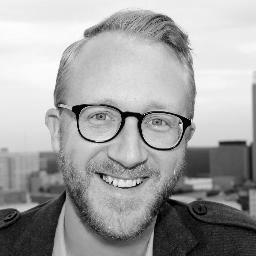
 Colin Marshall sits down in the Los Angeles Central Library’s Maguire Gardens with Nathan Masters, writer interested in all things Los Angeles, especially the history of the city, about which he writes as a representative of L.A. as Subject, hosted by the USC Libraries, for KCET and Los Angeles Magazine. They discuss how he regarded the distant downtown Los Angeles skyline while growing up in the Orange County town of Anaheim; the changing ways the county of his youth has regarded itself relative to Los Angeles; how far back you can go into the history of southern California and still have it bolster your understanding of the place, even to the era of allegedly “sleepy little village” of Mexican Los Angeles; why observers have insisted that this city has had little interest its own history; how he didn’t need to spend time away from Los Angeles to appreciate it; the debate over whether actual orange groves inspired the “Orange” in Orange County, and his grandfather’s home-movie footage of the uprooting of said groves; why observers have insisted that this city stands atop a desert; the competing boosting and demythologizing narratives; where he finds the greatest historical surprises, especially in the “old, weird” American 19th century; why knowing your history might get you driving more safely down the Arroyo Seco Parkway; how each foreign culture engages with Los Angeles in a different way, and how Los Angeles has no one way of accepting, absorbing, or digesting these influences; the seeming impossibility, given all this, of writing an overarching narrative of the city; the eternal struggle here between optimism and nostalgia; readers’ love of stories of “lost geography”; the creek bed hidden in Koreatown; his own love of stories about trees; and the elusive stories of history’s ordinary Angelenos.
Download the interview from Notebook on Cities and Culture’s feed or on iTunes.
Thursday, October 3, 2013

On the latest Los Angeles Review of Books podcast, I have a conversation with Leslie Cockburn, a reporter-documentarian-novelist, most recently the author of Baghdad Solitaire, who has entered more war zones than any of us have entered bars. You can listen to the conversation on the LARB‘s site, or download it on iTunes.
Wednesday, October 2, 2013

We must make peace with the fact that some people arrive in Los Angeles expecting to spot celebrities. Nine times out of ten, though, they board the plane home disappointed; this city fosters a secretive, detached celebrity culture, the uppermost sector of which somehow walls itself off completely from open society. Public figures of slightly less renown make their way through Los Angeles as any other resident would, but this everyday conspicuousness renders them, in many cases, inconspicuous; I sense they take pains to avoid places “celebrities would go.” Visitors from other states, other countries, and other continents alike, thus roam the likes of Hollywood Boulevard and the Sunset Strip in vain, encountering only the occasional reality television star, a class of performer whose very existence owes to their readiness for the spotlight. If you wish to bask in the aura of proper celebrities — the kind who don’t want you to notice them — go somewhere like the Farmers Market, which for nearly eighty years now, at the corner of Third Street and Fairfax Avenue, has offered a collection of produce dealers, food stalls, larger eateries, coffee shops, and souvenir stands.
Perhaps this already sounds like a tourist trap, and I haven’t yet mentioned its abundance of palm tree-filled postcards and its vintage gas pump, enshrined and gleaming just as it must have back when the Gilmore Oil Company kept a functioning station there. Yet the whole operation has, over time, settled into the kind of hybrid appeal enjoyed by Seattle’s Pike Place Market (the kind that has, in recent decades, eluded San Francisco’s Fisherman’s Wharf): it draws locals and outsiders in seemingly equal measure, inspiring in them seemingly equal enthusiasm. Seated at one of the many tables scattered around the Farmers Market, practicing the ancient art of people-watching, I’ve seen day-long waves of obvious regulars making beelines for long-preferred seats, politics-arguing old-timers, Los Angeles-unsavvy new arrivals wondering if they’ve stumbled upon the city’s center, hungry employees of nearby CBS Televison City, and foreign nationals with cameras in hand. One day at the Farmers Market, two such tourists, young girls from Japan, approached me very slowly. “Take a picture with me?” one asked, gesturing toward her friend who stood ready to capture an image of her traveling companion and this specimen of the elusive Homo americanus.
Read the whole thing at KCET Departures.
Sunday, September 29, 2013
Vital stats:
Format: Jeff Garlin talking before a live audience with people he respects and/or people who interest him
Episode duration: 1-2h
Frequency: 2-3 per month
I suppose we must live in the Age of Conversation. Podcasts gave me that impression, and podcasts — the ones I listen to, at least — have given me no reason to deny it. Despite having rejoiced at the seemingly limitless formal possibilities newly opened up by the medium, especially against the seemingly numberless limitations under which many radio programs still labor, I notice that my most memorable podcast listening experiences come from nothing more innovative than people talking to one another. Then again, the least memorable podcasts I’ve heard (to the extent, of course, that I can recall them) also featured nothing more than people talking to one another. Indeed, most podcasts, the enjoyable and the less so, need nothing more than a few microphones and enough people to speak into them. Out of this easiest of all configurations comes, it seems, podcasting’s both highest and lowest moments. Into this peaceable ring of extremity Jeff Garlin dares to throw his hat with his very own conversation podcast, By the Way, in Conversation with Jeff Garlin [RSS] [iTunes].
We must here define a subgenre: within the bounds of the conversation podcast, we have the more specialized celebrity conversation podcast, in which a certain celebrity, presumably feeling they can hold, in their own personae, conversations of interest to audiences wider than those actually at their dinner parties, hold them and turn them into MP3 files. Sometimes this assumption works out; sometimes it doesn’t. Alec Baldwin’s Here’s the Thing stands out in my mind as a particularly successful example of recent years, though he takes the strategy (with assistance from WNYC) of making the proceedings sound as public radio-y as possible. Conan O’Brien’s Charlie Rose homage Serious Jibber-Jabber strikes me as ranking in a similar league, despite appearing only as videos, and sporadically at that. Garlin goes the route of maximum rawness, recording in front of a live audience at Los Angeles’ Largo — a place I tend inexplicably to conflate with Los Angeles’ Spago — and cutting out, apparently, only what absolutely needs currently out. But he has taken this on as a mission: a mission, he says, set against the highly produced, thoroughly pre-interviewed, rigorously edited interview programs so prevalent today. I can sign on to that.
Read the whole thing at Maximum Fun.
Wednesday, September 25, 2013

On the latest Los Angeles Review of Books podcast, I have a conversation with Gabe Durham, author of Fun Camp, a polyphonic novel of the American summer-camp experience, and the work-in-progress Meanwhile. He also publishes the video game-themed series Boss Fight Books. You can listen to the conversation on the LARB‘s site, or download it on iTunes.
Tuesday, September 24, 2013

The stories of certain Los Angeles neighborhoods seem easy to tell. Sometimes their geography, architecture, and apparent population practically tell it for you. Boyle Heights, for instance, located just east of downtown over the river, looks and feels like a district that has drifted far from its original purposes. Like Westlake, the neighborhood around MacArthur Park, Boyle Heights built up its identity in the early- to mid-twentieth century as a more or less Jewish community, original home of Canter’s Delicatessen. More recently it has, also like Westlake (which remains the home of Canter’s distant rival Langer’s Delicatessen), gone overwhelmingly Latino. While this has, speaking on the most superficial but nonetheless most accessible level, filled it with choice places to eat, most of my recent trips to have started or ended with visits to Libros Schmibros, the used bookstore founded by bookseller David Kipen, who refers to himself as “the first Jew in decades” to move back to Boyle Heights. If more have followed, they haven’t made themselves commercially known. None of my trans-river lunches have brought me to a new-wave delicatessen, though I have noticed a spot called Thai Deli on Cesar Chavez Avenue, well known for its teriyaki plates and macaroni salad. Clearly, the tale of Boyle Heights has more nuance than we assume.
The employees of the nearby White Memorial Medical Center know Thai Deli well, anyway; those coming from anywhere farther away would presumably feel put off by its uncomfortable proximity to Interstate 5. Yet keep walking east on Cesar E. Chavez Avenue, the continuation of Los Angeles’ wearily iconic Sunset Boulevard, and you find what architecture critic Christopher Hawthorne calls “a model for other neighborhoods eager to make their major thoroughfares friendlier to pedestrians, cyclists and local business” with “all the urban-design amenities the average L.A. boulevard is desperately missing.” My mind has come to conceive of this particularly welcoming mile, along with the parallel run of First Street two blocks to its south, as Boyle Heights — its core, if not its entirety. Certainly not its entirety: set out to see the entire neighborhood, and you could find yourself walking across it for nearly two hours. Like Los Angeles itself, Boyle Heights looks big; you just don’t realize exactly how big until you decide you want to see it up close.
Read the whole thing at KCET Departures.
Monday, September 23, 2013
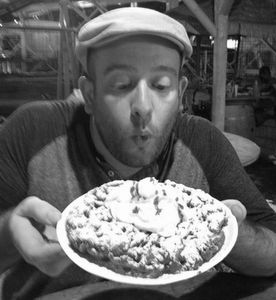 Colin Marshall sits down at the intersection of Los Feliz, Thai Town, and Little Armenia with Caleb Bacon, writer on the TBS sitcom Sullivan and Son and host of the podcast Man School (as well as the podcast Sullivan and Son: Behind the Bar). They discuss his feeling in his own guest seat; his move to Los Angeles from Albany purely in search of “good times and good weather”; the deliberately old-school-sitcom nature of Sullivan and Son, and the opportunity its Pittsburgh setting provides for racist jokes; how it feels to work simultaneously in “old” and “new” media; how he fell into television, and how he deliberately entered podcasting during the Great Podcasting Boom of ’09; why he even focused his first podcast The Gentlemen’s Club on men’s interests; how he soon came to interview, alternately, comedians and pornstars, and what the overall combination taught him about humanity and the Los Angeles entertainment industry; the conversations he had with other men as he pulled his own life into shape, what he learned from them, and how that experience fueled Man School; the riches of “real stuff” yielded by genuine-curiosity-driven conversations, even outside of podcasting, as when he once met a retail clerk who mentioned getting kidnapped in Africa (and then invited him to come on Man School); whether our generation has become worse at being men than previous generations; how social fragmentation, of Los Angeles’ type and others, has led men to have less meaningful communication with one another; his interest in the rules that new-media creators, in their ostensibly rule-free environments, inevitably create; Thai Town’s enduring Seinfeld billboard; Man School’s first live show at the Los Angeles Podcast Festival; the grand lessons he’s learned from man-to-man conversations, such as the importance of slight progress adding up to big progress, and what travel teaches you about yourself; and the value of simple suggestions like “Hey man, just be cool,” or, simpler still, “Don’t be a jerk.”
Download the interview from Notebook on Cities and Culture’s feed or on iTunes.
Wednesday, September 18, 2013

The Expo Line may not come to stop in the middle of Sawtelle, but it can already carry you somewhat closer to the center of an even better-known west-side neighborhood: Culver City, which — the name doesn’t lie — actually counts as a city on its own. People seem, generally, to know that it enjoys this status in a way they don’t always know it about, say, West Hollywood; despite encirclement by several areas we call “Los Angeles,” Culver City has retained a noticeably separate identity. Ten miles of distance from downtown have no doubt helped it to do so, but in the century since developer Harry Culver took the first steps to establish his eponymous municipality, the place has also cultivated something else. Having resisted strong bids for annexation, the way the likes of Venice didn’t find themselves in the position to do, Culver City has even made a fair few annexations of its own, resulting in a confusing zig-zag of a border, but one that has apparently done no harm to its brand. Not that this comes as surprise; if anyone can build a brand, movie studios can, and you’ll find a great deal of studio activity in Culver City’s history.
The modern robustness of the Culver City brand draws much from twentieth-century film production. You recognize this early, provided you enter on the right street; one particularly notable sign doesn’t just present the words “CULVER CITY” inside a stylized film strip, but places the silhouette of a motion-picture camera beside it, and over that, the motto “THE HEART OF SCREENLAND.” You get the impression, looking into the matter, that the local city fathers never really got over how “Hollywood” became the synecdoche for greater Los Angeles’ entertainment industry. One especially telling late-1930s struggle saw the Culver City Chamber of Commerce adopt the slogan “Where Hollywood Movies Are Made,” not quite managing to push through a proposed change of the city’s name to, simply, Hollywood. But whether you consider its center Culver City or Hollywood proper, the glamorously polished old American film machine would soon thereafter achieve peak performance in its annus mirabilis, as acknowledged by many an observer and insider alike, of 1939. These days, I imagine such historically distant territorial disputes weigh none too heavily on the minds of either the Hollywood tourists flocking compulsively to Graumann’s Chinese Theater, or the workaday Culver City studio employees just looking for a decent lunch panini.
Read the whole thing at KCET Departures.
Sunday, September 15, 2013

On the latest Los Angeles Review of Books podcast, I have a conversation about the man who made Knife in the Water, Rosemary’s Baby, Chinatown, The Ghost Writer, and many more pictures to this day with James Greenberg, author of Roman Polanski: A Retrospective, and James Morrison, author of Contemporary Film Directors: Roman Polanski. You can listen to the conversation on the LARB’s site, or download it on iTunes.
Tuesday, September 10, 2013

In 1965, the New Yorker published a series of articles on Los Angeles by “far-flung correspondent” Christopher Rand, then known by the magazine’s readers for his dispatches from other such exotic locales as Greece, India, Hong Kong, and Cambridge, Massachusetts. Two years later, these became the book “Los Angeles: The Ultimate City,” which, despite its age, I often recommend to friends looking to understand the place. Very few to whom I mention the title have heard it before, and Rand himself, who passed in 1968, rings a faint bell at best, even to other New Yorker writers. “He was a man of intense curiosity and strong perceptive powers, whose writing showed the results of a quest for understanding through the amassing of relevant detail,” reads Rand’s obituary in the magazine, which adds, “he once walked a hundred miles over rough Himalayan terrain in two days.” When this highly skilled and now unjustly forgotten writer of place came to seek his own thorough understanding of Los Angeles almost half a century ago, he set up base camp in Sawtelle, a small west-side neighborhood centered on that boulevard between Olympic and Santa Monica.
“The place is a dozen miles west of Little Tokyo, toward the ocean, and it has been a satellite Japanese quarter since the thirties at least,” Rand explains. “Japanese truck-gardeners and nurserymen moved out there from Little Tokyo because the land was cheap, being mostly open country then, and the weather was good for growing.” Though not enthralled by all Los Angeles has, sometimes aggressively, to offer — but clearly always fascinated by it — the writer takes pleasure in this neighborhood he makes his temporary home. “In July the Japanese Buddhist Church of Sawtelle put on a fair to celebrate the festival Obon,” he writes, with a quaintly touching use of use of italics. “The fair was complete with paper lanterns and scores of kimono’d women dancing old Japanese dances; it also had food-stalls, and Mexican tacos were sold there along with Japanese delicacies like sushi and chicken teriyaki. Mexicans of all ages came to it, too, as did several Anglos or Caucasians, and an air of intercultural friendliness prevailed.”
Read the whole thing at KCET Departures.