Wednesday, October 30, 2013

Heading south, it always surprises me how quickly downtown Los Angeles gives way to raw industry. The average building height drops precipitously as the average building width expands enormously, into proportions befitting warehouses, factories, cold storage facilities, and “suppliers” of every kind. Such a streetscape may appeal only to the sort of urban photographer inclined toward gray desolation, alienating scale, and smoking loading-dock workers, but it soon presents a sight that, while still dreary in its way, will strike even those who’ve never before set foot in the city as reassuringly familiar: the American Apparel factory, the very seat of the company’s claim to sell garments “sweatshop-free, made in downtown Los Angeles.” I must admit I’ve always appreciated their billboards, which, while seedy, bring a refreshing kind of seediness to different from the ones that permeated it before. More to the point, I’ve also appreciated the versatility and (if it doesn’t sound like too much of an oxymoron) modern timelessness of their clothing, at least when it doesn’t go self-consciously retro. But rarely, anywhere in town, can I bring myself to pay full retail prices for it.
Go down Alameda Street to American Apparel’s mothership, though, and there you can buy at a pleasing discount, thus participating in the same pursuit that brings thousands to the Fashion District each and every day: getting a deal. Despite bordering on hopeless Skid Row, with its scarce goods and services mainly of the charitable variety, the Fashion District itself explodes with commercial energy. On one level, it has established itself as a dizzyingly robust resource for garment-industry professionals: if you fail to find a particular textile, button, or zipper there, it doesn’t — can’t possibly — exist. On another level, if you need suspiciously cheap suits in suspiciously high quantities, seek there and you’ll find, repeatedly: $199 each, one tiny storefront advertises; $129 each, offers the next; two for $99, insists the third. If you need a bootleg, everything bootlegable surely appears somewhere in Santee Alley, a series of narrow blocks where the sellers and the buyers grow even thicker on the ground. This sounds like one of those whispered-about, faintly menacing urban crevices with its own set of laws, and in some sense it does qualify as one. The larger neighborhood has, however, grown wise this very appeal, and above Santee Alley has hung banner after banner announcing that “THE LA FASHION DISTRICT WELCOMES YOU TO SANTEE ALLEY.”
Read the whole thing at KCET Departures.
Saturday, October 26, 2013
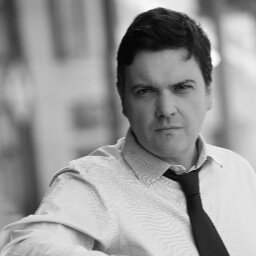 Colin Marshall sits down above downtown Los Angeles in the U.S. Bank tower with Stephen Gee, senior producer at ITV Studios and author of Iconic Vision: John Parkinson, Architect of Los Angeles, the first book on the man who designed such landmark structures in the city as Union Station, the Memorial Coliseum, Bullock’s Wilshire, and City Hall. They discuss how such a visionary could have gone unknown so long; Los Angeles’ relationship to its public buildings; Parkinson’s notion, during a time when Los Angeles set about defining itself, of putting up a built environment that would leave people inspired; the neatness, elegance, and organization that characterize a Parkinson building; the city’s assumption that Parkinson would remain a household name for generations to come, and how World War II and the years after threw that off; Parkinson’s move from England, and his own move from England in 1995; his struggle to find information related to the architect, and how everything new he learned made him want to learn more (as also happens with knowledge about the city of Los Angeles itself); how you engage better with Los Angeles after coming to understand its original intention; how to break down the false images of the city the rest of the world gets fed; Los Angeles as “the city of the future” in most or all eras of its existence; the modern repurposing of Parkinson buildings, into apartments and retail spaces and law schools; Iconic Vision‘s origin as, and possible future as, a television documentary; the new relevance of Parkinson buildings in an era when Angelenos have begun to regard and use the city differently; what he learned when he assembled of Parkinson’s buildings, from Los Angeles and elsewhere, “in one place”; and what might architecturally excite the always forward-looking Parkinson in this always forward-looking city today.
Download the interview here as an MP3 or on iTunes.
Tuesday, October 22, 2013

The homes of Hancock Park, while nostalgic, didn’t set off Los Angeles’ interest in architectural revival. Some builders looked backward here even as others looked most enthusiastically forward, and their collective effect on the environment remains in the hills of Los Feliz, five miles to the northeast. There you find examples of Beaux-Arts, Art Deco, Spanish, Mediterranean, Moderne, Mayanesque, Tudor, Italian Renaissance, Doric, Ionic, International, an odd kind of alpine Mitteleuropa, and much else besides, the most notable of which went up in the twenties, thirties, and forties. Where the higher elevations of Silver Lake provides the low-profile Los Angeles residential architecture tour, those of Los Feliz provide the high-profile one. The prepared architectural tourist will turn up ready to seek out such well-known residences, often photographed and sometimes used in movies, as Frank Lloyd Wright’s Ennis House, Gregory Ain’s Ernest and Edwards Houses, and Richard Neutra’s Lovell Health House. They will, most likely, do it with a copy of David Gebhard and Robert Winter’s “An Architectural Guide to Los Angeles” in hand.
Gebhard and Winter diligently map out Los Feliz’s numerous homes of aesthetic interest in Los Feliz, then dismiss much of the neighborhood — namely the commercial and medical developments centered around Vermont Avenue and Sunset Boulevard — with the unusual term “skulchpile.” You’ll find no more peaceful vantage point from which to view this skulchpile than Frank Lloyd Wright and Rudolph Schindler’s Barnsdall House, also known as the Hollyhock House, now known as the main set of structures in what has become Barnsdall Park, or Barnsdall Art Park, or Barnsdall Arts Park, depending on which sign you read. Despite those, and despite how unignorably the bold angularity of the house itself looms over Vermont, Barnsdall Park remains one of the strangely little-known assets of Los Feliz — indeed, of all Los Angeles. The first time someone told me to meet them there, I had to look the place up; now most friends, even those who’ve logged many more years in the city than I have, look surprised then I take them up there. Perhaps those who lift their gazes from the streets of Los Feliz get distracted by other sights: the Hollywood sign, for instance, or the Griffith Observatory, whose vast eponymous park people do tend to know something about.
Read the whole thing at KCET Departures.

Vital stats:
Format: various segments, mostly interviews, on subjects like guns, cycles, rebels, and unemployment
Episode duration: ~1h
Frequency: monthly
Nearly a decade into the medium’s existence, quitting one’s first podcast and starting a second continues to produce intriguing results. It did for Caleb Bacon, whose The Gentlemen’s Club gave way to Man School. I like to think it did for yours truly, whose The Marketplace of Ideas gave way Notebook on Cities and Culture. And it seems to have for Edward Champion, a man even earlier into the podcast game, first known for The Bat Segundo Show. When he decided to put an end to that cultural interview program, he didn’t wait long to bounce back with Follow Your Ears, a podcast dealing not with individual guests, but with concepts: guns,cycles, aid, rebels, bullies, unemployment. (I’d have done lawyers, then guns, then money, but only out of personal preference.) Each of these episodes comprises not just an interview, but several different segments around the day’s theme. It reminded me, even when first I heard of it, of certain topical This American Life episodes, which appear whenever that show decides to ask questions about large-scale problems of war, politics, health, finance, what have you.
Despite having always done a solid job with those sorts of topics, This American Life never struck me as fully suited to that territory. (I found myself tuning in least often — or tuning out most often — in the stretch when they might as well have titled the show This American Foreign Policy.) Perhaps Follow Your Ears, seemingly born out of such an investigative nature, might offer a less awkward integration of forum, if you will, and substance. But This American Life operates, as I’ve heard major public radio programs tend to, with a staff and an office and legitimacy and everything. From what I can tell, Champion runs Follow Your Ears pretty much the way he ran Bat Segundo, as a one-man show. A tall order indeed, but you’ve got to respect the willing acceptance of that challenge, especially in podcasting. If I had to name one consistent source of disappointment during this five-and-a-half-year-long-and-almost-over tour of Podthinking duty, I’d point my finger straight at podcasters’ tendency to avoid challenge: to talk to people they already know, to talk about things they already know about, to fall into forms already familiar — to hang their proverbial pictures wherever they happen find the nails.
Read the whole thing at Maximum Fun.

On the latest Los Angeles Review of Books podcast, a special on the debut issue of its new quarterly print journal, I have a conversation about race and the craft thereof in Los Angeles, America, and the world with critic Maria Bustillos and Gawker West Coast editor Cord Jefferson. Then, Ander Monson reads from his piece in the issue about the Arizona Renaissance Festival. You can listen to the conversation on the LARB’s site, or download it on iTunes.
Wednesday, October 16, 2013
 Colin Marshall sits down in North Hollywood with Carren Jao, Manila- and Los Angeles-based writer on architecture, art, and design. They discuss what rain does to the aesthetic of Los Angeles; the role of the river here as the connection people don’t realize they have; the difference between the floods Los Angeles used to routinely endure and the ones Manila routinely endures now; how, growing up in the Philippines, she got interested in the shape and form of cities; Manila’s “improvisational” nature not centered around always having functioning systems; the Filipino inclination to make guests’ lives easier in any way possible; her entry into the United States, but not the one that “everyone knows”; public transit as amusement-park ride; the important role of the Jeepney in Manila’s transportation; her life in the San Fernando Valley, very much a place distinct from Los Angeles itself; how writing has forced her to explore this city and its environs, including still-developing ones like Pacoima’s “mural mile”; how to get the wide-openness of the Los Angeles experience across to friends, family, and readers; the “third-world” contrasts of nice homes next to squatters’ villages in Manila and the Arts District next to Skid Row in Los Angeles; the boom in interest related to architecture, design, and space-making, and the importance of leaving openings for people to construct their own environments; what she’d look at first after five years away from Los Angeles, and from Manila; this city’s long-confused relationship with its water; what the Philippines have learned from other countries; what America could learn from the Asian sense of accommodation; what she learns from having to attend neighborhood council meetings; how fast word and social knowledge travel in Manila, how slow they can travel in Los Angeles, and how both have their advantages.
Download the interview from Notebook on Cities and Culture’s feed or on iTunes.
(Photo: Janna Dotschkal)
Wednesday, October 16, 2013

When I arrived in Los Angeles, I conducted my daily exploration of the city on a bicycle, which remains, as a result, my primary mode of transportation. (The trains rank second, then, when it comes down to it, the buses.) Many an Angeleno, so I’ve gathered since first setting out on two wheels, would have expected me to say that I still insist on riding a bike despite having tried it, or that, after one harrowing attempt, I locked the thing up at home, never to free it again. Even when I tell someone outside the city that I get around by bike, they express disbelief at the very notion. Somewhere along the line, whether due its size, the varying quality of its roads, its high-profile car culture — they may imagine me pedaling desperately on the thin shoulder of a raging freeway — or some combination thereof, Los Angeles gained a reputation as a uniquely un-bikeable place. This may explain the harsh, defensive posture of certain local cyclists I encounter — “Hey man, I just happen to prefer getting around Los Angeles on a bicycle, okay?” — and it can, at times, make cycling here feel like an inherently contrarian act.
Even on Slate, with its own penchant for contrarianism, Andy Bowers calls Los Angeles, where he lives and rides, “an almost pathologically bike-unfriendly city.” Then again, he does so in the context of a piece on the joys of cycling after he began commuting that way. “I cycled quiet back streets — the kind that infuriate me in a car because of all the stop signs and the impossibility of crossing major streets without a signal,” he writes. “I soon started looking for other short trips I could make on the bike — picking up a few groceries, going to the gym, returning library books — then longer ones. I plotted new stealth routes no driver would ever take.” The daily Los Angeles cyclist gains a command of these quiet back streets, and a host of quiet-enough medium-sized streets as well, which together constitute a parallel road network, shadowing the wide arterials — Wilshire, La Brea, Olympic, Western — that form the grid in every driver’s geographical mind. When getting into or out of downtown, for instance, use the more lightly commercialized Seventh Street; riding through Beverly Hills, go with Charleville Boulevard, and just glide past all the cars that stack up on it; through Hollywood, take Yucca, the city’s first politically official “Bicycle Friendly Street.”
Read the whole thing at KCET Departures.
 Conversations about menswear writing kept coming to the same book: Anne Hollander’s Sex and Suits: The Evolution of Modern Dress. Though led by a promising title, the content comes as something of a surprise. While enlightened enough to realize that a woman can, possessed of inherently fresh perspective, put together a men’s style book, I wouldn’t expect it to take this form. Sex and Suits has less in common with Cally Blackman’s highly visual 100 Years of Menswear, which primarily shows, than with Nicholas Antongiavanni’s thoroughly textual The Suit, which (in the male manner) primarily tells. Yet like fashion historian Blackman, art historian Hollander has an interest in the evolution of dress, and like Antongiavanni, she centers her analysis around what we today call the men’s suit: how it came about, how we wear it now, and what may become of it in the future.
We live in that future, since Sex and Suits came out in 1994. A curious age: the suit hardly enjoyed a heyday in mid-nineties America, nor do we look back to that era for high watermarks in other areas of men’s dress. But Hollander acknowledges writing at the suit’s low ebb, seizing the moment for Gauguin-ish reflection: where do we come from? What are we? Where are we going? She asks not just on behalf of male dressers, but for females as well, dealing with both sex and suits by tracing the relationship of men’s and women’s fashion from the seventeenth century to the then-present, a tale of separation, envy, imitation, and, finally, a new exchange. She establishes early on her sense of “something perpetually more modern about male dress that has always made it inherently more desirable than female dress.” She cares not about its supposed status or power, but “a certain fundamental esthetic superiority, a more advanced seriousness of visual form.”
Read the whole thing at Put This On.
Wednesday, October 9, 2013

On the latest Los Angeles Review of Books podcast, I have a conversation about revenge, sexual jealousy, and screenwriting with novelist Nick Antosca, author of Fires, Midnight Picnic, The Obese, the new short-story collection The Girlfriend Game, and the upcoming The Hangman’s Ritual. You can listen to the conversation on the LARB’s site, or download it on iTunes.

“So many people wanna cruise on Crenshaw on Sunday,” raps Skee-Lo on his 1995 hit “I Wish”. “Well then, I’mma have to get in my car and go.” He even gives directions: “You know I take the 110 until the 105” — from the relatively venerable Harbor Freeway to the then-brand-new Century Freeway — “get off at Crenshaw, tell my homies, ‘Look alive.'” You can still follow Skee-Lo’s route, but don’t expect to emerge into the very same neighborhood you saw in the music video for “I Wish”. Head north on Crenshaw for about six more miles, though, and there you’ll arrive: Leimert Park, just over one square mile of late-1920s planned community which would become, as LA Weekly music critic Jeff Weiss puts it in a profile of Skee-Lo (who still resides nearby), “the Left Bank of early-90s underground hip-hop.” I’d recommend against doing much cruising, though; since Skee-Lo’s summer days on the charts, sternly official signs have appeared: “NO CRUISING,” they read. Then, in case of ambiguity: “2 TIMES PAST THE SAME POINT WITHIN 6 HOURS IS CRUISING.” Last I went down to Leimert Park on a Sunday, I couldn’t resist passing the same points repeatedly, daring each time not to let six hours elapse. My defiance raised little in the way of police attention.
Then again, I did it on a bicycle, not in the 1964 Impala of Skee-Lo’s underdog longings. But even in a car, I’d find the neighborhood too intriguing to move simply through rather than around, and besides, cycling has precedent there. I seem to recall that Jody, Tyrese Gibson’s feckless 20-year-old father at the center of the Leimert Park-set “Baby Boy”, relied on a bike to get around. Its director, John Singleton, has called Leimert Park “the black Greenwich Village.” He also made “Boyz N the Hood”, a better-known, more heightened cinematic tale of the perils of life in south Los Angeles, but this particular area feels more or less free of the air of menace movies and television have, imitating all the wrong aspects of work like Singleton’s, liberally applied to so much of Los Angeles below Interstate 10. (When Tom Cruise’s visiting assassin has to take out a jazz club owner with a shadowy past in “Collateral”, he does go straight to Leimert Park. That film, however, found its 21st-century noir sensibility by looking back, past the thug years, to what fueled the city’s first wave of noir: the Leimert Park-connected Black Dahlia murder, for instance.) But given both the Left Bank and Greenwich Village comparisons, it makes sense that people almost instinctively use the word “vibrant” to describe the place. I get the sense that when Angelenos who live far from Leimert Park come to it, they come in search of that elusive vibrancy, manifest as it may in music, murals, literature, or shops filled with African collectibles.
Read the whole thing at KCET Departures.