Skip to content

A Los Angeles Primer: Silver Lake

Just last weekend, I found myself in Silver Lake attending the closing party of Brightwell, my friend (and fellow KCET Departures columnist) Eric’s gentlemen’s shop. He may have opened the first such business in modern Silver Lake, but I guarantee you he won’t have opened the last. The neighborhood has over the past couple of decades grown only more dense with the relatively young, and thus with that great current fascination of America’s relatively young, artisanal retail. Then again, Japan’s twenty- and thirty-somethings have joined both the shop-small and neo-gentleman movements with even greater zeal; scouts from the Tokyo-basedPopeye, “the Magazine for City Boys,” dropped in on Brightwell while researching their Los Angeles issue. From foreign style journalists to shoppers in need of a respectable aftershave or tie clip, we act like Renaissance scholars poring over ancient Greek texts, deliberately and almost desperately attempting reconstruct the old aesthetics and practices of true manhood. Though Eric’s shop may have gone, I imagine the streets of Silver Lake will remain an advantageous place to set out on your own quest for this lost wisdom.

Recent years have so strengthened the area’s association with creative, style-conscious, do-it-yourselfism that, when I first moved to Los Angeles as a twenty-six-year-old without any particular prospects for a traditional job, friends simply assumed I would land in Silver Lake. They did so for understandable reasons, but they assumed wrong; I chose Koreatown instead, barely giving “the Portland of Los Angeles” consideration at all, mostly because of the bewildering thinness of its connection to the rest of the city. How, I wondered, did Silver Lake become such a center of “cool” when rail doesn’t even reach it? When the buses keep you waiting for ten minutes at a stretch? When even walking from one end of the neighborhood to the other can feel, on a sufficiently hot day, like a grueling ordeal? The journey from Brightwell to the local library comes to almost a mile, and heaven help he who then wants to stop for lunch in the fashionable Sunset Junction — named, ironically, for its convergence of two streetcar lines in the early 20th century — which necessitates two miles’ further schlep.

Read the whole thing at KCET Departures.

Podthoughts: Lexicon Valley

Vital stats:
Format: a “podcast about language, from pet peeves, syntax, and etymology to neurolinguistics and the death of languages”
Episode duration: 25-30m
Frequency: 1-2 per month, with gaps

I grew up with a reputation as a “smart kid.” Given your presence here, maybe you did too. If so, I do hope you handled it better than I did. Po Bronson explained a large part of my own burden in New York Times Magazine article a few years ago: hearing myself called smart, I set about protecting the image by avoiding any task, intellectual or otherwise, at which I might not easily succeed, a condition that persisted into my twenties. Worse, I gained this aura of intelligence to some extent illegitimately, by learning to read early and from then on cargo-cultishly employing whichever words and phrases I thought might impress adults. So I spent my childhood ever more fearfully performing what amounted to smoke-and-mirrors act, but at least it kept me off drugs. It also taught me about the power of language, and, ultimately, the importance of using that power productively. One example of unproductive use: compulsively correcting grammar and usage aloud.

Most kids lead such boring lives here in America that, if we’ve received the mixed blessing of stronger-than-usual verbal ability, we can’t resist passing the time by ridiculing mismatched tenses, split infinitives, and even grocer’s apostrophes. We become what, in his review of Bryan Garner’s A Dictionary of Modern American Usage, David Foster Wallace memorably called SNOOTs, “just about the last remaining kind of truly elitist nerd,” “the sorts of people who feel that special blend of wincing despair and sneering superiority when they see EXPRESS LANE — 10 ITEMS OR LESS or hear dialogue used as a verb or realize that the founders of the Super 8 motel chain must surely have been ignorant of the meaning of suppurate.” SNOOTs and only SNOOTs, you might assume, make up the audience for Lexicon Valley [iTunes], Slate’s “podcast about language, from pet peeves, syntax, and etymology to neurolinguistics and the death of languages,” but the show turns out to take a broader view of the subject. I report this with great relief, having spent the past five years listening to foreign-language podcasts and broadening my own linguistic Weltanschauung thereby.

Read the whole thing at Maximum Fun.

Los Angeles Review of Books Podcast: Tosh Berman

On the latest Los Angeles Review of Books podcast, I have a conversation with Tosh Berman, founder of TamTam Books, former longtime book buyer at Book Soup on the Sunset Strip, and author of Sparks-Tastic: Twenty-One Nights with Sparks in London. You can listen to the conversation on the LARB’s site, or download it on iTunes.

Jeffrey Banks and Doria de la Chapelle: Preppy

Most Americans I know hesitate to embrace all of “American culture.” This makes sense, considering the broadness of any such umbrella, one that would have to cover a population of 300 million with origins across the entire world. So we pick and choose from this country’s bulging social, political, cultural, and aesthetic grab bag, taking what we want and leaving (when not insistently repudiating) the rest. You might follow baseball but dismiss football, dream of your own car but not your own house, or hold one opinion about country music and its polar opposite about rap. This goes as well for the clothing styles we think of as distinctively American. To divide us, just start a debate about the influence of athletic wear on our national dress. The clothes of surfing, skating, and tennis, among other sports, have all since the Second World War greatly influenced everyday wear here — not, I would think, to the approval of every Put This On reader.

For a richer object of study, consider preppy, as Jeffrey Banks and Doria de la Chapelle do in Preppy: Cultivating Ivy Style, which examines the eponymous style of dress from its origins in the twenties through its adaptive evolution in each subsequent era. But how to define it without pinning it down too squarely? The authors quote Dierdre Clemente in the Journal of American Culture as astutely calling it an “ironic blend of rumpled and conservative.” Preppy, at its most viable, strikes me a rakish hybrid of the primly traditional and insouciantly athletic. This sounds like the stuff of mere trend, but the book marshals a quote on the contrary from social critic John Sedgwick arguing that “fashion has no place in the Ivy League wardrobe. The Ivy Leaguer is really buying an ethic in his clothing choices [ … ] a puritanical anti-fashion conviction that classic garments should continue in the contemporary wardrobe like a college’s well-established and unquestioned curriculum.” The doctrinaire preppy wears the correct navy blazer and khakis, naturally, but only when correctly weatherbeaten.

Read the whole thing at Put This On.

A Los Angeles Primer: MacArthur Park

“It’s hard to screw up a pupusa,” a friend replied when I suggested he have one for lunch. The thick, cheese-filled Salvadoran tortillas, topped generously with shredded cabbage and hot sauce, available across Los Angeles, do give their preparers little chance for grievous error. But the location of my friend’s office places him especially well to enjoy a fresh one on the cheap: from the very spot where we stood, nine stories above MacArthur Park, we could see the ladies with their shopping cart-mounted griddles parked on Alvarado making them fresh. This welcoming sight hardly seems to agree with the threatening image the area spent many of the past forty years cultivating, but it contrasts even more starkly against the visions of the park’s late nineteenth-century builders. A onetime high-profile vacation destination and one of the city’s many formerly wealthy neighborhoods, MacArthur Park and the surrounding Westlake area has since become the second-densest (after neighboring Koreatown), and one of the poorest — but one of the most delicious.

“MacArthur Park is melting in the dark,” sang Richard Harris on his immortal 1968 recording of the song “MacArthur Park”. “Jurassic Park is frightening in the dark,” sang Weird Al Yankovic on his parody, capitalizing on the mid-nineties popularity of Steven Spielberg’s scary-dinosaur movie. Strictly speaking, MacArthur Park must also, in that era, been pretty frightening in the dark. Legend has it that, by then, the place had become, effectively, an open-air market of vice: drugs, sex — human souls, no doubt. I’ve heard “Permanent Midnight” author Jerry Stahl tell some serious MacArthur Park stories. Despite sensing little of that former menace today, I can assure you that the neighborhood retains its robust trade in fake identification documents. Walk down certain side streets, and you hear the same short question over and over again — “IDs? IDs? IDs?” — no matter whether you look like you have indeed just endured a trying illegal border-crossing, or whether you look like, well, me. (After turning down yet another fake ID, my friend with the office remarked that the slouchy entrepreneur offering it must have mistaken him for “the world’s baldest sixteen-year-old, non-chemotherapy division.”)

Read the whole thing at KCET Departures.

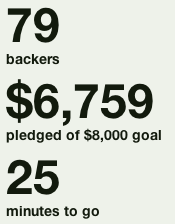
Less than half an hour to go. Will Notebook on Cities & Culture survive?

Just a reminder that the Kickstarter drive for Notebook on Cities and Culture‘s fourth season has 25 minutes to go before closing. We just need $1200 or so before that time expires, and the show can continue on to Toronto, Copenhagen, London — and, in future seasons, beyond. If you need to adjust your backing amount or reward, or if you want to inform anyone else about the drive, this is your last chance. Thanks very much indeed for your generous contributions!

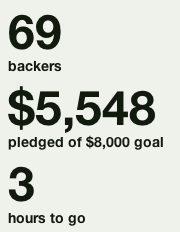
Under four hours to go, and just $2500 needed, for Notebook on Cities and Culture to continue

We’ve roamed cities like Los Angeles, San Francisco, Portland, Vancouver, Mexico City, Kyoto, Nara, and Osaka. We’ve talked to writers, broadcasters, critics, comedians, designers, bloggers, academics, journalists, artists, editors, and monologists. We’ve planned a fourth season that will reach such fascinating world cities as Toronto, Copenhagen, and London. But Notebook on Cities and Culture’s latest Kickstarter drive hasn’t quite hit its mark yet, and time has run short. We only need to raise almost $2500 more to meet the season’s funding goal, but we need to do it in under four hours from now.
If you’ve planned to back the show, the best possible time has come to do it. And if you know anyone else who’d intended to back it, the best possible time has come to remind them! 68 listeners have backed Notebook on Cities and Culture season four so far, but these words reach many more, so we certainly have the potential to close this small funding gap quickly. You, or anyone else, can back the show here on its Kickstarter page and receive backer rewards like mentions of your project or message on the show, postcards from the cities visited, or even you as a guest. But only if we reach $8000 by noon Pacific time today will the show go on. Thanks.

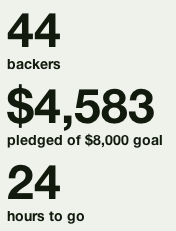
The end of Notebook on Cities and Culture? Not if we raise $3417 in 24 hours!

A mere 24 hours remain in the Kickstarter drive for Notebook on Cities and Culture season four, but we still need to raise $3417 more to meet the funding goal. If we do, the show will air many more in-depth conversations with cultural creators, internationalists, and observers of the urban scene in Los Angeles, Toronto, Copenhagen, and London. If we don’t, the show will air… well, no more in-depth conversations with anyone anywhere, I suppose.

Last season, we aimed to raise $4000 to produce 24 episodes. (However, adhering to the sacred principles of underpromising and overdelivery, we produced 31.) This season, we’re aiming to produce 60 episodes, half of them recorded in three new cities, for only $8000. But the Kickstarter drive for this most ambitious season of Notebook on Cities and Culture yet ends in just a day, at noon Pacific time on Monday, June 24th. Find out how you can help make it happen on the show’s Kickstarter page. Thanks.

Almost $3500 still to raise, and only two days to do it, for Notebook on Cities and Culture season four

The Kickstarter drive for Notebook on Cities and Culture‘s fourth and most ambitious season has, as of this writing, raised $4506. Thanks very much indeed to all who have generously backed it. If we don’t raise the remaining $3494 of the season’s budget in the next two days, the season won’t happen. (On the bright side, none of you will pay anything!) But if we do, prepare to enjoy not twenty, not thirty, but sixty full-length conversations with cultural creators, internationalists, and observers of the urban scene in Los Angeles, Toronto, Copenhagen, and London.

(And if you have any suggestions of guests you’d like to hear interviewed in those cities, by all means make them! You can reach me at colinjmarshall at gmail.)

Again, to find out how you can back Notebook on Cities and Culture‘s fourth season, and what backer rewards lay in store for you — thanks, postcards, mentions of your project or message, you as a guest — just visit the show’s Kickstarter page. The drive ends at noon Pacific time on Monday, June 24th. Thanks.

Los Angeles Review of Books Podcast: David Shook

On the latest Los Angeles Review of Books podcast, I have a conversation with poet and translator David Shook about his latest collection Our Obsidian Tongues, his translation of experimental Latin American author Mario Bellatin’s Shiki Nagaoka: A Nose for Fiction, and his covert filmmaking in Equatorial Guinea. You can listen to the conversation on the LARB’s site, or download it on iTunes.