Skip to content

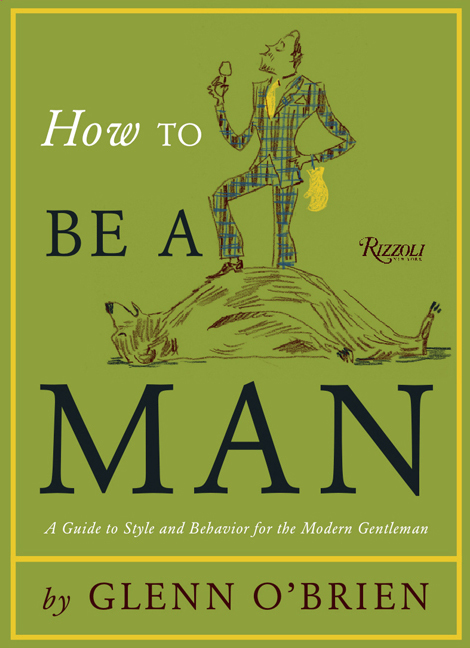
Glenn O’Brien: How to Be a Man

I knew little about Glenn O’Brien before hearing Jesse Thorn interview him on The Sound of Young America, but now my mental shelf of examples of career-life unity couldn’t do without him. Assemble what you can of the man’s résumé, and the full picture looks colorful to the point of unreality: host of the punkisly and cultishly beloved public-access show TV Party, music critic at Interview, creative director at Barneys, writer and producer of the film Downtown 81, associate of Andy Warhol, Artforum columnist, High Times editor-at-large (allegedly he coined the title), stand-up comedian, editor of Madonna’s infamous Sex, and, more recently, GQ‘s “Style Guy.” This winding path leads to How to Be a Man, a handsome green hardcover filled with short essays ostensibly about dressing, decorating, smoking (or not), eating, marrying (or not), drinking, and dying (or not), but effectively about how best, in the mind of Glenn O’Brien, to lead one’s life.

O’Brien has admitted to this thematic sleight of hand. You can’t write like Montaigne anymore, so he and other essayists have lamented; today’s readers shrink away from overt discussion of How to Live. The reasons for this shift in popular taste over the last 400 years remain opaque, but it forces those who would dare to think, speak, and write directly on life into a kind of fake specialization. O’Brien, having accrued experience and notoriety from years of answering letters from GQ readers nervous about whether to match their socks to their shoes or their pants, surely saw his strategy with all possible clarity: sell a style book, write a life book.

But he wrote How to Be a Man for those of us for whom life and style have grown inseparable, men for whom the major questions — what to wear and how to wear it, what to eat and how to eat it, what to work on and how to work on it, where to go and how to get there, when to stare and whom to stare at — all come, of a piece, as the enterprise of existence. Despite the fun of making broad pronouncements about life in general, though, rarely do I find said pronouncements coming in handy in the day-to-day — or, for that matter, sticking in my memory as anything more substantial than a profound-smelling mist. O’Brien spends the most useful half of his book on the details, the specifics, the nuts and bolts of all this. And he accepts, with evident rue, that he must first do some damage control.

“Man has been reduced everywhere,” O’Brien writes, “serving the hive like an ant or bee, toiling away at mechanical tasks and never approaching a knowledge of the whole, or performing the great work. There are no Renaissance men because there is no Renaissance. Or is it the other way around?” He spies both signal and cause of man’s fall — a devastating feedback loop indeed — in man’s wardrobe. “The barbarian revolution of the last half-century” has, in O’Brien’s assessment, made it “possible for men to dress like boys or adolescents for life. We see these fellows around us every day. They are the chaps in comfy running shoes, worn jeans, tracksuits, sweats, t-shirts, and caps advertising the sports teams to which they hold allegiance. These men are dressed not for success but for existence.”

Hence the presence of one essay titled, simply, “How Not to Look Stupid,” and the presence of a couple dozen others with similar pedagogical goals. You might now think of O’Brien — and, by association, me — as a bitter crank who longs for nothing more than the days when gray-flanneled husbands marched from the house every morning anticipating a two-martini lunch, an afternoon of light sexism, and a roast already glistening on the table upon their return home. But we’ve read Richard Yates; we know how often midcentury man desperately concealed, behind his blustering, boozy façade, an abyss of weakness and shame. This same faulty core rolled out the carpet for Company Man conformity, shot the notion of aesthetic agency full of holes, and reinforced the ultimate suppression of the modernist impulse. It brought us to a generation of men lost in their own ambivalence about being men, the shocking depth of their self-loathing on brazen sartorial display. In an interview, O’Brien reduced it to a question that never drifts far from my mind: “Supposedly we’re created in the image of God, and you’re gonna put on a Steelers Jersey?”

I don’t fully blame my fellow twentysomethings, or even the former iterations (or, I can assure you, the many iterations to go) of myself, for their negligence. Having imprinted on the strange, complicated geldedness of our immediate predecessors, we on one morning or another wake up to the sudden, overwhelming feeling of being unequipped. How could we have reached our age, we ask in panic, without knowing how to find lasting furniture, how to drive a five-speed, how to poach an egg, how to distinguish friendship from (choke) “networking,” how to tie a four-in-hand? And if we lack so much as that  foundation, how can we hope to advance ourselves along more nebulous lines: refining our taste, extending ourselves across times and traditions, and crafting our very presence in this world?

Despite his book’s title — and could I go far wrong in suspecting a clumsy yet insistent pair of hands at the publishing house? — O’Brien has not written a straight-ahead manual for manhood, nor would I trust any such product. If he’s working in the tradition of crypto-Montaigne, he’s working even harder in the tradition of crypto-memoir. His essays present the lessons that one man and one man only has learned, internalized, and re-expressed over sixty-odd years. This one man asks barbers to make him look like a Roman emperor, strictly orchestrates his dinner-party seating arrangements to spark maximum interestingness, urges his ideas to “bubble up” by walking city streets, drinks only wine due to its ancient provenance, marshals Nietzsche to describe the new Prada collection, courts the preferential treatment of a regular at his choicest eateries, advocates a generation gap between man and wife, does not smoke yet maintains household ashtrays, mixes time periods with reckless abandon, and once got turned away from a gay bar in the company of John Waters. Plus, he’s flown on the Concorde, “whose passing seemed to mark a permanent turn for the worse, not only in travel but also in the history of modernism itself.” You either know you can use his experience or you can’t.

It all seems to return, as O’Brien writes it, to aesthetics, and most immediately to clothes. He references in several places the 18th-century code of the dandy, who, per Baudelaire, presents himself with such concentrated attention not out of “excessive delight in clothes and material elegance” but as one manifestation of “the aristocratic superiority of his mind.” Unusually — and for me, refreshingly — O’Brien expresses little regard for the concept of authenticity, highlighting instead the usefulness of the dandy’s fake-it-’til-you-make-it enthusiasm. “A dandy may begin as a poseur,” he writes, “but gradually the pose takes hold and gives him strength, and though he may have begun as a phony, by affecting a grand posture, the power of the posture reforms him and he becomes a real phony.”

The dandy, in other words, takes the career counselor’s recommendation to “dress for the job you want,” a pointer weary for the glue factory, and applies it not just to “the job” but to the life — and how, of course, could he separate the two? This way of thinking and acting, as O’Brien explains it, “applies everything we have learned about aesthetics and from philosophy to our persons and to our environments.” Time and time again, he uses the phrase “sense of occasion” to evoke what we’ve lost and what a man must regain in order to prove himself worthy of the demographic designation. Every facet of our relationship with the world reveals our sense of occasion, though I find it difficult to infer what occasion most fellow guys on the street could possibly have prepared themselves for. Masturbation?

So, sure, sure, sure — we’ve all slacked off on our masculine duties, and we need to act better and dress better and live better and just display a whole hell of a lot more discernment. But if O’Brien writes about what’s gone south about manhood, how our taste reveals it, and how finally paying attention to the latter can patch the holes in the former, he writes equally about taste as a non-normative lens that, peered through, can make your environment that much more interestingness-rich: “Taste sums up what a person is thinking and not thinking. Your carpet and drapes tell us more about you than anything you could possibly say. The books on your shelf, the black plastic twirling on your turntable, the condiment rack in your fridge, your sock drawer: these are the auguries by which we navigate society. Taste is the fingerprint of intelligence and the visible manifestation of personality.” Learn to read the codes instinctively, and I bet it’ll feel like you’ve gained a flâneur’s superpower.

How O’Brien diagnoses the ills of 21st-century man might not sit right with everyone; MetaFilter’s reaction to Jesse Thorn launching his menswear-focused enterprise Put This On (“A Webseries About Dressing Like a Grownup”) comes to mind. Weren’t we assured that the skinless meritocracy was dead ahead? Shouldn’t we have dispensed with superficial concerns the moment we put a man into outer space — or even the moment we built the first aqueduct? Can’t we relinquish this snobbery? Yet it increasingly appears to me that phase one of growing up involves accepting that the skinless meritocracy won’t come to pass; phase two surely must involve accepting that we didn’t really want it to in the first place. How to Be a Man offers a redemption of the snob by redefinition, or by a return to the term’s roots in the phrase sine nobilitate: “We’re all snobs, one way or another. The good snob is the one who uses his upward mobility to improve himself, to develop real character, and to graduate and lose that ‘sine‘ and become ‘nobilitate.’ Since nobility is extinct, we have to invent it. We have to nobilitate ourselves.” So that’s what we’re calling it now.
Podthoughts: You Made it Weird


Vital stats:
Format: one-on-one comedy/sex/God conversations
Episode duration: 50m-1h45m
Frequency: 3-7 per month

You’ve surely heard the name Pete Holmes resonating through the halls of alternative and/or podcast-y comedy lately. The words themselves could, by their broad pan-American nature, gain only the loosest purchase on anyone’s memory — far less than the evangelical fervor with which some speak them. Even if that piques your curiosity, casual investigation reveals only one more head in the endless perp walk of white, early-thirties, college improv-bred, sitcom-writing Los Angeles standup comics by way of New York. Yet everyone, as another noted comedy podcaster I recently interviewed put it, seems to be boarding the Pete Holmes bus.

Since this podcaster said that in response to my own salvo of Pete Holmes-related evangelization, perhaps I can offer some explanation. To truly “get” Pete Holmes, I submit that you must see Pete Holmes, like I did at a live Risk! taping. In the aftermath of his punchlines, watch the man twist his open, wholesome features — his name made flesh — into those of a lower-tier Midwestern politician on the brink of a flop sweat, the pressure from a desperate tap just inches too far down into his well of theatrical affability forcing open the stress fractures that will hasten his undoing. A subtle element of Holmes’ performance, yet a harrowing one; it would surprise me if even he fully understands how or why he pulls it off.

Then again, as his podcast You Made it Weird [RSS] [iTunes] reveals, I may vastly underestimate his capacity for (or compulsion toward) self-scrutiny. The show’s simple format drops Holmes into one-on-one conversations with friends, colleagues, and friend-colleagues, like a WTF without the confrontation. The resemblance between the two podcasts actually runs deep enough so as to get tough to explain; suffice it to say that, when Holmes brings Marc Maron on [MP3], the resulting episode could have fit just as well into one show’s feed as the other’s.

Read the whole thing at Maximumfun.org.

Lessons of Kickstartiness

The Kickstarter fund drive for Notebook on Cities and Culture‘s first season wrapped up this week, earning what I would call a successful $3000. Having entertained many a vision of just staggering over the $999 line by the close of the final day, I look upon the nearly 300% with some satisfaction. Some fun facts about the results, if you’re collecting experiential data for your own potentially Kickstartable projects:

  • 46 backers pledged $3000 total, so the average backer pledged $65.21, the price of a reasonably slick Taschen book or maybe a smaller Criterion box set.
  • The great majority of the backers pledged within eight hours of the drive’s launch, which is about how long it took to pass its funding goal.
  • The $300 pledge level, where I talk about the backer’s own project before every episode, sold out all three slots.
  • The $30 pledge level, where I thank backers by name at the end of every episode, sold 23 slots.
  • The $80 pledge level, where I talk about the backer’s own project before one episode, sold four of 24 slots. Maybe I’ll retool that middle incentive next season. (Kickstarter suggests offering something “tangible,” but I can’t imagine what that would be. Many projects screenprint up some t-shirts, but when was the last time you wore a t-shirt with words on it? Been nearly a decade for me.)
  • Since the drive passed its goal so quickly, I declared that, for each $250 raised over the initial $1000, I would add another episode to the season. (I’ve never found a snappy way to put that.) This resulted in a planned 24-episode season lasting three months growing into a 32-episode season lasting four months.
  • Next season, I might make $3000 the goal and produce an additional episode for each $150 or $200. Then again, I might bump up the goal a little bit more to fund recording in other cities. Perhaps an exploration of the West Coast? Notebook: San Francisco, Portland, Seattle, and Vancouver? We’re talking Cities and Culture, after all, not City and Culture.
  • Before the drive had ended, I’d already recorded six or so interviews. Glad I don’t have to explain to those interviewees why the world shall never hear our conversations.
  • Kickstarter and Amazon (who process the payments) combined take almost a ten-percent cut, and you have to wait almost three weeks for the money to land in your account. So allow for that in your budget! Or, y’know, keep a budget. Not that I’m going to lead by example.

Now to make sure the show doesn’t suck. No assurance of quality like the old chorus of “people paid for this” running through one’s mind!

Twenty-first-century man of letters

Preparing to record another conversation with (twotime Marketplace of Ideas guest) David L. Ulin, I thought I’d give his recent book reviews a re-read. In his consideration of (one-time Marketplace of Ideas guest) Geoff Dyer’s essay collection Otherwise Known as the Human Condition, he writes that “Dyer lays out a quiet kind of writerly revolution, in which ‘the late-twentieth-early-twenty-first-century man of letters’ might best be described as a literary gadfly, unbound by genre or a reader’s expectations, writing about anything that comes to mind.” So that’s me quoting Ulin, quoting Dyer.

I have no small stake in the definition of the late-twentieth-early-twenty-first-century man of letters — or, now that we’re up to 2012, the twenty-first-century man of letters. I’ve occasionally introduced myself as a “man of letters and sound waves” in broadcasts, and indeed, that little-trod pathway offers my only hope, and a vague one at that, of three squares a day. Increasingly, the figures I follow closely — those whose work I can’t stop examining, dismantling, and sweating to re-create — inhabit the spaces where the circles in culture’s Venn diagrams overlap. They absorb as many forms of the stuff as possible and craft their experience for delivery right back out, far and wide, into the world.

Like Dyer, these figures have often carved out reputations primarily or solely as cultural writers — reviewing, essaying, criticizing, reflecting, what have you. They pull ahead of their vast herd of colleagues for the simple reason of not sounding so damned wan. Nine out of ten cultural articles I read come off as 750-word shrugs, premised chiefly on the assumptions that (a) nobody will read this and (b) yeah, but nobody would’ve sought out the films, books, or albums it’s about anyway. B.S. Johnson once sent down an edict, as he was wont to do, to write like you mean it, like it matters, and like you mean it to matter. Those who’ve let the mandate slide — and thousands have, I fear unknowingly — write like they want to make word count, like it barely matters even to them, and like they wonder when their two hundred bucks will get here.

The time has come to capitalize on my compulsion to work the cultural room (as Dyer’s U.K. publisher might say) and my mounting irritation at the volume of would-be man-of-letters product written at a workmanlike plod, heaving under its own inconsequentiality. The task of engineering a new species of cultural writing, one not burdened into meaningless by traditional obligations interpretation and/or evaluation, could well yield fruit. I find myself in a not entirely disadvantageous place to do that, given that my writing thus far has walked me around a sizable patch of that old Venn diagram. My last nine literary primers for The Millions, for instance:

(Even now, Oulipo fans, I labor over a Harry Mathews primer. It’s taking longer than I thought.)

Or my pieces on books for The Quarterly Conversation:

Or my last nine Humanists columns for 3Quarksdaily:

Or even my last nine (as long as we’re doing nines) Podthoughts for Maximumfun.org:

(And let’s not forget the Ubuweb Experimental Video project, found here, on my old Typepad blog, and on Ubuweb itself.)

Sure, the goal of this post lays, ultimately, in clarifying my direction to myself. But, that admitted, perhaps I could be of use? Happen to read any publications lately that feel in need of a bracing shot of interestingness?

Only two days (and one season sponsorship) left to fund Notebook on Cities and Culture — and to demand more interviews

As of this writing, the Kickstarter fund drive for Notebook on Cities and Culture‘s first season has raised $2386. The original funding goal asked for $999 to cover the production of a 24-interview season, but when the drive blew past $999 in about eight hours, I decided to add another incentive: for each $250 raised over the goal amount, I’ll produce an additional interview in the first season. We’re already up to a 29-episode season. Care to help make it an even 30? (I’d also be willing to furnish, say, an even 40, if the public so wishes.)

Two backers have snapped up sponsorships of the entire season, but one remains, so if you’d like your project or message mentioned at the top of every single episode of Notebook on Cities and Culture‘s first season, you’d better hurry! Nineteen episode sponsorships remain, so if you’d like your project or message mentioned at the top of one episode of Notebook on Cities and Culture‘s first season, don’t feel quite so rushed. But do feel a little rushed; the fund drive wraps up entirely in about 48 hours.

In any event, many thanks to all the backers who have come on board so far for their generous support, and thanks as well to all those who plan to listen to the show when it debuts. Rest assured that I’ve been hard at work these last few weeks trying to create a conversationally stimulating program for you. You can get a slight sense of it with the four brief previews I’ve released so far:

Podthoughts: Point of Inquiry


Vital stats:
Format: interviews with bigtime skeptics
Episode duration: 30m-1h
Frequency: weekly

“In-KWAI-ree.” That’s how the hosts of Point of Inquiry [RSS] [iTunes] pronounce, sometimes with great deliberateness, the final word of their program’s title. Does this sound strange? Not terribly. Is it even not the standard pronunciation? Admittedly, I don’t know. But at certain moments, the word as uttered on this podcast sounds saturated with the sterile moisture of pedantry. Most of the time, I feel comforted to hear the speaker taking such pains. But other times — few times, but telling ones — I feel a flood of desire to shake him down for his lunch money.

The show belongs to the genre of podcasts on skepticism, one which took off with surprising force early in the medium’s emergence. Its name, despite my complicated feelings about how announcers say it, strikes me as a paragon of dignity compared with those its swarm of brethren have taken up: Skepticality, Skeptiko, Skeptoid, Skepchick. Truth to tell, had Point of Inquiry’s sponsoring organization the Center for Inquiry called it, say, Skeptacular or Stupid SkepTricks, you probably wouldn’t be reading a Podthought about it. But by today, skepticism shows have multiplied to the extent that no pun, no matter how goofy, can set a show apart.

Point of Inquiry’s form also exhibits an uncommon poise. Many skepticism podcasts divide themselves into a distracting array of segments, compulsively gin up uncomfortable confrontations with suspiciously dopey adversaries, or loose slightly-too-large casts of panelists into a frenzy over the delusion of the week like bored jungle cats upon a limping wildebeest. This one has evolved into straightforward interviews with luminaries who have carved out careers staring down particular skeptical bugaboos: Brendan Nyhan on political spin in the media [MP3], Michael Shermer on evidence-free beliefs [MP3], Steven Pinker on traditional notions of human nature [MP3], Jonathan Kay on 9/11 “Truthers” [MP3], the late Christopher Hitchens on God [MP3]. Somebody behind these scenes wields wide-ranging connections, slick booking skills, or both; no skeptical podcast I know gets consistently heavier hitters on the phone.

Read the whole thing at Maximumfun.org.

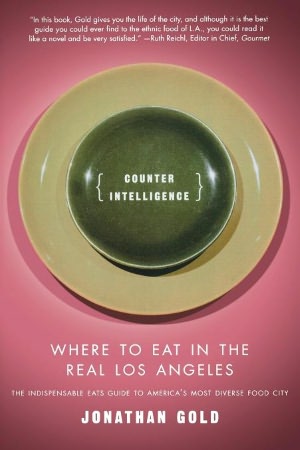
Jonathan Gold: Counter Intelligence

Here we have a sheaf of dozen-year-old restaurant reviews. Yet here we also have what the New Yorker calls “one of the great contemporary books about Los Angeles.” Sure, the magazine distances itself from that accolade, attributing it to a nebulous group of “people,” but it does so in a profile of Jonathan Gold that reveals why you’d want to read his thoughts on dishes eaten during (and well before) the Clinton administration. Such is Gold’s presence in the zeitgeist of American urban journalism that, moving to Los Angeles, I felt no immediate need for another Baedeker.

Partisans of other metropolises, learning that one of Los Angeles’ best-regarded living writers cranks out restaurant reviews for a free weekly paper, might write the city off then and there. But somehow, Gold’s own background stops them from writing him off. The New Yorker profile touches on his past as an experimental musician, his early notions about joining the Foreign Service, his unrepentant maintenance of an appetite straight out of the decline of Rome, and the almost active lack of ambition that characterized several of his decades before winning a Pulizter. The article mentions, with surprising unsmugness, Gold’s late-2000s move to New york to write for Gourmet, but then, a few years later, he made his most shocking choice to non-Angelenos yet: returning to Los Angeles.

Gourmet went under, true, but even I, still new to the city, immediately grasp why Gold felt his homeland beckoning for further eating. From where I stand — specifically, the line between the Korean part of Koreatown and the Central American part of Koreatown — Los Angeles looks to me like a loose confederation of immigrant communities, with culinary offerings to match. Gold puts it to the New Yorker with characteristic succinctness: “The difference is that in New York they’re cooking for us. Here they’re cooking for themselves.” This holds true for most forms of human intercourse that go on here; to understand Los Angeles’ restaurants is to understand all its other cultural institutions as well.

Unlike those who practice the more rarefied yet more standard forms of food criticism, Gold also understands that eating cannot, or at least should not, be approached in a cultural vacuum. He unhesitatingly pulls in references to, comparisons with, and terms of the full variety his artistic experience, whenever it seems necessary. “The Germans contributed the symphony,” he writes in one of the many restaurant reviews Counter Intelligence comprises. “The French, symbolist poetry; the Irish, William Butler Yeats. The Dutch chimed in with Mannerist painting; the Nigerians with the great sculptures of Benin. And the Belgians? French fries… French fries and a funny kind of beer that tastes like cherries.”

Counter Intelligence goes on to see Gold eat “a dish that suggests more subtleties of green than a Jennifer Bartlett painting.” He describes “a Louis L’Amour scene transplanted to a Little Tokyo mini-mall.” He tastes a house hot sauce that “puts a Carville-quality spin” on a dish. He knows that, “in good French toast, milk and egg invade a slice of bread the way the creatures in I Married a Monster from Outer Space took over police officers.” He frequents an Ethiopian joint with “four sharply dressed men clustered around the turntables arguing whether next to play Lakeside or Cameo.” (Sounds like my kind of place — and indeed, I go with some frequency.) He figures that “if The Honeymooners were set in Osaka instead of Brooklyn, Ralph would eat a lot of curry.” He admits that “like a bad Elmore Leonard novel, a bad scallion pancake, even the doughy ones they sell in the frozen-food aisles of Chinese supermarkets, which you heat in your toaster like a Pop-Tart, is still pretty hard to resist.”

But again, beyond the (considerable) raw entertainment value of such critical performance, why read a compilation of restaurant reviews from 2000? Surely even the most relevant of Gold’s assessments have gone cold by now, and his archive of opinions on L.A. Weekly‘s web site gets updated practically in real time. But as a perhaps too-avid reader of criticism in all its breeds, though, allow me to submit that timeliness is just what we don’t need more of. If I read a review hailing from, say, the theater pages, let me read the one that hails from the theater pages of years, decades, centuries ago,  one that describes a performance fast fading from or completely out of living memory yet somehow retains its intellectual impact. If I read a review of a meal — the one form even more ephemeral than theater — let me read a review of a meal from an eatery shuttered years ago, its small but once-devoted clientele long dispersed. But let it be a review I read over and over again, vainly attempt to explain diagram the workings of the idiosyncratic mind behind it.

As it happens, most of the eateries Gold writes up in Counter Intelligence remain open for business. I know; I kept my iPhone beside the book at all times just to check. In the same way that an old, foreign film’s continued presence in the public consciousness signals something enduring enough at its core to blow through walls erected by age and distance, a restaurant that already boasted a strong track record in the previous century which I can still visit today is a restaurant I want to visit today. But under Gold’s mandate, “restaurant” isn’t always the right word; often, he saves his most probing, far-reaching, and celebratory investigations for stands, shacks, and, yes, counters — holes in the wall, sometimes literally.

This gets at what we can now see as Gold’s chief critical strength: the man knows how to use a filter. The New Yorker describes one example of the only-in-Los-Angeles phenomenon he calls a “triple carom”: “the Cajun food restaurant that caters to Chinese customers and is run by Vietnamese from Texas.” Seek out such an unlikely combination and you’re halfway there. But does it demand that you haul your ass out to a distant suburb filled with oil derricks and abandoned aerospace complexes? Does it do business out of a shambolic corner strip mall? Does its window proudly display a grade of “C” from the Los Angeles Board of Health? Has it nevertheless filled to bursting for lunch every single day since 1982? If yes to all, then, by Gold’s rubric, you’re at least three-quarters of the way there.

I borrowed my copy of Counter Intelligence from the Los Angeles Central Library downtown. There they shelve it not with the food books, but, correctly, in a stretch of stacks on the very bottom floor given over to Los Angeles history, culture, and geography. I have already spent good times getting lost in this section, and I plan to spend more. The book I checked out, dog-eared and pencil-marked with over a decade of use, contained the following underlinings and scribblings, which reveal “the Real Los Angeles” of its subtitle just as much as its main text does:


strawberry-papaya

homemade lemon agua fresca

fresh, heavy cream

too expensive

banh mi shop

sugar-cane juice

green-papaya salad

less than $2

iced coffee is

steamed-vegetable salad gado-gado is garnished with fried tofu, tempeh fritters, and half a dozen shrimp chips — silly-looking things that jut from the top of the salad like varicolored jibs

exotic sweet

malted glasses

brown-sugar drink es cendol

soups

tom kha kai

fresh pasta

bufala

panini

best vegetarian plates

called pastis

stand in line to order

fried plantain

Cafe Brasil lunch is generally an uncomplicated

$20

Mexican cactus pizza

foie gras calzone

steamed in banana leaves

yogurt drink, dough

Buenos Aires-style pasta

Argentine cooking is probably the most popular new cuisine in Los Angeles since Thai food

$21

a dense, hard-grilled brioche

onion, squeaky panela cheese

Sri Lankan iced coffee

White Russians you

banana smoothies seem to be — but aren’t — flavored with a shot of dark rum

curries

entree at Coley’s Kitchen: a subtly sweet mound of rice cooked with red beans; a small heap of steamed cabbage; a fried slice of plantain; an egg-size capsule of festival bread that will remind you of a buttermilk doughnut. Before this massive plate of food arrives, there might be a cup of thick, curried chicken soup, or spicy cow’s-foot soup — or, on Mondays, incredible, intricately spiced red-bean soup, which

“patties”

tall glass of the restaurants

Caribbean vegetable akee looks

scrambled eggs

Guelaguetza in Koreatown

cornmeal platforms

mole negro

to include half a dozen small loaves of buttered French bread instead

oyster loaf

cheese-on-a-stick

Ten dollars’ worth of shrimp dumplings and egg rolls

“Pregnant Burritos”

in Nose Knows

inera bread

Eritrean vegetable combination plate

best fried-green plantains I’ve had

baba ghanoush

Peru’s central Andean highlands

sour cream

turnovers stuffed with tart spinach

Matsuhisa’s prices are high

proper papaya salad

unripe fruit shredded

omelets

pupusas, hand-patted

vegetable loroco

samarkand is the sort of cold sauteed eggplant

plov, the godfather of all rice pilafs

pineapple rice

3:00 A.M.

kimchi

cabbage kimchi

a sweet squash

passion-fruit

pizzas

bananas and cinnamon

bananas and cheese

The Notebook on Cities and Culture season on Kickstarter Campaign goes live…

… right this moment. You can pledge or just keep an eye on the drive’s progress at the show’s Kickstarter project page. We’re aiming for $999 in pledges to fund the first season, i.e., the first three months, i.e. the first 24 hour-long interviews. You can pledge any amount like, starting from one dollar. But if you’d like to go beyond the Washington, I can offer the following incentives:

  • If you pledge $30 or more, I’ll thank you by name in each and every one of season one’s episodes.
  • If you pledge $80 or more, I’ll thank you by name in each and every one of season one’s episodes, and mention your own project or message at the top of one of them. (Only 24 backers can do this, for the obvious reason.)
  • If you pledge $300 or more, I’ll thank you by name in each and every one of season one’s episodes. and mention your own project or message at the top of all of them. (Only three people can do this, for reasons of not wanting to lose the audience’s attention at the top of the show.)

So, $999. If we get there by 12:05 a.m. Pacific time on Thursday, February, 2nd, the show’s first season will come out. If not… well, just yesterday I walked by a Five Guys burger joint on Wilshire that was hiring, so I’ve got options.

Introducing, audio- and video-previewing, and (on Thursday) Kickstarting Notebook on Cities and Culture

I give you The Marketplace of Ideas‘ replacement, and the next evolutionary stage of my grand project to deliver cultural conversation of the depth you demand: Notebook on Cities and Culture, debuting February 2012. Well, scheduled to debut in February 2012, anyway.

In the new show, I’ll sit down twice a week with cultural creators, internationalists, and observers of the urban scene for long-form conversations recorded all over Los Angeles and beyond. Guests scheduled so far include writers, sound artists, comedians, broadcasters, critics, bloggers, and people with careers so self-styled that labels fail me. (Locations so far include homes, offices, libraries, tar pits, and a Denny’s in the middle of the night.)

But before Notebook on Cities and Culture makes its entrance, we’ll need to do some fundraising. You know Kickstarter, right? It’s that service people have been using to fund projects like (and here I quote their own front page) “balloon mapping kits,” “earth-banked aging rooms,” and “graphic novel about a guy who views himself as a troll and is in love with his best friend’s girlfriend.” The good people at Kickstarter have approved Notebook‘s first season of three months and 24 interviews as a fundable project, and its week-long campaign for $999 in production money begins this Thursday, January 26.

One of Kickstarter’s advantages, one I would suspect has helped it grow so widely used, is that, if a campaign doesn’t reach its goal, nobody who’s pledged pays anything. (Good for those who pledge, anyway; perhaps less good for those of us who’ve, uh, had trouble with listener mobilization before.) More details on all this will come soon. In the meantime, give this brief video about Notebook on Cities and Culture a watch, listen to a couple clips from the new show, and, now more than ever, try not to get laid off:


The Ubuweb Experimental Video Project 50. John Baldessari’s The Meaning of Various News Photos to Ed Henderson


John Baldessari, The Meaning of Various News Photos to Ed Henderson, 1973

I don’t know Ed Henderson’s story, but that voice talking to him from offscreen definitely belongs to John Baldessari. In this piece, the artist doesn’t ask nor seem to expect that we know or learn much about Henderson, other than that he looks and sounds on the young side; that he wears shiny black-rimmed glasses and what some a “jewfro;” and that he retains only imperfect memories, if any at all, of recent pieces of photojournalism. Pushpinning a series of newspaper photographs onto the wall, Baldessari asks Ed to describe what he thinks they depict.

“Looks like it was in Northern California,” Ed says about one. Another moves him to finer-grained geographical specificity: “It’s Los Angeles: palm trees, trashy little houses.” In the photo Baldessari has put up, a pair of cops train their guns on a t-shirted fellow flat on the sidewalk. “Police don’t pull out firearms unless it’s absolutely necessary,” Ed assures us in the flatly optimistic tones of the True Stories-era David Byrne. “Obviously, this is a military man,” Ed says of a strapping subject in a harshly folded hat doubled over and sniffing his way along a trail; “basic jungle training,” it seems. One image, harder to make out than the rest, appears to contain a beaked creature in its corner. “This, I’m almost positive,” Ed ventures, “is some sort of rare hummingbird.”

Unaccompanied photographs, even muddy ones seen through Portapak footage like these, combine a surprising richness of information with a total lack of context. Of course, Baldessari has done some of the decontexualizing himself, snipping away the articles they illustrate. I can’t write anything more incisive about this phenomenon, and certainly won’t write anything more voluminous, than documentarian Errol Morris has in his New York Times blog and his blog-based book, Believing is Seeing. Suffice it to say that we get in trouble when we examine photographs and our minds wander beyond the frame. Ed doesn’t say anything too patently ridiculous in the video — I did chuckle when he initially mistakes a beach full of crabs for a beach full of “bugs,” though I felt I was laughing with him — but we have know way of knowing how close he comes to the target. More to the point, we have know way of knowing what the “target” even is.