Skip to content

Notebook on Cities and Culture S2E22: Uncaptive Rider with Jarrett Walker

Colin Marshall sits down in southeast Portland with Jarrett Walker, public transit consultant and author of the blogs Human Transit and Creature of the Shade as well as the book Human Transit: How Clearer Thinking About Public Transit Can Enrich Our Communities and Our Lives. They discuss how Portland “turned the battleship” toward sustainable transport in that least likely of all decades, the seventies; the city’s discovery of its own extraordinary capacity for self-promotion in the nineties; his adolescence there spent in fascination at the buses departing to all their myriad destinations; how thinking about transit makes thinking about cities more interesting; the unfortunate divide between urban design and transport planning; how the North American revolt against highway-building also hampered the construction of transit infrastructure; a city’s transportation system as the ultimate test of its citizen’s freedom; the close relationship between a city’s density and its transit possibilities, and why fantastically inefficient systems are always pleasant to ride; how he has come to love Los Angeles, during its current transitional moment, as someone who has hated it; Los Angeles’ place as a “city on the edge” that always captures the imagination, no matter the petty judgments it draws; Los Angeles’ distinctive geography offering the best possible opportunity for transit-building; the questions he asks about whether a city wants him to understand the whole of its transit system, and whether it treats him as a free actor; the surprises that delight him now that he’s gotten used to confusing, sad, and unpleasant transit experiences; airport stations and their tendency toward “symbolic transit”; and the importance of whether a city treats transit as a commuting device or as an all-purpose urban structure, and whether or not it’s motivated simply by the coolness of the vehicles.

Download the interview from Notebook on Cities and Culture’s feed or on iTunes.

Notebook on Cities and Culture S2E21: Grittiness and Heart with Kevin Sampsell

Colin Marshall sits down in Portland’s Montavilla with Kevin Sampsell, publisher of Future Tense Books, editor of Portland Noir, and author of the memoir A Common Pornography and the novel This is Between Us, forthcoming from Tin House. They discuss the meth crime to be found beyond 82nd Avenue; Portland from the vantage point of his childhood in Washington’s Tri-Cities; how he met other writers by publishing his own “lo-fi chapbooks”; how one forges one’s own unique voice by maintaining their not-giving-a-crap nonchalance; his chronologically un-pinpointable founding of Future Tense and its surprise success with Zoe Trope’s Please Don’t Kill the Freshman; writing as a kind of martial art, which develops you even if you start out flabby, and which demands its own kind of meditation; how he became a (more) serious reader at Powell’s Books; his love of southern writers, and more generally those who combine grittiness and heart; how unimportant he finds sense of place in fiction, yet how much praise he won for “capturing the Tri-Cities” in A Common Pornography; his technique of mixing the mundane with the shocking and hoping for the best; moving from the “no style” and short chapters of his last book to the longer chapters and conversational style of his new one; and the attractions of the Portland writing life, including having space to live and being in a place where nonfiction writers and poets might actually associate.

Download the interview from Notebook on Cities and Culture’s feed or on iTunes.

Notebook on Cities and Culture S2E20: Conservatively Progressive with Carl Abbott

Colin Marshall sits down at Portland State University with Carl Abbott, professor there of urban studies and planning and author of Portland in Three Centuries: The Place and the People. They discuss the debate over Portland’s status as a “small city” or a “big town”; the distinctive ease of making connections in the city; how modern-day Portland enthusiasts would look at the place before 1965 and see Akron, Ohio; the oft-made comparisons between Portland, Seattle, and Austin; the history and continued presence of agriculture and industry around the “cool Portland” of today; Microsoft and Boeing, the “accidental” companies that made Seattle the younger sibling that out-competed Portland, one with better booms but worse busts; Portland’s “conservatively progressive”  politics, and how that sensibility shows up in its light rail system and central library (especially as compared to Seattle’s); the relationship between the city’s vaunted “livability” and its patterns of diversity; how he came to Portland and when, exactly, the city turned away from its former stodginess (and when its porno theaters started turning into revival houses); Portland entrepreneurship, which Portlanders prefer to call “D.I.Y.”; how best to engage new immigrants and hip youngsters in “Portlandism,” a civic-minded, participatory approach to incremental problem-solving; science fiction’s visions of cities, which present recurring patterns related to urban theory; and whether Portland counts as a utopian project, if a practical one.

Download the interview from Notebook on Cities and Culture’s feed or on iTunes.

Podthoughts: Here’s the Thing

Vital stats:
Format: actors, musicians, and intellectuals interviewed — by Alec Baldwin!
Episode duration: 20m-1h
Frequency: 2-3 per month

Here’s the Thing [RSS] [iTunes] is an interview show hosted by Alec Baldwin. Perhaps your curiosity requires no more detail than that. I wonder how much more detail the development of the program itself required. One easily imagines Alec Baldwin casually mentioning how he’d damn sure like to host one of those smart public radio shows, then a higher-up over at WNYC immediately giving the notion a pre-emptive green light. A prominent, name- and voice-recognizable middle-aged political liberal with a wide range of celebrity buddies (whoa, David Letterman?) a non-famous host would struggle to land? Add it up, and Baldwin almost slots too well into the existing machinery of American public radio.

Then again, one just as easily imagines a troubled gestation. Public radio, already a mildly anxious field, has fallen into the thrall of a lot of ideas about its relationship to the terminally anxious field of greater journalism. The industry has long provided refuge to many a program director who would dismiss the concept of an Alec Baldwin interview show out of hand as frivolous, unserious, insufficiently informational. I fear Here’s the Thing, despite its relative chastity of form, therefore qualifies as one of those Bold Experiments in Public Radio™. Somehow, the view of the show a comfortable no-brainer and that of the show as a brow-furrowing risk seem equally plausible. By the same token, Baldwin himself comes off as, simultaneously, an impressively thoughtful, curious accidental interviewer and a Hollywood actor “dicking around” between jobs.

Read the whole thing at Maximum Fun.

Kansai no Nikki III

Scott Adams once posted this tip for getting to sleep:

Don’t think words.

By that I mean don’t imagine conversations that you plan to have, and don’t replay in your head conversations you’ve had.

It’s impossible to clear your mind of all thoughts. But I find it somewhat easy to switch off the language center of my brain. What happens after that is a flow of images, starting with ones that make some sense to my current life, quickly followed by randomness, then sleep. It usually takes less than a minute.

Given how many western filmmakers depict the country as a waking dream, maybe it stands to reason that I also found this technique applicable while walking through Japan. On a purely linguistic level, understanding Japanese (or Korean, or Spanish, or whichever) gets easier when I simply shut off my mind’s instinctive flow of English-language commentary. But I also seem to perceive the Japanese urban environment more richly when I restrict my thoughts to the non-linguistic. “It’s a visual culture,” many of the resident expats I met told me, and I figured I’d approach a place that supposedly thinks primarily in images by thinking primarily in images myself.

“Appearances are reality,” Donald Richie writes of Japan in The Inland Sea. “The mask is literally the face, and the cynic can find no telltale gap because none exists.” Though this element of Japan divides observers, I personally find it one of the most compelling reasons to go. I’ve long felt, but now understand, a longing to enter a realm where nobody prattles on about the supposed divide between one’s embodiment, one’s behavior, and who one “really is.” I can’t imagine a Japanese person seriously throwing around accusations of “pretension,” a charge that even in America says nothing about the accused but everything about the accuser.

Perhaps we’d do better to call it a formal culture than a visual one. “The Japanese are a people who have managed to retain, right into the latter half of the dehumanized twentieth century, a very human, even primitive quality: their innocence,” Richie writes later in the book. “While this does not prevent great subtlety and a degree of sophistication, this mighty innocence — one that the Japanese share with what those white man elsewhere calls natives — rests upon an uncompromising acceptance. The innocent does not look for reasons behind reasons. He, secure in the animal nature that all of us have and only half of us admit, is able to see that all reality is what the West finds merely ostensible reality. Reality is only skin deep because there is only skin. The ostensible is the truth.”

Or, as one interviewee, an Englishman who’s spent 25 years in Japan, said to me: “You know how you can tell an artist in Japan? They’re the ones wearing berets.” He wasn’t joking. Another day I climbed to the top of a mountain with another interviewee, another westerner. We watched, in our everyday clothes and shoes, as Japanese hikers passed by dressed in full outdoorsman’s regalia. They all but wore Tyrolean hats — and some of them may well have worn Tyrolean hats.
The aggrieved periodically e-mail me to complain that I interview too few women or minorities or what have you. Wait until they get a load of my conversations from Japan, conducted with a veritable murderer’s row of mostly middle-aged, often English, men. While happy indeed with how these recording sessions went, I do regret that not one Japanese person consented to sit at the other end of the microphone. Knowing full well that that the clearest-eyed perspectives on a place do come from outsiders — Englishmen, from Christopher Isherwood to Reyner Banham to David Hockney to Richard Rayner, having also offered the most enduring views of Los Angeles — I’ll still look harder next trip.

But from what I’ve heard, few Japanese people, no matter how polished their English, will willingly speak it in anything like an official context. Pico Iyer, in The Lady and the Monk, wrote perhaps the funniest and most cringe-inducing illustration of this phenomenon when recalling the time he was forced to summon his more or less forgotten Spanish, and act as impromptu translator between a family of Argentine refugees and an eager Japanese audience — a Japanese audience that contained several fluent, but unwilling, Spanish-speakers. Terrified of making so much as a mistake every few paragraphs — fewer mistakes than I make, routinely, in my native English — they adamantly refused to step up.

(Also, I didn’t bring any business cards with me this time. Friends have told me that failing to offer mine in return when given one by a Japanese counts as a mortal gaffe. Formal culture.)

This obstacle would loom less formidably, it seems to me, with a Japanese person who has lived abroad than with one who hasn’t. I happen to think of a Wire profile of the Korean-Japanese sound artist Aki Onda: “I really hated that country, I thought it’s just boring. If that’s the only system you know, you have to obey it, but I knew many other countries. Then, when I was 11 I found a diary in my house. My father kept it when he was young, in his Korean name, about his experience as a foreigner. That gave me a good excuse: I thought, ‘Oh, I’m just a stranger, I have no obligation to follow the rules.’”

Of all the people I meet, Japanese who do know other countries rank as some of the coolest; no accident I made mainly amigos japoneses in Mexico City. Japanese who never leave, I may never get to know at all. This contrast looks especially stark when you specifically consider the women, some of whom feel compelled to leave their homeland to assemble a life with enough freedom to merit the name. But even deeply unreconstructed me feels for these often highly intelligent, capable ladies who nevertheless land in careers or lives that would feel to you or me like purgatorial treadmills. That this still beats their probable lot back in Japan speaks volumes.

I suppose the younger ones sometimes find work on airplanes. My bargain-priced tickets flew me to Japan on All Nippon Airways and back on United, offering me an unusually close comparison between a foreign airline and one of our own. On the return flight, I formulated a theory: to gauge the condition of a nation, look at the condition of its air stewardesses. Welcome, then, to withered, sullen America, dragging itself toward retirement and down to its last Nicorette. Old Glory comes out of the culinary comparison even more badly tattered. How to interpret scanty trays of brittle styrofoam cups, heaps of rice overwhelming lonely nodules of chicken, and defeated ham-and-cheese sandwiches but as the white flags of a surrendering country? Images of longing filled my mind: Japanese hot towels presented without fail before each meal, well-stocked Japanese green tea vending machines, clean Japanese trains turning up every four minutes. This is why, you want to say. This is why the world sees the United States as such a tacky, risible nation.

“I don’t care if I never go back,” Richie writes at both the beginning and the end of The Inland Sea. I re-read the book, which Richard Lloyd Parry calls “a learned, beautifully paced elegy for one of ‘the last places on earth where men rise with the sun and where streets are dark and silent by nine at night’,” “the only full-length work of Richie’s that will be remembered a generation from now,” throughout my stay. Though this island-centric travelogue only geographically coincided with my own journey in two cities, Hiroshima and the nearby naval town of Kure, I read it everywhere I went. I read it, increasingly unable to put it back in my bag and take in the live foreignness around me, on trains, over lunch, in parks, with midday coffee, and late at night in donut shops.

This fueled a discussion with a friend, himself a well-known writer of books on Japan and other Asian places, about whether anyone under the age of sixty  seems a promising heir to to the 88-year-old Richie’s throne. The matter has grown worrisome, since Richie himself, if I’ve read correctly interpreted the vague but dispiriting reports from other prominent gaijin, seems not long for this world.  That I evidently slept on the chance to interview him — seemingly only by a few years — and thus to do my part to bridge his generation of Japan enthusiasts and mine stands as my foremost professional regret. And I’ve never separated professional from personal.

Richie’s lack of concern about returning — to Tokyo, to mainland Japan, to America — brings to mind another oft-quoted line of his about first entering his adopted land: “In Okinawa, I felt my testicles descend to the earth.” Or, as he writes in The Inland Sea, “I like myself here.” Or, as a wise sage once sung, “This must be the place.” Though I came to Kansai primarily to collect interviews, and secondarily because I leave the country for my birthday, I kept an eye on evaluating each city as a potential place to live.

While I don’t envision myself — indeed, wouldn’t want myself — becoming a full-time gaijin, I do sense a regular presence in Asia somewhere in my future. Of Kansai’s four major cities, Osaka, supposedly the unforgivably vulgar, unrelentingly ugly, damnably commercial-minded central metropolis, strikes me as the most viable proposition. We westerners are supposed to disdain Osaka in favor of Kyoto — those wooden buildings, those unbroken lines of history — but my impulse to possess a place, through accrued knowledge and experience, only fired up in the company of the comparatively oafish neighbor.

Though though many Asian cities remain to test, I find this mindset alleviated that most onerous burden of tourism, explaining (if only to yourself) why you’re not a tourist. Away went the terribly unpleasant touristic pressure of feeling obligated to see everything, to set foot everywhere, to technically get it all in — inside two weeks, no less. Knowing I’d be back, if not right away in Kansai, then at least in Japan, or in this part of the world, and regularly, I felt free — it even seemed necessary — to leave water in the pump.

Geoff Dyer argued similarly in favor of long trips: staying in a foreign city for months at a time, you absolve yourself of guilt over occasionally staying in and putting on the kettle instead of pounding the pavement in constant, desperate search for the exotic. Then again, other writers have told me that ten-ish-day drips are where it’s at, impressions-wise: they allow you to skim the surface in a highly observant way, collecting and processing only the freshest, least weariness-tainted experiences. Confident that more ten-day as well as months-long trips to Japan lay in store, I need not wring my hands over the difference.

There I sat, staring sorrowfully at my ham-and-cheese yet feeling as much of a yearning to return to Japan as to return to Los Angeles, which some might consider the very capital of tacky risibility. “If you like attractive women,” someone tautologically e-mailed to me years ago, “Japan will be like a whole other planet.” Indeed, Japanese women excel in the same manner as do the preparers of Japanese food: even the ones employed by All Nippon Airways attend painstakingly to presentation — to form — in ways that wouldn’t even occur to their U.S. counterparts. You can’t really blame the Americans; most of us just don’t know. And as in the cabin, so on the streets; most of the stroller-pushing okaasan I spotted in Japan put together a more striking appearance than archetypically blonde Californian college girls can manage on their most focused days. But I had something to return to, something without which I may well have extended my stay in Kansai by weeks if not months, something beside which these flowers of Japanese womanhood were as nothing. As that same wise sage also sung, “I got a girlfriend that’s better than that. She has the smoke in her eyes.” Next time, I’ll bring her.
 

[Previous diariesSeattle 2012Portland 2012San Francisco 2012Mexico City 2011]

Notebook on Cities and Culture S2E19: Small Town Cop with Matt Haughey

Colin Marshall sits down in Portland’s Slabtown with Matt Haughey, founder of MetaFilter, the most civilized community on the internet, co-founder of Fuelly, and creator of several other sites as well. They discuss his escape from San Francisco’s “goofball startup culture”; what it means for MetaFilter to be “civilized”; his desire not simply to create “a safe place for people to yell past each other”; the importance of keeping personal identity out of debates; the strange backend provided by MetaFilter’s question-and-answer service Ask MetaFilter; the second-most popular Ask MetaFilter thread of all time, Colin’s own “What in life did it take you a surprisingly long time to realize you’ve been doing wrong all along?“; the strange popularity of questions about how to talk to girls, relate humanity, and/or live life, also known as the “forever alone” series; what it takes to become one of MetaFilter’s ten worst users, drunk on power or stupidity; the hyperarticulate sourness that makes bad comments on MetaFilter especially bad, and how it leads to users pre-emptively armor-plate their sentences; Portland as a setting for the simple life, but also the good one; advertising’s domination of internet business models, and the bite mobile browsing even now takes out of that; who’s actually clicking those ads that ostensibly support everything; the benefits of living down the long tail, and of executing difficult-to-describe ideas that are therefore difficult to replicate; where to shut yourself off from the net in Portland, be it on a bike or at a food cart; and how a Portlander can possibly react to a kid on a unicycle, in a Utilikilt, playing a bagpipe, topped with a Darth Vader helmet.

Download the interview from Notebook on Cities and Culture’s feed or on iTunes.

Kansai no Nikki II

Suggestions for a truly modern traveler’s Japanese phrasebook:

“Does this coffee-shop have wi-fi?”

“Then what do those stickers on your windows with the word ‘wi-fi’ mean?”

“But why would I have to do all that just to connect?”

“Why don’t you know?”

In Japan, one doesn’t come by wi-fi hotspots easily; one doesn’t come by reliable wi-fi hotspots at all. I’d expect this in, say, Mozambique, but in William-Gibson-future-unequally-distributed here? Akky Akimoto sheds some light on this surprising inconvenience in The Japan Times:

In Japan, most demand for email and Web access outside the home has long been satisfied by mobile phone features such as NTT Docomo’s i-mode service, which began in 1999. Years before the age of the smartphone, on i-mode and its competitors, over 70 million users — the same amount as PC Web users —were enjoying Internet access through their phones (there were some limitations, but it was still the Internet). Flat-rate data plans (which only became common in the United States with the introduction of the iPhone in 2007), became available in Japan around 2004, and people began to do everything Net-related from their cellphones. For these users, there was no need for a network of free Wi-Fi at shops and cafes.

Instead, what people in urban areas of Japan wanted was to access the Web while they were on the train to work. People who spend 3 to 4 hours on their weekday commute boosted the cellphone-Web infrastructure. Making a simple Wi-Fi network within a cafe or store may be an easy task, but offering Wi-Fi to hundreds of thousands people on trains is not realistic. Cellphone access might not be as fast as Wi-Fi, but cellphones are capable of being connected on high-speed trains.

Keitai intanetto on their densha, eh? So that’s how these people play it. Nevertheless, I have found one reasonably handy source of wi-fi for the deadline-bound writing gaijin: Sutaabakkusu. They don’t charge you for it, though they do put you through a catch-22: you first must sign up for an account on the internet before they’ll connect you the internet. Having accomplished that, I’ve gone on to visit Starbucks more often in the past week in Japan than I have in the past year in Los Angeles. Drinking my shooto kappachiino, I reflect upon my own admiration for the fact that Japanese Starbucks actually displays the eight-ounce size on their menu. You can order a short in the States, but they sure as hell won’t make it obvious that they’ll deign to serve you such a non-prosperously modest cup.

But if you find yourself needing the net in Kyoto’s Kawaramachi shopping district, I suggest trying the more comfortable Second House. Walk just south of Sanjo Kawaramachi, go into the Mina Kyoto department store, and ride up seven floors. I conducted an interview there, then ate one of their special ebi-and-cheese quiches, then ordered a kappachiino. Then my phone informed me of their open wi-fi network, so I proceeded to break out the laptop and linger over my drink for the next two hours. Yet the connection still crapped out every ten minutes, just as Starbucks’ periodically slows to uselessness for no discernible reason. Japan, so I will generalize, richly mixes the impossibly advanced and the mystifyingly broken. For another instance, Sutaba (for short, as McDonald’s becomes “Makudo”) often attaches itself to and thus shares a bathroom with a swank hotel. There you’ll find only the cleanest, heatedest, most advanced Washlet toilets. Elsewhere, toilets make you squat. Little exists in between.

(“Not for pooping,” replied an interviewee when I asked if he’d yet made his peace with squat toilets after a year in Japan.)

If you opt for Second House, keep it to the daylight. Do your work there. “The places where you have fun after dark in Japan are always hidden. The unknowing foreigner walks along Tokyo’s Ginza or along Kawaramachi in Kyoto, lonely, little knowing that just a few blocks over are lanes of bars and blocks of cabarets.” So writes Donald Richie in The Inland Sea, his best-known book and the one I’ve brought along on this trip. The observation holds in the big cities of 2012 just as well as it did in the island hamlets of 1970. Take mere steps off of its main drags, and you’ll discover that Osaka is made of thousands of  distinctively illuminated, aesthetically specialized 300-square-foot eateries and watering holes. Even my own temporary neighborhood, the relatively sleepy side of the Ikuno ward near Momodani station, boasts a veritable mini-labyrinth of compellingly tiny establishments along what are neither alleys nor proper streets.

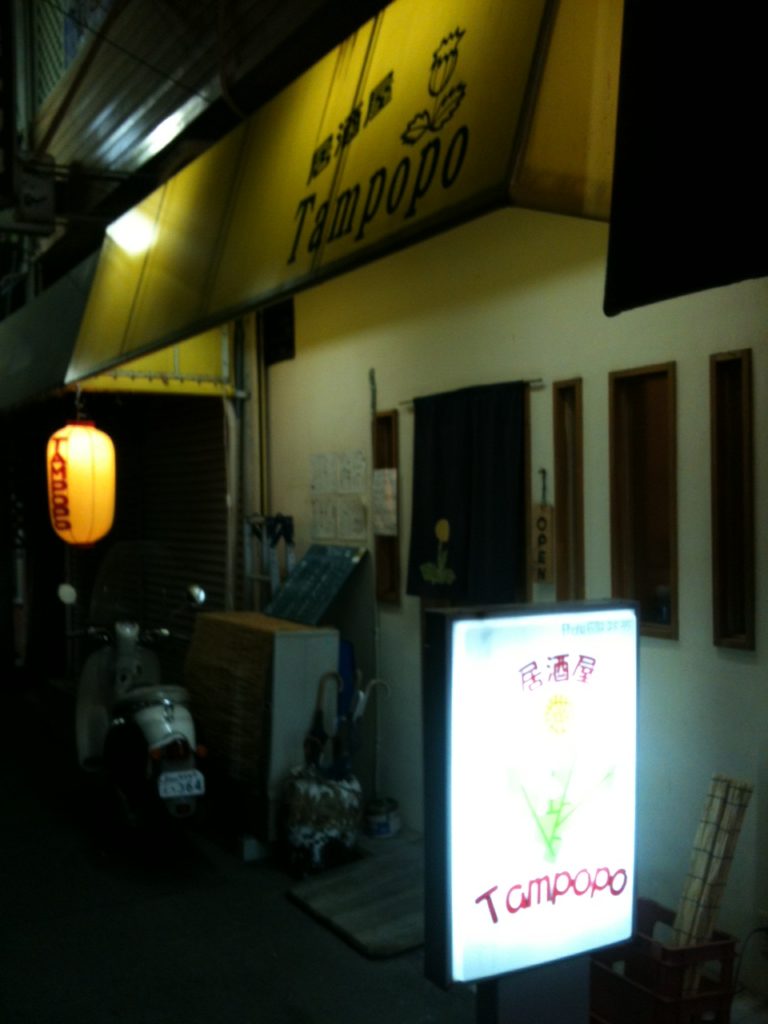
I’ve walked by the little restaurant Tampopo an obsessive number of times. On each I consider entering, but its posted menu, over half of it written in kanji I don’t know, chills me. Intellectually, I realize I could probably just walk in, play the bumbling-gaijin card, and throw myself on the mercy of the no doubt non-English-speaking owners. They would simply serve me a house specialty, or I’d point to another customer’s dish and ask to have that. “Hai, hai, wakarimasu,” I would reply to their questions, the words — “yes, yes, I understand” — I use when I have understood nothing at all. That works, though in a maximally embarrassing fashion. Then again, just as I only learn a city by getting lost in that city, I only learn a language by making mistakes. Humiliation is education. These delightful-looking holes in the wall provide me not only with a prize on which to keep my eyes during Japanese study, but a reason — one of many, and more emerge daily — to return to Osaka soon. If on my next visit I cannot stroll into Tampopo with a modicum of confidence, otoko dewanai.

(My fixation on Tampopo in particular also comes from the fact that it shares a name with the finest comedy about the Japanese relationship with food to come out of the 1980s. And with its main character. And with that character’s ramen shop.)

Rest assured, though, that I do make mistakes in Japanese. I make so many mistakes. My first few days here, I tended to begin sentences in boldly Japanese and finish them having wandered into Korean. This began with the flight attendant serving me drinks:

“Tsumetai ocha kudasai.”

“Ah! Jyozu desu!”

“Iie, iie. Nihongo dekimasen, demo… kongbu hago isseoyo.”

I spent my birthday in Hiroshima, visiting Peace Park, the Atomic Bomb Dome, and Peace Memorial Museum. (Have at it with your jokes about the incongruity of the day and its activities; my lady has long since beat you to it.) These rounds I made with my friends Yoko, Tomoko, and Misa, whom I know from Mexico City. We conduct our conversations in a mixture of Japanese and Spanish, a hybrid tongue — Spapanese? — of which I hope to become, the proud Japanese Peruvians aside, the world’s foremost speaker. At one point, Yoko rightly admonished me for leaning so heavily on Spanish instead of seizing the opportunity to practice Japanese in the very land where people speak it. As we emerged from hall after hall of melted rubble, scorched flesh, and shredded school uniforms, Yoko told me of a friend who claimed that, after this harrowing viewing experience, she couldn’t eat for three days. Summoning my flawless command of her native language, I replied. “Wow! No eating, three months?”

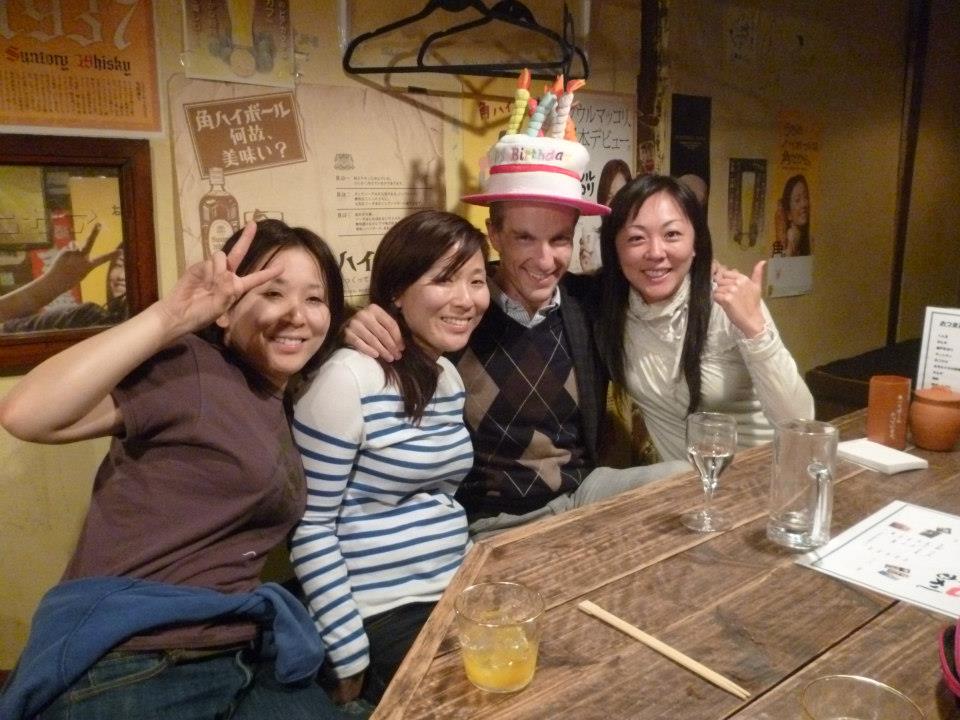
With some regret, I inform you that I could eat immediately afterward. Not only did I eat, but I ate my share of three heaping Hiroshima-style okonomiyaki, with an enormous beer on the side. We all did. My friends even snapped pictures of the meal. Every notion about the Japanese being more enthusiastic about and better at casual photography is true. Whenever a waiter set dishes before us, all three ladies would whip out their cameras as if by instinct. I tried to take a picture of this, but they proved too quick on the draw every time. As a collective Baedeker to their homeland, Yoko, Tomoko, and Misa did well indeed, even taking me to the very sort of narrow, darkened, neatly cluttered, English-free drinking establishment to which I perpetually long for entry. Nobody brought the cake hat for the occasion; the bar just happened to have it sitting atop some immaculately piled junk. It also had an absolutely state-of-the-art toilet.


[Previous diaries: Seattle 2012, Portland 2012, San Francisco 2012Mexico City 2011]

Notebook on Cities and Culture S2E18: 200% Happier with Mia Birk

Colin Marshall sits down in southeast Portland with Mia Birk, author of Joyride: Pedaling Toward a Healthier Future and President of Alta Planning + Design, which strives to make biking, walking, and mass transit an integral part of daily life. The discuss exactly how much happier he would have been riding a bicycle to the interview than riding a bus; the way Portland “got the ball rolling” for its cycling infrastructure development in the nineties; the moments of surprising hostility she found upon first pedaling down Portland streets; bicycle infrastructure as a facilitator of cooperation; how to extend enthusiasm for cycling beyond the guys in Lance Armstrong spandex to those who simply need to get somewhere; the ill effects of America’s having spent decades incentivizing driving, and exactly how European cities like Copenhagen pulled so far ahead; how she gauges the cycling in a new town, asking first to see “the good, the bad, and the ugly”; the importance of creating conditions of delight for riding in a city, and the need to re-teach the occasional public official how to use a bike before doing so; how the declared identity of a city affects the implementation of cycling within it; how she finds you can fit “a little party” into every day; and what, exactly, to do when you turn up in Portland yourself, jonesing to ride.

Download the interview from Notebook on Cities and Culture’s feed or on iTunes.

Kansai no Nikki I

At some point, I was just delaying going to Japan. Making the journey, once a faint but seemingly unrealizable desire, passed silently into inevitability. The question of Japan turned from whether to when, and from when to how often. This dual-purpose round of Notebook on Cities and Culture interview-gathering and mandatory birthday departure from the homeland, as it approached, didn’t loom as My Trip to Japan. I’ll remember it as My First Trip to Japan, certainly, and indeed My First Trip to Asia (Unlesss You Count Living in Koreatown). But even now, in the middle of it, I understand that it simply starts my lifetime count of total hours logged in Japan ticking.

“You aren’t going to get lost?” asked my mom before I left the States. On the contrary; not only would I get lost, likely several times per day, but I would make doing so my first priority. I know of no more educational way to travel than simply heading off in any direction — often directly away from my destination — and seeing how things shake out. I’ve never learned anything, not in a lasting way, while getting directly from point A to point B. Doing the opposite works best when traveling solo, or alongside an easygoing companion. Roaming back and forth between meetings in Osaka, Kyoto, Kobe, and Nara, the four major cities of western Japan’s Kansai region, I’ve made a point of turning up hours early in order to lose my way, and, ultimately, to gain a firmer grasp of place. As with geography, so with information: “Efficient search,” once tweeted Aaron Haspel, “is serendipity’s implacable enemy.”

My first impulse to enter Japan through Osaka, the country’s boisterous, Chicago-esque “second city,” came when Momus publicly pondered moving there himself:

I’ve never seriously thought about living in Osaka before. I love Tokyo best of all. But increasingly, my outlook has Berlinified, by which I mean I regard expensive cities like New York, London and Tokyo as unsuited to subculture. They’re essentially uncreative because creative people living there have to put too much of their time and effort into the meaningless hackwork which allows them to meet the city’s high rents and prices. So disciplines like graphic design and television thrive, but more interesting types of art are throttled in the cradle.

[ … ]

Despite its shabby bits, Osaka is a vastly wealthy city (if it were a country, it would be one of the world’s richest) with a vulgar commercial energy Berlin can’t begin to match. Osaka is massive, industrious and dense, and there are businesses here that cater to every imagineable human whim, and that don’t close on Sundays. And if you want to escape the density and intensity, well, the mountains of Shikoku aren’t far.

The day after my arrival, I went to visit a friend of mine who, through 25 years of tourist visas, makes his part-time home in Nara. He wisely urged me to minimize my days in the garish concrete maze of Osaka and maximize my days  amid the lightly worn yet deep history and quiet natural beauty of Kyoto. Contrarian to the core, I responded that, if I’m to spend time in the most refined and civilized country on Earth, I long to experience the height of its vulgarity. Yet I wouldn’t entirely dismiss this as my own haphazard justification. Isn’t there genuine fascination — genuine value — in concentrating on the dot of yang within the yin, the dot of yin within the yang? “The interesting lies in the in-between,” said the German-language Japanese novelist Yoko Tawada. That’s precisely why when this same friend, showing me around his thoroughly Japanese neighborhood, asked if I’d like to eat some Californian food, I jumped at the chance.

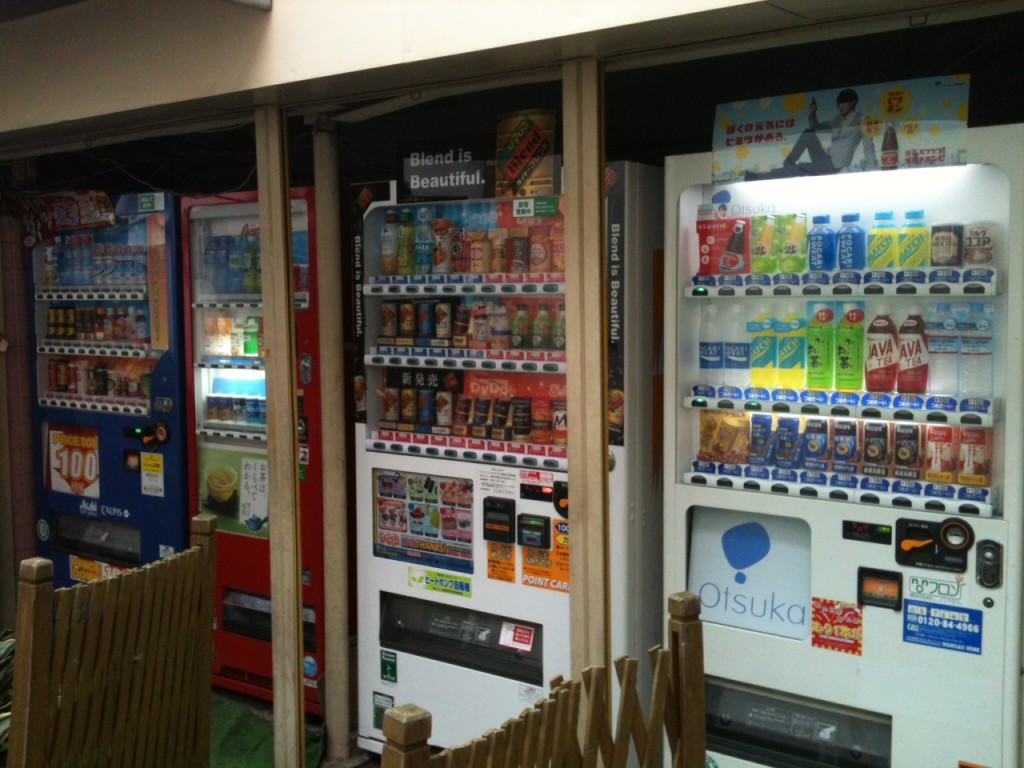
Yet even in the allegedly vulgarian, consumption-driven metropolis of Osaka — “the stomach of Japan” — a westerner can neither ignore nor escape this high civilization. From what my explorations have so far shown me, the Japanese sense of convenience penetrates everywhere and everything. Of all the countless amenities that result, I’ve grown most used to — indeed, now feel entitled to — beverage vending machines on the street. They come full of not just hot and cold coffee and tea, but cans of corn and azuki bean soup as well. I’ve quoted David Sedaris on the subject before, and now I’ll return to Momus:

Cool sugarfree green tea dispensed from machines on every corner. Why don’t we have this in the West? Because Western inequality means the streets are full of poor people who would smash the machines for the coins inside. Also, Western people like sugar, and sugarless drinks would quickly be discontinued for lack of sales. As with all these things, it’s not a question of importing Japanese technology, but of importing the Japanese mind. What’s more, while you can have a few of these things in your private home, ultimately the West cannot have them until they can exist in public space.

I landed at Itami, the older of the two large airports near Osaka, which immediately confirmed my hopes of seeing a slightly older, less polished urban Japan. Everything around me seemed to have been manufactured twenty to forty years ago. I boarded a train and thrilled at its stretches of avocado green seat fabric and wood-grained wall plastic. Yet all of it also looked and felt surreally well-maintained. Every westerner I talk to about the vending machines — and I talk to all of them about the vending machines — says a variation on the same thing: back home, people would trash those things! Nobody seems inclined to trash anything in Japan; the public trusts itself to treat the country as, well, its home. Later, I learned that the locals regard Itami as the “bad” airport, the one whose unpresentable dinginess fills them with shame.

From Itami on, every hour in Japan has presented another reason to let my face drop into my palm and mutter, back toward America, “Why can’t we have nice things?” But part of me knows full well that I couldn’t live as a unit of a population that regards itself as one big family. A public that won’t trash things is a public that, for a variety of reasons, can’t trash things. I bear no obligation from the complex, burdensome social contract that allows the Japanese clean streets, washlets, trains that show up, pedestrian bridges, subway-station bathrooms, and green-tea vending machines. Yet the society can’t stop non-participating me — the dot of yang in their yin? — from enjoying these same luxuries. Walking through the supposedly unrefined embarrassment that is Osaka, a city that has yet to show me so much as a piece of garbage, I accept that, despite Japan’s considerable expensiveness, I’m freeloading.


[Previous diaries: Seattle 2012, Portland 2012, San Francisco 2012Mexico City 2011]

Notebook on Cities and Culture S2E17: Grueling Whittling with Mike Russell

Colin Marshall sits down in northwest Portland with comic artist and film critic Mike Russell, co-host on the Cort and Fatboy podcast, creator of Culturepulp, Mr. Do and Mr. Don’t, The Sabertooth Vampire, and more. They discuss the excruciating process of drawing an interview; his adaptation of a page of David Foster Wallace’s “Up, Simba”; what it’s like to artistically live-blog the Portland Opera; the unusual robustness of the Portland comics industry, and its incentivization of “putting comics where they shouldn’t be”; his current task of drawing a comic for a set of European finance ministers; the origins of Portland podcasting, and how he became a part; how Star Wars formed at least part of his cinematic consciousness, and what it takes to grow up into an astute genre fan; the worrisome effects of nostalgia and “remix culture”; the Portland “put it out there, what the hell” attitude; Portlandia‘s proper title of Southeast Portlandia, and how Los Angeles still sees the dream of the nineties as alive in the city; Portland as an undrying source of drawable weirdness; and the quintessentially Portland sport of “hashing,” or taking runs from bar to bar, drinking beer at each.

Download the interview from Notebook on Cities and Culture’s feed or on iTunes.