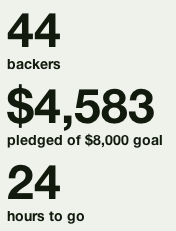
 A mere 24 hours remain in the Kickstarter drive for Notebook on Cities and Culture season four, but we still need to raise $3417 more to meet the funding goal. If we do, the show will air many more in-depth conversations with cultural creators, internationalists, and observers of the urban scene in Los Angeles, Toronto, Copenhagen, and London. If we don’t, the show will air… well, no more in-depth conversations with anyone anywhere, I suppose.
Last season, we aimed to raise $4000 to produce 24 episodes. (However, adhering to the sacred principles of underpromising and overdelivery, we produced 31.) This season, we’re aiming to produce 60 episodes, half of them recorded in three new cities, for only $8000. But the Kickstarter drive for this most ambitious season of Notebook on Cities and Culture yet ends in just a day, at noon Pacific time on Monday, June 24th. Find out how you can help make it happen on the show’s Kickstarter page. Thanks.
 The Kickstarter drive for Notebook on Cities and Culture‘s fourth and most ambitious season has, as of this writing, raised $4506. Thanks very much indeed to all who have generously backed it. If we don’t raise the remaining $3494 of the season’s budget in the next two days, the season won’t happen. (On the bright side, none of you will pay anything!) But if we do, prepare to enjoy not twenty, not thirty, but sixty full-length conversations with cultural creators, internationalists, and observers of the urban scene in Los Angeles, Toronto, Copenhagen, and London.
(And if you have any suggestions of guests you’d like to hear interviewed in those cities, by all means make them! You can reach me at colinjmarshall at gmail.)
Again, to find out how you can back Notebook on Cities and Culture‘s fourth season, and what backer rewards lay in store for you — thanks, postcards, mentions of your project or message, you as a guest — just visit the show’s Kickstarter page. The drive ends at noon Pacific time on Monday, June 24th. Thanks.

On the latest Los Angeles Review of Books podcast, I have a conversation with poet and translator David Shook about his latest collection Our Obsidian Tongues, his translation of experimental Latin American author Mario Bellatin’s Shiki Nagaoka: A Nose for Fiction, and his covert filmmaking in Equatorial Guinea. You can listen to the conversation on the LARB’s site, or download it on iTunes.
 We’ve so far raised $1655 on Kickstarter for Notebook on Cities and Culture‘s fourth and most ambitious season, but still have $6345 to go before we can make it happen. If we can raise it in the next four days, the show will indeed go not just to Los Angeles, but to Toronto, Copenhagen, and London producing a full sixty (count ’em) full-length conversations with more cultural creators, internationalists, and observers of the urban scene. If we can’t, then season four will, alas, come to zero episodes.
Find out how you can back Notebook on Cities and Culture season four, and what backer rewards you can claim — thanks, postcards, mentions of your project or message, you as a guest — on the show’s Kickstarter page. Thanks.

Should you get in the mood to read a book on public transit for nonspecialists, I unhesitatingly recommend Jarrett Walker’s “Human Transit: How Clearer Thinking About Public Transit Can Enrich Our Communities and Our Lives.” Though Portland-based, the transit consultant Walker makes many a clear observation about Los Angeles, its transit, its communities, and its lives. Toward the end of the book, he imagines the tantalizing street of one day this city’s future, which “feels more like a Parisian boulevard in many ways, including generous sidewalks, shade trees, and of course a transit lane” in which “bus and streetcar technologies have converged into a long snakelike vehicle lined with many doors, so that people can flow on and off as easily as they do on a subway,” which is “guided by optical technology” and which, “mostly transparent above waist height,” “feels like a continuation of the sidewalk.”
That day, alas, has yet to come. “I thought about the bus in Los Angeles,” narrates Richard, the hapless young Englishman in Richard Rayner’s novel “Los Angeles Without a Map.” “It was the way to travel. Once I had waited for over two hours at the corner of Sunset and Crescent Heights Boulevard when a driver with a cowboy hat and and a drawling voice like Harrison Ford decided he was sick of his job. His solution to the problem was to stop the bus and make everyone get off.” Richard goes on to tell of enraged aisle-prowlers, robberies by prepubescent thugs, and passing motorists shouting “Lo-sers, asshole losers!.” His blonde, über-Angeleno girlfriend asks him if he really likes riding the bus. “It’s democratic,” he replies. She snorts and asks whether democracy arrives on time. “‘Never had to wait more than five minutes,’ I lied.”
Read the whole thing at KCET Departures.
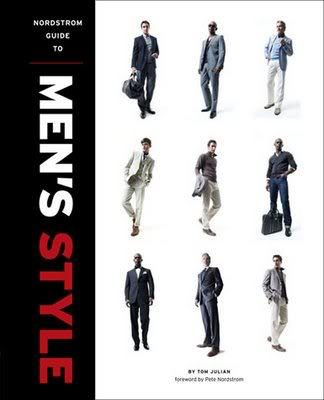 I haven’t set foot in a Nordstrom in years. Come to think of it, maybe I’ve never entered one at all. They seem expensive, and I — perhaps you, too — tend only to break out that kind of money at the most obscurely specialized of specialty shops: places with new-old-stock tie clips from sixties Japan, pocket squares made of battleship blueprints, aftershave left over from the days of Empire, that sort of thing. Certainly not old-school department stores that make me suspect my purchases will underwrite walls full of dark wood. But that caricatures unfairly a business like Nordstrom, which has provided stylistic succor to generations and generations of men in need of a wardrobe, and which I can’t imagine afflicted by the national plague — downfall of so many other men’s shops — of full-time suit salesmen who dress carelessly themselves. Though our age has seen the decline of the department store as a concept, Nordstrom appears to have retained not just its reliability, but a certain respectability as well. That merits a few points right there.
But a Nordstrom-authorized men’s style guide? Such a book seems somehow at odds with the store’s core mission, which I understand as not just clothes sales but a kind of expertise rental: the high prices buy you peace of mind through a gentle, even genteel, Jeeves-like guidance away from embarrassing choices and toward flattering ones, as well as the dark-wooded environment in which it all happens. Shouldn’t the study of men’s style books, at least as we practice it here at Put This On, obviate the need for just that kind of pricey consigliere service? But even as he passes along his lessons in this sort of expertise in the Nordstrom Guide to Men’s Style, “consumer trend expert” Tom Julian implements the countermeasure of periodically inserting the word “Nordstrom” into his sentences: “You have more than thirty sizes to select from at Nordstrom stores.” “If all this measuring sounds like a nightmare, don’t worry — every Nordstrom salesperson can do it for you.” “All four of these looks express strong, masculine style in their own way — which is quintessentially Nordstrom.”
Read the whole thing at Put This On.
The Kickstarter drive has begun! If we can raise season four’s $8000 budget by noon Pacific time on Monday, June 24th, Notebook on Cities and Culture will bring you 60 conversations with cultural creators, internationalists, and observers of the urban scene in Los Angeles, Toronto, Copenhagen, and London.
For every $200 raised above the $8000 goal, we’ll add another episode to season four’s total episode count. So if we raise $9000, for example, season four will have 65 episodes, if we raise $10000, it will have 70 episodes, and so on. Backing rewards will include:
- $15 or more: I’ll thank you by name in all of season four’s episodes.
- $30 or more: I’ll thank you by name in all of season four’s episodes and send you postcards from the cities the show visits during it.
- $50 or more: I’ll mention your own project or message at the top of one of season’s four’s episodes, in addition to everything you’d get at the previous levels.
- $300 or more: I’ll mention your own project or message at the top of all of season four’s episodes, in addition to everything you’d get at the previous levels.
- $800 or more: You’ll be the guest in one of season four’s episodes: I’ll come to you (recording locations in North America, greater London, or greater Copenhagen only) and we’ll record a conversation about the culture you create and the city you create it in, in addition to everything you’d get at the previous levels.
Find out how you can help make it all happen on Notebook on Cities and Culture season four’s Kickstarter page.

Vital stats:
Format: two publishers talking books, and much else in the cultural space besides
Episode duration: 40m-1h20m
Frequency: 1-2 per month
Checking out any new bookstore, I head immediately to its world literature shelves. That is, I see if it has them at all. It usually doesn’t. Though small, the world literature shelf at Skylight Books here in Los Angeles so impresses me that, often, I don’t leave it for the entire visit. Not that I visit much anymore; shortly after moving to town, a broadcaster friend of mine — probably the best-known non-writing figure in the Los Angeles book world — called up Skylight and recommended they hire me, using some of the most gleamingly superlatively terms with which I will ever hear myself described. When I turned up to talk to the managers, they asked if I had a car, suggesting that maybe I could drive stuff around for events. I didn’t have a car. My applications to a few other such businesses met with the indifference of the universe. I did land an interview with one noted Pasadena bookstore, which proceeded to surround me with at least a dozen other, clammier applicants — supplicants, really — each more desperate than the last, and all more desperate than me, to convince the interviewers of their single-minded dedication to customer service.
That about sums up my contact with that side of the book business, though I do spend much of my time reading about books, writing about books, and interviewing the writers of books, especially books of the international variety. Hence my interest in The Three Percent Podcast [iTunes], the audio branch of Three Percent, a site from the University of Rochester meant to provide “a destination for readers, editors, and translators interested in finding out about modern and contemporary international literature” (which constitutes three percent of the business). Podcast co-host Chad W. Post teaches at the University, runs Three Percent, and also direct’s Open Letter, the University’s own literary publishing house. They’ve put out a few cool-looking titles from the likes of Alejandro Zambra, Mathias Énard, and Marguerite Duras. Tom Roberge, the podcast’s other co-host, works as the Publicity and Marketing Director at the long-respected press New Directions, whose spine logo — a “colophon,” I think they call it — my eyes zip right toward when I scan those world-lit shelves. I trust that little stylized man and wolf. Having introduced before to writers like César Aira, Yoko Tawada, and Enrique Vila-Matas, they probably won’t steer me wrong now.
Read the whole thing at Maximum Fun.
 Colin Marshall sits down above Gastown, Vancouver, British Columbia with novelist Timothy Taylor, author of Stanley Park, Story House, and The Blue Light Project, as well as the short story collection Silent Cruise. They discuss what, exactly, Vancouver is; what, exactly, CanLit is; his being born into a nomadic lifestyle; his inadvertent prediction of the modern locavore movement; whether one can live in Vancouver without developing an interest in architecture; his fascination with creative and toxic “dyadic relationships,” as well as the place of emulation and envy in human affairs; how he discovered René Girard’s ideas about “mimetic desire” and came up with a critique of consumerism contra his countrywoman Naomi Klein; the visible desires of Vancouver and its murky, independent-minded past; our quasi-sacrificial system of celebrity; what he learned from watching reaction videos on YouTube; his moves from the navy to banking to consulting to writing; how he grew fascinated with entrepreneurs; why we haven’t eaten so well, historically, in North America; Canada’s potential as the New-Worldiest place in the New World; his search for where people gather when he visits a new city, and where he would say Vancouverites go to be Vancouverites; his disputation of tradition in Canadian literature; his next project picking up on the lives of the characters from Stanley Park; and what to open yourself up to when you come to Vancouver.
Download the interview from Notebook on Cities and Culture’s feed or on iTunes.

I’ve just appeared as a co-host on an episode of Andrew Jonhstone’s Podcast Squared. Under the banner of “Serious Podcast Talk”, we get into topics such as whether podcasting represents not the 21st-century evolution of the radio, as commonly assumed, but the 12st-century evolution of the telephone. “If you’ve ever wondered what the ideal Podcast Squared episode for new comers to listen to,” writes Andrew, ” this might just be it.”
See also my Podthought on Podcast Squared, my previous appearance on Podcast Squared, and Podcast Squared‘s review of Notebook on Cities and Culture.