Saturday, February 23, 2013

Vital stats:
Format: reading/exegesis/celebration of one sentence to one paragraph of James Joyce’s Ulysses
Episode duration: 5m-25m
Frequency: weekly
If you described the medium of podcasting to an aspirational American of sixty years ago — the kind with a complete shelf of Mortimer Adler-approved Great Books of the Western World, purchased whole — they’d imagine something like Frank Delaney’s Re: Joyce [RSS] [iTunes] as its primary use. For a time, we envisioned all forms media as potential delivery systems for read-along literary and historical lectures by learned, articulate middle-aged men, preferably from across the Atlantic. Delaney thoroughly embodies these qualities, and in fact he once received National Public Radio’s anointment as “the most eloquent man in the world.” I know because the quote appears prominently in the header of every page on his site, as it would on my own. NPR has never made a big deal of my articulateness, but if they ranked me even among the top twenty, I assume they’d grant me as much airtime as I need to say whatever I want.
This, in any case, is why Delaney will dominate America’s public airwaves once a week for the next 27 years to discuss James Joyce’s Ulysses. As least I assume he will, since my mind can’t process the notion that NPR wouldn’t see fit to commit all necessary resources to an exegesis of one of the most important novels ever written in the English language by the man they named the most eloquent in the world. Though I personally listen to the show as a podcast, my brittle value system requires me to believe that other families gather round the wireless each and every Wednesday to hear celebrated one more facet of Joyce’s linguistic, structural, and sheer Dublinistic acumen. The majority of the broadcasts only run between five and fifteen minutes, after all, which only slightly exceeds American radio’s ever-supercilicizing estimate of audience attention span. In fact, I’ve surely gotten to you far too late; you’ve no doubt already listened to every episode since the show’s inception two and a half years ago. I should instead point you to something more marginal, like Two and a Half Men. I hear it is a situation comedy.
Read the whole thing at Maximum Fun.
Thursday, February 21, 2013
 Colin Marshall sits down in Westwood, Los Angeles with Kevin Smokler, author of Practical Classics: 50 Reasons to Reread 50 Books You Haven’t Touched Since High School. They discuss what makes him think of Holden Caulfield as a Bing user; why we study novels in high school at all, and what it might have to do with Renaissance classics scholarship; how we got turned off to these books the first time around, and the radical notion that we now have time to properly absorb them; his hymn to his obnoxious teenage self, when he felt he possessed many abilities, yet none worked in concert with one another, and all lacked context; how these curricular books interact with the teenage impulse to rail at unfairness; whether Jane Austen represents the triumph of content over form or form over content; what, exactly, is the matter with The Scarlet Letter; David Foster Wallace’s notion of challenging the reader in the act of seduction; books now fashionably disliked, such as A Separate Peace; our onetime love of Dead White Males, our swing too far away from them in the early nineties, and the ambiguous DWM-relative position in which we now find ourselves; how he earned a lasting reputation at his high school for deeming Shakespeare “trite”; those moments where the necessary context for a work floods in all at once; The Day of the Locust, and how he read it only after coming to Los Angeles at 19 to supplicate before the altar of cinema; high school readers’ tendency to gravitate to the freaks and the outcasts, and whether his home city of San Francisco still welcomes such people; Rebecca Solnit’s lament over Google, and how the city’s future belongs to them rather than to the Grateful Dead; the life of a coffee-shop based San Francisco writer; and his next book, on music, which will go looking for a universal cultural experience in the particulars of his own adolescence.
Download the interview from Notebook on Cities and Culture’s feed or on iTunes.
Sunday, February 17, 2013
 Colin Marshall sits down in Santa Monica with Clive Piercy, founder and principal of design studio air-conditioned and author of the photo book Pretty Vacant, an appreciation of Los Angeles “dingbat” apartments. They discuss Reyner Banham’s enduring definition of the dingbat; his time growing up in England enamored with American culture, and his surprise to find Los Angeles existed in color; the glory of freeways and the guilt of driving them, and the sense of failed utopia they share with dingbat buildings; how dingbats crept into his Los Angeles photography jaunts, shaped by his love of Ed Ruscha’s paintings, and what happened when his fellow immigrants living in them came out to confront him; how his countryman Martin Parr perfectly captures the blandness of modern architectural wonders; his countrywoman Frances Anderton and their separate flights from the crushing burden of history; the cars parked under dingbats, and their saddening cheapness that resonates with the saddening cheapness of the home itself; inherent British negativity versus inherent American positivity; his participation in the aesthetics of eighties Los Angeles, the redesign of the Shangri-La hotel, and the newspaper coverage of the 1984 Olympics; how the mini-mall co-opted postmodernism, getting the proportions all wrong in the process; Reyner Banham Loves Los Angeles, which brought Banham and Ruscha together; Clive James and Ian Nairn’s writing on cities, which honor the high and the low together; how neither graphic design nor Los Angeles needs you, and how that’s the appeal; the current availability of all aesthetics, and his students’ tendency not to discriminate between them and focus on brands instead; and whether he’s been able to get any of these internet-savvy kids, usually from Asia and indifferent to Los Angeles, excited about dingbats.
Download the interview from Notebook on Cities and Culture’s feed or on iTunes.
Thursday, February 14, 2013

On the latest Los Angeles Review of Books podcast, I have a conversation with Eric Lax, author of books on Woody Allen, penicillin, Paul Newman, bone marrow transplantation. His new book, co-written with Robert Peter Gale M.D., is Radiation: What it Is, What You Need to Know. You can listen to the conversation on the LARB’s site, or download it on iTunes.
Wednesday, February 13, 2013
 Colin Marshall sits down in Nishinomiya, Japan with translator, writer, and former Kansai Time Out editor Christopher Stephens. They discuss whether higher Japanese skills get a foreigner more suspicion; the nearby presence and touristic effects of novelist Haruki Murakami’s elementary school; the older writers, like Yasunari Kawabata, Junichiro Tanizaki, and Yukio Mishima, who stoked his interest in Japan; the experimental music to be found in Japan, such as the work of Keiji Haino and the Boredoms, and specifically in the Kansai noise scene; the Osaka duality between money-making hard workers and underground weirdness; the local pride taken in relative roughness and unrefinement, and the stereotype of the bad Osakan; what actually distinguishes the Osaka dialect, and how entirely different words might see use in one city but not its neighbor; Japan’s visual culture, and the problematic emphasis on beauty that can ensue; his youth in Fresno, California, whose finest quality was the way it pushed him out; the time he took Wilco to an Osaka psychedelic sixties rock bar; how, when the Japanese open a psychedelic sixties rock bar, they really open a psychedelic sixties rock bar; his early struggles with regional backwardness in the eighties, and what happens when Japanese friends still ask him to hold their babies; Osaka’s high crime rate for Japan and Fresno’s high crime rate for California; whether Paris syndrome actually afflicts the Japanese; the West’s eagerness to believe everything they hear about Japan; photographer Kyoichi Tsuzuki’s purchase of the entire collection of Toba’s science-fiction erotic museum; the cannaboid substance known as “herb” that recently made the rounds in Japan; the persistence of visual art in Japan which goes well beyond Takashi Murakami, and his own specialty, the Gutai group of painters; why no Japanese person has yet appeared on this show, and what linguistic reasons might explain it; the corrections Japanese people make to his English; his work editing Kansai Time Out during the heyday of its breed of publication; Japan’s relatively robust print culture, at least by contrast to America’s; how little time translation leaves to learn new words or savor the language; and, despite the world’s having lost confidence in Japan, his theory that darkness always brings light, and that trouble sparks creativity.
Download the interview from Notebook on Cities and Culture’s feed or on iTunes.
Monday, February 11, 2013

Vital stats:
Format: poor and/or freakish writing found on the internet, then read aloud
Episode duration: ~1h, plus the occasional special short
Frequency: weekly, in theory
The internet offers more of a chance than we’ve ever had to engage with the written word and with others who share our interests. As much fruit as this development has borne, The F Plus [iTunes] [RSS] reminds us that we’re dealing with, at best, a double-edged sword. Young “digital natives” aside, most internet users never prepared themselves for a life where they’d need to write anything at all, much less their everyday communication about the things most important to them. And who among us has adequately shielded himself against the universal human temptation to settle into a set of opinions and then retreat into an unthreatening — indeed, reinforcing — echo chamber? At the intersection of these two avenues of misfortune, this podcast taps into a considerable vein of comedy: almost 120 episodes’ worth, at this point, with no signs of resource depletion.
I don’t know whether anyone has written it as a rule of the internet, but for every interest, no matter how fringe, a forum must surely exist. Indeed, the fringier the interest, and so the deeper into the margins of society its practitioners must dwell, the more likely a forum somewhere supports it. The F Plus troupe — whom, for all my listening, still often sound to me like a barely differentiated gaggle of comedic-white-guy voices — scour these fora for the most bizarre, inept, or otherwise laughable posts, then read them out loud in funny voices. Some take pains to faithfully pronounce standard tics and errors — “LOL” becomes “lawl,” an apostrophe-less “I’m” becomes “im” — but that merely pours into the show’s abundant stream of cheap laughs. The deeper, more troubling humor, the kind that gives you as much of a pause as it does a chuckle, comes partially rooted in good old they-walk-among-us fear.
Read the whole thing at Maximum Fun.
 Colin Marshall sits down overlooking greater Kyoto on Mt. Ogura with Stephen Gill, poet, BBC radio scriptwriter, and executive director of People Together for Mt. Ogura. They discuss the mountain’s place in a traditional Japanese poetry card game; how, after scores of Japanese noticed in it an opportunity for free trash disposal, the mountain generated the headline “Ogurayama, gomi no yama” (Mt. Ogura, Mountain of Trash); the compilation of a collection about Mt. Ogura featuring verse by one hundred different poets; the onset of sightseeing season, which mostly brings visitors to the neighboring Mt. Arashiyama; the rich literary heritage of this now-suburban area, which even offers real locations from The Tale of Genji; the modern development of Kyoto, whose tower blocks at least cast into relief its more historical elements in the “glorious chaos” mixture well known to Asia; his three stretches in Japan, and the constant visits to the doctor his early acclimatization required; how he makes radio programs about Japan, always beginning with an image and then crafting a broadcast around it; how he only learned about his native Britain by living abroad, and what a foreign poet can offer Japan by way of a helpful thorn in the side; his view of Kyoto as a vast intermeshing of systems, which once there tend to last a hundred, or even five hundred years; what could possibly “shake up” Kyoto short of actual destruction; and what it means for him to “tune in” to a place like this. He also reads haiku poems, both his own and those by other People Together for Mt. Ogura participants.
Download the interview from Notebook on Cities and Culture’s feed or on iTunes.
Tuesday, February 5, 2013
 About Queer Eye for the Straight Guy, Bravo’s hit reality program that ran from 2003 to 2007, you may recall exactly one thing: that despite their presentation as paragons of taste, none of the “Fab Five” dressed with much of it. Or, more charitably, they seldom displayed what a Put This On reader might value. “The kind of dress,” as Will Boehlke of A Suitable Wardrobe once put it, “that the eye passes over, only to return in appreciation.” But to object is to misunderstand the show’s central joke — its practical joke, really — of dropping a squadron of homosexual style consultants, playing up all applicable stereotypes at every chance, on schlub after heterosexual schlub. Though you wouldn’t necessarily covet his wardrobe, I always appreciated the sartorial inconspicuousness of Ted Allen, the team’s food-and-wine man, whose patient, mild manner offered these shaken straights a port in the storm of insistent fabulousness. But the laws of casting dictate that every such sober yin must balance a raging yang. Enter Carson Kressley, clothing specialist, “fashion savant,” and author of Off the Cuff: The Essential Style Guide for Men and the Women Who Love Them (also known asOff the Cuff: The Guy’s Guide to Looking Good.)
Should future cultural historians harshly re-evaluate Queer Eye as the minstrel show of our day, they’ll hold up Kressley’s performance as Exhibit A. Ablaze with bright colors and camera-distracting accessories, the man could, seemingly on cue, turn on a firehose of groanworthy sexual innuendo and witheringly sarcastic critique. If you never watched the show, you’ll find him insufferable already; if you did, you’ll understand that he nevertheless emerged as the most appealing character of many an episode. He somehow inspired the confidence, beneath all the theatrics, that he really did know his stuff. You wanted him in your corner. Cut to your core though his choice words about your shirts may, you knew he would sooner die than fail to find you better ones. Fans still argue, in comments below the broadcasts that have made it to YouTube, about whether the Fab Five truly left any given straight better off in the time-consuming food, complicated decor, or nebulous cultural departments, but at least Kressley always seemed to leave them more respectably clothed than he found them.
Read the whole thing at Put This On.
 Colin Marshall sits down in Los Angeles’ Koreatown with filmmaker Rob Montz, director of Juche Strong, a short documentary about North Korea and its propaganda. They discuss reaching the same age as Kim Jong-un without a hermit kingdom to rule; the question of why North Koreans continue to believe in their state, despite having good reason not to; his early fascination with North Korea’s World Cup showing, and how pursuing that fascination led him from standard opinions on the country to newer, more interesting ones; his realization that North Korean ideology comes built upon the same basic structures of psychological truth that any of us have; his interviewing of experts on North Korea, and their disagreements about the nature of the Juche idea; his trip to Pyongyang, and how it didn’t require him to hide underwater from North Korean commandos, breathing through a reed; the state’s aspirations to totalitarian watchfulness, and how incompetence shatters that image right at the airport; the boredom a visitor to North Korea endures, and how that boredom differs from the boredom we experience in the developed world, where we’ve mostly cured it; the nihilism that sets upon a mind deprived of the ability to autonomously create meaning and provide purpose; how life in the constant American stimulation stream may render you more vulnerable to boredom when you momentarily step out of it; how many pleasures a people will willingly forego if they’re given a larger sense of purpose and community, and how we know the North Korean government knows this; what North and South Korea still have ideologically in common, though the South chose the means of ideological expression that let its people get fed; Confucian values on both sides of the DMZ, and how they even manifest in the strange filial piety of East Asian friends; his extension of the examination of North Korean-style propaganda to United States politics, and especially the ceaseless repetition of the phrase “God bless America” therein; of Washington, D.C., where homosexual atheist political operatives instruct Republican politicians to insist upon the divine ordainment of American exceptionalism an inveigh against the “gay menace”; and how you can help fund the completion of Juche Strong on Indie Go Go (not to mention the clam-roasting footage you can get for doing so).
Download the interview from Notebook on Cities and Culture’s feed or on iTunes.
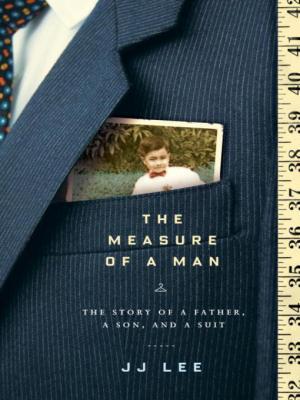 The Measure of a Man: The Story of a Father, a Son, and a Suit presents us with an unusual form: the menswear memoir. It offers not the story of a life in the male garment trade, nor of a long career spent cutting and sewing. Nevertheless, it does contain a fair bit of material — pun only faintly intended — about developing a discerning sartorial eye, and about learning how to stitch a proper seam. Chinese-Canadian author JJ Lee made his name as a style writer and radio broadcaster, and only then, in his late thirties, did he begin studying at the feet of a master tailor. This in itself could make for a knocked-off entertainment freighted with a deadening subtitle like How a Mid-Life Apprenticeship Taught Me Everything I Needed to Know About Life, Love, and Lapels. But Lee elevates his work beyond such fluff by braiding in two other narratives: a history of the modern tailored suit, and the quick rise and prolonged, agonizing fall of his once well-turned out, aspirational, driven young father.