Skip to content

Notebook on Cities and Culture S1E11: How Serious Are You? with Megan Ganz

Colin Marshall sits down in Larchmont with comedy writer Megan Ganz, who’s written for the Onion and Important Things with Demetri Martin, and now writes for NBC’s Community. They talk about easing her transition from New York to Los Angeles with the Coen Brothers’ Barton Fink; Los Angeles as an unfurnished apartment to New York as a furnished one; her fond memories of aimless subway trips; what we don’t know about growing up in Michigan, especially regarding the preparation of vegetables and local pride in Tim Allen; the Onion as something to aspire to in adolescence; the best comedy’s tendency to happen naturally, without being in on its own jokes; what one would get wrong by assuming Community, the “show that can get away with anything,” represents a model of sitcoms today; her use of the voices of various characters and institutions rather than he own; the comedy gold to be mined from misalignments between tone and content; community college-going as a hobby; and the lingering question that hangs over certain people, places, and operations: “How serious are you?”

Download the interview from Notebook on Cities and Culture’s feed here or on iTunes here.

Podthoughts: Dave Hill’s Podcasting Incident


Vital stats:
Format: Dave Hill talking to comedians and other people he knows, bracketed by Dave Hill talking (or shredding)
Episode duration: 45m-2h
Frequency: one or two per month

I feel the time has nearly come to define a new genre of podcasting: comedians interviewing their friends and, if they seem entertaining enough, their acquaintances and friends-of-friends. Marc Maron’s Los Angeles-based WTF became a notable early example of this, though he’s found even more success by widening his mandate to include people he doesn’t much like or simply has a curiosity about. More recently, Pete Holmes gave the idea his own peculiar spin with You Made It Weird, and Julie Klausner’s How Was Your Week transplanted it into rich New York City soil. A couple years back, comedian Dave Hill launched a similar project from his own NYC base: Dave Hill’s Podcasting Incident [RSS] [iTunes].

Then again, “comedian” doesn’t quite cover it. The man also writes articles, contributes to This American Life, and plays guitar or bass in a bunch of current, former, and semi-fictional bands. He also maintains a faintly Wildean personal style, on display when he hit fashion week as a correspondent for Put This On. Hill, in other words, has made himself into a man of many skills. This would have gotten him all kinds of traction in, say, the eighteenth or nineteenth century, but in our debased modern era, this sort of thing seems to drain one’s notoriety rather than boost it. But I suspect this very range has allowed him to cultivate such a striking podcast guest list: accompanying the comedians like Tig Notaro [MP3] or Rob Delaney [MP3], we’ve got New Yorker writer Malcolm Gladwell [MP3], no-longer-uptight (so he claims) musician Moby [MP3], and charter Culture Club member Boy George [MP3]. See a mix of names like those, and you more or less have to download a few episodes, just to hear what could possibly be going on.


Read the whole thing at maximumfun.org.

Notebook on Cities and Culture S1E10: A Roomful of Strangers with Wade Major

Colin Marshall sits down in Santa Monica with Wade Major, senior film critic at Boxoffice, co-host of IGN’s Digigods, and regular participant on KPCC’s Filmweek. They discuss what Sucker Punch represents the coagulation of; whether it is a greater crime for Zack Snyder to make Zack Snyder movies sincerely, or for Zack Snyder to make Zack Snyder movies cynically; the importance of spontaneity, not formula, to creative business; the simultaneous democratization of criticism and of filmmaking itself; the world he emerged out of film school into; his father’s career in silent pictures; the philosophical differences between the film schools at USC, UCLA, and CalArts; the possibilities of a new business model for criticism meant to be read after seeing the movie; Pauline Kael’s conception of criticism as a means of keeping filmmakers honest; bigtime directors’ assumptions that they can’t make films about their real passions; The Artist as it taps into both filmmakers’ and critics’ fears of getting left behind; how without taste, you’ve lost; feeding off the energy of a roomful of strangers in actual theatrical screenings, and learning something about yourself at the same time; the “dysfunctional family” that is the Los Angeles Film Critics Association; the critic’s mandate to move film into a larger cultural context; and the director’s mandate to get out into the world and live before ever shooting a frame.

Download the interview from Notebook on Cities and Culture’s feed here or on iTunes here.

(Photo: Kristi Lake)

Notebook on Cities and Culture S1E9: Suggested User with Alison Agosti

Colin Marshall sits down in Los Feliz with comedy writer, baseball reporter, and Twitter “suggested user” Alison Agosti. They discuss the preferred pronunciation of “Los Feliz”; Rancho Cucamonga’s chief industry of teenage pregnancy; how Los Angeles looked while she was growing up in the Inland Empire; the promise of New York as a land of letters, art, and coats; her mass childhood purchase of used Woody Allen tapes, including but not limited to Husbands and Wives; the morning she woke up to 1500 e-mails from Twitter in her inbox; her realization that comedy writing could count as a job; what it takes to get on a Maude team; her struggle to coming up with new ways to write “hit the ball” or to present a narrative in a 2-1 game against the Diamondbacks; her music blog Headphones In; finding humor in the complicated, as unworkable as it can end up in a sketch; raking in the Twitter stars by mentioning eating something weird by yourself; her weariness of apologizing for Los Angeles, a city that doesn’t work against you except when you can’t find parking; Venice, either the “weirder” or “non-shitty” Santa Monica; how we only children who refuse to network or compete can explain ourselves to actual grown-ups; the appeal of the intelligent, loud, brilliant but unself-aware Woody Allen-type character; what she likes to satirize in herself; playing (but not beating) Ecco the Dolphin on the Sega Genesis; and “the woman-in comedy thing,” which turns out not to be a thing at all.

Download the interview from Notebook on Cities and Culture’s feed here or on iTunes here.

(Photo: Philip Eierund)

Little Tokyo Historical Society: Los Angeles’s Little Tokyo

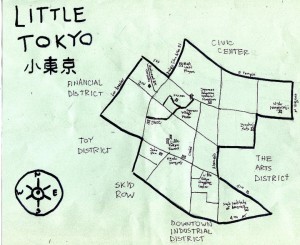
Only natural, I figure, to go from the Images of America book on where I live in Los Angeles to the Images of America book on a neighborhood that first fired up my interest in Los Angeles. Before I moved, visits to Little Tokyo underscored Santa Barbara’s failure to provide certain necessities: ramen shops, sit-down arcade machines, Kinokuniya, fresh-griddled imagawayaki, 1-Man Band Arthur Nakane. After I moved, I would often ride the subway to Little Tokyo in the mornings just to eat snacks and explore. Some Los Angeles visitors might ask what there is to explore, given that, even at its height, Little Tokyo covered not much more than a square mile. I reply that the neighborhood’s tininess and the distance from its boom years make it a richer experience, not a poorer one. As I wrote about the view from Cafe Dulce, a Little Tokyo coffee shop I frequent, you sit below the hotels Miyako and Kyoto Grand, those aging hulks of near-colonial seventies and eighties Japanese prosperity, you defocus your eyes a little, and you almost feel like that Bubble never burst.

A friend once asked me what I’d change about Little Tokyo. “Nothing,” I replied. He followed up, incredulous: “So you think it’s perfect?” Well… certainly not, but better to live amid distinctive imperfection than perfection, am I right? This makes intuitive sense to me, but I remain unsure quite how to explain it. I suppose it fits in with that whole notion of wabi-sabi — the appreciation of beauty in the imperfect, impermanent, and incomplete — which, in this context, at least has the credibility of coming from Japan. As in Little Tokyo, so in greater Los Angeles: an interviewee once observed that, looking at the city, you often can’t tell whether it’s coming up or falling down. To get the most out of either the larger or the smaller place, you must appreciate that ambiguity in itself. You must also lay down enough shoe leather to get closely acquainted with the streets. To know Los Angeles or Little Tokyo is not necessarily to love them, but if you don’t know them, you won’t even stand a fighting chance of liking them.
It helped that, before even moving to California, I’d logged years of listening to Hiroshima, the Japanese-American jazz-funk band known for their allegiance to Los Angeles in general and Little Tokyo in particular. They named their eighth album after the city, and their fourteenth after the neighborhood. At least every couple weeks, I drop the needle on their second album Odori (featuring a piece of cover photography, shot on a downtown Los Angeles rooftop, which still ranks among the most strangely compelling I’ve seen) and hear it begin with a number called “Cruisin’ J-Town.” J-Town is another name for Little Tokyo, and Cruisin’ J-Town is also a short documentary about the band; I recently caught a screening, totally by accident, when volunteering at a Sunday-afternoon Filmforum show. Hiroshima also put out a ninja-themed music video for their 1983 song “San Say,” parts of which look to have been shot in or near Little Tokyo.

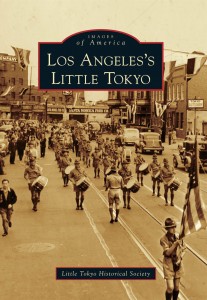
A group photo of Hiroshima in front of a well-known Little Tokyo mural appears in Los Angeles’s Little Tokyo, as does one of a lady at the Mitsuru Café making the aforementioned imagawayaki. Those aside, the book actually depicts fairly few of what I would consider the pleasures of Little Tokyo, focusing instead on the ever-shifting social order that made and remade the neighborhood. Some sort of housing discrimination pushed the first wave of Japanese immigration in the late 19th century toward this particular corner of downtown, and when post-Pearl Harbor internment cleared the place out, Little Tokyo briefly became a black neighborhood called Bronzeville; I hear Orson Welles loved to hit the jazz clubs that sprouted along Central Avenue. Despite the local government’s strongest efforts to avoid the reformation of “ethnic enclaves,” Little Tokyo went Japanese again after the war. A great deal of investment rode in on the crest of that high wave Japan set off in the late seventies, creating elements of that still define the neighborhood’s built environment, like the blue-roofed Japanese Village Plaza (which houses the likes of Mitsuru Café, Cafe Dulce, and, usually, Arthur Nakane) and the New Otani Hotel, which would become the Kyoto Grand in 2007 (and inside of which, so I’ve heard, it remains 1987).

Given how heavily Los Angeles’s Koreatown leaned on group pictures of Korean and Korean-American churches, sports teams, social clubs, it comes as no surprise that Los Angeles’s Little Tokyo triples down on that sort of thing. Little Tokyo’s history stretches further back in time than Koreatown’s, and thus it stretches further into the era when, to warrant something as flamboyantly high-tech as a photograph, you really needed to assemble at least a dozen people, all in their Sunday best. Not being much of a historian, I know little about how to read these photos for significant, non-menswear-related information. Luckily, a photographer by the name of Tōyō Miyatake roamed Little Tokyo in the early 20th century, beret on head and camera in hand, capturing the look and feel of his corner of Los Angeles even when on wedding detail. Such dedication did he cultivate for his craft that, when he got shipped off to Manzanar, he actually secreted his gear in with him and shot internment camp life. Something about the idea of a tireless, faintly eccentric, ever-recognizable documenter of place very much appeals to me. Does Little Tokyo still have them? Does any place? And assuming the oft-told story of the California roll being invented in Little Tokyo is true — there’s the day that will really live in infamy — did Miyatake capture it?
Notebook on Cities and Culture S1E8: Can We Talk About Driving? with John Rabe

Colin Marshall sits down in the Los Angeles Central Library’s courtyard with John Rabe, host of Off-Ramp, KPCC’s weekend pointillist portrait of Southern California. They discuss the merits of recording in a library courtyard and in Cheech Marin’s house in Malibu; picking a road in Los Angeles and following it wherever it goes; the troubled history of Cypress Park and the truth about the Isabel Street shooting; the Los Angeles “churn” and the effect of constant neighborhood change on the historical consciousness; the historical bounty to be found in the Los Angeles Public Library’s photo collection; the city’s rising optimism and falling crime (and its lack of a mob); the McMartin preschool trial; his desire to live in a place with the word “gardens” in its name; his tendency to look ahead, not back, and to move randomly, not in patterns, and how that shapes Off-Ramp‘s character; his anger at drivers who slow down on the freeway with their brakes; his plan to banish citizens who break the social contract and institute a Waste and Fraud Corruption Lottery to give money to the rest; the lessons of Carmageddon; what makes radio documentaries sustain; and how, if you want to create radio, you should just break out your iPhone (or whatever you have) and record something.

Download the interview from Notebook on Cities and Culture’s feed here or on iTunes here.

(Photo: Karl Rabe)

Notebook on Cities and Culture S1E7: Geographical Verisimilitude with David Bax

Colin Marshall sits down in North Hollywood with film and television critic David Bax, co-host of the podcasts Battleship Pretension and Previously On. They discuss his fifth-grade shoving match over Ghostbusters; the difference between criticism and the assertion of one’s opinions; being a film and television critic while living right near the heart of film and television production; Chicago’s advantages as a filmgoing city, including but not limited to the Gene Siskel Film Center; discovering a cinephile community on the bus; St. Louis and other cities’ loss of local critics writing with local sensibilities; whether the aspiring critic must first reject working in production; the sharpening of his critical perspectives on formalism and structuralism as revealed by Michael Mann’s Public Enemies; if a critic should tell an audience why they like a film, why the audience should like a film, why the audience should pay attention to a film, or simply how a film works; why the internet offers a superior medium for television criticism; what television can do that film can’t, and why to watch them differently; whether television shows labor under a corrupting business model; Treme, New Orleans and geographical verisimilitude; the askew real-placeness of many Los Angeles productions; the outdated marketing of television as evidenced by the Whitney billboards that once littered town; how and why to avoid approaching art as commodity; what he would say to those who who don’t consider criticism a “real job” (and how he would agree with them); and the necessity of discussing film and television as if for posterity, just as a program like The Sopranos seems to have been created for it.

Download the interview from Notebook on Cities and Culture’s feed here or on iTunes here.

(Photo: Jenny Smith)

Put This On menswear books: Alan Flusser’s Dressing the Man

My series of menswear-related book reviews for Put This On (see also my Marketplace of Ideas interview about PTO with Jesse Thorn and Adam Lisagor) debuts today with a writeup of Alan Flusser’s Dressing the Man:

If I didn’t know the name Alan Flusser, I’d still trust Dressing the Man by virtue of heft alone. Its size, shape, and weight could deal serious damage, although those cumbersome qualities keep me from carrying it around to test in a street fight, and even if I could easily carry it around, would I? I don’t mind learning how to dress in public — we always have to, in some sense — but it feels somehow inappropriate to reading a big, shiny book on how to dress in public. Then gain, if you’re going to learn how to dress that way, make it with a big, shiny book by a guy like Flusser, who dressed Michael Douglas for Wall Street and, more importantly, appeared in the sixth episode of Put This On’s first season (as well as an interview minisode).
But does this one rise above its closest-looking relative in publishing, the coffee-table book? All the lush, often page-filling photography of the Fred Astaire, the Duke of Windsor, and Luciano Barbera, not to mention the jaunty vintage illustrations, makes you wonder. After so many school years of bloated, distraction-laden textbooks, my alarms sound at the sight of splashy chapter-opening spreads, fonts a little too large, lines set a little too far apart, or boxes which may or may not enclose information. The aesthetics of Dressing the Man outshine most educational publishers’ strongest design efforts, but a confusion of purpose remains: is this an analysis of the best men have worn, or a primer for those who need to know how a shirt works? Reaching for both audiences, the book generates a certain friction: experienced dressers will wonder why they’re opening fold-out sections showing which fabrics are which, while learners like myself will, buoyed by how nifty they find those fold-outs, proceed to mire themselves in a discussion of dinner jacket trousers versus full-dress trousers. (Something to do with stripes.) Flusser includes a glossary to help us find our way home, deepen the feeling of textbookishness though it may.

Hence my suggestion that the next edition be titled something like Permanent Fashion: Theory and Practice. Flusser introduces this concept, which should ring familiar to longtime Put This On followers, with an explanation born of a paradox. “Menswear has enjoyed three decades of unprecedented growth and freedom to configure and reconfigure the sartorial tastes of several generations,” he writes, “yet there are fewer genuinely well-dressed men now than before. There has been nothing permanent about recent fashion.” He roots his proposed alternative as deeply as possible in the era between the World Wars, noting that, despite the “considerable economic tumult for America,” this time produced, regardless of wealth or class, “the best-dressed generation in the twentieth century.” This opens the door to 21st-century man’s standard objection: he fears looking like an octogenarian on his way to a costume party. But the book’s images seem curated to dispel just these reservations; who, even today, would laugh a Douglas Fairbanks, Jr. or a Leslie Howard out of the room? (Even the Howard wearing an unflatteringly narrow collar in a photo Flusser uses as a negative example commands respect.)

Read the whole thing at putthison.com.

(And hey, do any of you Tumblr people know how to add HSPACE and/or VSPACE to an image you upload into a Tumblr post? I’ve tried inserting the code directly into the HTML, but it doesn’t take.)

Podthoughts: How Did This Get Made?


Vital stats:
Format: discussion of the various unbelievabilities of non-respected movies with comedians — and sometimes the filmmakers themselves
Episode duration: 35m-1h30m
Frequency: biweekly (with previews on the weeks between)

When I grew old enough to watch, I began watching films. When I grew old enough to read, I began reading film criticism. I’ve never slowed in either pursuit, but only lately have I realized that I don’t care if a movie is “good” or “bad.” By that I mean not only that it doesn’t matter to me if a critic, even one I read religiously, thinks a movie is good or bad — I figured that out first — but that it doesn’t matter to me if I think a movie is good or bad. We build no more rickety structures than opinions, instinctively slapping them together in the heat of the moment on foundations of shifting sand. Thumbing a picture up or down may make for a satisfying declaration of self — “I feel this way about this movie, and moreover, I exist!” — but I need to hear more. I long to discuss film as an experience, not as a mere object of acceptance or rejection — and I suspect, on some level, that you do too.

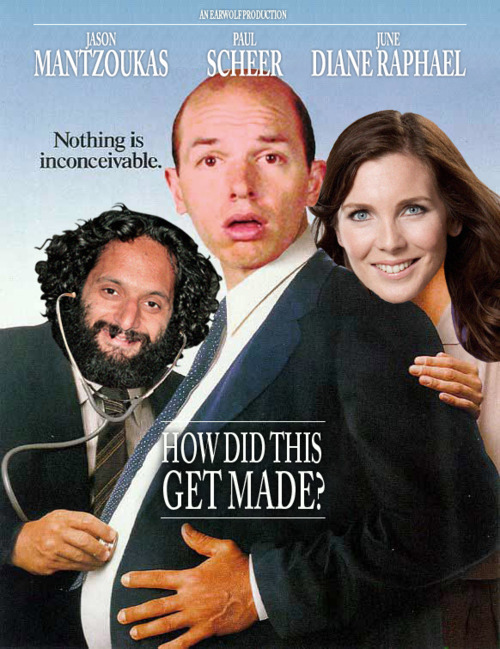
How Did This Get Made? [RSS] [iTunes] keys into that desire, though it doesn’t announce its mission in quite those words. “Have you ever watched a movie so terrible, so unwatchable, that it actually is amazing?” its iTunes description asks. Admittedly, that question alone hardly gets my blood flowing; I felt forced long ago to, in the manner of Dave Erdman, abandon enthusiasm for the intellectual and aesthetic dead end of the so-bad-it’s-good. But I didn’t replace it with undivided pursuit of “the good,” since, when I try to get my mind around it to define it, the concept disperses like smoke. I began to conceive of all cinema as a circle, with the movies people call “good” and the movies people call “bad” meeting at one particularly fascinating point. I downloaded a slew of this podcast’s episodes when I heard Patton Oswalt, in a guest appearance on How Was Your Week?, tell Julie Klausner that its crew doesn’t just bitch and moan about movies they don’t like; they treat their widely reviled subjects as sources of interestingness equal to their most respected brethren.

This crew, by the way, comprises comedians Paul Scheer, June Diane Raphael, and Jason Mantzoukas (who, we are often told, is not on Twitter). They watch recent and recent-ish releases like Sucker Punch, Gigli, and Battlefield Earth, movies whose box-office performances vary but around all of whom the stink of failure hangs heavily. They sometimes discuss them with comedy-type guests like Matt Walsh [MP3], Paul Rust [MP3], and Maximum Fun’s own Jordan Morris [MP3]. In a series of clever coups for a show not about to dole out praise, they occasionally bring in guests involved in the production of the fortnight’s film, like Greg Sestero, co-star and jack-of-all-trades on Tommy Wiseau’s immortal The Room [MP3] or — wait for it — the star of Cool as Ice, the one and only Vanilla Ice [MP3]. (For the last fifteen minutes of the episode, anyway.)

Read the whole thing at Maximumfun.org.

Notebook on Cities and Culture S1E6: Discernment with Tyler Smith

Colin Marshall sits down in North Hollywood at midnight with film critic Tyler Smith, co-host of the podcast Battleship Pretension and host of the podcast More than One Lesson. They discuss the strong associations between diners late at night and talk about movies; his struggle to stay in Chicago and ultimate move to Los Angeles; his choice between screenwriting and film criticism; film criticism’s relationship with the kinds of conversations film geeks have; the impulse to start a podcast, and what it took to understand what makes a fascinating film discussion; how to talk to comedians about film, even if they claim not to care about the medium; his return to his old church in Nixa, Missouri to give a lecture about the film industry in Los Angeles; the concept of discernment not just in criticism, but in Christianity; the power and influence some Christian ideas about film ascribe purely to content; Fight Club and the attitude pictures hold to their own content; whether film reflects the personality of its creators or possesses one of its own; and how much one wants to get to know the personality behind a film when that personality happens to be, say, Orson Welles’.

Download the interview from Notebook on Cities and Culture’s feed here or on iTunes here.