Skip to content

Podthoughts: The Subaltern


Vital stats:
Format: one young writer interviewing others
Episode duration: 30-50m
Frequency: weekly, in series of ten episodes

If you’ve passed through an institution of higher learning in the last twenty years, you twitch, almost imperceptibly, when you hear a word like “subaltern.” You do the same when upon hearing the terms “hegemony,” “rearticulation,” or “(dis)loc[a/u]tion.” You twitch because you remember feeling plunged into insoluble confusion, right where you sat in the lecture hall: you didn’t know whether to believe your professor was feeding you these whole verbal grapefruits in the good-faith service of important points, or whether they were just screwing with you. Maybe, as certain high-profile academics argue, their complicated arguments could only find honest expression in a vocabulary whose very comprehension demanded a mental struggle. But maybe, having themselves started out as wide-eyed undergraduates with an unquenchable love for novels or a pang in their hearts over the world’s injustices, these professors ultimately found themselves marooned in an academic hellscape of fear, insecurity, and obfuscatory self-justification. Maybe they knew only one way to rattle the bars of their cage: to make you share their painful bewilderment.

Imagine my relief, then, to find that The Subaltern Podcast [RSS] [iTunes] comes not from a haunted-eyed lecturer but from a hard-tweeting novelist. This novelist, a certain Nikesh Shukla, seems to have written a book called Coconut Unlimited, about some young British Indians who form a collectively inept hip-hop trio. I would like to read this book, just as I would like to read the many hundreds of other books that new writers all over the Anglosphere (and, in translation, beyond) are putting out as we speak. But how to choose where to begin? Even the most dedicated readers suffer under the burden of many, many thousands of exciting novels they could never hope to live long enough to crack, and that doesn’t even include the countless undoubtedly brilliant ones to be published over the rest of their lifetimes. This problem surely weighs even heavier on Shukla and his Subaltern interviewees, all reasonably young writers who must compete against every novel ever written for vanishingly scarce readerly attention.

Read the whole thing at maximumfun.org.

Me on Battleship Pretension: a three-hour course on the nineties’ “Indiewood” movement

The latest episode of the film podcast Battleship Pretension [RSS, iTunes] features yours truly on the third mic, discussing the history of the “Indiewood” movement in the United States. If you’ve personally experienced any important chapter in the history of American independent film, you’ve experienced this one: it saw the combined forces of the Sundance Film Festival, Miramax Films, and an energetic pack of young (or young-ish) Gen-X (or Gen-X-ish) filmmakers release a storm of creativity into the mainstream U.S. zeitgeist, the likes of which it hadn’t seen since the “New Hollywood” of the seventies. Quentin Tarantino, Kevin Smith, Robert Rodriguez, Steven Soderbergh, Wes Anderson, Paul Thomas Anderson — like these guys’ work or not, you can’t help but get drawn in by how they made it, how it pulled them into the public consciousness, and how they rode the wave even as it broke.

And if you happened to come of age as a filmmaker or cinephile in the nineties, you couldn’t help but draw inspiration from all these Indiewood directors’ nearly budgetless but always exhilarating first features. After a bit of discussion about, of course, travel in New Zealand, Tyler, David, and I work our way through a history of Indiewood through a selection of these debut films:

Alas, as my research revealed to me, any guide like this is doomed to incompleteness. Where, you might ask, has Tom DiCillo gone? Vincent Gallo? Allison Anders?  Alexandre Rockwell? We do touch on a couple of them, and our discussion does reach a few disputed members of the movement like David Fincher, Sofia Coppola, Michael Moore, and “honorary Americans” Christopher Nolan and Danny Boyle, but yes, the overlooked approach numberlessness.

So I encourage you, dear readers and listeners, to chart your own path through Indiewood. You can get a detailed lay of the land from the following five books, available from retailers and friendly local libraries everywhere:

Y’know, I feel like we might’ve given Hal Hartley the short shrift. I should go back on to talk about Hal Hartley for three more hours.

* * *

My other guest appearances:

Notebook on Cities and Culture S1E15: Your Own Pimp and Your Own Whore with Molly McAleer

Colin Marshall walks through Larchmont with Molly McAleer, co-founder of HelloGiggles and writer for CBS’ Two Broke Girls. They discuss the definition of internet fame, especially when one’s internet debut comes in a photo funneling a beer; whether moving to Los Angeles after graduating from the disappointingly party-free Boston College counts as a betrayal of Boston; her avoidance of the label “humorist,” and thus any association with Mark Twain; her time at Defamer, which gave her a “magical” view of Los Angeles, and what she’d say to those who accuse it and every other Gawker site of hastening the decline of western civilization; joining Two Broke Girls at the height of the Whitney Cummings boom; Koreatown, her point of entry into Los Angeles after having lived in a frat house with 32 dudes; aging a thousand years after spending six in Los Angeles; how much of a discount on nail polish counts as a deep discount on nail polish; her struggle to be as popular with her friends as her mom; the resurgence of press-on nails; experiencing utter brokeness in Los Angeles, and getting banned from using Google ads when those friends tried to help her out; cookies aside, the reduced presence of the Girl Scouts, except in cases of high-profile transsexual trouble; her resistance to driving, and her feeling that some people are meant to drive, while others are meant to be driven; the basic tasks of life that somehow never get taught; manicures as the last bastion of personal maintenance; and how hard it is to avoid humblebragging when The Wonder Years‘ Fred Savage directs your script.

Download the interview from Notebook on Cities and Culture’s feed here or on iTunes here.

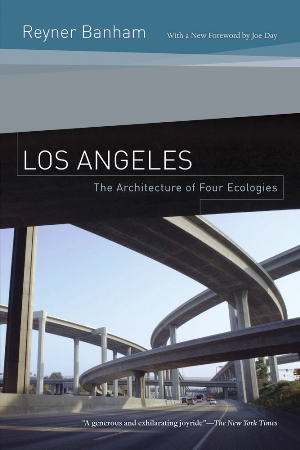
Reyner Banham: Los Angeles: The Architecture of Four Ecologies

The Livejournalist formerly known as Cobalt999 came to visit Los Angeles last week, and before he arrived, I thought I’d link him up to a few items on the web to prepare him for the city. Combing through my bookmarks got me thinking about what I’d include in a more general internet-based Los Angeles primer. Food critic Jonathan Gold’s personal history of Koreatown (“the fire escapes now were blanketed with cabbage leaves in the fall, clotheslines (like mine) bristled with drying fish, the silence of dawn punctuated with the steady, rhythmic pounding of garlic in wooden mortars”) delivers a brief and eloquent introduction to my particular neighborhood. Public transit blogger Jarrett Walker’s post “Los Angeles: The Next Great Transit Metropolis?” describes what I’d like to believe are the coming decade’s great changes, and showcases transit as one organizing principle — and the one I most often use — for thinking about cities as wholes. Los Angeles Magazine’s recent profile of economist/urban planner/”parking guru” Donald Shoup, who diagnoses many local ills as caused less by cars, per se, than by mandated parking infrastructure, asks, “What if the free and abundant parking drivers crave is about the worst thing for the life of cities?”

These writings will all get you thinking about the workings (or non-workings) of southern California’s metropolis, but even if you read none of them, make sure to watch the 1972 television documentary Reyner Banham Loves Los Angeles. It may strike you as dated, even goofy, and I grant you that, but I find it as irresistible as Banham found this city. A British architectural critic who broke from his profession’s proud and long-standing tradition of actively deriding Los Angeles at best and totally ignoring it at worst, Banham eschewed the old European or New Yorker’s approach of arriving, gawping aghast at a few unusual architectural features (including but not limited to giant donuts), and then sequestering themselves back in their hotels to commence vituperation. Not only did Banham commit the heresy of learning to drive — “like earlier generations of English intellectuals who taught themselves Italian in order to read Dante in the original, I learned to drive to read Los Angeles in the original” — he had the temerity to write an enduringly popular book about the place, Los Angeles: The Architecture of Four Ecologies.

Soon after checking out Four Ecologies, I knew I’d buy the book — and I rarely buy books — for permanent addition to my Los Angeles-as-subject shelf. And though graduate school no doubt had him too busy to do much research before his arrival, Chris picked up and read my library copy during much of the downtime during his stay. The book came out in 1971, so either Banham must have written with great prescience, or Los Angeles must not have changed much in forty years, right? Yet neither strike me as true. Banham often seems to describe a city I’ve never experienced and predict a future I can’t say I inhabit. Without a car, I rarely enter his freeway realm of “Autopia,” let alone take it as “a complete way of life.” Prices in certain communities of his “Surfurbia” have long since inflated out of the reach of beach bums. I live in part of his “Plains of Id,” which Jonathan Gold now describes as “a nightlife zone almost as dense as Tokyo’s Roppongi District, a 24-hour neighborhood of neon and giant video screens.” When Banham does get dismissive, he does so with a “note” on downtown — “because that is all downtown Los Angeles deserves” — which describes something very different than the bustling quarter of loft-dwellers that even some Manhattanites have paid the ultimate compliment (to their minds) of calling “Manhattan-like.”

Still, as with all the best old books, the outdated bits serve as a history lesson and the non-outdated bits come not just as truth, but as time-tested truth. Much of the magnificent kitsch architecture at which Banham marveled still stands, albeit not quite as much as I’d like. I had struggled to define a certain common type of building before reading Banham employ the term “Los Angeles dingbat”: “a two storey walk-up apartment-block developed back over the full depth of the site, built of wood and stuccoed over,” with “standardized neat backs and sides,” but with façades ranging from “Tacoburger Aztec to Wavy-line Moderne, from Cod Cape Cod to unsupported Jaoul vaults, from Gourmet Mansardic to Polynesian Gabled.” I live one block off Wilshire Boulevard, the closest thing the entirety of Los Angeles has to a main street, and even today it holds as much interest for me as a pioneering “linear downtown,” its high commercial towers immediately giving way at the back to low-rise housing, as it did for Banham. Had he lived a decade longer, he would have seen Los Angeles become the only city in America (I suspect, anyway) where you can, in fewer than ten minutes, walk from your detached house to a subway station.

What I wouldn’t give for the chance to take Reyner Banham on the same tour of Los Angeles I did with Chris: from Koreatown to Westlake to Watts to Little Tokyo to Boyle Heights to downtown — all by rail. (With more aggressive ambition, I’d have even wedged in Chinatown and some Amoeba Music shopping in Hollywood.) What would Banham, who mentions neither Koreans nor nor Japanese nor Central Americans, who on television walked solemnly along the then-disused Pacific Electric Railway/Metro Blue Line tracks, who ventures that much of the area we explored could vanish without the average Angeleno even noticing, make of it? Would he approve? Despite never once using the freeways, getting anywhere near the ocean, or so much as glancing at the striking midcentury modern residences up in the hills, I like to think Chris and I traveled in a Banhamian spirit by honoring Los Angeles’ robust multi-centeredness. And I wouldn’t for a moment have considered ignoring Watts Towers, the hand-built monument to Los Angeles’ public eclecticism by way of private individualism that he anachronistically but reverently includes on all the book’s maps going back to the mid-19th century. We just got there a different way. But I wonder: did we do so in a different mindset?

Notebook on Cities and Culture S1E14: Fathers Chosen and Unchosen with Pico Iyer

Colin Marshall sits down in downtown Los Angeles with Pico Iyer, writer about place — both our dreams of it and its realities. They discuss his new book The Man Within My Head; how best to introduce Graham Greene’s The Quiet American to new readers; how he started a book on being a pleasantly bewildered foreigner in Japan and finished a book about Greene, brush fires, and his own father; the roles of fathers both chosen and unchosen; the ultimate unknowability of other people, and the form of intimacy found in accepting that not-knowing; graduating from school into a British Empire twenty years dead; his Fowlerian perspective to Los Angeles’ Pyle; England under the burden of too much past, California under the burden of too little, and his inoculation against the excesses of both by having oscillated between them; his return to England in the form of Japan; how Los Angeles anthologizes the world within itself versus how Japan does, and how Los Angeles handles its multiculturalism versus how Toronto does; his distrust of words, and Greene’s distrust of everything but words; his father’s interaction with the children of the 1960s’ Californian counterculture, and Hunter S. Thompson chronicling the collapse of that culture while seeing idealism without ideology; living friends as traveling companions versus dead authors as traveling companions; and Greene as, at once, his predictor, reflector, guide, understander, and anticipator.

Download the interview from Notebook on Cities and Culture’s feed here or on iTunes here.

(Photo: Derek Shapton)

Podthoughts: Travel with Rick Steves

Vital stats:
Format: a travel guide talks to travelers and tourists
Episode duration: exactly 53:30
Frequency: weekly

Growing up in Seattle, I thought of Rick Steves as a guru for locals aspiring to European travel just as I thought of Dan Savage as a guru for locals suffering sexual complications. But even though both men initially became famous in western Washington state and continue to reside there under auras of regional heroism, they’ve eluded the attentions of that cruelest mistress, “Seattle fame.” Unlike the work of, say, Ted Narcotic, Savage and Steves’ writing has spread across pretty much the entire Anglophone world. Both have reached even wider audiences still by launching first radio shows, then podcasts. I wager that most Max Funsters already know about Savage Love (reviewed by my esteemed predecessor Ian Brill here), but stand to benefit by learning about Travel with Rick Steves [RSS] [iTunes].

Just as Savage’s sex-advice column, reliably printed each and every week in Seattle’s “cooler” weekly paper, quickly became a fixture of my adolescence, Steves’ television program Rick Steves’ Europe felt ever-present. Yet I never really sat down and watched it, since I got from some of Steves’ fans the vague impression of a certain detached, cheapskate Europhilia, the kind that obligates Joe and Jane Washingtonian to go somewhere rustic in Italy or France, marvel photographically at boulevards and cathedrals, fumble through a phrasebook, and after two weeks return essentially unchanged to Microsoft or Boeing or wherever. This impression sounds uncharitable, I realize, but surely you understand the essential distinction of in-depth travel versus perfunctory tourism. While Steves is not to blame for the attitudes of his less intellectually engaged followers, I do faintly recall seeing him, in one of his shows, provide tips on how the busy traveler can best wash his underwear in the sink. This still horrifies me.

Read the whole thing at maximumfun.org.

A Colin Classic: Trav’lin man

[NOTE: Since this post, a popular one (by my standards, anyway) I wrote in 2008, has relevance to this week’s Podthought, I figured I’d re-post it. You can still find it in its original context in my old blogs but, ehh, why bother with links. My attitude toward Travel People has grown more charitable in the past three years, but only by twenty percent or so.]

Today I went down to my friendly local passport office to apply for — you guessed it — a passport. Surely, you must think, I only needed a replacement after casually tossing my latest ragged booklet, its countless stamps blurred by exotic moisture, onto the pile of previous filled ones. That’s not exactly the case; I wasn’t so much world-wearily checking the “renewal” box for the umpteenth time as, well, checking the “new” one. Perhaps you think this reveals that I have been lying about my age and am actually seven years old, essentially fresh out of the womb and raring to take on the planet. Or perhaps I’ve been lying about my nationality and, as a newly naturalized U.S. citizen, am proudly acquiring the passport of my free, democratic adopted homeland. But no, I’m an honest guy — an honest, American-born, nearly twenty-four-year-old guy. Coming up on the quarter-century mark. Applying for his first passport.

One question, needless to say, haunted me throughout the process: how did it come to this?

Was I born without arms or legs, rendered unable to travel by my condition until the recent development of adequate bionic prostheses? Did I commit a childhood crime so henious as to warrant lockdown lasting through early adulthood? Am I some kind of backwoods rube who opens beer cans with his few remaining teeth while cursing furniers and immygints alike? The answer to all these questions is, of course, yes. But that still doesn’t let me off the hook.

Don’t get me wrong; I’m glad I’m not getting my first passport at thirty-four or fourty-four, but that’s a little like saying that I’m glad I didn’t put off toilet training until adolescence: technically true, but nonetheless a sad admission. How have I avoided it? I don’t recall turning down opportunities to go abroad. (I remember a handful of proposed and quickly aborted trips to Italy growing up, but none of that was my call. I was quite relieved, later, to hear Adam Carolla’s description of the country: “It’s like someone got Mexico out of bed and sent it to Cal State Northridge.” Then again, I don’t know what Mexico is like.) I’d mention that I don’t come from poverty, but those I know who have poor backgrounds do the most globetrotting. Across nationalities and SES categories, my friends all — and I do mean all — have stories about Bulgaria, Japan, Italy, the Philippines, France, Kenya, Finland, Chile, Morocco, Belgium, China, Great Britain, Singapore and other, lesser-known countries that it’s too demoralizing even to name. I have stories of precisely dick.

It’s not like I’m one of those people you hear about who’s never left his birthplace, though; I’ve moved all around. From, uh, northern California. To Washington. Then back down to southern California. (Yes, I’m bi-Calual — it’s not true what they say about bi-Caluality just being a pit stop on the way to homo-Caluality.) And I’ve taken some jaunts. Up north, for instance, to Oregon. Been up and down this here west coast, yessiree. There were a few jaunts to Idaho, Montana and Florida in there as well.

None of this is to say that I’m ungrateful for the limited forays I have taken into the outside world. Some of my favorite memories come from these trips, especially one weekend spent kayaking by Vancouver Island. And, yes, I’ve been to Canada several times, so technically mine feet hath trod foreign soil, but when people ask me where I’ve been, replying with the limp, solitary word “Canada” actually feels more pathetic than remaining silent. Whichever my response, interlocutors are surprised in much the same manner as when I reveal my low GPA. They look at me with one of those are-you-sure? stares, as if I might have absent-mindedly forgotten a semester or two in New Zealand. (Which, but for that aforementioned GPA, I might’ve taken.)

Thus it is with a heavy heart that I report the destination that shotgunned me to the U.S. State Department’s altar: Canada. I’m going to Vancouver to visit the expatriate Livejournalist formerly known as [info]cobalt999, [info]cool_moose, the wisest man on Livejournal and Facebook, and possibly [info]shofarot, who may or may not be based in the area but in any case reputedly appears like smoke, unpredictably materializing and dispersing when and where he sees fit. Also, something about a French MBA. I’m actually quite excited about the excursion and am looking forward to seeing the place (again) and the people (in [info]cobalt999‘s case, again), even though I won’t be venturing into any badly-needed uncharted territory.

But all that said, I blame myself. Ultimately, my own negligence put me in the pathetic position of applying for passport one at well beyond even the legal U.S. drinking age. What circumstances led me to make such bad choices? I can think of nine:

  • Laziness. As a kid, I couldn’t be bothered to engage in any effort that didn’t immediately result in comic books or video games. I’m not exactly condemning that mindset, though, because I don’t remember there being a whole lot of environmental cues indicating that there were other goals worth pursuing. Perhaps I just surrounded myself with a highly pursuit-unfriendly coterie. But as hard as I try, I can’t remember one hint that that leaving the continent might in any way repay the effort.
  • A false conception of travel. Also as a kid, I imagined that going on a trip meant either (a) decamping for two weeks to some sun-drenched “paradise” like Hawaii (I don’t like the sun or anything it nourishes), (b) staring at a series of post card-y landmarks and feigning engagement, (c) roughing it like some Rick Stevesite through narrow cobblestone streets in a pair of underpants you washed in the sink, desperately dodging swarms of filthy urchins, their dozens of tiny hands grabbing tirelessly for your dorky, inconvenient money belt or (d) a truly unpalatable cocktail of all three. Only relatively recently has it occurred to me that you can do whatever you want with your time abroad, like exploring cities and whatnot.

    (I really fixated on the urchin scenario, warned as I was about it so many times in the lead-ups to the various aforementioned Italian vaporcations. But I’d be lying if I said I didn’t find appealing my assumption that, if urchins could freely steal from you, you could freely beat up urchins. I fantasized about various urchin-exploding mechanisms: remotely detonated decoy wallets, for instance.)

  • Fear. Again, as a kid, I asked the following: What if I get lost? What if I can’t read distant street signs (because I sure as hell won’t wear glasses)? What if I have to wear dirty clothes? What if someone steals my Game Boy? What if someone breaks into the house while I’m away and steals my Genesis? What if nobody speaks English (because, surely, I’m totally unable to learn a foreign language)? What if somebody laughs at me when I either speak English or pathetically attempt to speak the local tongue? What if the house catches fire while I’m gone and my Genesis melts? What if it’s too hot? What if it’s too cold? What if my hair looks bad one day? What if I get tired from walking? What if someone can tell I’m fat?

    (I was not the most confident child.)

  • Outprioritization. As childhood ended and middle school began, my priorities narrowed down to (a) stop being fat and (b) hey, check out those girls. I accomplished (a) and then some, and regarding (b), I have entertained cosmic hypotheses that my extended lack of a passport is a vengeful YHWH’s payback for an abbreviated virginity. Can’t have everything.
  • No obvious reason. Going someplace “just to go” never held water with me. Still doesn’t. A hunch says my habitual non-traveling can be explained away in large part by my failure to come up with a reason to travel that didn’t ring flighty. I bet I’d have gone abroad in childhood if I had a convenient reason to do so — school assignment, comic book sale, video game tournament — but none occurred to me. To an extent, I still consider traveling for traveling’s sake a very “free spirit” (read: flake) thing to do, but I’m better at spinning half-baked yet convincing rationale these days. (A travel writing gig would be the ideal solution, I suppose.)
  • Europhiliaphobia. I won’t claim this has gone away; though I endorse gap years in principle, I still cringe in embarrassment for teenagers who take one to “backpack” through Europe and “find themselves”. As I approached eligibility for that sort of thing, I loathed the idea of inhabiting the stereotype. The sentiment worsened one do-nothing day in senior year history, when everyone in the class (except me) exchanged stories about how “they live better” in Europe. The qualities invoked were no great shakes: 35-hour work weeks, coffee shops, boulevards, that kind of rinky-dink stuff, but these kids were practically drooling over them. I vowed then and there never to become… that.
  • Distaste for manky accommodations and “budget” conveyance. I once thought I’d take a bullet before staying in a youth hostel or living out of a backpack, and I probably still would. The main change over time is that I’ve now got more money. Also, I watched too many Michael Palin travel programs as a kid and envisioned myself riding on the outside of a corrugated steel train in 115-degree weather sandwiched between a thousand Sudanese guys. But this sort of thing isn’t so much of a problem anymore, as my travel jones is almost exclusively for the developed world.
  • Travel People don’t have much to show for it. This was, and is, a huge one. A lot of friends who go abroad seem, in my observation, only to gain a short-term laconism and a penchant for staring into the distance. Some of them let the bumming-around attitude they’d adopted while away bleed into their real life, which gets insufferable real quick. In my junior year of high school, my history class had a student teacher who’d been criss-crossing the globe and admitted that, as a result, he’d “been poor pretty much [his] whole life.” One day he pulled up next to me at a gas station in his rusted-out pickup, took a glance at my high school car — which I liked, but which had a resale value of $900 — and said, “Wanna trade?”
  • Travel People are assholes. There, I said it. This is less a hard-science law than a social-science law: not true in every case, but solid enough to work with. It’s not as if all Travel People are openly supercilious about their advanced internationalism and trenchcoat lined with only the finest life-altering brushes with the Other, but it does come through in other ways. For instance, I have yet to converse at length with a Travel Person who does not marshal their travel experience to address issues to which it has absolutely no relevance. Start talking about macroeconomic policy, for instance, and a Travel Person might well whip out an anecdote about watching Senegalese kids drink water out of their cupped hands. And you’re like, zuh?

But what’s past is past. Fait accompli. In this and other areas of life, I’ve got some serious catching up to do. It doesn’t help, though, that the passport process is the most anachronistic-feeling thing I’ve ever been involved with. Maybe it’s second nature to you habitués, but is there not something really weird and archaic about having to acquire a physical, paper booklet before going to another country, and having to wait three weeks for the thing? Let alone having to present a birth certificate to acquire it. A birth certificate? Birth certificates shouldn’t be required for anything — they shouldn’t be required for birth! And don’t get me started on having to write out a paper check as payment. I mean, it’s 2008; politically as well as technologically, shouldn’t we be well beyond junk like this? At least possessing the damn thing rids me of another obstacle to foreign adventure: “But I’d have to get a passport!”


Notebook on Cities and Culture S1E13: The Trash Compactor of Reality with Scott Jacobson

Colin Marshall sits down in Atwater Village with comedy writer and music video director Scott Jacobson, who has written for programs like The Daily Show, Squidbillies, and Bob’s Burgers, and made videos for artists like Nick Lowe, Superchunk, and The National. They discuss the comedic style of George Herriman’s Krazy Kat and whether a place exists for it today; expectations, the enemy of comedy; what it means that the likes of Adult Swim and Tim & Eric can thrive in today’s world, or if they indeed thrive in it; The Daily Show‘s rise alongside George W. Bush’s, and the trickiness of presenting its voice as the voice of reason; the feeling of finally getting a foothold in New York, and the sense of personal failing that comes from not loving it; whether anyone else misses the obscure cruelty of Craig Kilborn’s Daily Show; the “journalistic vamp” and other news filler, up to and including Glenn Beck’s moment of popularity; the “trash compactor of reality” that is political coverage, and the solace offered by a Squidbillies or a Bob’s Burgers; his childhood love of the divisive Dr. Katz, Professional Therapist; the way critical opinion eventually came to elevate Carl Barks’ Scrooge McDuck Comics, and the joy of bringing something in “low art,” like Hospitality’s “Friends of Friends,” to the public’s attention; using ridiculous contexts to smuggle genuine content; New York’s manic energy that insistently pushes you forward; and the phenomenon of “really smart people doing really stupid things” that, championed by the David Lettermans and Conan O’Briens of the world, has risen to prominence in modern comedy.

Download the interview from Notebook on Cities and Culture’s feed here or on iTunes here.

Notebook on Cities and Culture S1E12: We Care About Everyone with William Flesch

Colin Marshall sits down in Westwood with William Flesch, professor at Brandeis University and author of Comeuppance: Costly Signaling, Altruistic Punishment, and Other Biological Components of Fiction. They discuss José Saramago’s way with obscure Biblical episodes; literary Darwinism and its discontents; why and how we get concerned with what happens to fictional characters at all; the difference between stories we care about versus stories we don’t; how we recommend books, films, and shows to friends, thus caring about how they care about how characters care about one another; Michael Haneke’s scary Funny Games viewed with an audience and Michael Haneke’s ludicrous Funny Games viewed at home; what’s so great about Wittgenstein; the trade-off between humanizing and monsterizing your villains, as with Hitler in Max and The Boys from Brazil; the perfect biological pitching of Onion‘s 9/11 headline “Hijackers Surprised To Find Selves In Hell”; what makes the 19th-century novels of George Eliot, Anthony Trollope, Charles Dickens, and William Makepeace Thackeray so gripping; our desire to feel we’ve misjudged characters; Buffy, Angel, and our bets about liking them; and characterization and reversion to type all the way from Shylock to Stewie Griffin.

Download the interview from Notebook on Cities and Culture’s feed here or on iTunes here.

Podthoughts: CB Radio

Vital stats:
Format comedian interviewing comedians (but in Austin!)
Episode duration: 12m-45m
Frequency: twice weekly

Cameron Buchholtz interviews comedians. This places him alongside several well-known podcasters, including public radio’s own Jesse Thorn (and public radio’s nearly nobody else). Cameron Buchholtz also does comedy, which places him alongside several well-known comedian-podcasters, including Marc Maron, Pete Holmes, Dave Hill, and Julie Klausner. He sets his own podcast apart in three ways, first and most obviously by giving it the delightfully punny name of CB Radio [iTunes]. (You’ll also notice its site’s sweet design.)

Second, he tends to record interviews in Austin, Texas, his city of residence. You might assume that this choice would limit him to marginal if nevertheless funny interviewees, but nope; for better or for worse, Buchholtz talks with a great many of the same comics that Los Angeles or (to a lesser extent) New York podcasters do. By catching them when their circuit — or, less often, a to-do like South by Southwest — rolls them by, he’s interviewed the likes of Jimmy Pardo [MP3], Doug Benson with Graham Ellwood [MP3], Paul F. Tompkins [MP3, Jackie Kashian [MP3, and even fellow comedian-interviewers like Pete Holmes [MP3]. I don’t need to tell you about these comics’ conversational skills; if you’ve listened to podcasts for any time at all, you already know. Holmes, in fact, somehow gets Buchholtz to publicly admit his schoolyard nickname: “Crammin’ Buttholes.” Once you hear it, you can’t unhear it.

Read the whole thing at maximumfun.org.