Wednesday, December 10, 2014
Englishmen have come to Los Angeles since it first qualified as a city, and another one comes in The Limey. Wilson, a London thief just out of jail, comes to town to investigate and possibly avenge the mysterious death of his daughter. The trail leads Wilson, played by icon of 60s British cinema Terence Stamp, to the heavily cantilevered Hollywood Hills mansion of record producer Terry Valentine, played by icon of 60s American cinema Peter Fonda. The two square off in a post-utopian era of violence through and ultimately well outside a city that allows nothing so comfortable as finality.
The video essays of “Los Angeles, the City in Cinema” examine the variety of Los Angeleses revealed in the films set there, both those new and old, mainstream and obscure, respectable and schlocky, appealing and unappealing — just like the city itself.
Tuesday, December 9, 2014
 Notebook on Cities and Culture‘s Korea Tour is brought to you by Daniel Murphy, David Hayes, and The Polar Intertia Journal, an outlet for artists and researchers documenting the urban condition.
In Seoul’s Itaewon District, Colin talks with Stephen Revere, CEO of 10 Media (producer of Chip’s Maps), co-founder and managing editor of 10 Magazine, author of two Survival Korean books, and for three years the teacher on Arirang television’s Let’s Speak Korean. The Seoul in which he arrived, and which amazed him, in 1995; how quickly he decided to master the Korean language, and the dearth of tools he had back in those days, such as the Korean Through English books; where the Defense Language Institute’s hierarchy of difficulty discouragingly ranks Korean; the frustrations of studying Korean alongside Chinese and Japanese classmates; why students on Let’s Speak Korean had to pretend to speak Korean poorly; his days with the “한외모” speaking group; what he enjoyed most about Korean life that convinced him to learn more and more about it; what got him from subscribing to 3-2-1 Contact as a kid to starting 10 Magazine as an adult; what a foreigner should know to make best use of a city like Seoul, or a country like Korea; what remains “hidden” about Korea in this era of the “Korean wave”; why so many Koreans dismiss their hometowns, if they don’t come from Seoul; what he does when he heads out in to the provinces; the “massive” generational difference between older and younger Koreans; what his life in Korea has taught him about America; what positive aspect of Korea it reflects that you can easily get into shouting matches there; how the size of your vehicle determines your right-of-way on the roads of Seoul; the unique role Itaewon, home of 10 Magazine headquarters as well as “Hooker Hill”, “Homo Hill”, and a mosque, plays in Seoul, and why it inspires a song like “Itaewon Freedom“; whether more Korean teaching lies in his future; when he knew he would’t be going back to America; when he realized he’d attained fluency in Korea, and what it means to be fluent anyway; why you’ve got to join the group for eating in Korea (and possibly turn ex-vegetarian because of that); why the markets provide the purest experience of the culture; and whether he still considers mastering another language.
Download the interview here as an MP3 or on iTunes.
Saturday, December 6, 2014
 Notebook on Cities and Culture‘s Korea Tour is brought to you by Daniel Murphy, David Hayes, and The Polar Intertia Journal, an outlet for artists and researchers documenting the urban condition.
In Seoul’s Insadong district, Colin talks with Michael Breen, author of The Koreans: Who They Are, What They Want, Where Their Future Lies as well as other books on Kim Jong-il and Sun Myung Moon as well as founder and CEO of Insight Communications Consultants. They discuss what you can infer about Korean society from the way Koreans drive versus now versus when he first wrote wrote The Koreans; the difference in the role of the law where it has traditionally oppressed people, as in Korea, and in society like the United States; the permanently red traffic lights in front of the president’s house, and how you get through by “looking at the man”; what effect the sinking of the Sewol and the “third-world accidents” that preceded it had on the country’s psyche as a developed nation; why those from already-developed countries have a hard time advising less-developed nations on matters like corruption; how “the politics lags behind the quality of the the people” in Korea, why the skills of rhetoric matter less there than elsewhere, and what the situation might have in common with Yes Minister; the dictator Park Chung-hee, “son of a bitch, but our son of a bitch” who ordered the country into development; why the South Korean government has no long-term plan for unification with the North; what sort of country he thought he’d got into in 1982, the extent of his ignorance about it at first, and the theoretical frameworks and attitudes he thereby escaped; the moment he found himself taking the side of journalist-beating cops; how Korean dictators, not just “random brutes” who rose to power, got put there by a particular system; why the potential “Seoul Spring” after the fall of Park Chung-hee didn’t immediately lead to democracy, but to conflicts between the citizenry and the police; what he heard (and couldn’t hear) in North Korea; how many branches of Starbucks he could hit with a stone (and how different were the old coffee shops in which dissidents met); what got stamp collectors arrested in the “old” South Korea; what lengths the South Korean government goes to not to allow its citizens their own judgment on North Korea; the lingering sense, in South Korea, that the North may have taken the high road; the issue of how unbroken Korean history really could have remained over the millennia; the Korean lack of an idea of Korean philosophical tradition; what got him interested enough in the Koreans to write The Koreans; the traditionally condescending (if thoughtfully condescending) attitude foreigners had toward Korea; what may change in the next edition in The Koreans, especially its coverage of culture; whether modern Korea remains recognizably the same place he came to in 1982; and what issues might make the most impact on the country soon.
Download the interview here as an MP3 or on iTunes.
Thursday, December 4, 2014
Pitched between comedy, horror, and disaster, those reliable Los Angeles genres,
Night of the Comet manages, in its thoroughly 1980s sensibility, to be at once the parody and the thing parodied. In it, two Valley-girl sisters who happen to survive the passing of a nearly humanity-extincting comet must contend with zombies, thugs, survivalist scientists, and one another — mostly in the already half-apocalyptic setting of downtown Los Angeles thirty years ago.
The video essays of “Los Angeles, the City in Cinema” examine the variety of Los Angeleses revealed in the films set there, both those new and old, mainstream and obscure, respectable and schlocky, appealing and unappealing — just like the city itself.
Wednesday, December 3, 2014
 Notebook on Cities and Culture‘s Korea Tour is brought to you by Daniel Murphy, David Hayes, and The Polar Intertia Journal, an outlet for artists and researchers documenting the urban condition.
In Seoul’s Arirang building, Colin talks with Adrien Lee, host of Arirang TV’s Showbiz Korea and Arirang radio’s Catch the Wave. They discuss how he first reacted to the sight of all the branches of Paris Baguette, Tout les Jours, and Ciel de France in Seoul; how he got from industrial engineering studies in France to television and radio in Korea (and why he isn’t looking back); what Korean culture he could get exposure to growing up in France; how few complications his background introduced into his childhood; how his French mom met, and learned to speak Korean before meeting, his Korean dad; the Korean dream of Paris, France, and Europe; the constant change in Korea, the “exciting hell,” versus the unchanging stability of France, the “boring heaven”; what Koreans ask him when they find out he comes from France; how he grew up speaking a mother tongue, a father tongue, and a school tongue; how he teaches Korean language with Hyunwoo Sun, and why he finds people start studying it; how Korean people make the study of Korean interesting (in slight contrast to the situation with French); how he adapts his behavior to different cultures; the elements of Korean popular culture he personally enjoys, even when he doesn’t have to talk about them for work; the sort of Korean food you get in Paris; the things you wouldn’t expect that Korea, but not France, puts into bread; what has surprised him about the strengths of Korean culture, including the Korean women’s golf performance; the convenience of Seoul’s safety, 24/7 culture, and ease of leaving your laptop out at the coffee shop when you get up to use the bathroom; whether Korea and France can learn from one another’s priorities; whether Seoul has become an international city in the Parisian manner; where he takes visiting friends and relatives in Seoul; what first steps to take toward Korean culture before coming here; and how to keep up with his broadcasts, wherever you may live.
Download the interview here as an MP3 or on iTunes.
Sunday, November 30, 2014
 Notebook on Cities and Culture‘s Korea Tour is brought to you by Daniel Murphy, David Hayes, and The Polar Intertia Journal, an outlet for artists and researchers documenting the urban condition.
On a rainy day in Seoul’s Garosu-gil, Colin Marshall talks with Marc Raymond, film scholar, teacher at Kangwoon University, and author of Hollywood’s New Yorker: The Making of Martin Scorsese. They discuss how much you can learn about Korean life from Hong Sangsoo movies; what Hong has in common with Martin Scorsese; how the two directors relate differently to their “outsider” status; the international code Hong seems to have cracked, and why the rest of Korea covets that; Hong’s probable place in the Criterion Collection (or at least the Eclipse Series); how, exactly, he would describe what a Hong Sangsoo film is; the rarity of the intersection between talky relationship cinema and formally experimental cinema; the importance of drinking, smoking, and improvisation in not just Hong’s method but in Korean culture itself; how he first discovered Hong, and how he discovered Scorsese shared his enthusiasm; how Hong illustrates the breakdown of the social rules Korea doesn’t expect to break down; why his Korean wife laugh at different moments in the movies than he does; whether straight-up critiques of Korean masculinity have remained central to Hong’s work; Hong’s less-discussed critique of Korean femininity; whether he finds, given his experience with Korean life, that Hong’s criticism of Korean society hit the mark; how Hong’s films have become linguistically easier as he has gained larger international audiences; why, between degrees, he came to Korea in the first place; his early impressions of the familial attitude and reliance on authority that penetrated all environments; the reductiveness he dislikes in the scholarship of both Korea and Scorsese; where his native Canada’s lack of popular cinema drove him; whether Koreans expect him to exemplify Canadian virtues; the hockey comedy that outgrossed Titanic in Quebec; what it felt like to go from a huge, thinly populated country to a small, thickly populated one where his first apartment complex had more people than his hometown; the importance of a career that allows you to pick and choose where you go and when in a big city; what films, besides Hong’s, have helped him integrate into Korean culture, like Oasis and Secret Sunshine; the difference between Korean melodrama and other countries’ melodrama; who we can call “the Korean Martin Scorsese”; and whether Canada has, or could use, a Scorsese of its own.
Download the interview here as an MP3 or on iTunes.
Wednesday, November 26, 2014
 Notebook on Cities and Culture‘s Korea Tour is brought to you by Daniel Murphy, David Hayes, and The Polar Intertia Journal, an outlet for artists and researchers documenting the urban condition.
In Seoul’s Gangnam district, Colin Marshall speaks with Mipa Lee, proprietor of Itaewon’s vegan cafe and bake shop and café PLANT and author of the blog Alien’s Day Out. They discuss the unlikely country in which she became vegan; her journey from Korea to England to Africa to the United States and back to Korea again; her constant expectation of a move that had kept her from putting down roots or buying furniture; how her parents became early international Koreans; how her boarding school gave her blog its name; how much distance she now feels from “Korean Koreans”; PLANT’s role as a kind of international waters in the international neighborhood (and tourist space for Koreans) of Itaewon; how her return to Korea initially happened against her will, but how she then turned it to her advantage; how Korea’s advanced delivery infrastructure aided her initial baking ventures; the way to integrate into Seoul’s vast ecosystem of coffee shops, in which many Koreans want to participate at least once in their life; why you don’t get tainted for life here if your business goes under, unlike in Japan; when vegan desserts became widely viable, and which desserts quickly became successful for her; how exotic Koreans find “comfort food for foreigners”; when she discovered the fact that people want to indulge in “heavier and heartier” foods, vegan or otherwise; why, in Korea, she often has to “explain exactly what meat is”; the challenge of finding even kimchi in vegan form (and her memories of the kimchi situation in Ghana); the popularity in Korea of Ghana brand chocolate; the “laid-back culture” she misses from Africa; the search for Ethiopian food in Seoul, and how seeking out vegan cuisine in general got her exploring the city, even in places she’d never go otherwise; the difference between Seoul and her birthplace of Busan; how she might one day balance her culinary, artistic, and exploratory interests; the way Korean eminence leads to more work, not less; where she dreams of traveling while spending six weeks at the shop; the contrast between her childhood memories of Korea and her experience of it today; whether the world might inevitably turn vegan; how she deals with eating vegan amid Korean social culture (by, for example, hanging out with foreigners); how different Seoul looks from the vantage of Itaewon; what she learns from getting to know, and in a sense “traveling” through, her international clientele; what art she dreams of creating while spending six weeks at the shop; what advice she gives to other vegans and vegetarians about existence in Seoul, such as how to obtain kale.
Download the interview here as an MP3 or on iTunes.
Saturday, November 22, 2014
 Notebook on Cities and Culture‘s Korea Tour is brought to you by Daniel Murphy, David Hayes, and The Polar Intertia Journal, an outlet for artists and researchers documenting the urban condition.
In Seoul’s Hongdae district, Colin Marshall talks with Mark Russell, author of the books Pop Goes Korea, K-Pop Now!, and the coming novel Young-hee and the Pullocho. They discuss what unites Korean pop culture other than having made by Korean people; the tendency toward mixture that characterizes so much of the country culture; his early experience with Korean culture practicing tae kwon do in high school; where the “if this doesn’t work, I can go teach English in Korea” took him, how he envisioned that prospect, and how he found himself on a plane to Korea the same week he brought up the idea; the “completely different” Seoul of today from the “bare” one he found in the nineties, where Pringles could excite him; what in Korea doesn’t change, amid all the change that has gone on; the European look backward, and the Korean look forward; how Korea makes the impossible possible, but sometimes takes the possible and screws it up; the bygone days when every foreigner was assumed to be an American; whether K-pop saturates Korea more than American pop saturates American; what, exactly, makes pop music uncool; the consequences of the fact that “most people don’t live at the PhD level; what makes Korean blockbusters more interesting than American ones, including not having quite cracked the “scientific blockbuster code”; the Korean popular culture his first discovered; what happens when you go drinking with a favorite director; what happens when you look too closely into the “sausage factory” of art production; the pop golden age people remember from three years ago; when he realized his own life in Korea had taken shape; his plunge into the Seoul alternative music scene; when Busan, not Seoul, had the best music in Korea; the role Hongdae has played in Korean music, having become the Korean music scene itself; why groups have trouble touring the country; Korea’s lack of unconventional “slots” in which to live, especially outside Seoul; when he began writing fiction, and how he wrote a novel set in Korea while in Spain; the all-important “de-terriblization” process in art; how much insight traditional Korean folktales give him into the culture today; the foreigner’s freedom to “get things wrong in your own way”; his years in Spain, and the difference drinking wine there versus drinking wine in Korea; what he began to miss about Seoul while away; his impressions of the Spanish economic crisis; his sense of Korea getting better and better, economically as well as culturally, despite the fact that he “wants to be as cynical as everyone else.”
Download the interview here as an MP3 or on iTunes.
Friday, November 21, 2014

On the latest Los Angeles Review of Books podcast, I talk with Mona Simpson, author of the novels Anywhere But Here, Off Keck Road and My Hollywood. Her latest is Casebook, a story of marriage, divorce, boyhood and surveillance, told as a text within a text and set in this most suitable city for detective stories, Los Angeles.
You can stream the conversation just above, listen to it on the LARB’s site, or download it on iTunes.
Thursday, November 20, 2014
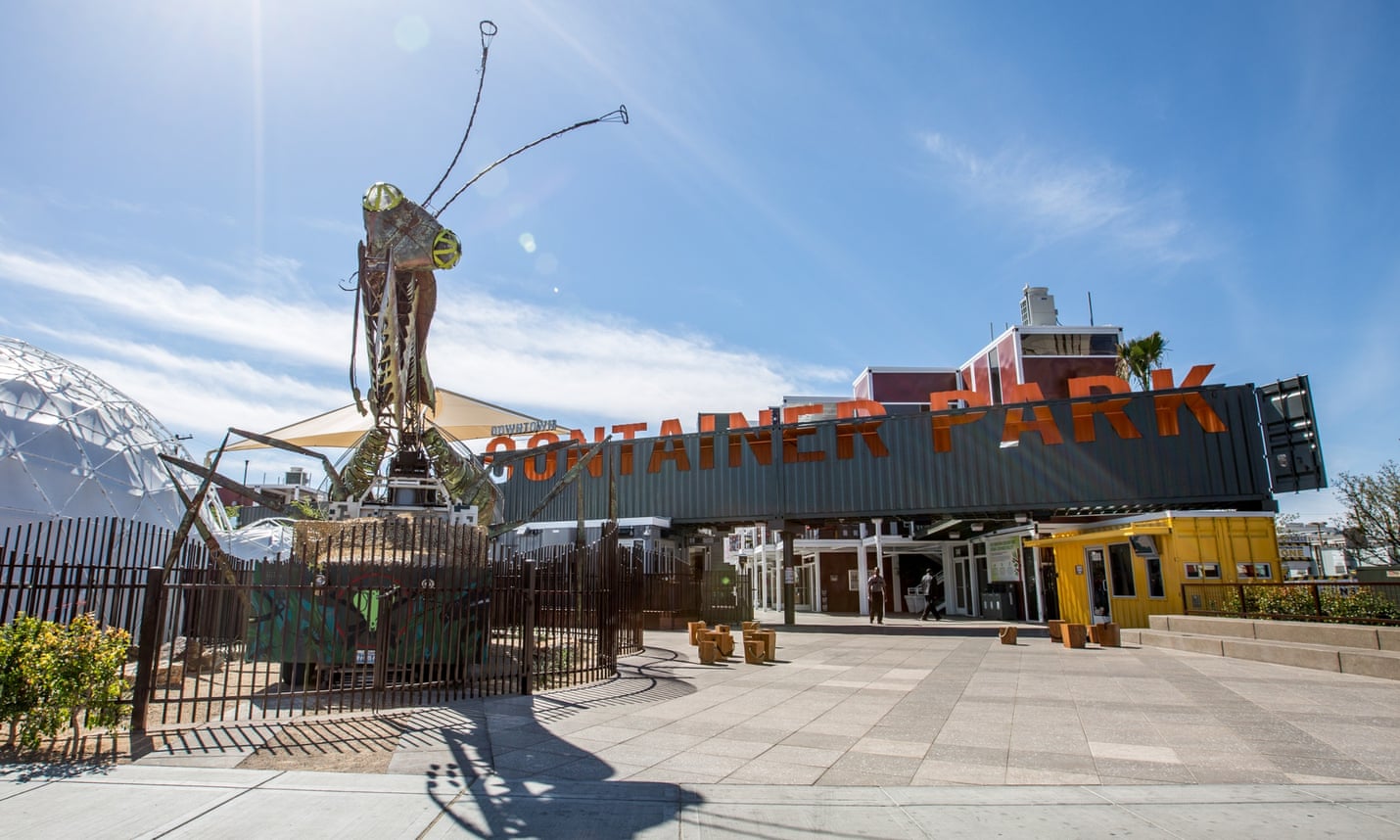
“You have to promise not to drink the Kool-Aid there.” That’s what a colleague familiar with Las Vegas’s infamous “Downtown Project” told me just before I went out to experience this outlandish experiment in urban revival for myself.
Certainly, the $350m (£225m) investment in businesses and other spaces in the city’s depressed core by multi-millionaire internet entrepreneur and retailer Tony Hsieh is in a fragile state. Some of the excitement and acclaim that met the effort at its beginning in 2012 has already congealed into a mixture of ridicule, schadenfreude and plain confusion: did Hsieh really think he could run a city like an internet startup? What did he really intend in the first place? And has he already abandoned ship?
Hsieh’s story, one well-told among American urbanists, resonates with the country’s culture on several levels. The Harvard-educated child of Taiwanese immigrants became rich in the late 1990s when Microsoft purchased LinkExchange, the internet advertising firm he had founded after ditching his corporate job.
Hsieh’s subsequent foray into venture capitalism led to his investment in the idea of an online shoe store, which soon morphed into the “service company that just happens to sell shoes” (in Hsieh’s own description) now better known as Zappos. When he brought his company to downtown Las Vegas, Hsieh also brought his entrepreneurial spirit, his reputation as an unpretentious bon vivant, and his media-friendly sense of spectacle. Furthermore, he brought his interest in privately creating a new start for the city’s depressed centre – its original gambling district, before the supercharged Strip took over.
Read the whole thing at The Guardian.