Skip to content

Notebook on Cities and Culture S2E23: Stumptown Shaolin with Dan Halsted

Colin Marshall sits down in the basement of Portland’s Hollywood Theatre with Dan Halsted, head programmer there and founder of the 35mm Shaolin Archive. They discuss fake Bruce Lee films; his adventure of rescuing classic kung-fu film prints, including gems like The Eight Diagram Pole Fighter and The Boxer’s Omen from a shuttered, junkie-surrounded theater in Vancouver; his youth in a distant Oregon town with 600 people, his move to Portland, and his discovery of kung-fu cinema; how much more kung-fu movies offer than the fighting; the advantageous openmindedness of Portland filmgoing culture; exploitation films and Quentin Tarantino’s high-profile love thereof; how different cities react to kung-fu movies, like the robust Chinese turnout in San Francisco or the disappointing attendance in St. Louis; kung-fu movies as a gateway to Chinese culture; 36 Chamber of Shaolin as a gateway to kung-fu movies; the evaporation of celluloid film, and the apparently dramatic shift in the way those under age twenty experience cinema; the various meanings of terms like “exploitation” and “grindhouse,” and how the attendant concepts cannot be separated from the seventies, a time when Hollywood acted serious and independent film acted frivolous; what Portland’s smallness affords a film programmer; why audiences sometimes prefer watching a beaten-up print to a pristine one; how Portland has successfully integrated food and alcohol with filmgoing; his experience getting tased, and how the Portland police force, known for its own aggression, tried to use kung-fu movies against him in court; and his never-ending task of pushing outward the limits of local film taste.

Download the interview from Notebook on Cities and Culture’s feed or on iTunes.

Podthoughts: SMoviemakers

Vital stats:
Format: Kevin Smith interviews the makers of films he likes
Episode duration: 50m-2h30m
Frequency: erratic

Finally, someone has given Richard Kelly a chance to explain himself. Actually, wait a second — he had a chance to explain himself, back on the Donnie Darko DVD commentary track. Or at least he had a chance to explain the movie — and to my great dismay, he did, with a sweaty, near-schizophrenic detail and consistency. But Kelly’s appearance on SMoviemakers [RSS] [iTunes] happened years later, after the world had already sneered his follow-up, the chaotically paranoid Southland Tales, into an early grave. Say what you will about the coherence of Kelly’s movies; they’re something, or at least they aspire to that state. My memories of Donnie Darko remain as hauntingly askew as the film itself, and as for Southland Tales, well, J. Hoberman and Manohla Dargis don’t win themselves over. I never would have expected a guy like Kevin Smith to lend Kelly a sympathetic ear, but so he does on the debut episode of this, his filmmaker-on-filmmaker interview podcast. And in a certain maligned-auteur-on-maligned-auteur way, the invitation makes perfect sense.

Whenever I bring up the maligning of Kevin Smith, I ask myself whether I’ve done my share of that maligning. Alongside many cinephiles of my generation, I thrilled to Clerks and everything it revealed about the potential of micro-budget independent filmmaking in the nineties. But like several other of the subsequent movement’s leading lights, Smith has arguably proven damp cinematic powder. Even a picture like Chasing Amy, regarded as one of his strongest efforts, falls victim to both a half-hearted interest in craft and an unpalatably thorough seediness. Smith himself admits, as a born writer and talker, to never finding film a particularly good fit. With the advent of podcasting, which made possible his flagship program SModcast and its countless spin-offs, he may at last have found his medium. SMoviemakers goes up a level by sitting him down with other directors, and ones he admires, thus harnessing his considerable drive as a film fan and his experience (even if he disclaims real skill) as a filmmaker.

Read the whole thing at Maximum Fun.

A Los Angeles Primer

“Los Angeles does not get the attention it deserves — it gets attention, but it’s the attention that Sodom and Gomorrah have received, primarily a reflection of other people’s bad consciences.”

Reyner Banham, Los Angeles: The Architecture of Four Ecologies

“Prejudices are useless. Call Los Angeles any dirty name you like — Six Suburbs in Search of a City, Paradise with a Lobotomy, anything — but the fact remains that you are already living in it before you get there.”

Clive James, “Postcard from Los Angeles”


In 1967, Dennis Hopper and David Hemmings had an idea. Hopper you already know all about; Hemmings you may remember as the troubled young photographer in Michelangelo Antonioni’s Blow-Up. Together they schemed to introduce Los Angeles to the world. “London is supposed to be the swinging city,” a 25-year-old Hemmings told Roger Ebert, fresh off shooting there with the Italian auteur. “But Los Angeles has the opportunity to become the next great city of the world. What Dennis Hopper and I are going to show in our Los Angeles Primer is, we hope, an exhibition of what is happening in Los Angeles. Some of the artifacts that make the city a work of art. Cheap restaurant glasses that, in a century, will be collector’s items. Street signs. Buildings. And the people.”

“Will he and hopper use photographs?” Ebert wrote.

“Yes, where they are appropriate.”

“And the actual objects?”

“Yes, the actual objects in some cases. And the people, too, who are the real artwork of this city.”

“But surely you aren’t going to put people in an art gallery?

Ebert notes Hemmings’ enigmatic smile. “Just you wait and see.”

Conceived in the realm of the conceptual, the exhibition, alas, most likely remained there. 35 years later, Hemmings reminisced to Stuart Jeffries of The Age: “Once, Dennis Hopper and I proposed this wonderful exhibition called A Los Angeles Primer. We took two coaches of dignitaries from the Ferris-Pace gallery in La Cienega to Malibu and back. On the way, Dennis got out of the front coach and signed the Beverly Hilton and the Beverly Hills Hotel. At Malibu, he went into the water and signed a wave. And then the coaches were driven back to the gallery where, behind a huge screen, the Mamas and Papas played ‘California Dreamin’’ constantly. Cards were given to the dignitaries saying, ‘You are the art of Los Angeles. Look at each other carefully.’ Blank walls all around the gallery, of course, just music playing. That was the exhibition. And that was the swinging ’60s.”

“Did that really happen?” asked Jeffries, understandably.

“If you wanted to report that we did, Dennis would back me up.”

Both Hemmings and Hopper have gone, as has the Los Angeles on which they meant to prime us. Some saw the city of the late nineteen-sixties, that moment in which it may — may — have made sense to sign the ocean and play the Mamas and the Papas on loop, as a Los Angeles already gone sour. But then, every period strikes someone as prelapsarian. Many a current or former Angeleno has lamented their last great Los Angeles: sun-bleached twenty-minute beachward drives in the early sixties; paradisical quasi-suburban childhoods in the mid-fifties; punk rock and junk food in the early eighties. This holds especially true for Los Angeleses never actually experienced.

For all its qualities of art, Hemmings and Hopper’s Los Angeles surely bears little resemblance to the one I live in. Neither look much like the city Clive James alternately marveled at and ridiculed in his 1979 postcards for the Observer, or the one whose built environment Reyner Banham famously defended eight years earlier in The Architecture of Four Ecologies. And how much do any of them have to do with the setting of novels like like John Fante’s Ask the Dust, Christopher Isherwood’s A Single Man, and Richard Rayner’s Los Angeles Without a Map? Or wherever it is David Hockney and Ed Ruscha have painted? Yet all these past or imaginary Los Angeleses have done their part to draw me to the current, real one. What’s more, each still bears its own peculiar relevance to existence here. A forty-year-old story, image, analysis, or exhibition by definition cannot depict Los Angeles as it is, but nor can it help speaking to whatever might constitute Los Angeles as it has always been.

No two people live, or have ever lived, in exactly the same Los Angeles. Sheer size has something to do with it, not to mention practical boundaries. Enclosing roughly 500 square miles and four million inhabitants within its wonkily delineated borders, the effective city expands grotesquely when you include everywhere someone might live when they say they live in “Los Angeles.” This far-flung dilution of residency results in a certain worsening of the city’s already checkered reputation. Ask someone who claims to hate living in Los Angeles where exactly they call home, and half the time it lays as far from downtown as Parsippany, New Jersey does from Manhattan.

You could argue, the way cinephiles do about Hemmings himself, that Los Angeles failed to deliver on its complexly youthful promise. How many modern, developed-world destination cities have been so often described not like hell but as hell? A decade before creating The Simpsons, Matt Groening put out a comic book called Life in Hell. He meant, as Hemmings and Hopper optimistically did in the late sixties, to introduce Los Angeles to outsiders — albeit reflecting the very different level of optimism of the late seventies. “I got here on a Friday night in August,” he once told Playboy. “It was about a hundred and two degrees; my car broke down in the fast lane of the Hollywood Freeway while I was listening to a drunken deejay who was giving his last program on a local rock station and bitterly denouncing the station’s management. And then I had a series of lousy jobs.”

Like nearly all my peers, I grew up watching The Simpsons with near-religious devotion, but I like to think my Life in Hell readership set me apart. Growing up, as Groening himself did, in the Pacific Northwest, I couldn’t follow the strip as it appeared weekly in the Los Angeles Reader, but I could pore over its collections published in book form. I did so in the Seattle of the nineties, a city then dosing the national zeitgeist with equal parts Nirvana, Microsoft, and Starbucks. The town had turned high-profile, in the process becoming “young,” “high-tech,” “edgy,” “hip,” and “livable.” Los Angeles was, well… hell.  Yet as much ire as Californians raised by making fashionable pilgrimage to the Emerald City, the waves of voluntary transplantation to Los Angeles from every other city in America — from nearly every city in the world — never seemed to slow. A place so openly loathed yet so obviously attractive had to have something going for it, and something highly unusual indeed.

New Yorkers famously complain about their town, but with a proud masochism that recalls Churchill on democracy: sure, New York is the worst city, except for all those others. Angeleno gripes, by contrast, intrigued me with their lack of pugnacity. In its place I heard a strangely promising resignation. Tales of the city’s infuriating traffic, semi-breathable air, and mindlessly grasping population, no matter how despairingly told, invariably arrived at the same unspoken conclusion: but it’s not like we’re going anywhere. Rattle off, bemoan in detail, and even exaggerate the depredations of Los Angeles life if you must; they all turn instantaneously trivial in the glaring light of a complete absence of apparent intention to escape or even avoid them.

Many craft their own private hells here, to be sure, an opportunity the city unhesitatingly allows. You can see this in the eyes of anyone making three hours of daily commute to and from one of the Sisyphean lower tiers of the entertainment industry. I think of James M. Cain, in “Paradise,” his harshly optimistic 1933 judgment of Southern California, indicting “the piddling occupations to which the people dedicate their lives.” Less depressingly, this same void of expectations made possible the architectural mulligan stew that triggered the gag reflex of so many East Coast and foreign observers over the twentieth century. “There is no reward for aesthetic virtue here, no punishment for aesthetic crime,” wrote Cain. “Nothing but a vast cosmic indifference.” Making best use of Los Angeles requires first making peace with this indifference, and I would submit that the city offers no comfortable place to anyone who can take seriously the concept of “aesthetic crime.”

But for every Angeleno living in hell, it seems to me that many more live in, if not heaven, then at least somewhere considerably more interesting than a pit of fire, brimstone, and torment. Even the world of that poor sub-Hollywood gofer has its pleasures, and for me personally, it has the fascination of foreignness. He lives not only in a socially, industrially, stylistically, psychologically, and even linguistically different Los Angeles than I do, but a geographically different one. They simply don’t overlap. Despite our both holding driver’s licenses that read “Los Angeles,” I may set foot in the coastal and northerly realms his city comprises as rarely as he does in the dense central ones that comprise mine. Even my immediate neighbors, for the most part permanent or temporary immigrants of varying documentation status from Korea, Mexico, and Central America, experience a different city than I do. To the extent that we bear an unwillingness or inability to visit each others’, so much the worse for all of us.

These countless and multiplying subjective Los Angeleses, mine as well as everyone else’s, make for an infinitely richer subject than could any single, objective place. It certainly compensates for the city’s tendency, in every dimension one can easily describe, to move the target. Best of all, it legitimizes my own compulsion to write about Los Angeles. A San Franciscan friend told me that, if I tried to say anything about his city after only a year there, the backlash would come swiftly: a tide of locals of thirty, forty, fifty years’ standing, rising to demand to know where a Johnny-come-lately like myself gets off making so much an observation about their hometown. Yet in this city, the words of a disoriented arriviste and a native hardened by decades of sun and hundreds of thousands of  freeway miles stand on disconcertingly equal footing. They each have their own Los Angeles, as I have mine, and as you have, or will have, yours. If any piece of understanding makes the foundation of a Los Angeles primer, there it is.

Notebook on Cities and Culture S2E22: Uncaptive Rider with Jarrett Walker

Colin Marshall sits down in southeast Portland with Jarrett Walker, public transit consultant and author of the blogs Human Transit and Creature of the Shade as well as the book Human Transit: How Clearer Thinking About Public Transit Can Enrich Our Communities and Our Lives. They discuss how Portland “turned the battleship” toward sustainable transport in that least likely of all decades, the seventies; the city’s discovery of its own extraordinary capacity for self-promotion in the nineties; his adolescence there spent in fascination at the buses departing to all their myriad destinations; how thinking about transit makes thinking about cities more interesting; the unfortunate divide between urban design and transport planning; how the North American revolt against highway-building also hampered the construction of transit infrastructure; a city’s transportation system as the ultimate test of its citizen’s freedom; the close relationship between a city’s density and its transit possibilities, and why fantastically inefficient systems are always pleasant to ride; how he has come to love Los Angeles, during its current transitional moment, as someone who has hated it; Los Angeles’ place as a “city on the edge” that always captures the imagination, no matter the petty judgments it draws; Los Angeles’ distinctive geography offering the best possible opportunity for transit-building; the questions he asks about whether a city wants him to understand the whole of its transit system, and whether it treats him as a free actor; the surprises that delight him now that he’s gotten used to confusing, sad, and unpleasant transit experiences; airport stations and their tendency toward “symbolic transit”; and the importance of whether a city treats transit as a commuting device or as an all-purpose urban structure, and whether or not it’s motivated simply by the coolness of the vehicles.

Download the interview from Notebook on Cities and Culture’s feed or on iTunes.

Notebook on Cities and Culture S2E21: Grittiness and Heart with Kevin Sampsell

Colin Marshall sits down in Portland’s Montavilla with Kevin Sampsell, publisher of Future Tense Books, editor of Portland Noir, and author of the memoir A Common Pornography and the novel This is Between Us, forthcoming from Tin House. They discuss the meth crime to be found beyond 82nd Avenue; Portland from the vantage point of his childhood in Washington’s Tri-Cities; how he met other writers by publishing his own “lo-fi chapbooks”; how one forges one’s own unique voice by maintaining their not-giving-a-crap nonchalance; his chronologically un-pinpointable founding of Future Tense and its surprise success with Zoe Trope’s Please Don’t Kill the Freshman; writing as a kind of martial art, which develops you even if you start out flabby, and which demands its own kind of meditation; how he became a (more) serious reader at Powell’s Books; his love of southern writers, and more generally those who combine grittiness and heart; how unimportant he finds sense of place in fiction, yet how much praise he won for “capturing the Tri-Cities” in A Common Pornography; his technique of mixing the mundane with the shocking and hoping for the best; moving from the “no style” and short chapters of his last book to the longer chapters and conversational style of his new one; and the attractions of the Portland writing life, including having space to live and being in a place where nonfiction writers and poets might actually associate.

Download the interview from Notebook on Cities and Culture’s feed or on iTunes.

Notebook on Cities and Culture S2E20: Conservatively Progressive with Carl Abbott

Colin Marshall sits down at Portland State University with Carl Abbott, professor there of urban studies and planning and author of Portland in Three Centuries: The Place and the People. They discuss the debate over Portland’s status as a “small city” or a “big town”; the distinctive ease of making connections in the city; how modern-day Portland enthusiasts would look at the place before 1965 and see Akron, Ohio; the oft-made comparisons between Portland, Seattle, and Austin; the history and continued presence of agriculture and industry around the “cool Portland” of today; Microsoft and Boeing, the “accidental” companies that made Seattle the younger sibling that out-competed Portland, one with better booms but worse busts; Portland’s “conservatively progressive”  politics, and how that sensibility shows up in its light rail system and central library (especially as compared to Seattle’s); the relationship between the city’s vaunted “livability” and its patterns of diversity; how he came to Portland and when, exactly, the city turned away from its former stodginess (and when its porno theaters started turning into revival houses); Portland entrepreneurship, which Portlanders prefer to call “D.I.Y.”; how best to engage new immigrants and hip youngsters in “Portlandism,” a civic-minded, participatory approach to incremental problem-solving; science fiction’s visions of cities, which present recurring patterns related to urban theory; and whether Portland counts as a utopian project, if a practical one.

Download the interview from Notebook on Cities and Culture’s feed or on iTunes.

Podthoughts: Here’s the Thing

Vital stats:
Format: actors, musicians, and intellectuals interviewed — by Alec Baldwin!
Episode duration: 20m-1h
Frequency: 2-3 per month

Here’s the Thing [RSS] [iTunes] is an interview show hosted by Alec Baldwin. Perhaps your curiosity requires no more detail than that. I wonder how much more detail the development of the program itself required. One easily imagines Alec Baldwin casually mentioning how he’d damn sure like to host one of those smart public radio shows, then a higher-up over at WNYC immediately giving the notion a pre-emptive green light. A prominent, name- and voice-recognizable middle-aged political liberal with a wide range of celebrity buddies (whoa, David Letterman?) a non-famous host would struggle to land? Add it up, and Baldwin almost slots too well into the existing machinery of American public radio.

Then again, one just as easily imagines a troubled gestation. Public radio, already a mildly anxious field, has fallen into the thrall of a lot of ideas about its relationship to the terminally anxious field of greater journalism. The industry has long provided refuge to many a program director who would dismiss the concept of an Alec Baldwin interview show out of hand as frivolous, unserious, insufficiently informational. I fear Here’s the Thing, despite its relative chastity of form, therefore qualifies as one of those Bold Experiments in Public Radio™. Somehow, the view of the show a comfortable no-brainer and that of the show as a brow-furrowing risk seem equally plausible. By the same token, Baldwin himself comes off as, simultaneously, an impressively thoughtful, curious accidental interviewer and a Hollywood actor “dicking around” between jobs.

Read the whole thing at Maximum Fun.

Kansai no Nikki III

Scott Adams once posted this tip for getting to sleep:

Don’t think words.

By that I mean don’t imagine conversations that you plan to have, and don’t replay in your head conversations you’ve had.

It’s impossible to clear your mind of all thoughts. But I find it somewhat easy to switch off the language center of my brain. What happens after that is a flow of images, starting with ones that make some sense to my current life, quickly followed by randomness, then sleep. It usually takes less than a minute.

Given how many western filmmakers depict the country as a waking dream, maybe it stands to reason that I also found this technique applicable while walking through Japan. On a purely linguistic level, understanding Japanese (or Korean, or Spanish, or whichever) gets easier when I simply shut off my mind’s instinctive flow of English-language commentary. But I also seem to perceive the Japanese urban environment more richly when I restrict my thoughts to the non-linguistic. “It’s a visual culture,” many of the resident expats I met told me, and I figured I’d approach a place that supposedly thinks primarily in images by thinking primarily in images myself.

“Appearances are reality,” Donald Richie writes of Japan in The Inland Sea. “The mask is literally the face, and the cynic can find no telltale gap because none exists.” Though this element of Japan divides observers, I personally find it one of the most compelling reasons to go. I’ve long felt, but now understand, a longing to enter a realm where nobody prattles on about the supposed divide between one’s embodiment, one’s behavior, and who one “really is.” I can’t imagine a Japanese person seriously throwing around accusations of “pretension,” a charge that even in America says nothing about the accused but everything about the accuser.

Perhaps we’d do better to call it a formal culture than a visual one. “The Japanese are a people who have managed to retain, right into the latter half of the dehumanized twentieth century, a very human, even primitive quality: their innocence,” Richie writes later in the book. “While this does not prevent great subtlety and a degree of sophistication, this mighty innocence — one that the Japanese share with what those white man elsewhere calls natives — rests upon an uncompromising acceptance. The innocent does not look for reasons behind reasons. He, secure in the animal nature that all of us have and only half of us admit, is able to see that all reality is what the West finds merely ostensible reality. Reality is only skin deep because there is only skin. The ostensible is the truth.”

Or, as one interviewee, an Englishman who’s spent 25 years in Japan, said to me: “You know how you can tell an artist in Japan? They’re the ones wearing berets.” He wasn’t joking. Another day I climbed to the top of a mountain with another interviewee, another westerner. We watched, in our everyday clothes and shoes, as Japanese hikers passed by dressed in full outdoorsman’s regalia. They all but wore Tyrolean hats — and some of them may well have worn Tyrolean hats.
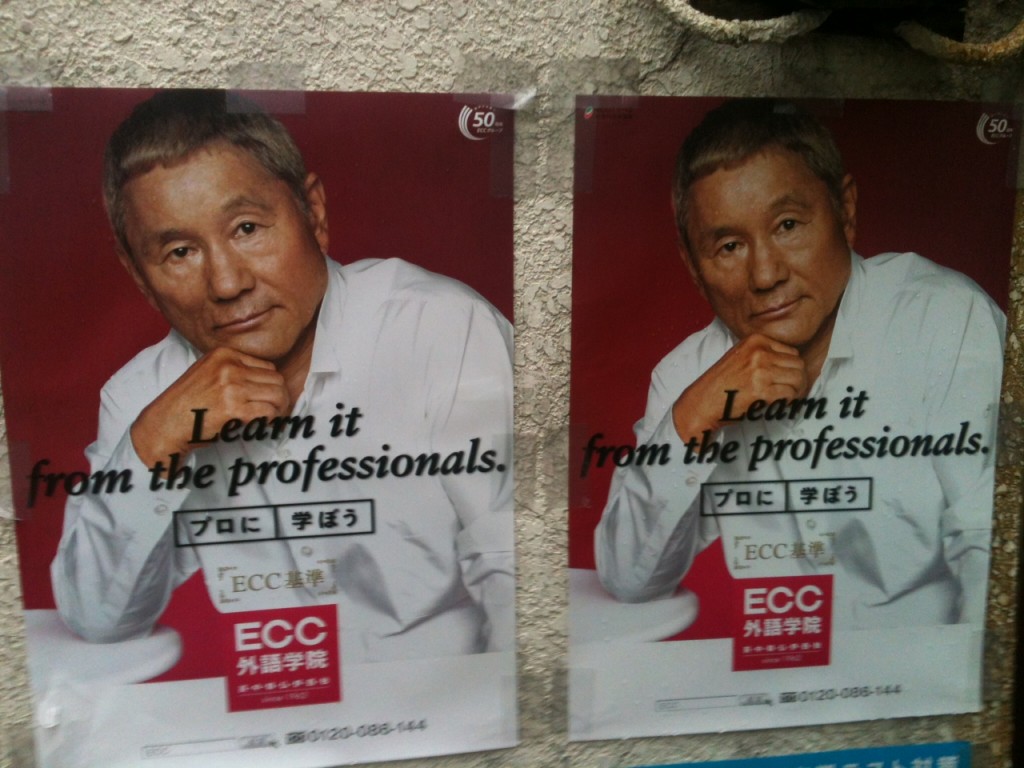
The aggrieved periodically e-mail me to complain that I interview too few women or minorities or what have you. Wait until they get a load of my conversations from Japan, conducted with a veritable murderer’s row of mostly middle-aged, often English, men. While happy indeed with how these recording sessions went, I do regret that not one Japanese person consented to sit at the other end of the microphone. Knowing full well that that the clearest-eyed perspectives on a place do come from outsiders — Englishmen, from Christopher Isherwood to Reyner Banham to David Hockney to Richard Rayner, having also offered the most enduring views of Los Angeles — I’ll still look harder next trip.

But from what I’ve heard, few Japanese people, no matter how polished their English, will willingly speak it in anything like an official context. Pico Iyer, in The Lady and the Monk, wrote perhaps the funniest and most cringe-inducing illustration of this phenomenon when recalling the time he was forced to summon his more or less forgotten Spanish, and act as impromptu translator between a family of Argentine refugees and an eager Japanese audience — a Japanese audience that contained several fluent, but unwilling, Spanish-speakers. Terrified of making so much as a mistake every few paragraphs — fewer mistakes than I make, routinely, in my native English — they adamantly refused to step up.

(Also, I didn’t bring any business cards with me this time. Friends have told me that failing to offer mine in return when given one by a Japanese counts as a mortal gaffe. Formal culture.)

This obstacle would loom less formidably, it seems to me, with a Japanese person who has lived abroad than with one who hasn’t. I happen to think of a Wire profile of the Korean-Japanese sound artist Aki Onda: “I really hated that country, I thought it’s just boring. If that’s the only system you know, you have to obey it, but I knew many other countries. Then, when I was 11 I found a diary in my house. My father kept it when he was young, in his Korean name, about his experience as a foreigner. That gave me a good excuse: I thought, ‘Oh, I’m just a stranger, I have no obligation to follow the rules.’”

Of all the people I meet, Japanese who do know other countries rank as some of the coolest; no accident I made mainly amigos japoneses in Mexico City. Japanese who never leave, I may never get to know at all. This contrast looks especially stark when you specifically consider the women, some of whom feel compelled to leave their homeland to assemble a life with enough freedom to merit the name. But even deeply unreconstructed me feels for these often highly intelligent, capable ladies who nevertheless land in careers or lives that would feel to you or me like purgatorial treadmills. That this still beats their probable lot back in Japan speaks volumes.

I suppose the younger ones sometimes find work on airplanes. My bargain-priced tickets flew me to Japan on All Nippon Airways and back on United, offering me an unusually close comparison between a foreign airline and one of our own. On the return flight, I formulated a theory: to gauge the condition of a nation, look at the condition of its air stewardesses. Welcome, then, to withered, sullen America, dragging itself toward retirement and down to its last Nicorette. Old Glory comes out of the culinary comparison even more badly tattered. How to interpret scanty trays of brittle styrofoam cups, heaps of rice overwhelming lonely nodules of chicken, and defeated ham-and-cheese sandwiches but as the white flags of a surrendering country? Images of longing filled my mind: Japanese hot towels presented without fail before each meal, well-stocked Japanese green tea vending machines, clean Japanese trains turning up every four minutes. This is why, you want to say. This is why the world sees the United States as such a tacky, risible nation.

“I don’t care if I never go back,” Richie writes at both the beginning and the end of The Inland Sea. I re-read the book, which Richard Lloyd Parry calls “a learned, beautifully paced elegy for one of ‘the last places on earth where men rise with the sun and where streets are dark and silent by nine at night’,” “the only full-length work of Richie’s that will be remembered a generation from now,” throughout my stay. Though this island-centric travelogue only geographically coincided with my own journey in two cities, Hiroshima and the nearby naval town of Kure, I read it everywhere I went. I read it, increasingly unable to put it back in my bag and take in the live foreignness around me, on trains, over lunch, in parks, with midday coffee, and late at night in donut shops.

This fueled a discussion with a friend, himself a well-known writer of books on Japan and other Asian places, about whether anyone under the age of sixty  seems a promising heir to to the 88-year-old Richie’s throne. The matter has grown worrisome, since Richie himself, if I’ve read correctly interpreted the vague but dispiriting reports from other prominent gaijin, seems not long for this world.  That I evidently slept on the chance to interview him — seemingly only by a few years — and thus to do my part to bridge his generation of Japan enthusiasts and mine stands as my foremost professional regret. And I’ve never separated professional from personal.

Richie’s lack of concern about returning — to Tokyo, to mainland Japan, to America — brings to mind another oft-quoted line of his about first entering his adopted land: “In Okinawa, I felt my testicles descend to the earth.” Or, as he writes in The Inland Sea, “I like myself here.” Or, as a wise sage once sung, “This must be the place.” Though I came to Kansai primarily to collect interviews, and secondarily because I leave the country for my birthday, I kept an eye on evaluating each city as a potential place to live.

While I don’t envision myself — indeed, wouldn’t want myself — becoming a full-time gaijin, I do sense a regular presence in Asia somewhere in my future. Of Kansai’s four major cities, Osaka, supposedly the unforgivably vulgar, unrelentingly ugly, damnably commercial-minded central metropolis, strikes me as the most viable proposition. We westerners are supposed to disdain Osaka in favor of Kyoto — those wooden buildings, those unbroken lines of history — but my impulse to possess a place, through accrued knowledge and experience, only fired up in the company of the comparatively oafish neighbor.

Though though many Asian cities remain to test, I find this mindset alleviated that most onerous burden of tourism, explaining (if only to yourself) why you’re not a tourist. Away went the terribly unpleasant touristic pressure of feeling obligated to see everything, to set foot everywhere, to technically get it all in — inside two weeks, no less. Knowing I’d be back, if not right away in Kansai, then at least in Japan, or in this part of the world, and regularly, I felt free — it even seemed necessary — to leave water in the pump.

Geoff Dyer argued similarly in favor of long trips: staying in a foreign city for months at a time, you absolve yourself of guilt over occasionally staying in and putting on the kettle instead of pounding the pavement in constant, desperate search for the exotic. Then again, other writers have told me that ten-ish-day drips are where it’s at, impressions-wise: they allow you to skim the surface in a highly observant way, collecting and processing only the freshest, least weariness-tainted experiences. Confident that more ten-day as well as months-long trips to Japan lay in store, I need not wring my hands over the difference.

There I sat, staring sorrowfully at my ham-and-cheese yet feeling as much of a yearning to return to Japan as to return to Los Angeles, which some might consider the very capital of tacky risibility. “If you like attractive women,” someone tautologically e-mailed to me years ago, “Japan will be like a whole other planet.” Indeed, Japanese women excel in the same manner as do the preparers of Japanese food: even the ones employed by All Nippon Airways attend painstakingly to presentation — to form — in ways that wouldn’t even occur to their U.S. counterparts. You can’t really blame the Americans; most of us just don’t know. And as in the cabin, so on the streets; most of the stroller-pushing okaasan I spotted in Japan put together a more striking appearance than archetypically blonde Californian college girls can manage on their most focused days. But I had something to return to, something without which I may well have extended my stay in Kansai by weeks if not months, something beside which these flowers of Japanese womanhood were as nothing. As that same wise sage also sung, “I got a girlfriend that’s better than that. She has the smoke in her eyes.” Next time, I’ll bring her.
 

[Previous diariesSeattle 2012Portland 2012San Francisco 2012Mexico City 2011]

Notebook on Cities and Culture S2E19: Small Town Cop with Matt Haughey

Colin Marshall sits down in Portland’s Slabtown with Matt Haughey, founder of MetaFilter, the most civilized community on the internet, co-founder of Fuelly, and creator of several other sites as well. They discuss his escape from San Francisco’s “goofball startup culture”; what it means for MetaFilter to be “civilized”; his desire not simply to create “a safe place for people to yell past each other”; the importance of keeping personal identity out of debates; the strange backend provided by MetaFilter’s question-and-answer service Ask MetaFilter; the second-most popular Ask MetaFilter thread of all time, Colin’s own “What in life did it take you a surprisingly long time to realize you’ve been doing wrong all along?“; the strange popularity of questions about how to talk to girls, relate humanity, and/or live life, also known as the “forever alone” series; what it takes to become one of MetaFilter’s ten worst users, drunk on power or stupidity; the hyperarticulate sourness that makes bad comments on MetaFilter especially bad, and how it leads to users pre-emptively armor-plate their sentences; Portland as a setting for the simple life, but also the good one; advertising’s domination of internet business models, and the bite mobile browsing even now takes out of that; who’s actually clicking those ads that ostensibly support everything; the benefits of living down the long tail, and of executing difficult-to-describe ideas that are therefore difficult to replicate; where to shut yourself off from the net in Portland, be it on a bike or at a food cart; and how a Portlander can possibly react to a kid on a unicycle, in a Utilikilt, playing a bagpipe, topped with a Darth Vader helmet.

Download the interview from Notebook on Cities and Culture’s feed or on iTunes.

Kansai no Nikki II

Suggestions for a truly modern traveler’s Japanese phrasebook:

“Does this coffee-shop have wi-fi?”

“Then what do those stickers on your windows with the word ‘wi-fi’ mean?”

“But why would I have to do all that just to connect?”

“Why don’t you know?”

In Japan, one doesn’t come by wi-fi hotspots easily; one doesn’t come by reliable wi-fi hotspots at all. I’d expect this in, say, Mozambique, but in William-Gibson-future-unequally-distributed here? Akky Akimoto sheds some light on this surprising inconvenience in The Japan Times:

In Japan, most demand for email and Web access outside the home has long been satisfied by mobile phone features such as NTT Docomo’s i-mode service, which began in 1999. Years before the age of the smartphone, on i-mode and its competitors, over 70 million users — the same amount as PC Web users —were enjoying Internet access through their phones (there were some limitations, but it was still the Internet). Flat-rate data plans (which only became common in the United States with the introduction of the iPhone in 2007), became available in Japan around 2004, and people began to do everything Net-related from their cellphones. For these users, there was no need for a network of free Wi-Fi at shops and cafes.

Instead, what people in urban areas of Japan wanted was to access the Web while they were on the train to work. People who spend 3 to 4 hours on their weekday commute boosted the cellphone-Web infrastructure. Making a simple Wi-Fi network within a cafe or store may be an easy task, but offering Wi-Fi to hundreds of thousands people on trains is not realistic. Cellphone access might not be as fast as Wi-Fi, but cellphones are capable of being connected on high-speed trains.

Keitai intanetto on their densha, eh? So that’s how these people play it. Nevertheless, I have found one reasonably handy source of wi-fi for the deadline-bound writing gaijin: Sutaabakkusu. They don’t charge you for it, though they do put you through a catch-22: you first must sign up for an account on the internet before they’ll connect you the internet. Having accomplished that, I’ve gone on to visit Starbucks more often in the past week in Japan than I have in the past year in Los Angeles. Drinking my shooto kappachiino, I reflect upon my own admiration for the fact that Japanese Starbucks actually displays the eight-ounce size on their menu. You can order a short in the States, but they sure as hell won’t make it obvious that they’ll deign to serve you such a non-prosperously modest cup.

But if you find yourself needing the net in Kyoto’s Kawaramachi shopping district, I suggest trying the more comfortable Second House. Walk just south of Sanjo Kawaramachi, go into the Mina Kyoto department store, and ride up seven floors. I conducted an interview there, then ate one of their special ebi-and-cheese quiches, then ordered a kappachiino. Then my phone informed me of their open wi-fi network, so I proceeded to break out the laptop and linger over my drink for the next two hours. Yet the connection still crapped out every ten minutes, just as Starbucks’ periodically slows to uselessness for no discernible reason. Japan, so I will generalize, richly mixes the impossibly advanced and the mystifyingly broken. For another instance, Sutaba (for short, as McDonald’s becomes “Makudo”) often attaches itself to and thus shares a bathroom with a swank hotel. There you’ll find only the cleanest, heatedest, most advanced Washlet toilets. Elsewhere, toilets make you squat. Little exists in between.

(“Not for pooping,” replied an interviewee when I asked if he’d yet made his peace with squat toilets after a year in Japan.)

If you opt for Second House, keep it to the daylight. Do your work there. “The places where you have fun after dark in Japan are always hidden. The unknowing foreigner walks along Tokyo’s Ginza or along Kawaramachi in Kyoto, lonely, little knowing that just a few blocks over are lanes of bars and blocks of cabarets.” So writes Donald Richie in The Inland Sea, his best-known book and the one I’ve brought along on this trip. The observation holds in the big cities of 2012 just as well as it did in the island hamlets of 1970. Take mere steps off of its main drags, and you’ll discover that Osaka is made of thousands of  distinctively illuminated, aesthetically specialized 300-square-foot eateries and watering holes. Even my own temporary neighborhood, the relatively sleepy side of the Ikuno ward near Momodani station, boasts a veritable mini-labyrinth of compellingly tiny establishments along what are neither alleys nor proper streets.

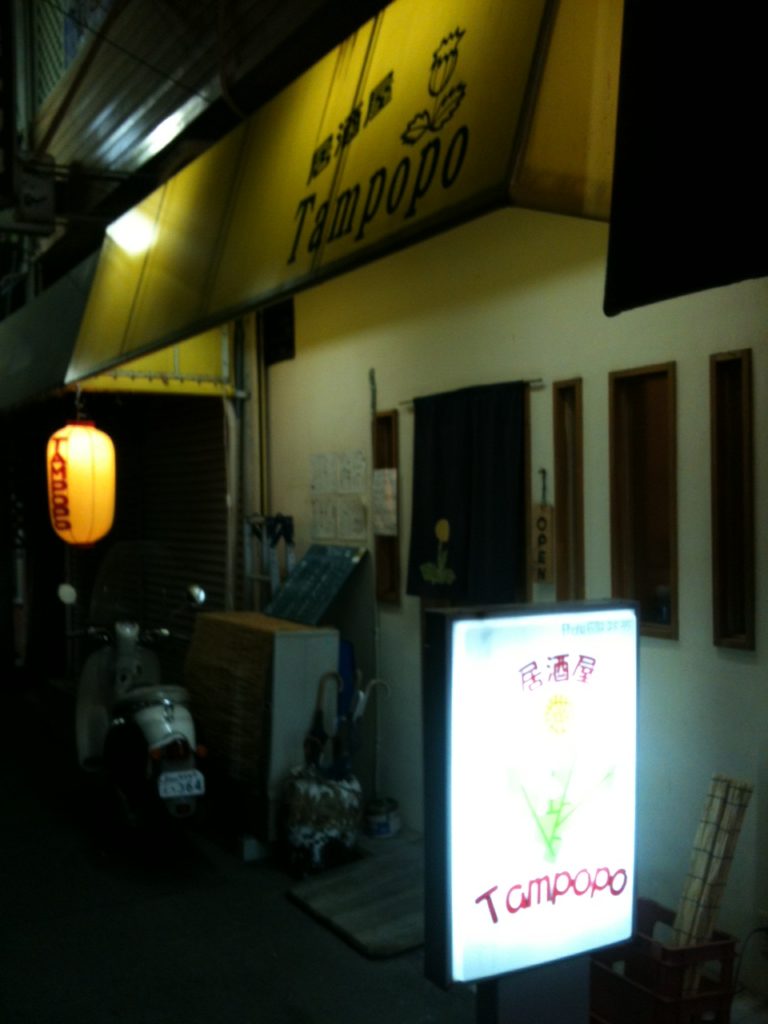
I’ve walked by the little restaurant Tampopo an obsessive number of times. On each I consider entering, but its posted menu, over half of it written in kanji I don’t know, chills me. Intellectually, I realize I could probably just walk in, play the bumbling-gaijin card, and throw myself on the mercy of the no doubt non-English-speaking owners. They would simply serve me a house specialty, or I’d point to another customer’s dish and ask to have that. “Hai, hai, wakarimasu,” I would reply to their questions, the words — “yes, yes, I understand” — I use when I have understood nothing at all. That works, though in a maximally embarrassing fashion. Then again, just as I only learn a city by getting lost in that city, I only learn a language by making mistakes. Humiliation is education. These delightful-looking holes in the wall provide me not only with a prize on which to keep my eyes during Japanese study, but a reason — one of many, and more emerge daily — to return to Osaka soon. If on my next visit I cannot stroll into Tampopo with a modicum of confidence, otoko dewanai.

(My fixation on Tampopo in particular also comes from the fact that it shares a name with the finest comedy about the Japanese relationship with food to come out of the 1980s. And with its main character. And with that character’s ramen shop.)

Rest assured, though, that I do make mistakes in Japanese. I make so many mistakes. My first few days here, I tended to begin sentences in boldly Japanese and finish them having wandered into Korean. This began with the flight attendant serving me drinks:

“Tsumetai ocha kudasai.”

“Ah! Jyozu desu!”

“Iie, iie. Nihongo dekimasen, demo… kongbu hago isseoyo.”

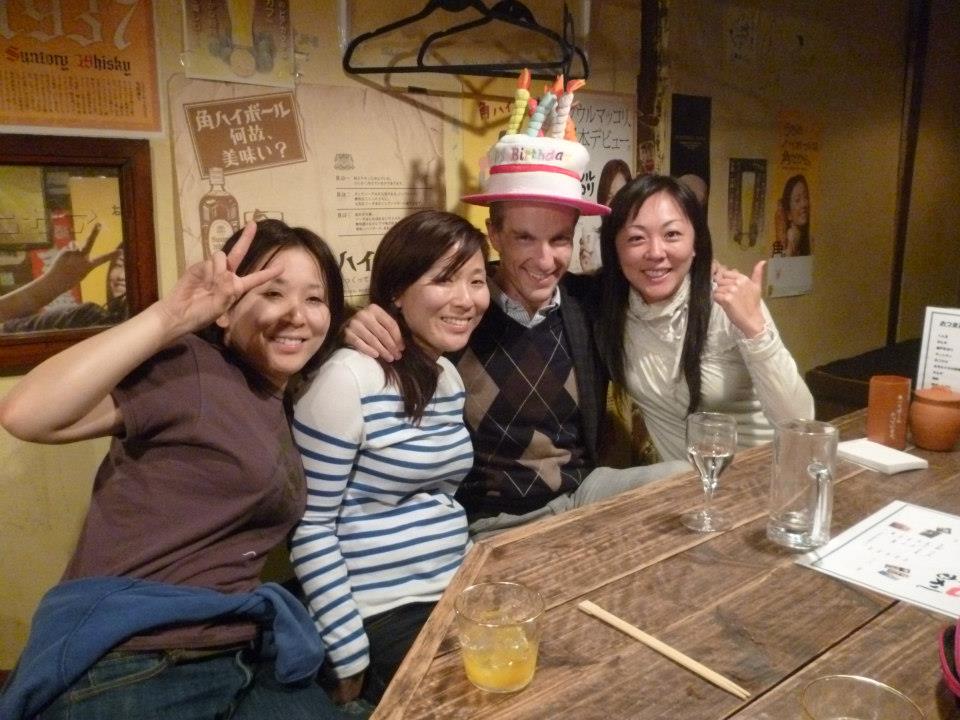
I spent my birthday in Hiroshima, visiting Peace Park, the Atomic Bomb Dome, and Peace Memorial Museum. (Have at it with your jokes about the incongruity of the day and its activities; my lady has long since beat you to it.) These rounds I made with my friends Yoko, Tomoko, and Misa, whom I know from Mexico City. We conduct our conversations in a mixture of Japanese and Spanish, a hybrid tongue — Spapanese? — of which I hope to become, the proud Japanese Peruvians aside, the world’s foremost speaker. At one point, Yoko rightly admonished me for leaning so heavily on Spanish instead of seizing the opportunity to practice Japanese in the very land where people speak it. As we emerged from hall after hall of melted rubble, scorched flesh, and shredded school uniforms, Yoko told me of a friend who claimed that, after this harrowing viewing experience, she couldn’t eat for three days. Summoning my flawless command of her native language, I replied. “Wow! No eating, three months?”

With some regret, I inform you that I could eat immediately afterward. Not only did I eat, but I ate my share of three heaping Hiroshima-style okonomiyaki, with an enormous beer on the side. We all did. My friends even snapped pictures of the meal. Every notion about the Japanese being more enthusiastic about and better at casual photography is true. Whenever a waiter set dishes before us, all three ladies would whip out their cameras as if by instinct. I tried to take a picture of this, but they proved too quick on the draw every time. As a collective Baedeker to their homeland, Yoko, Tomoko, and Misa did well indeed, even taking me to the very sort of narrow, darkened, neatly cluttered, English-free drinking establishment to which I perpetually long for entry. Nobody brought the cake hat for the occasion; the bar just happened to have it sitting atop some immaculately piled junk. It also had an absolutely state-of-the-art toilet.


[Previous diaries: Seattle 2012, Portland 2012, San Francisco 2012Mexico City 2011]