Skip to content

Los Angeles Review of Books Podcast: Patricia Wakida, “LAtitudes: An Angeleno’s Atlas”

Colin Marshall talks with Patricia Wakida, editor of Heyday Books’ new LAtitudes: An Angeleno’s Atlas, a collection of cartographically organized essays on the real Los Angeles from such contributors as David L. Ulin, Glen Creason, Laura Pulido, Lynell George, and Josh Kun.

You can stream the conversation just above, listen to it on the LARB’s site, or download it on iTunes.

The History of Cities in 50 Buildings: The Sampoong Department Store

Observers tend to describe the rise of South Korea as a miracle, and the actual story makes the word seem only a minor exaggeration. Having emerged an utter wreck from the Korean War in the early 1950s, by the 21st century the country had become a rich, infrastructurally impressive, technologically forward-thinking global economic and cultural force. But South Korea’s unprecedentedly rapid entry into the first world has taken its tolls, and no one event of its dizzying 20th-century period of growth forced as many of its people to face them as the collapse of the Sampoong Department Store.

Those who endured the hardships of the Korean War and its aftermath had to welcome whatever prosperity the future could bring, despite the repression of the dictators who oversaw it and the grinding nature of a national life rigorously dedicated to nation-building. But from the 1970s through to the early 1990s, even the most development-minded Korean couldn’t help but suspect that something had gone wrong. An apartment block falls to the ground, a hotel catches fire, a train station explodes, a bridge collapses: the built environment that had risen so recently and triumphantly around them had already begun to crumble.

From the beginning, South Korea has understood that development and urbanisation go hand in hand. In fact, it understands that almost too well, resulting in what ranks today as one of the most capital-centric countries in the world. The resources it has devoted to Seoul make the rest of South Korea seem almost like a mere support system for that 24-hour high-rise megalopolis of 25 million people, built over the rubble of the modest Japanese colonial city it had been before the second world war.

Read the whole thing at The Guardian.


Diary: Walking (All of) Wilshire

IMG_0002

I’ve long wanted to walk the length of Wilshire Boulevard, the closest thing the whole of Los Angeles has to a “main street.” The city does have a street actually named Main, which runs north-south through downtown all the way up to Lincoln Heights and all the way down to the port, but Main somehow never attained the iconic status Wilshire has. That, and the variety of well-known areas through which the boulevard runs — downtown, MacArthur Park, Koreatown, the Miracle Mile, Beverly Hills, Westwood, Santa Monica — make it the logical choice as the Los Angeles urban walking experience.
IMG_0010

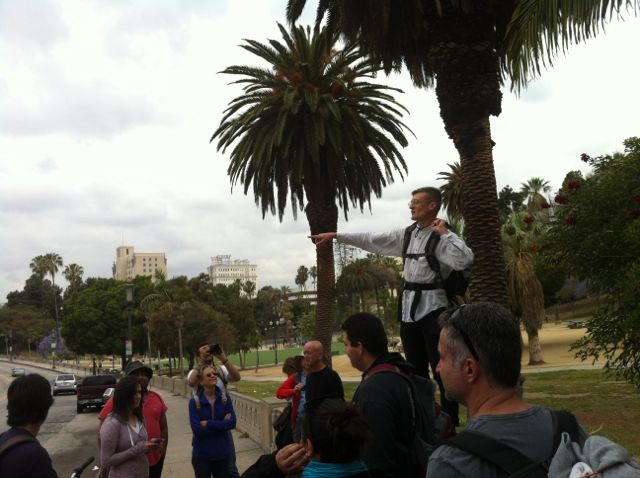
A few friends have taken it wholly upon themselves to walk Wilshire before, all sixteen miles from Grand Avenue to the coast, but I guess I needed a more specific impetus. It came in the form of a group walk led by Tom Carroll, host of the Youtube series Tom Explores Los Angeles. I’d appreciated Tom’s videos for a little while already — at first because I’d never seen anyone so closely examine the Triforium, as I told Tom himself when we happened to be walking alongside one another for a mile or so — but didn’t hear about the walk until a couple days beforehand. One of the prime benefits of a flexible schedule like mine: if you want to spend an entire Wednesday walking down a street, you just clear the day’s calendar and do it.
IMG_0018

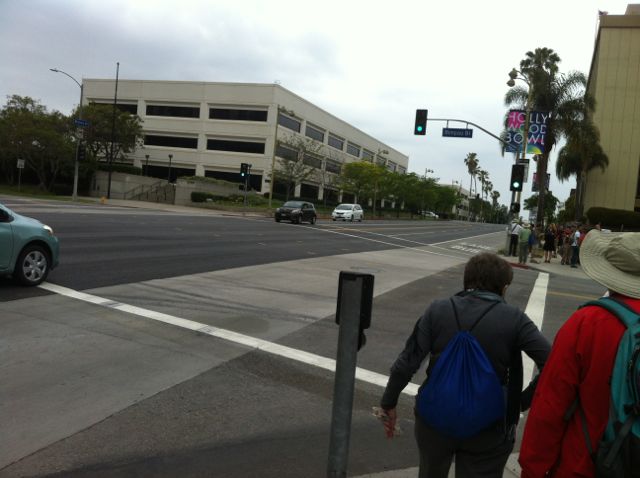
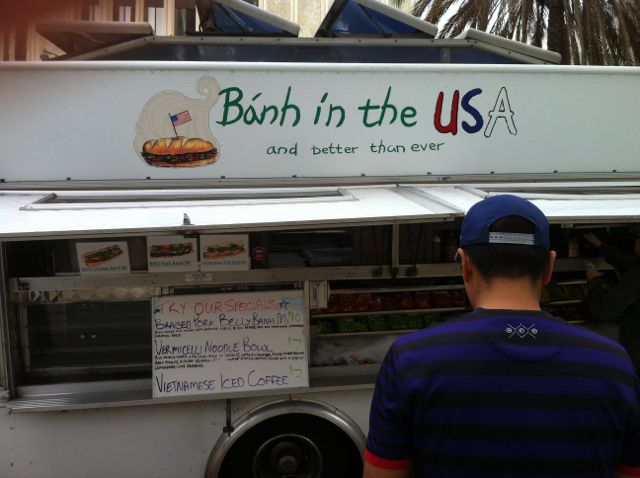
We set off as a group of about thirty from Grand Avenue at 9:30 in the morning, and ended up on Ocean Boulevard, after some fell away and some joined along the way, as a group of about twenty at 6:00 in the evening. We took an hourlong lunch break among the food trucks that line up outside the Los Angeles County Museum of Art, and not long after that paid a visit to the Los Angeles office of GOOD Worldwide, on the seventeenth floor of a nondescript Miracle Mile office building, to refill our water bottles.
IMG_0020

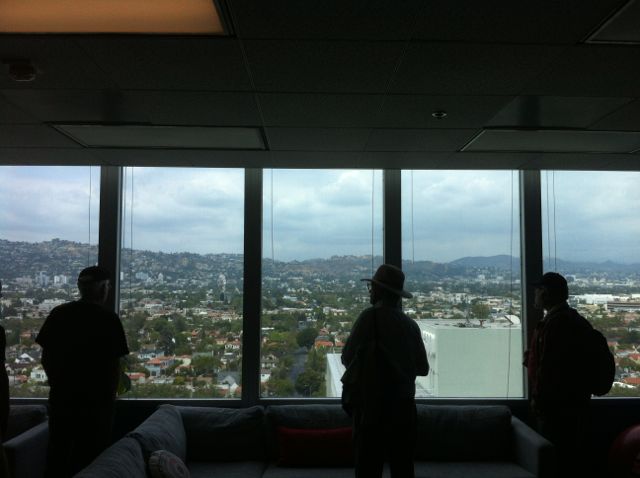
I harbor a vague admiration for GOOD without quite understanding what they do. I mostly know them for their eponymous magazine, which re-launched a few months ago. They co-sponsored the Wilshire walk alongside something called Sambazon, a blended juice product of which we had several opportunities to grab free bottles out of coolers. I drank one while taking in the view from GOOD’s office windows, which offer a perspective on the built environment just north of Wilshire I rarely get to see. (Park La Brea looked really striking from there.) It seemed like one of those benevolent, Millennial-filled work environments, though I guess that’s the idea. An employee cranked up the chiptune electronic dance music on their office speakers as soon as we entered.
IMG_0023

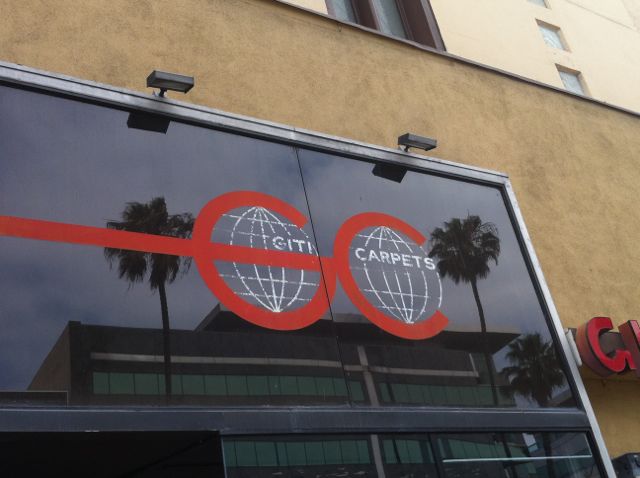
Though Millennial myself, I didn’t fare quite as well, physically, as some of the group’s maturer members. While I did make it to the end, I’d started hobbling and fell to the back of the line halfway through Santa Monica. Every time I sat down while waiting for a red light to change presented a realer and realer challenge to my getting up again. Yet the sexagenarians, septuagenarians and (I couldn’t tell, maybe even) octogenarians who held out took it literally in stride. Maybe it’s all the power-walking older generations supposedly do to forestall decrepitude; most of my exercise comes from my bike.
IMG_0028

I kept thinking of The Long Walk, a dystopian and faintly homoerotic novel Stephen King wrote under the pseudonym of Richard Bachman (and, according to King himself, the first book he ever wrote) which, in adolescence, I read over and over again. In it, a hundred teenagers have to keep walking and walking until only one remains. (Laggards get shot by soldiers following in a half-track.) Supposedly the last boy walking gets whatever he wants most in the world, though the story’s ambiguous ending — not a technique I necessarily expect from Stephen King, under any name — stops short of revealing that promise as genuine or a sham.
IMG_0037

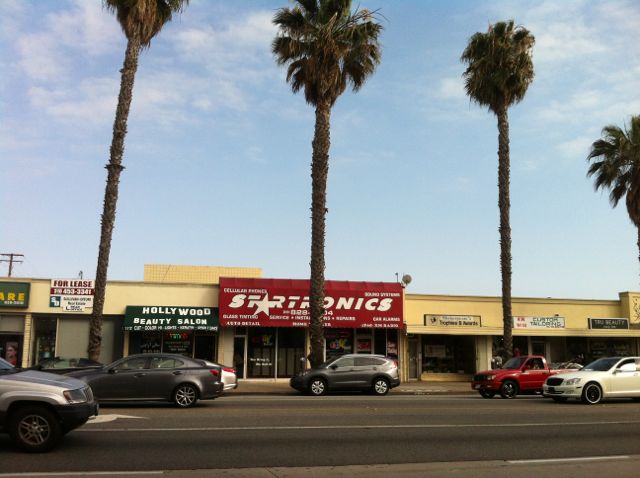
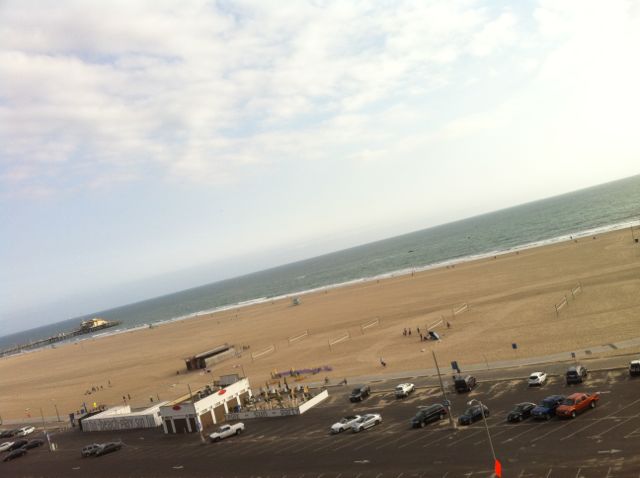
For our part, we Wilshire walkers got a carbo-loading afterparty — pizza, pita, fries, sweet potato fries, beer, chicken wings, all of which kept coming — on the roof of the Shangri-La hotel. We couldn’t resist taking the stairs. Having dragged myself up there, I pitched Tom an idea for next time: why not Pico?
IMG_0039

Los Angeles Review of Books Podcast: Grace Jung

Grace Jung

Colin Marshall talks with novelist, poet, translator, and film producer Grace Jung. She is the author of Deli Ideology, a new novel from Thought Catalog about one young woman’s experience of the Great Recession in New York and Seoul.

You can stream the conversation just above, listen to it on the LARB’s site, or download it on iTunes.

The History of Cities in 50 Buildings: The Renaissance Center

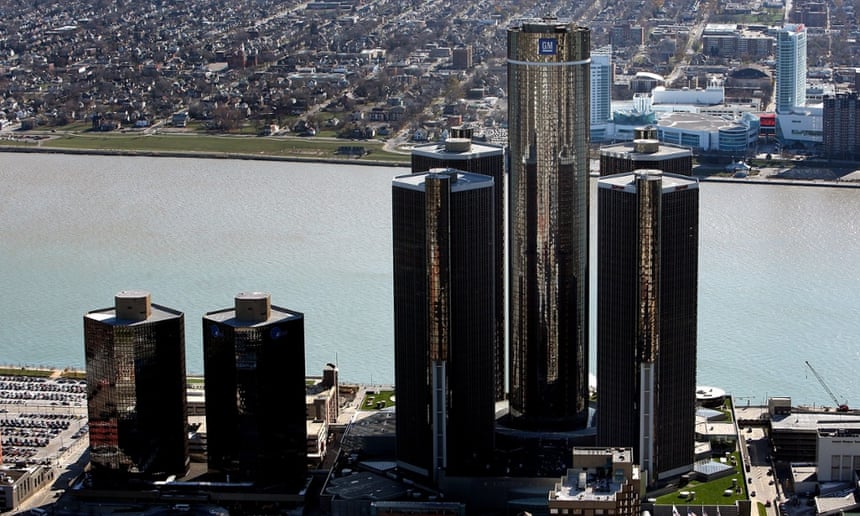
No one has taken as much blame for Detroit’s woes as the major American car companies who, through the early 20th century, concentrated themselves there to such an extent that the city’s name became a byword for the industry.

Despite the contradiction of an urban metropolis owing so much to an explosion in car ownership, for decades the arrangement worked reasonably well. But eventually, as the likes of Ford, Chrysler, and General Motors faltered – especially during the oil crises of the 1970s, when Japanese and European manufacturers gained the upper hand while homegrown ones responded with plant closures and massive layoffs – so the fortunes of the Motor City flagged.

Watching in dismay as his hometown turned hollower by the day, Ford chairman Henry Ford II had an idea: surely if all the car manufacturers – indeed, all the city’s industrial companies – got together, they could pool their resources and build Detroit out of its spiral? And so, in 1970, arose the non-profit organisation Detroit Renaissance, the city’s newest advocate for downtown – and, with its plan to kickstart the local economy by putting up the world’s largest private development, its most ambitious.

Read the whole thing at The Guardian.

The History of Cities in 50 Buildings: The Original Starbucks

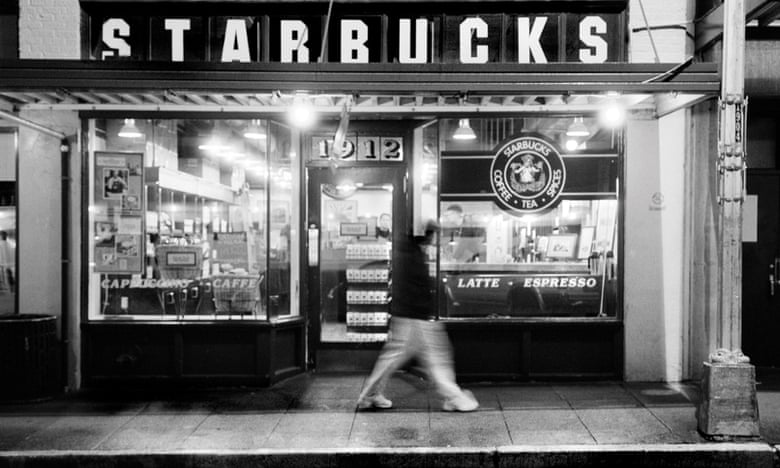
With more than 21,500 stores in 64 countries and territories, the Starbucks coffee chain has enjoyed the image of omnipresence for so long that jokes about walking across the street from one branch straight into another have themselves become clichéd. In certain cities, it’s simply the reality: Seattle, for instance, where the now universally recognised green mermaid got her humble start.

But when the very first Starbucks opened on 30 March 1971, its sign bore not a green mermaid but a brown one — and a more anatomically detailed one at that. Founders Jerry Baldwin, Zev Siegl and Gordon Bowker (friends from the University of San Francisco, all instructed in the art of roasting by Peet’s Coffee and Tea founder Alfred Peet) drew the theme of their new coffee company from nautical mythology, commissioning that first version of the company’s signature siren and picking a name out of Herman Melville’s Moby-Dick – “Starbucks” having narrowly pipped the second-place contender, “Pequod”.

You can still see Starbucks’ original mermaid, baring her breasts and spreading her tails, on the window of the “original Starbucks” (actually the second location of the original Starbucks, to which it moved in 1977) at Seattle’s tourist-beloved Pike Place market. A site of pilgrimage for Starbucks habitués the world over, the store offers not just all the drinks on the company’s modern menu — from normal coffee and espresso to chai tea lattes and caramel Frappuccinos — but a sense of just how much the operation has changed over the decades.

Read the whole thing at The Guardian.

Los Angeles Review of Books Podcast: Sam Quinones

Colin Marshall talks with reporter Sam Quinones, who covered gangs, drugs, and immigration at the Los Angeles Times for a decade. He has written the books Antonio’s Gun and Delfino’s Dream, True Tales from Another Mexico, and the new Dreamland: The True Tale of America’s Opiate Epidemic.

You can stream the conversation just above, listen to it on the LARB’s site, or download it on iTunes.

The History of Cities in 50 Buildings: The Southdale Center

Behold the shopping mall – the built epitome, according to its critics, of the mindless, car-bound consumerism of white-bread suburban America. Yet Southdale Center, the first fully enclosed, climate-controlled collection of shops from which all the 1,100 or so similarly designed malls now standing across the United States descend, came from the mind of an anti-car, pro-pedestrian European Jewish socialist.

Victor Gruen, a refugee from Nazi-occupied Austria, arrived in America in 1938 with high architectural aims. He soon launched a career creating New York City storefronts for urban businesses, like Ciro’s on Fifth Avenue and Steckler’s on Broadway, 14 years into which he received a commission to design something else entirely: a shopping centre 10 miles outside Minneapolis.

This job offered Gruen a blank canvas on which to realise his long-imagined utopian vision of an indoor city centre that would import the urbanity of his native Vienna into his fast-growing adopted homeland. Southdale itself went up as he had imagined it – but nothing else went according to plan. By the 1970s, Gruen had returned to Austria to live out his days having all-too-clearly realised what a suburban monster he’d created.

Though few built environments now seem as prosaic as that of the shopping mall, it looked downright radical when Gruen first came up with it. He first publicly submitted such a design in 1943, to Architectural Forum magazine’s competition “Architecture 194X”, which called upon modern architects to imagine the city of the post-war future. Alas Gruen’s entry, with its full enclosure and lack of a central square, struck even those forward-thinking editors as a bit much, and they sent him back to the drawing board.

Read the whole thing at The Guardian.

Everything I’ve written about Haruki Murakami for Open Culture

Haruki Murakami

I began writing for Open Culture with a post on In Search of Haruki Murakami, a BBC documentary on the elusiveness of the novelist and his work. In the years since, I do believe I’ve written more about Murakami there than I have any other culture figure, Western or Eastern, living or dead. (Orson Welles probably comes in second.) Here are all my posts of Murakamiana (fueled by Murakamania?) so far:

See also my favorite Open Culture posts so far, a list which of course includes a bit of Murakami itself.

The History of Cities in 50 Buildings: Levittown

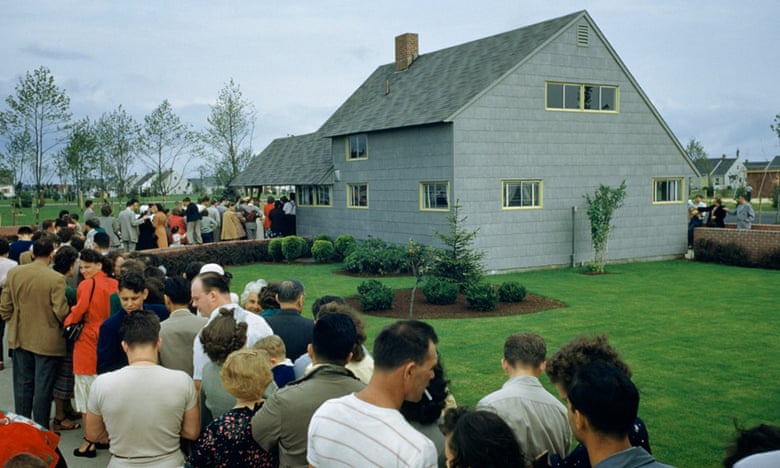
Levittown isn’t a single building but a development of more than 17,000 detached houses. The project – started in 1947 as America’s prototypical postwar planned community – has outlived its heartiest supporters and harshest detractors to stand today as something more complicated than a monument to the glory of the American dream, or to the blandness and conformity to which that dream led.

Like so much else in 20th-century America, Levittown began as a shrewd business move. The homebuilding firm of Levitt and Sons had specialised in upper middle class dwellings on New York’s Long Island before the second world war, only to be curtailed by the conflict’s enormous consumption of construction resources.

But then the founder’s son, William Levitt, came home from the navy with an idea: every young veteran returning to the United States would need a home. Couldn’t the mass-production strategies he’d learned putting up military housing give it to them?

Read the whole thing at The Guardian.