 Colin Marshall sits down for a pint at Nelson’s Retreat, a pub on London’s Old Street, with Neil Denny, host of Little Atoms, a show about ideas and culture on Resonance FM. They discuss whether beer improves or degrades the quality of ideas discussed; how the show’s concept has changed over time, differently involving notions of science, culture, atheism, the Enlightenment, and the left; how he began podcasting, and then had to stand out from the sudden morass of skepticism-themed podcast; the different role of religion in the United States and the United Kingdom, and the difficulty of making any untrue statement about America; what effect the events of July 7, 2005 had on the formation of the show; how he conceives of his interviews as encounters with authors you read at the pub; the early inclusion of Jonathan Meades on the guest list, and how he represents the show’s ever-growing interest in place; whether you must polarize to truly gain popularity; the Little Atoms American road trip, and what it taught him about how best to think about America’s dually prominent scientific and religious enterprises; the American sense of place and the built environment versus that of England; how he sought out the semi-secret public gardens in the skyscrapers of San Francisco; how both of them changed the way they frame their core interests on their shows, but not the interests themselves; how he feels when he listens to his own early interviews, from back when he labored under the feeling of fraudulence then inherent to working outside the “legitimate media”; guests’ welcome yet troubling compliments of, “You actually read my book” or “You really listened to me”; and friends’ equally telling questions of, “Can you really talk to somebody for an hour?”
Download the interview here as an MP3 or on iTunes.

Just a few songs into her set, the formerly Oakland-based Anna Ash admitted that she hadn’t yet emerged from the standard Los Angeles adjustment period. She felt especially unused, she emphasized, to still sweating in the middle of January, but had made enough progress to accept the idea of Los Angeles as simply “a different beast” from other cities. Enjoying a metropolis like this one — not that many metropolises resemble this one — doesn’t come naturally; most have to learn how to live well in it for themselves, picking up the knowledge essential to doing so however and wherever they can.
For music lovers, one bit of knowledge proves particularly helpful for the enrichment of their cultural life in Los Angeles: the existence of the Hotel Cafe, on whose stage I first saw Ash and her three-man band play. You’ve got to do a little work just to find it, given its location down a black-painted alley off Hollywood’s Cahuenga strip. Still, only by the standards of 21st-century self-promotion (especially as practiced Hollywood) does the place count as hidden; the management have put up a logo on the wall outside, albeit a tasteful one (especially, again, given the usual definition of taste in Hollywood).
Read the whole thing in the debut issue of the newly relaunched F.A.M.E.’ US magazine.
Thursday, February 27, 2014
 I Am Dandy: The Return of the Elegant Gentleman consists of 56 profiles of well-dressed men. Each one names the place of birth, current location, and occupation of the profiled. The first varies, the second tends toward the predictable urban suite of New York, London, and Paris, and the third includes such implausible careers as “creative advisor,” “flâneur,” “boulevardier,” “professional bohemian,” “reality escapologist,” and “editor.” Luminaries referenced in the interviews include Quentin Crisp, Stephen Tennant, and Sebastian Horsley. If you can’t put faces to those names, or can’t imagine the actual pursuits some of those lifestyles comprise, you fall squarely on one side of the many debates surrounding dandyism currently roiling on the internet, usually in quarters some distance from Put This On: should a dandy work, or should he live for elegance and leisure?
You may wonder what becoming a dandy — commonly understood as a man who wears, deliberately, the finest clothes he can, without fear of standing out — has to do with not having a real job. According to some of this book’s dandies, they have little to do with each other; according to others, for whom crafting and refining the presentation of themselves and their surroundings adds up to much more than a full-time gig, they have everything to do with each other. Writer Nathaniel Adams and photographer Rose Callahan teach the controversy, if you will, placing the consummately self-styled writers (Gay Talese makes a notable and unsurprisingly dignified appearance), wine buyers, filmmakers, musicians, brand managers, and businessmen alongside figures whose sources of income remain as mysterious as their biographical details, sexual orientations, makeup-free faces, and given names.
Read the whole thing at Put This On.
Tuesday, February 25, 2014

Who could cross the country by rail today without dreaming of a distant, more glamorous, wholly lost, and perhaps even partially imaginary era of American train travel? Who, indeed, could set foot in Los Angeles’ Union Station without doing the same? The building itself, built in 1939, is a palm-surrounded hybrid of Dutch Colonial Revival, Spanish Mission Colonial Revival, and Streamline Moderne, designed by John Parkinson, the English expat architect responsible also for City Hall, Bullock’s Wilshire, and the Memorial Coliseum. As the last of the country’s major railway terminals, it first made for a monument, and soon a memorial, to the heyday of passenger trains in the United States. Well-kept up even now, and seemingly always undergoing some type of restorative maintenance, Union Station at moments evokes the road not taken, one leading to, say, New York in an afternoon, rather than in 63 hours. (Not counting the inevitable delays.)
Just as the once-exhilarating promise of a long-distance train journey has become an occasion for preemptive despondency, so does Union Station feel at once grand and forlorn. Its original bold aesthetic vision, right down to its original weighty furniture, has survived, pulling through even its decades of near-desertion in the sixties, seventies, and eighties. This has made it a showpiece of high historical value, and a favorite touring spot for not just rail fans but enthusiasts of Los Angeles’ past. These qualities impress me, even as they fill me with impatience. How often, I regularly find myself asking, must a city so young ask us to appreciate a place because it shows off a flash of genius from a long-dead architect — who passed, in fact, almost five years before the building itself opened — or because colorful things happened there before, or may have?
Read the whole thing at KCET Departures.
Sunday, February 23, 2014
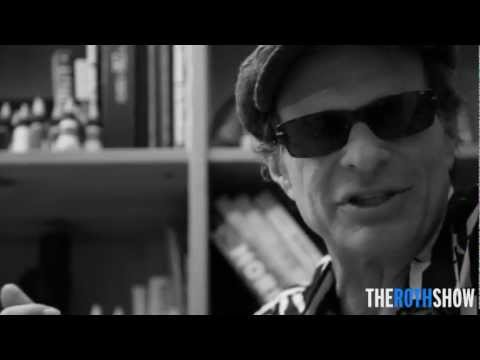
Vital stats:
Format: David Lee Roth’s “social-studies lectures by way of rock ‘n’ roll Babylon, at carnival-barker cadence”
Episode duration: 20-50m
Frequency: biweekly, with hiatuses
I found out about The Roth Show [RSS] [iTunes] from an in-depth profile of its host, yes, former and current Van Halen lead singer David Lee Roth. The article, Steve Kandell’s “David Lee Roth Will Not Go Quietly”, appeared on Buzzfeed, of all places, but I didn’t judge, I just marveled. Specifically, I marveled at Kandell’s description of Roth’s lack of furniture and possession of “a rack of Japanese katana swords,” his successful completion of an EMT program in New York and tactical medicine training in Southern California, his 600-pound ex-sumo wrestler language mentor, his apartment in Tokyo, his lifestyle “rich and weird and singular and driven by very particular and exotic enthusiasms ranging from mountain climbing to martial arts to tending to gunshot victims in the Bronx.”
Needless to say, Kandell’s mention of a Roth-helmed “sprawling one-man video series and podcast that aspires to do nothing less than tell the history of modern culture through the eyes of someone who has been everywhere, done everything, met everyone, and hired a couple of midgets to be his security detail along the way” raised my eyebrow. “It’s nothing more or less than David Lee Roth speaking for a half hour on, more or less, a single topic. Tattoos. FM and underground radio. The history and semiotics of pop videos by way of Picasso. A long-ago trip to New Guinea. His personal history with drinking and smoking. Slideshows from an unending vacation. The episodes are monologues, history lessons, personal taxonomy, but really, mostly just talking and more talking, social-studies lectures by way of rock ‘n’ roll Babylon, at carnival-barker cadence.”
Read the whole thing at Maximum Fun.
Sunday, February 23, 2014
 Colin Marshall sits down in London’s Tower Hamlets with composer and artist Robin Rimbaud, better known as Scanner. They discuss the usefulness of a new place’s disorientation; the fun of grasping that new place’s systems and making its connections; other skills in the set gained from a lifetime of travel; the “great change” he has observed living in east London for fourteen years, where he arrived in search of “light and high ceilings”; the value of his work’s taking him to places he doesn’t choose; what he learned long ago when his visiting American friend’s girlfriend reflexively called every difference in England “really stupid”; the ease of complaint and the difficulty of embracing these differences; the importance of pattern in all areas of life; the complex question of how to cross a street in Vietnam; travel as a means of seeing your own home; photography as a means of notetaking; his shelves of diaries, kept every single day since age twelve, and what it says about his overarching skill of discipline; self-documentation’s need of a system to give it meaning, and how his famous early Scanner work gave meaning to other people’s phone calls; the intriguing question of how, exactly, you ended up interested in something, friends with someone, or in a place; whether not liking a piece of culture just means you can’t connect anything else to it; the greater fascination of why others love something you don’t love, and the need to experience it all in order to value what you do love; why we had such strong allegiances to music as teenagers; Nick Drake, B.S. Johnson, and the non-connected creator alone against the world; how he facilitates connections himself by staying available at all times; what he listens to in London, especially the local accents and terms of address like “mate,” “love,” and “boss”; how friends visit London and fail to connect to the west end, whereas he remains excited by the rest of the city; and the joy of walking by the historic site of George Orwell’s arrest.
Download the interview here as an MP3 or on iTunes.
Wednesday, February 19, 2014

On the latest Los Angeles Review of Books podcast I have a conversation with the prolific and philosophical novelist Percival Everett, author of books like Erasure, Assumption, I Am Not Sidney Poitier, Percival Everett by Virgil Russell, and the newly reissued Glyph. You can listen to the conversation on the LARB’s site, or download it on iTunes.
Tuesday, February 18, 2014

Deep into my exploration of Los Angeles, I took my first trip to London, a city whose built environment one assumes contrasts in the starkest, least flattering way against that of the city I came from. A classic London architectural tour would take you past all the city’s least Los Angelinian aspects: Edwardian buildings lining the Thames, Big Ben, the glories of the neo-Gothic. Eschewing this pathway, I instead wandered without aim into the areas least in line with London’s self-image, all the while reflecting upon the many conversations I’ve had with Brits who’d left this native land of theirs, made a beeline for Los Angeles, and proceeded to enjoy their subsequent absence of regrets. Everyone cites writers like Christopher Isherwood and artists like David Hockney as this movement’s visionaries, and I still find the freshest perspectives of the city from their countless spiritual descendants, even if they’ve lived in Los Angeles a dozen times as long as I have.
You’ll mostly find them in the coastal northwest around Santa Monica, which seems well on its way to spearheading a new generation of British colonies. I rode out there one day to talk with Bath-born architecture and design journalist and broadcaster Frances Anderton on my podcast Notebook on Cities and Culture. Having grown up in a town known for its preservation of the image of one particular, long-gone England, Anderton found in Los Angeles an escape, as many of her countrymen do, from “the crushing burden of history.” And to the city’s ahistorical, untraditional aesthetic tendencies she credits not just the reflection of a kind of freedom, but the production of a kind of beauty.
Read the whole thing on KCET Departures.
Monday, February 17, 2014
My recent, first trip to London presented me with two surprises: the reach, convenience, and frequency of the tube, and the volume of Londoners’ complaints about the reach, convenience, and frequency of the tube.
English friends had explained to me, not without pride, the importance of grumbling to the national character, but I still want to stress to every Londoner I meet that — take it from a visiting Los Angeleno — the tube exists, and that counts as no trifling achievement. Beyond that, and like every other means of urban transport system around the world, it tells you nearly everything you need to know about the city it serves.
If you wish to understand London or any place else, look no further than how people move through it. This goes not just for subways, but overground trains, buses, cycleways, rickshaws, and every mobility solution in between. You can learn a great deal from robust transport systems, and even more from underdeveloped ones.
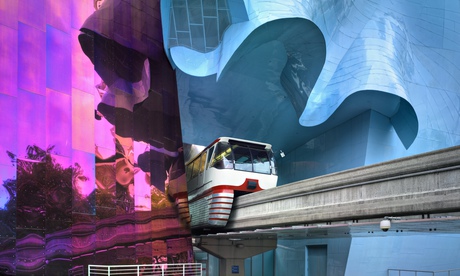
This line of thinking never occurred to me in my years growing up just outside Seattle, a city which I frequented but never gave much thought. Seattle’s “retro-futuristic” image has, for the past half century, rested in large part on a pair of structures built for its 1962 World’s Fair: the globally recognisable Space Needle, and the lesser-known but still sadly evocative monorail. While neither offer much of everyday value to the locals, the monorail – which takes the form but, in running back and forth on only a mile of track, not the function of a dedicated public transit system – stands as a reminder of the city’s many frustrated attempts at complete urbanisation. Proposals for a useful monorail network have risen and fallen over the years; the first light rail line there opened only in 2009.
Read the whole thing at The Guardian.
Sunday, February 16, 2014
 Colin Marshall stands around Hackney, London’s “Tech City” with urban designer Euan Mills. They discuss how to tip in a London bar and how to cross a London street; when he realized he has become an urban designer, and what that entails; the hugeness and non-understandability of the spread-out, car-dependent, crime-fearing São Paulo, where he grew up hating cities; the development of his interest in people, not buildings, and cities as networks of people; how he came to London, a city of paradoxes that still gives him the sense that anything exciting that happens will happen there; what, exactly, makes a “high street”; how zoning differences between the U.S. and the U.K. affect neighborhoods, and the sorts of changes he’s seen in London’s in the 21st century; This Isn’t F***ing Dalston, and what it told him about the edges of neighborhoods; how long a place takes to gentrify, and how it then matures, coming to embody all its eras at once; what bars, and the price of a pint of Guinness, tell you about a neighborhood; how everybody likes “authenticity” and nobody likes to feel like a target market; the test of a business you feel uncomfortable entering; what it means then the charity shops, 99p stores, and betting offices start showing up; the change in places like the growth in our hair, so show we don’t notice it; the necessity of combining local experience with placemaking expertise; São Paulo as a repeat of London in the 1960s, and the bad reputation top-down planning developed in that era; what to look for in London, like the intentions of a place or its people; the importance of thinking about who owns the land; and what effect the London weather might have on all this.
Download the interview here as an MP3 or on iTunes.