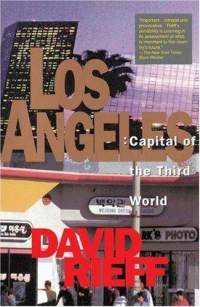
 When I noticed this book on a downtown library shelf, the prospect of a twenty-year-old assessment of Los Angeles by Susan Sontag’s “polemicist” son did not immediately appeal. Thinking of Sontag’s cultural affiliations with New York and Europe, one easily envisions nothing more than a prolonged dismissal of this city as a vast, backward hellscape of philistines and oppressed laborers. But since pre-judging a writer by not even his mother but an idea of his mother struck me as uncharitable — the very thing my imagined son of the idea of Susan Sontag would do to Los Angeles — I began reading. Rieff opens with an almost savage critique of friends and acquaintances in his New York coterie who, despite priding themselves on thinking with nuance and balance about issues like Israel-Palestine and German reunification (the year was 1991), blithely condemn the whole of Los Angeles with a misremembered Gertrude Stein quote or a one-liner that sounded warmed-over back when it came out of Woody Allen. Clearly, I was in for something unexpected.
Not far into Los Angeles: Capital of the Third World, either I remembered or Rieff reminded me that Sontag, though born and deceased in New York and buried in Paris, did a fair bit of growing up in Los Angeles. She even graduated from North Hollywood High, which puts her in the company of no less a Valley luminary than Adam Carolla (who, by his own admission, the administration just sort of waved through). Rieff himself logged a chunk of his back-and-forth, divorced-parents childhood in Los Angeles. So here we have a many-rooted and thus seemingly rootless cosmopolitan returning, in some sense, to the dirt where just one of these thin strands buried itself. No sooner does he emerge from LAX than he marvels anew at the openness, cleanliness, and peculiar conveniences — smiles, for instance — he’d grown accustomed to doing without in New York.
While these stars in Rieff’s eyes soon dim, he holds to this premise: we New Yorkers think of Los Angeles as undeveloped and culturally benighted, sometimes with good cause, but, y’know, we ain’t doin’ so hot ourselves. He directly and incisively analogizes the teeth-grinding freeway traffic to which Angelenos freely submit to the pervasive “filth and insecurity” to which he and his fellow New Yorkers have long since surrendered. He pokes fun at New York society’s increasingly apparent bewilderment, that of an out-of-touch parent, not only at Los Angeles’ failure to look east for guidance, but its lack of concern about what goes on in Manhattan at all. He relates terse telephone conversations with flinty friends back home who defensively repeat mantras like “Life is hard,” ridiculing the very notion that anyone, especially those airheaded Angelenos, might expect pleasure from existence rather than pain.
While inoculating himself against the cruder anti-Los Angeles prejudices, Rieff performs his own criticism of the city from what must have read, at the time, like a fresh angle. He enters Los Angeles from and bases himself in its wealthier, coastal westside. There he attends cocktail parties and visits friends of friends who, slowly but surely, reveal their startlingly total ignorance about neighborhoods mere miles from their own. Investigating further, he builds a narrative of Los Angeles starting with an improbable early 20th-century greening of the desert. This continues into large-scale salesmanship for the resulting “Anglo-Saxon homemaker’s” ideal place in the sun. Then follows the development of a freeway-laden constellation of otherwise isolated municipalities optimistically meant to avoid the entrenched troubles of the eastern industrial metropolis. By 1990, where Rieff came in, we watch the bewilderment as this Los Angeles dream fragments into something much more alien.
Though he gets decent mileage out of conversations with their illegal “help,” Rieff ultimately loses interest in westsiders and their real estate-y concerns. He spends more “vivid, peculiar, and unsettling” days among Los Angeles’ various immigrant populations, whose steady inflow from Mexico, Central America, and Asia — not to mention all of that era’s ominously direct Japanese investment — seems to have taken the “natives,” Anglo-Saxon homemakers and otherwise, by surprise. Sensing a local knack for the language of branding, Rieff notes how many Angelenos respond by boosterishly calling Los Angeles “the capital of the Pacific Rim” — indeed, the only American sub-economy diverse enough to compete with shrewd, calculating Japanese corporations otherwise raring to buy and sell the entire country. Certain well-to-do westsiders insist that Los Angeles’ Latin Americans and Asians will assimilate like New York’s Italians and Jews, but Rieff doesn’t see it happening — in fact, sees it actively not happening.
Rieff writes of much white, middle-class hand-wringing over the possibility that, assimilated or no, these waves of foreigners will wash them out of their exceptionalist Eden. And I understand the appeal, at least in the abstract, of a land of year-round sunshine that affords you — afforded you — a quiet, detached home of your very own, surrounded by an apron of Shropshire-grade lawn, from which you can smoothly motor — Twenty Minutes to Everwhere! — on those gleaming new freeways to your secure job in a faraway downtown tower. But I don’t feel it. Even today, I witness spasms of this strange nativist anxiety from longtime Angelenos, often triggered by exasperation at the prominence of the Spanish language they refuse to learn. “Betrayal” is the word Rieff uses; these people feel betrayed by the densifying, variegated, hyperpolyglot Babel of trains, towers, and desert gardens “their” city is becoming. But I would have moved to no other Los Angeles.
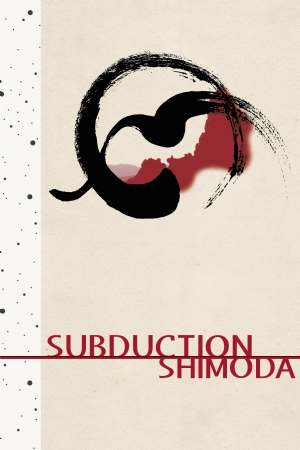
 Colin Marshall sits down in Little Tokyo with novelist Todd Shimoda, author, in collaboration with visual artist L.J.C. Shimoda, of “philosophical mystery” novels with science, engineering, Japanese and Japanese-American themes. His latest, Subduction, follows a disgraced young physician into his four-year exile on a tiny, earthquake-prone, mythology-freighted island off the Japanese coast. They discuss Japan’s very real earthquakes in Kobe and Fukushima; the book’s obsessed characters, whether obsessed with seismology, documentation, or simply staying on the island; the question of how much scientific data he can safely include in a novel, and if this age of Wikipedia changes that; the “four-dimensional” Japanese cultural co-existence of mythology and science, and its blurred boundary between practice and belief; writing a novel of Japan without writing a novel of Japanese-ness, and avoiding other problems that befall Westerners’ writing about the East; Haruki Murakami, Kobo Abe, and the Japanese International Style; his risk of real-life island despair while living on Kauai, and his regular, pendulum-like moves between the urban, suburban, and rural worlds; how to use the cultures that converge in Los Angeles to write a novel of Los Angeles, where the appearance of no neighborhoods becomes the reality of too many; the city’s actual earthquake of the previous evening; Chin Music Press’ sense of geographic place; and the availability of a constant stream of Western fascination with Japan for a novelist to tap into.
 Angelenos, you can catch me live-interviewing
 Colin Marshall sits down in Barnsdall Art Park with Hollywood Steve Huey, writer and media personality, former critic at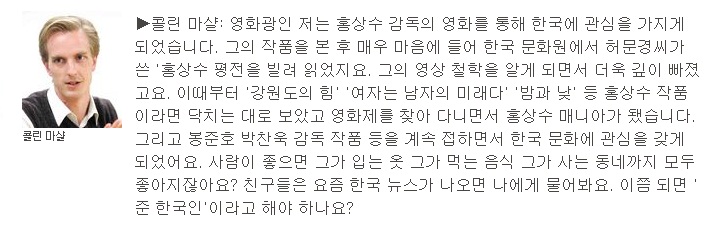

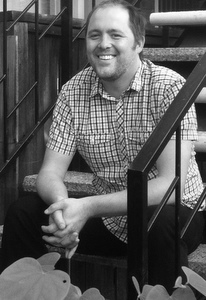 Colin Marshall sits down in Silver Lake with Eric Brightwell, proprietor of both
 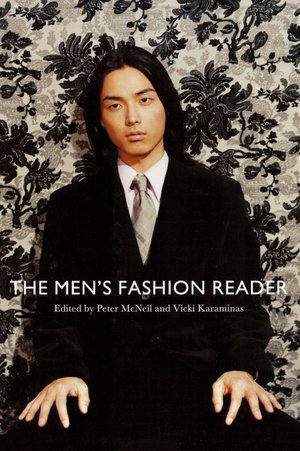 For all its relevance to their interests, I wonder how many menswear enthusiasts would, or could, sit down and read this book. Despite coming in the same thickness and glossiness as many standard menswear books do, The Men’s Fashion Reader has no dressing advice to offer, nor does it concentrate exclusively on the history, development, or mechanics of men’s clothing. It does contain a great deal of analysis, delivered in the form of 35 separate articles on everything from dandyism to the Japanese adoption of the western suit to the rise and fall of the Men’s Dress Reform Party. And indeed, any man who takes an active interest in what he wears will find dozens upon dozens of fascinating pages — embedded, alas, within hundreds of academic ones.
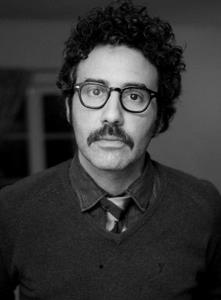 Colin Marshall sits down in Silver Lake with comedian, writer, and comedy writer