Skip to content

The Los Angeles Review of Books Podcast: Brad Listi

Colin Marshall talks with Brad Listi, founder of literary and culture site The Nervous Breakdown and author of the novel Attention. Deficit. Disorder. He also hosts the podcast Otherppl, on which, right here in Los Angeles, he has conducted “in-depth, inappropriate interviews” with over 400 writers about their lives, their working methods, their social media habits, and what they think happens when we die — among many, many other topics.

You can stream the conversation just above, listen to it on the LARB’s site, download it on iTunes.

The Korea Blog: Protest, Korean-Style

The first piece of writing I ever read on Korea had to have been P.J. O’Rourke’s “Seoul Brothers,” originally published in Rolling Stone in 1988. O’Rourke, whose work in many ways inspired me to get into writing myself, back then had the beat of the troubled parts of the world; I first read this particular article in a collection called Holidays in Hell. It opens as follows: “When the kid in the front row at the rally bit off the tip of his little finger and wrote KIM DAE JUNG in blood on his fancy white ski jacket — I think that was the first time I ever really felt like a foreign correspondent. I mean, here was something really fucking foreign.”

O’Rourke had come to Korea to cover the turmoil around the country’s first free direct presidential election. A Korean friend of mine, an economist as well as a fan The Economist, remembers opening up that magazine some time ago and reading an article which began with words like, “South Korea, which became a democracy in 1987…” — words which startled her. She on one level knew, of course, that her homeland held its first genuinely democratic (or close-enough) elections in that relatively recent-sounding year, but it’s one thing to know it, and quite another to have it plainly stated back at you as an acknowledged fact by a respected international news outlet.

History remembers Kim Dae-jung as an icon of Korean democracy, but despite having proven inspirational enough in December of 1987 to get his supporters writing his name in their own blood, he wouldn’t win the presidency until 1998. He ran against the late Kim Young-sam, who would serve as President first, from 1993 to 1998, and they both lost to Roh Tae-woo, President from 1988 to 1993, though rumors of vote fraud swirled around his victory fast enough that O’Rourke had the opportunity to don a helmet against the hail of thrown stones and a ventilator mask against the tear gas (which seems to have constituted a basic element of Seoul’s atmosphere in the 1980s) and make his way into a ward office occupied by enraged student radicals and under siege by the police.

Read the whole thing at The Los Angeles Review of Books.

The Korea Blog: Why I Left Los Angeles for Seoul

I’ve started a new Korea Blog for the Los Angeles Review of Books, and my first post there addresses the question of why I left Los Angeles for Seoul in the first place:

Three weeks ago, I moved from Los Angeles’ Koreatown to Korea itself. The relocation happened not suddenly but after years of planning, and as the date of the one-way flight came within a few months’ time, I found myself more and more frequently pressed to answer the same question: why? Why did I want to move across the Pacific Ocean to a country the size of Indiana, a country many Americans know only for a poorly understood war back in the 1950s (and then mainly through the 1970s television dramedy ostensibly set in it), an impoverished and feistily militaristic northern neighbor, and, more recently, squadrons of pop singers often sonically and visually indistinguishable from one another?

But I’ve hardly gone to Korea without precedent. Nowadays, most of those Americans who couldn’t describe Korea in even the broadest strokes themselves know a few other people who’ve been, whether as members of the U.S. military stationed here or, more often among Californians, college graduates who do a year or two of English teaching here to pay off student loans. The soldiers and English teachers still do more than their part to color the Westerner presence in Korea, but I didn’t want to join their ranks; I had to come on my own terms, outside of the established roles and acknowledged types.

This sort of venture has more of an association with Japan, inspirer of so many English-language expatriate memoirs and observational writings since the Second World War. I’ve enjoyed those books, and even taken their tradition as something of a research interest, but the Westerner-in-Japan narrative has, by now, assumed a pretty standard form. The Westerner-in-Korea narrative, however — essayed by Isabella Bird Bishop and the astronomer Percival Lowell in the late 19th century as well as Simon Winchester, Michael Stephens, and Clive Leatherdale in the late 20th, though none of them made a permanent home in the country — has yet to really take shape. The desire to experience that narrative for myself counted as one reason to leave America.

Read the whole thing at the Korea Blog.

The Los Angeles Review of Books Podcast: J. Ryan Stradal

Colin Marshall talks with J. Ryan Stradal, fiction editor at The Nervous Breakdown, editor-at-large at Unnamed Press, and advisory board member at 826LA. He is also the author of Kitchens of the Great Midwest, which offers at once its own spin on the modern food novel and its own spin on the modern family novel, telling dozens of stories about Midwesterners and the food they eat through the rise of one young girl, connected to all of them, who becomes one of the most respected chefs in America.

You can stream the conversation just above, listen to it on the LARB’s site, download it on iTunes.

Portland, the City in Cinema


Portland hardly runs the risk of cinematic overexposure, but when we see real a Portland movie, one with a sense of place, we remember it. These run the gamut from the 1950s noir morality play
Portland Exposé and nuclear-strike preparedness special A Day Called X to Penny Allen’s 1978 land-use satire Property to the work of such Portland auteurs as Gus van Sant, Kelly Reichardt, and Aaron Katz — not to mention the unerotic erotic thriller Body of Evidence, the pseudoscientific docudrama What the Bleep Do We Know!?, and B-movie master Albert Pyun’s Andrew Dice Clay vehicle Brain Smasher… a Love Story. All of them take the elements of Portland’s urban space — the bridges, the MAX trains, Big Pink, the woods just outside the city — to constitute a fascinating body of modern Portland urban cinema.

For more The City in Cinema video essays, visit its Vimeo page.

This Friday: a free screening of Blade Runner in San Francisco, introduced by yours truly

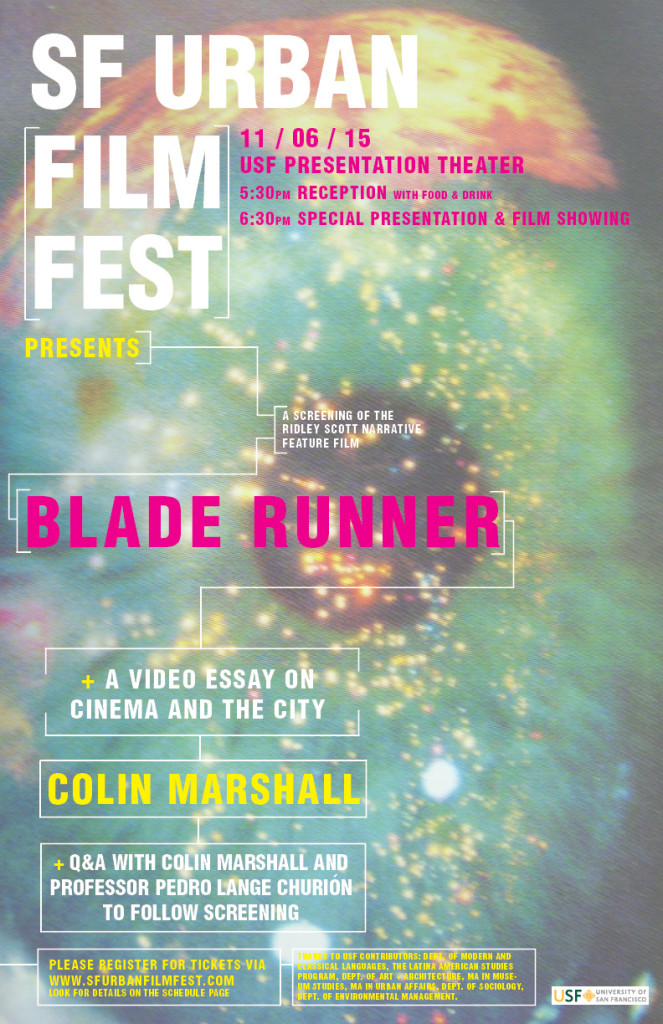
FILM_FEST_POSTER.finalSan Francisco urbanist-cinephiles! This Friday at the second annual San Francisco Urban Film Festival, with its theme of going “beyond dystopia,” you can catch a free screening of Ridley Scott’s Blade Runner, whose vision of 2019 Los Angeles established our aesthetic vocabulary for urban dystopia — but how dystopian does it really look these days?

I’ll show up to give a talk about that and other questions before the screening, and do a Q&A with professor Pedro Lange-Churion afterward. You’ll find all the details (especially those about getting your free tickets) here. You can follow the San Francisco Urban Film Festival on Twitter @SFUrbanFilmFest. And if you like, have a look at my City in Cinema video on Blade Runner beforehand. Start thinking dystopian now, and I’ll see you in San Francisco.

It’s the Final Day to Fund “Where Is the City of the Future?” — But Will This Urbanist-Travel-Cultural Journalistic Journey Happen?


Where is the city of the future? Unless we raise at least $860 today, we can’t even begin to find out. The final day of the funding period for this in-depth experiment in crowdfunded interactive urbanist-travel-cultural journalism across the Pacific Rim has come, and it all hangs in the balance. If you’ve already joined in but have friends who might want to get involved as well — friends who love cities, friends into travel on the Pacific Rim, friends who enjoy receiving postcards from exotic places (wherever they would consider “exotic,” from Sydney to Santiago to Seoul to Seattle), this is the time to bring them on over — specifically, to the project’s page on Byline, the new platform especially for crowdfunded journalism.

As I’ve previously mentioned, each $2000 “Where Is the City of the Future?” raises on Byline will produce one report, or long-form series of articles, on one particular Pacific Rim city that could serve as a model for the city of the future. We’ll begin with Los Angeles and Seoul, then move on, depending on the budget raised, to the other world cities of the Pacific Rim, in an order voted on by you, the supporters. And if you support the project at the top level, you can simply name the Pacific Rim city of your choice, and I’ll head over and do a report on it — after, of course, consulting you for your own thoughts on the place!

It goes without saying that “Where Is the City of the Future?” works best — indeed, works only — with the comparative aspect intact. You can’t really look for the city of the future among only one or two or three cities; you’ve got to cast a wider net, and this project intends to cast as wide a net as it can across the urban Pacific Rim. And so the bigger the budget we raise, the more interesting a reading (and viewing, and listening) experience the final product can become. Let’s make it as interesting as possible — in the urbanistic sense, the exploratory sense, the cultural sense, the culinary sense, the architectural sense, and all others besides — today. Thanks very much indeed, and I’ll see you over at Byline.

Diary: This American Road, Raleigh (and Asheville)

Cross-country 2015 - 65

Before arriving in Raleigh, the final destination of this cross-country road trip, we stopped in Asheville, one of those places often found alongside the likes of Athens, Georgia and Marfa, Texas in clickbait slideshows about America’s Coolest Cities of Under 100,000 People. It didn’t answer my long-standing question about who’s doing the clicking and why (coolness or low population; you kind of have to choose one), but I could see why it impresses visitors: it has well-regarded bookstores; it has an architecturally sound and human-scaled downtown (still an astonishing novelty to so many Americans); it has a pinball museum (closed, alas, when we passed by); it has a confectioner who makes shoes out of chocolate.

I didn’t leave with a chocolate shoe, but I did leave with a copy of Lawrence Osborne’s Paris Dreambook purchased, after flipping through it over a generous cheese plate, from the well-curated and highly explorable Battery Park Book Exchange and Champagne Bar (the name alone…), located in a restored shopping arcade somewhat reminiscent of the Bradbury Building back in Los Angeles. Despite having sworn off purchasing books in the months before my move to Korea, I do make exceptions for volumes on cities (professional interest, surely you understand), especially when I personally like the writer (and my interview with Osborne about his Bangkok book remains one of my very favorites from the Marketplace of Ideas days).
Cross-country 2015 - 70

Apart from Quail Ridge Books, an event-intensive strip-mall bookstore beloved of no less a locally raised man of letters than David Sedaris (whose signed portrait, hung in the bathroom, reads “I was a monster in 2009”), Raleigh, or at least my experience of Raleigh, seemed to me less about books than about food. Calvin Trillin wrote at length about the struggle for the soul of North Carolinian barbecue in the New Yorker just the other day, naming Raleigh as “the line of demarcation that separates the two principal schools” of that culinary art form.

But ironically, North Carolina counts as the sole barbecue-oriented state we passed through on our road trip in which we ate no barbecue at all: we had it in Texas, we had it in Arkansas, and we had it in Tennessee, but we wholly missed out on both eastern North Carolina’s version, “where barbecue means the whole hog, chopped, with a vinegar-based sauce that is flavored with pepper,” and western North Carolina’s version, which “uses only pork shoulders, chopped (or, sometimes, sliced), with a sauce that is also vinegar-based but has been turned pinkish by the addition of ketchup or tomato sauce.”

We did, however, eat Korean food, or in any case an intriguing local version of Korean food. After ten days on the road, I’d worked up a mighty craving for even a simple kimchi jjigae (or especially a simple kimchi jjigae), and so we stopped in for lunch at Kimbap, a “Korean-inspired” cafe in what I understand to be the Raleigh’s most interesting current food neighborhood outside downtown. If the menu offered kimbap I didn’t see it, but the dishes we did find provided a tasty experience at the intersection of traditional Korean food and hardcore North Carolina locavorism. (Its kimchi had a refreshingly vinegary taste — a distant echo, perhaps, of the eastern North Caroninian love of the stuff in their barbecue?)
Cross-country 2015 - 69

We had a chat with the chef, a Korean-born, Michigan-raised adoptee who surprised us with the revelation that she’d never once set foot in the land of her ancestors (not to mention the land of our next residence) after her adoption. I insisted that she visit, if only because she seemed like the ideal person to enjoy a food tour there, but Kimbap has cleared the bar of two and a half years in business, keeping her busier and thus less able to travel than ever with its ongoing demonstration of the apparent viability of selling Korean cuisine to Raleighites.

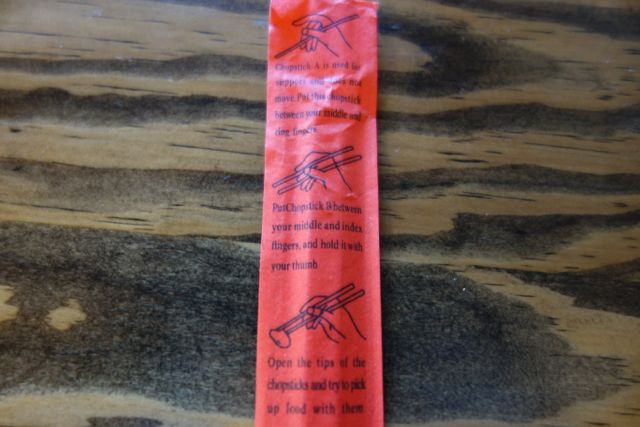
But the market hasn’t yet reached a saturation point, as indicated by the restaurant’s chopsticks, which come in sleeves printed with directions for how to use chopsticks. If I’d seen that in California, I’d have taken it as an attempt at irony, but North Carolina didn’t strike me as a particularly ironic place. Even there, though, I wonder how long we’ll see this sort of thing. I can’t think of a single American friend of my generation unable to eat with chopsticks, but I get the sense that Asia itself hasn’t yet got word about how thoroughly their stateside usage has spread.

My own unhesitant (if not unusually skillful) chopsticking has drawn expressions of astonishment from certain Koreans in both their homeland and mine, a reaction often revealing more surprise than the one I get when I actually speak Korean — though I did score a twofer once when, at a Koreatown Korean Chinese restaurant (a distinct variant of Chinese cuisine, with dishes as signature as though much more defined than American Chinese food’s orange chicken and chop suey), I explained in that language to the middle-aged lady who suddenly appeared at my side two-handedly proffering a fork that, thank you, but I didn’t need one.
Cross-country 2015 - 74

We ate more often downtown, and you can’t talk about downtown Raleigh food, so I gather, without taking about Ashley Christensen, the well-known chef who runs seven popular bars and restaurants in the city. We got to four of them in the span of two days without really trying: Beasley’s Chicken + Honey, a sort of North Carolinian Roscoe’s Chicken and Waffles; Chuck’s right next door, a specialty hamburger joint boasting myriad French-fry dipping sauces; Fox Liquor Bar, a brick-walls-and-bare-bulbs sort of place underneath Beasley’s and Chuck’s; and Poole’s, a new-wave diner open late enough for us to hit up after an event (although “late” in this case means midnight, a sign that downtown Raleigh has a little way to go yet, though huge swaths of Los Angeles suffer exactly the same problem).

Of course, I imagine that some hardcore Raleigh eaters and drinkers disdain Christensen’s restaurants in the same way that some hardcore Portland eaters and drinkers disdain the McMenamin’s establishments. But you know what? I’ve drawn great pleasure indeed from every McMenamin’s place I’ve visited, and at this point a visit to Portland wouldn’t feel complete without at least one. (It does boggle my mind, though, that with the Anderson School they’ve expanded into Bothell, Washington, the crappy suburb next to the crappy suburb where I went to high school.) Maybe, a few Raleigh trips from now, I’ll come to feel the same way about the Christensen empire.
Cross-country 2015 - 83

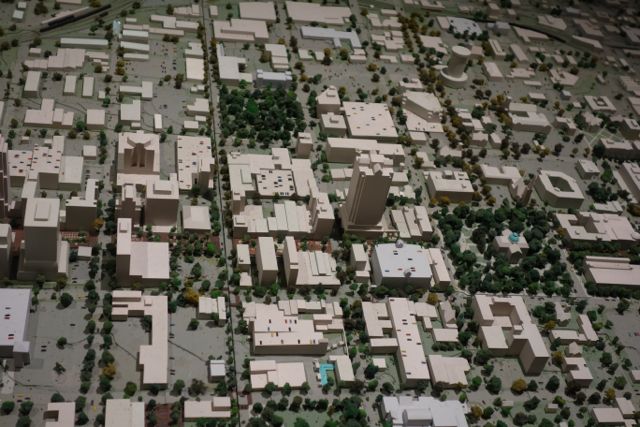
Raleigh’s other urban amenities I find it a bit harder to judge. Like many midsize American cities, it lacks even the most basic rapid transit system, though discussions have begun; in the doorway of a gift shop I found brochures detailing the pros and cons of rail versus bus rapid transit, though nothing will actually happen until 2026 at the earliest. I didn’t get the chance to ride the R-LINE, a nifty-looking free downtown circulator bus (albeit one that only goes in one direction and only comes every fifteen minutes). But we did stop by the also-free City of Raleigh Museum, whose maps and models on display give a sense of the city’s layout and how it developed. (I wish every city had one of those; I’d make them the first stop as a rule.)

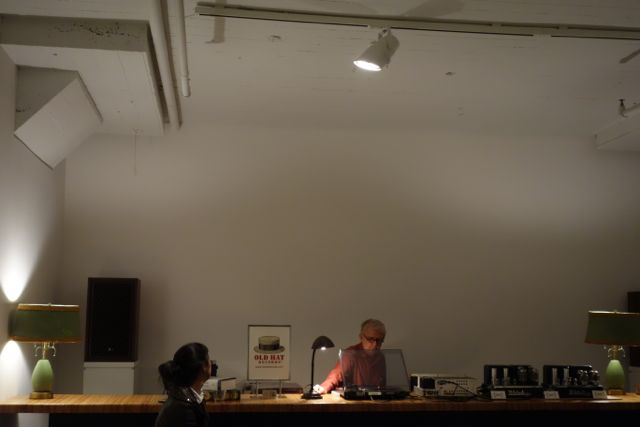
As always, on American road trips or any other form of travel, the most memorable things come unexpectedly. I put the call out on Twitter for recommendations from Raleigh urbanists, and someone replied to suggest the Contemporary Art Museum Raleigh’s kissa, held weekly on the building’s bottom floor and modeled after the 1950s Japanese kissaten, “bars and cafes where music lovers could share their record collections with devoted and curious listeners.”

On the week we happened to attend, we drank wine while listening to selections from the formidable collection of Marshall Wyatt, proprietor of vintage-Americana label Old Hat Records, concluding our journey through America’s present with a plunge into America’s past. Toward the end of the evening, Wyatt pulled out a piece of vinyl to which he said he wanted to give a special introduction, one that would let him “say the three words every collector longs to say: only. Known. Copy.” Misuse of the word “unique,” a habit common to American speech, has started to grate on me after thirty years here (maybe that along has driven me to Korea), but here we had a genuine opportunity to use the word: a unique recording in a unique country.

The Los Angeles Review of Books Podcast: Farley Elliott

Colin Marshall talks with Farley Elliott, senior editor at Eater Los Angeles and author of Los Angeles Street Food: A History from Tamaleros to Taco Trucks, a hybrid history of and guide to everything one can buy and eat on a sidewalk in this city, from taquitos on Olvera Street to illegal backyard Burmese restaurants in the San Gabriel Valley to new-wave fusion food trucks of the likes pioneered by Roy Choi’s Korean-Mexican Kogi fleet.

You can stream the conversation just above, listen to it on the LARB’s site, download it on iTunes.

Diary: This American Road, Memphis, Nashville, and Knoxville

Cross-country 2015 - 46

We pulled into Memphis at night and drove to Knoxville the following day, stopping in Nashville somewhere in the middle, then rolled on to North Carolina the morning after that. If you need to see the three biggest cities in Tennessee and have absolutely no more than 36 hours in which to do it, I can tell you how we did it.

We began with a bracing shot of déjà vu, dragging ourselves into the lobby of the Memphis Courtyard by Marriott that looked and felt in all respects identical to the lobby of the Oklahoma City Courtyard by Marriott in which we’d drank away the vibrations of the road the day before. At first I assumed the details would differ. Surely the Memphis instantiation of The Bistro wouldn’t have the same folksy chalkboard with its handwritten imperative to “Try Our Classic Oatmeal.” But it did indeed have the same folksy chalkboard — just propped up on the opposite shelf.

Cross-country 2015 - 45

I never tried their Classic Oatmeal. I always get excited about complimentary continental breakfasts at hotels (despite seldom eating anything from them but Raisin Bran), and at this point in life have come to expect them as a standard offering of the traditional hotel industry, perhaps the sole remaining reason not to go with an Airbnb 100 percent of the time (though I’ve noticed many Airbnb hosts raising their breakfast game lately).

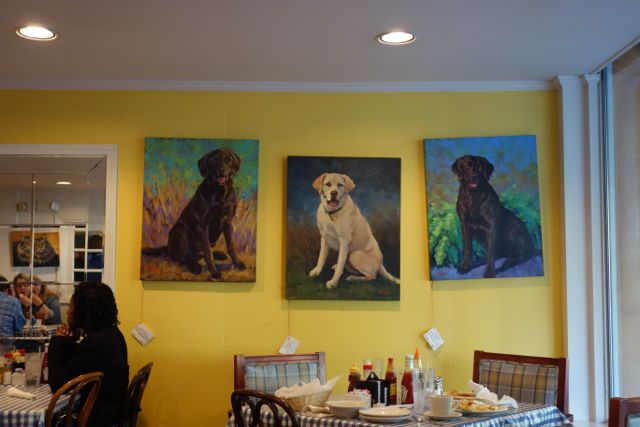
Bizarrely, Courtyards by Marriott don’t offer a continental breakfast, an unexpected point of tackiness I pondered while drinking my three-dollar coffee from The Bistro. But the lack of free Raisin Bran meant a chance to eat at a downtown institution instead, and so we ended up Sunday-brunching at the Blue Plate Cafe, where we put away a few omelets under the happily vacant gaze of dozens and dozens of dog portraits, their painter one of Memphis’ very own.

Cross-country 2015 - 50

I find few activities as pleasurable as discovering an unknown downtown on foot, and I looked forward to seeing what Memphis’ had to offer with the aid of its historic streetcar lines. Alas, I found whole system shut down for renovation since a fire in 2013, and its rails and stations remain silent today.

So instead of my usual improvised downtown tour, we opted for a tour of the official variety: specifically of Sun Studios, which some might know as the place Elvis got his start, but others, people like me, might know as the place to which Youki Kudoh and Masatoshi Nagase make their pilgrimage in Jim Jarmusch’s Mystery Train. Only one member of our tour group had managed to put together a credible 1950s rocker look for the occasion — pompadour, sideburns, cuffs, Converse — and he, not that surprisingly, turned out to have come all the way from Switzerland. Lucky nobody Japanese had turned up; they’d surely have eaten his subcultural lunch.

Cross-country 2015 - 54

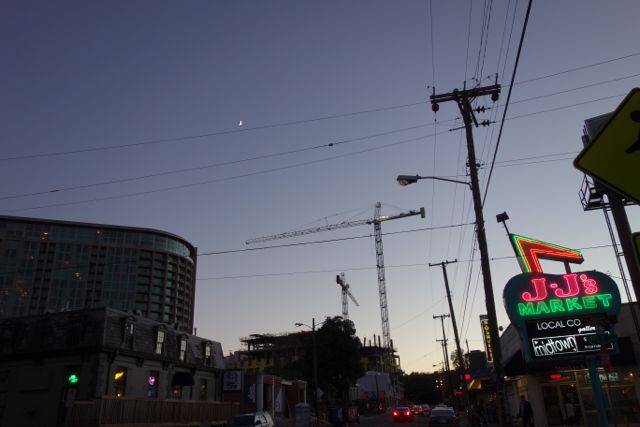
Tennessee ranks as only the 36th largest state in the Union (and actually, it roughly matches the size of South Korea, though Indiana, number 38, gets closer), but it still takes between three and four hours to drive from its first city to its second. The high-rises and elevated freeways of Nashville (not to mention its scores of construction cranes, hard at the apparent work doubling the size of the city) came into view just as the desperation for some urbanity was about to get the better of me.

We’d also felt a desperation for nachos for some miles, and so made for an oasis in Midtown (not to be confused with Oklahoma City‘s MidTown) called, simply, Tavern, whose staff, seeming to sense our weariness, seated us in a corner circular booth of our own, poured us some restorative cider and sangria, and served us a heap of tortilla chips, cheese, guacamole and something called “angry chicken.” On the table stood a variety of hot sauces, three of which came in brown eye-dropper bottles labeled only “X,” “XX,” and “XXX.”

simpsons sunsphere

After dinner we took a walk through Music Row (small speakers embedded in whose sidewalk utility boxes pipe out the hits 24/7), ending up at the kind of third-wave coffee shop, built in the comparatively cavernous space of a renovated garage, that makes you wonder not whether you could move to its city, but how soon you should. It helped that, from what I could tell through their illuminated floor-to-ceiling windows, all the nearby condos (whether still under construction or very recently finished) looked comfortable indeed.

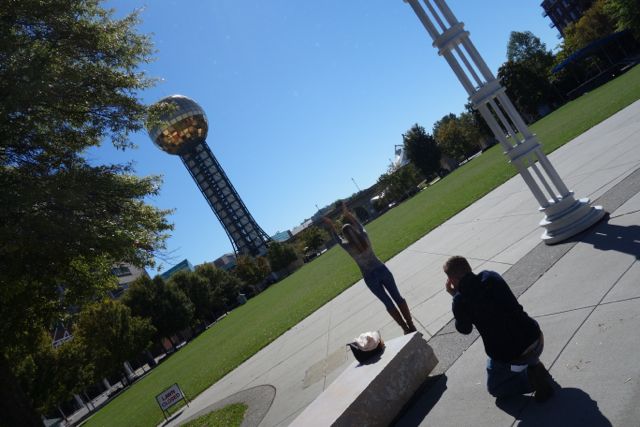
Part of me wondered if I’d see anything like it in Knoxville, but a bigger part of me — just like any thirty-year-old American male, and thus exegete of The Simpsons‘ 1990s golden era — wondered what I’d find when I made my own pilgrimage to the Sunsphere, at which Bart, Milhouse, Martin and Nelson once arrived fourteen years too late for the 1982 World’s Fair (and ultimately knocked over).

Cross-country 2015 - 62

I enjoy old World’s Fair grounds, and the park Osaka maintains at the site of Expo ’70 remains, for me, the old World’s Fair grounds to beat. Knoxville’s modest but pleasant equivalent doesn’t beat it, but there you can visit the Sunsphere’s observation deck and behold all of Knoxville laid before you for free, each vista’s accompanying display informing you of, say, the city’s title of red panda capital of the western hemisphere. (It reminds me of the non-free towers that overlook some Asian cities, especially Busan’s, though the Sunsphere boasts something called the “Icon Ultra Lounge” — currently closed, like Memphis’ trolleys, for renovation.)

If I lived in Knoxville, I’d live in the condo building with the best Sunsphere view, a converted candy factory from the turn of the 20th century with a chocolate shop on the bottom floor. As I stocked up on Sunsphere bars there, the owner excitedly told us about the coming developments in Knoxville’s own downtown revitalization, working in a sentiment I’ve heard in almost every city on this trip, and indeed almost every city in America from Los Angeles on down: “If you’d told me this place was going to come back to life ten, fifteen years ago, I’d never have believed you.”