Skip to content

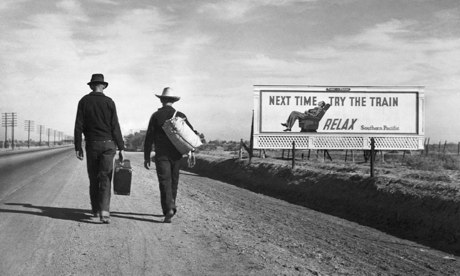
My debut for the Guardian, on the statelessness of Los Angeles

In drawing up our blueprint for a new metropolis, what can we learn about its layout from sprawling, stateless Los Angeles – whose grotesque size and dizzying variety of form surely repudiate the very notion of an ideal city? As soon as you think you’ve identified how it looks, how it acts, the condition to which it aspires, or even which nation or culture it belongs to, the opposite conclusion inevitably rushes up to confront you mere minutes down the road.

This lack of definition makes it no easy place to write about, and the challenge has reduced many an otherwise intelligent observer to the comforts of obscurantism and polemic. Nobody understands Los Angeles who thinks about it only through the framework of its entertainment industry, its freeways, its class divisions, or its race relations. I don’t even pretend to understand Los Angeles, but living here I’ve undergone the minor enlightenment whereby I recuse myself from the obligation of doing so.

My own time in LA has, in fact brought me to see many other world cities as theme-park experiences by comparison, made enjoyable yet severely limited by the claims of their images. San Francisco has long strained under the sheer fondness roundly felt for it, or at least for an idea of it, never quite living up to how people imagine or half-remember it in various supposedly prelapsarian states of 20, 40, 60 years ago. New York has similarly struggled with perceptions of it as the ultimate expression of the urban, and even lovers of Paris come back admitting that Paris-as-reality seems hobbled by Paris-as-idea.

I look around my own neighborhood of Koreatown and wonder what set of ideas could ever accommodate it. In its officially just under three, but in practice over five, of the densest square miles it churns business and culture brought straight from not just South Korea but southern Mexico as well. It all happens in and amid the sometimes incongruously grand structures of what they used to call the Ambassador District, an area swanky enough by the standards of 1930s and 40s America that it hosted Academy Awards ceremonies back then. I have a hard time imagining Koreatown emerging quite so robustly in any city contained by a vision.
Read the whole thing at The Guardian Cities.

Notebook on Cities and Culture S4E21: This Is Home Now with Melanie Haynes

Colin Marshall sits down in Copenhagen’s Frederiksberg with Melanie Haynes, author of the blog Dejlige Days. They discuss the Danish national virtue of hygge (and the also important quality of dejlige); how she came to leave her native England for Denmark; the Copenhagen system of smiley-face food sanitation ratings; the Danish habit of both asking “Why are you here in my country?” and personally receiving her praise for the country; why she writes about festivals, eating, design, and “the relaxed life”; how the British operate in fifth gear at all times, and the Danish in third; her popular post on “becoming Danish,” and Denmark’s concept of immigration; the necessity to learn Danish so as to avoid perpetually apologizing all the time for your non-Danishness; her troubled period in Berlin, a city with which she could never really engage; how Danish society frowns on ambition versus how British society does; scarves and the way Danish women wear them; what pregnancy taught her about Danish life; the relative perception of taxes, and how her work in government public relations sheds light on it; how she intends to help her young son become a citizen of the world; what she wished she’d known about Denmark before coming; and her immediate feeling that she “should’ve always been here.”

Download the interview here as an MP3 or on iTunes.

A Los Angeles Primer: Universal City

For such a high-profile metropolis, Los Angeles has a curious relationship with the word “city.” Its detractors have, for the better part of a century, argued that the term doesn’t apply: witness the longevity of the quip calling Los Angeles six, twelve, nineteen, or (somehow, most often) 72 suburbs in search of a city, variously attributed to a gallery of wits including Aldous Huxley, H.L. Mencken, Robert Benchley, Alexander Woollcott, and (somehow, most often) Dorothy Parker. Sometimes even its defenders say close to the same thing, agreeing that Los Angeles has nothing to do with, and thus admits no judgment by, the standards, traditions, and expectations implied by the word “city.” According to either framing, the more you think about Los Angeles in terms of a city, the less satisfactory the place feels. Any part referring explicitly to itself as city thus automatically raises alarms of suspicion.

The residentless Universal City, a 415-acre area of the suburban San Fernando Valley wholly owned by Universal Studios, bends most anyone’s definition of “city” to or beyond the breaking point. A small piece of of it lays within the boundaries of Los Angeles proper, but the rest of it — the part visitors see — has, as an unincorporated area, given rise to such attractions as the Universal Studios Hollywood theme park; before that, the actual, functioning production facilities from which that park draws its theme; and most recently Universal CityWalk, essentially a shopping mall, but one that requires some explanation. In his essay “Considering CityWalk: A Brief History of the Mall and Artificial Neighborhoods“, Oliver Wang describes it as “an amusement park concept of sorts” which grounds its fantasy “in a longing for a particular kind of real city space: dense, busy, and vibrant.” That longing comes through loud and clear in the branding: CityWalk features an upper deck called CityLoft, which itself contains a cluster of eateries called CityFood. Back on the ground level, at least one kiosk sells “City Caps.”

Read the whole thing at KCET Departures.

Notebook on Cities and Culture S4E20: A Man Alive with Per Šmidl

Colin Marshall sits down in Copenhagen’s Vesterbro with Per Šmidl, author of the bestseller Chop Suey, the essay Victim of Welfare, and the new novel Wagon 537 Christiania. They discuss the surprise foreigners, and especially Americans, feel upon discovering that a self-governing commune like Christiana has existed for over forty years in the middle of Copenhagen; how Christiana began as “a spiritual venture” and became “the last and greatest attempt Western man made to rid himself of the shackles of capitalism”; the criticism Danish society allows, but the price you must pay if you make it; how his speaking out resulted in his “confinement” to unpublishability; normal society as a corset, and the way life in a place like Christiana releases it; what it means when the protagonist of Wagon 537 Christiana discovers he can’t urinate; the question of whether one moves into Christiana because of an awareness of wanting to live differently, or simply because of a diffused feeling of something having gone wrong; the difference between short- and long-term Christianites, and the results they get from their respective stints there; how Henry Miller revealed to him “the importance of personal liberation”; how he wrote Chop Suey while keeping his contact with the Danish state to a minimum, and the Czech exile he moved into after he completed it; the societal “lie” he felt he had to expose by writing Victim of Welfare; the state as an eternal parent who considerers unacceptable the individual’s desire to live; how Christiana could possibly have survived as long as it has; what his time outside the Danish state taught him; and the importance of living a life between countries.

Download the interview here as an MP3 or on iTunes.

Podthoughts: DVDASA

Vital stats:
Format: one-, two-, three-hour conversations presided over by a painter and a pornstar
Episode duration: 1-3h
Frequency: twice weekly, at least

I started downloading DVDASA [RSS] [iTunes] knowing only that it involved a pornstar — and I didn’t even know the pornstar. Not to say that a known pornstar would have held out much promise; Caleb Bacon, now host of Man School, demonstrated the severe conversational limitations of pornstars the hard way on his previous show The Gentlemen’s Club. Sit even the supposedly “creative” and “smart” pornstars now in vogue down for an interview, and you soon find out that those labels indicate the somewhat less impressive “creative and smart by pornstar standards.” Still, pornstars lead unusual and thus fascinating careers, especially now that the democratization of media technology has dramatically altered, and will more dramatically alter, their very role in the culture. Now that anyone can potentially get naked before the camera for an audience of thousands, the professionals have to bring something extra to the table. Even pornstars almost entirely lacking the gift of verbal expression can shed at least a little light on what that feels like.

Asa Akira, DVDASA’s porn-starring co-host, doesn’t lack the gift of verbal expression, although read between the lines of what she has to say about the demands of stardom in the modern-day porn business, and it all echoes what David Foster Wallace wrote in his 1998 report from the Adult Video News awards: “The more acceptable in modern culture it becomes, the farther porn will have to go in order to preserve the sense of unacceptability that’s so essential to its appeal. As should be evident, the industry’s already gone pretty far; and with reenacted child abuse and barely disguised gang rapes now selling briskly, it is not hard to see where porn is eventually going to have to go in order to retain its edge of disrepute. Whether or not it ever actually gets there, it’s clear that the real horizon late-’90s porn is heading toward is the Snuff Film.” Until that time arrives, she joins David Choe, DVDASA’s non-porn-starring co-host, twice a week for one-, two-, three-hour conversations about sex, race, relationships, food, flying first-class, and crapping in Starbucks cups. (And sure, they sometimes talk about porn, but by now the novelty of Akira’s pornstardom seems to have worn off.)

Read the whole thing at Maximum Fun.

A Los Angeles Primer: Rodeo Drive

I brought a friend visiting from Canada on one of my nighttime bus rides down Wilshire Boulevard. Halfway through the trip, he looked out all the windows in search of any feature that might identify the area around us. Finding none, he turned to me and simply asked. When I told him that we’d reached Beverly Hills, he reacted with incredulity: what could this dark, silent row of office buildings possibly have to do with that internationally recognized pair of words, less a place name than an incantation of opulence? I tried my best to explain that, despite Wilshire’s status as the closest thing to the “main street” of western Los Angeles, it doesn’t necessarily play the same role for all the neighborhoods, districts, and municipalities through which it passes.

So if Wilshire doesn’t expose the heart of Beverly Hills, he asked, then what street does? I could only offer an assumption: Rodeo Drive. Among impassioned shoppers everywhere, its name surely sparks as much of reaction as that of Beverly Hills itself. Its four blocks between Wilshire and Santa Monica Boulevard run through the middle of the “golden triangle,” a commercial zone that, though small, has successfully exported its image of itself far and wide. More than a few Angelenos who originally came from other countries have told me that, when they envisioned Los Angeles from afar, they’d imagined miles of glossy façades fronted by palm trees; a landscape of vertiginously high-end brands and forbiddingly expensive boutiques; parking jammed with Rolls Royces, Maseratis, and Hummers; numerous plastic surgery clinics; cafés and spas populated by those clinics’ even more numerous clients waited on by the soap-opera stars of tomorrow.

Read the whole thing at KCET Departures.

Notebook on Cities and Culture S4E19: On the Wallpaper with Louise Sand

Colin Marshall sits down in Copenhagen’s Nørrebro with Louise Sand (and her baby daughter Alice), who teaches the Danish language on the Copenhagencast. They discuss why the Danes speak English so well, yet still feel shy about speaking it; her experience teaching Danish to classrooms of foreigners; her original studies to become a Spanish teacher; her inspirational friendship with Japanese-teaching podcaster Hitomi Griswold of Japancast.net; how she learns one language after another, like a musician addicted to learning one instrument after another; the importance, and difficulty, of giving up goals like perfect fluency; how podcasting lets her approach Danish education in a “modern,” less traditionally academic way; that thoroughly satisfying moment when a native speaker of a foreign language first understands you; the cultural lessons you find your way to when studying language, such as the existence of the onsdags snegle; how the Danish language enriches Danish life, especially its sense of humor; why to study subjects you love in other languages; the last twenty years you spend mastering the last ten percent of a language; the surprising directness of Danish in contrast with other languages, and the elements of life evoked by its idiomatic expressions; what she’s learned watching her young children acquire language; how flash cards “increase the storage space in your brain”; and the new expansion of the Danish language, as manifested in the signature expressions of a well-known traffic broadcaster.

Download the interview here as an MP3 or on iTunes.

A Los Angeles Primer: Torrance

“This section, to a greater extent than any other, is dependent on the automobile,” wrote novelist James M. Cain in “Paradise,” his 1933 essay on Southern California. “The distances are so vast, the waste of time so cruel if you go by bus or street car, that you must have your own transportation.” Many still believe this about the Los Angeles of eighty years later, sometimes wrongly, but sometimes rightly — or rather, in some places wrongly, and in other places rightly. Questions asked in and around Los Angeles, to continue Cain’s line of thinking, depend to a greater extent than anywhere else on where in particular you’ve come from and where you intend to go. When asking directions, you never hear the classic old New Englander’s response that “you can’t get there from here,” but you do hear quite often the equally frustrating response that “you can’t get there that way from here,” or in any case, that you certainly wouldn’t want to try.

So it has gone with my visits to Torrance, a town of just under 150,000 in the middle of the peninsular region known as the South Bay. Try as they will, the transit agencies involved have so far proven simply unable to get the trip from downtown to Torrance under eighty minutes or do it with fewer than three buses. The twenty-mile distance surely has something to do with this, although I can’t help but notice that you can quickly and easily hop a train in the developed swaths of Europe and Asia to make a similar trip. This holds especially true of one particularly developed bit of Asia: Japan. I have a more convenient transit experience going from Los Angeles to that country’s actual 47 prefectures than I’d have going from there to Torrance, which people used to jokingly call its 48th. The presence there of a number of branches of Japanese corporations has brought about a Japanese population of not quite ten percent (which, an unimpressive figure though it may seem, ranks second-highest in America), which in turn fosters in this quiet little city a surprising concentration of Japanese culture.

Read the whole thing at KCET Departures.

Notebook on Cities and Culture S4E18: Where Your Nails Are with Thomas E. Kennedy

Colin Marshall sits down in one of Copenhagen’s many storied serving houses with Thomas E. Kennedy, author of the “Copenhagen Quartet” of novels In the Company of Angels, Kerrigan in Copenhagen: A Love Story, Falling Sideways, and the forthcoming Beneath the Neon Egg. They discuss whether one can truly know Copenhagen without knowing its serving houses; the drinking guide from which Kerrigan in Copenhagen takes its “experimental” form; his mission not just to know all of the city’s serving houses, but to incorporate as much of its culture as possible into his books and to capture the “light of the four seasons” which first captivated him in 1972; how he came to live in Copenhagen, and the breakthrough as a fiction writer the act of leaving his native America brought about; how he overcame his fear of writing Danish characters; what happens after the first toast at a Danish dinner party; how he managed to take notes for the corporate satire Falling Sideways during dreaded office meetings; what it means that Danes tend to greet everyone in a room in rank order; his immersion into the Danish lifestyle, and to what extend the much-touted Danish happiness comes out of reduced expectations; whether he counts as an American, mid-Atlantic, Danish, Irish-American, or American European writer; how one society’s clichés, such as the Danish expression “to hang your pictures where your nails are,” offer bursts of insight to another; the American tendency to cling to differences and identity; the noir Beneath the Neon Egg, which explores Copenhagen’s underbelly of violence, crime, drugs, sex clubs, and its famous commune Christiana; how his conversion into a full-time novelist fits in with his habit of “living life on fortune” (and why he may have written more with a day job); how Danes react to his depictions of them; and what his life in Denmark has taught him about the importance of taxes.

Download the interview here as an MP3 or on iTunes.

Five favorite reads of 2013 on Conversational Reading

Conversational Reading collected five of my favorite reads this year, new or old, a list which wound up hitting Los Angeles, Japan, Mexico City, China, and spanning the mid-1940s to this year:

Mario Bellatin (trans. David Shook), Shiki Nagaoka: A Nose for Fiction.

Despite the excitement he reliably gins up among his readers, Mario Bellatin, the Peruvian-Mexican author of numerous short, unconventional books, has as yet barely entered the English language. Thanks to the young Mexico City-raised, Los Angeles-based poet and translator David Shook, however, the Anglophone world at least has one more of his categorization-resistant works to enjoy. But first, these Anglophone readers must to accept its title character, a 20th-century Japanese author driven by the trauma of his freakishly outsized nose to write esoteric works up to and including a book in a deliberately untranslatable invented language, as neither real nor fictitious. To their credit, both Bellatin, in the Spanish original, and Shook, in the English translation, somehow make the punishingly passive, borderline academic prose that lays out Nagaoka’s chronology entertaining, perhaps as a result of the contrast between the tone of the language and the utterly ridiculous life story it tells. (You can listen to my interview with Shook, conducted this year, here.)

Peter Hessler, Strange Stones.

As commercially viable forms go, the writing of place – or, if you prefer, the less accurate but more saleable label of “travel writing” – strikes me as the most versatile disguise for pure essayism. Peter Hessler, currently residing in Cairo but best known for River TownOracle Bones, and Country Driving, a trio of books written out of his years spent in China, here collects pieces composed not just in the Middle Kingdom but urban Japan and rural Colorado as well. Most of these, all driven by the vividly described personalities of his local subjects, originally ran in the New Yorker, which clearly hasn’t discarded its penchant for the long-form essay, nor for commissioning observations of parts lesser-known. How heartening it feels to see a fellow compulsive world citizen given an expansive space to practice his craft. (IncidentallyI also interviewed Hessler, and you can read it here.)

Read the whole thing there at Conversational Reading.