Monday, November 11, 2013

Vital stats:
Format: questions about Chicago history, culture, and infrastructure, investigated
Episode duration: 9-23m
Frequency: weekly
“Not so long ago Chicagoans were convinced that their city would soon be the greatest and most famous on Earth, outranking New York, London, and Paris, the centre of a new world, the boss city of the universe,” writes Jan Morris, our most astute observer of place, in a midcentury essay on the capital of the midwest. But now, “the blindest lover of Chicago would not claim for the place the status of a universal metropolis. Too much of the old grand assertiveness has been lost. Nobody pretends Chicago has overtaken New York; instead there is a provincial acceptance of inferiority, a resignation, coupled with a mild regret for the old days of brag and beef. For one reason or another, the stream of events generally passes Chicago by.” Chicagoans, a people still famously full of pride, may take issue with the passage quoted above, but they should note that Morris goes on to sing the praises of their city’s “magnificent art galleries,” “splendid libraries,” “plethora of universities,” “excellent symphony orchestra,” and so on. Why, just last night, I sat down to pizza with a couple of New York- and Los Angeles-loving urbanist friends just returned from the Windy City, both of whom had many strongly favorable impressions of its robustness, cleanliness, and comforting solidity to share. One of them even declared Chicago’s downtown his very favorite in the world.
Still, they laughed when I told the old joke about the discussion among Chicago’s founders: “Okay, we like New York; we like the crime, and we like the overcrowding. But consarn it, it’s not cold enough!” But our conversation, quite pro-Chicago overall, came at an advantageous time, for I’d spent the past few weeks listening to Curious City [RSS] [iTunes], a newish podcast from well-regarded Chicago-based public radio station WBEZ. Each week, the show hits the street in search of answers to questions about the city’s history, culture, and infrastructure submitted by residents: “Are there tunnels under the Loop?”, “What Do Aldermen Do?”, “How do they clean the Bean?” These questions will no doubt make more sense to you — some sense, anyway — if you’ve lived or spent time in Chicago, but the show, seemingly aiming toward even a non-Chicagoan audience, usually takes pains to explain, in simple, outsider-friendly terms, even the most beloved local landmarks and institutions.
Read the whole thing at Maximum Fun.
 Colin Marshall sits down in Silver Lake with showman, “histo-tainer” and “Ambassador of Americana” Charles Phoenix, curator of vintage midcentury slides and author of books like Southern Californialand, Americana the Beautiful, and Southern California in the 50s. They discuss the postwar period’s appealing mix of the highest and lowest American sophistication; how the country’s new middle class became “buying machines” and “cultural monsters”; the “time travel in a box” he experienced when he found his first set of old slides in a thrift shop; the “luxurious” nature of Kodachrome; what makes any given slide a keeper, and how he can tell, say, a 1960 from a 1961; the layers of history visible in a photo, which he looks through as if through a window; the meaning of the first freeway-side mall with fallout shelter-equipped hidden delivery tunnels; the many midcentury innovations Southern California didn’t invent, but perfected; his Disneyland tours of Down Los Angeles, and Disneyland as both a comparison to and metaphor for much in the human experience; how we gave up the joy of cars and let driving become a chore; the 1950s’ love of speed in contrast to our modern tendency to ” get it over with”; how he finds the good in every era, the seventies included; our hard-wiring to reject the past and buy new; his more recent interest in processed foodcraft, including work with Cheez Whiz and Jell-O molds; his Los Angeles architecture show, with which he intends to reveal the structures not yet properly acknowledged; how social media empowers the sharing of our aesthetic fetishes; whether modern designs like that of the iPhone express the optimism he sees in midcentury Americana; and the importance, often neglected today, of creating anticipation.
Download the interview here as an MP3 or on iTunes.
Tuesday, November 5, 2013

As an Angeleno, no matter of how brief a standing, you tend to want to steer visitors away from Olvera Street. I, for my part, have caught myself wanting to steer visitors away from Olvera Street without appearing to steer them away from Olvera Street. People who live elsewhere have heard of this set of narrow blocks in the very origin point of downtown Los Angeles as a shoppable commemoration of the city’s past as an eighteenth-century Spanish, later Mexican, pueblo, and they often want to see it for themselves. People who live here have heard of it as an unforgivable corralling and sanitization of certain particularly saleable elements of Latin American culture, a tidy serving of “fake” Mexican presence in a town with such a rich banquet of “real” Mexican presence on offer. Yet it has everywhere become deeply unfashionable to appoint oneself a defender of the authentic, and rightly so; in few other places does the concept of authenticity carry so little concrete meaning. I can come to only one reasonable position to setups like Olvera Street: neither for nor against. You can only enter and observe.
I’ve long observed Olvera Street, but usually from what I’ve considered a safe distance, away from the market-filled alley, out on the old plaza. Go in, I figured, and I might as well go in to Disneyland. Charles Phoenix, a well-known “histo-tainer” specializing in the retro, both unprecedentedly sophisticated and deeply unsophisticated mid-century Americana that so flowered in postwar Southern California, has taken the comparison as far as to offer booked-well-in-advance tours premised on the assumption that we Southern Californians have not just one glorious multi-centered theme park, but two: Disneyland, and downtown Los Angeles. Stops include Bunker Hill, Chinatown, and, of course, Olvera Street, of which the latter two (and, in a sense, arguably all) really did appear in their modern incarnations for the express purpose of taking in tourist money. Both came developed at the hand of English-born cultural promoter Christine Sterling, and since opening in 1938 and 1930, respectively, both of these highly deliberate simulacra have regained, or perhaps generated, reality of their own.
Read the whole thing at KCET Departures.

This Saturday, November 9th, I’ll record a live Notebook on Cities and Culture interview on stage at the New Urbanism Film Festival. Running between November 7th and 10th at the ACME Theater in Los Angeles, this first edition of the NUFF aims to “move the conversation about urban planning out of the text book and beyond the council chambers and into the movie theater.”
The conversation, which I’ll have with a senior member of the Congress for the New Urbanism, will happen at 6:30 p.m., with live streaming happening on the festival’s Facebook page. Other events on the schedule include a special presentation of City Walk (whose creators you may have heard me interview), short films on various urban subjects, a downtown Arts District walking tour, and an “urban hike” to Pink’s hot dogs. Get tickets and more information at the festival’s site.
If you’re in Los Angeles this weekend, I hope to see you there. (If not, I hope to have you in the streaming audience.)

On the latest Los Angeles Review of Books podcast I have a conversation about black life in the Inland Empire with Keenan Norris, author of Brother and the Dancer. You can listen to the conversation on the LARB’s site, or download it on iTunes.
Thursday, October 31, 2013
 Colin Marshall sits down in Hollywood with lawyer turned social dynamics expert Jordan Harbinger, co-host of the Pickup Podcast and co-founder of confidence education program The Art of Charm. They discuss how much time he spends explaining that he isn’t Tom Cruise from Magnolia; how he conceives of The Art of Charm’s mission to teach confidence, which involves teaching emotional intelligence; whether and how our generation of men have come out especially socially inept; the still-strong number of pickup artist types wandering around Hollywood, and the equally strong number of low-self-esteem women with whom they match; the importance of asking oneself the question “What can I learn from this person?”, an entirely different question from “What can I get from this person?”; the Pickup Podcast‘s origin in someone else’s basement, and how that developed into coaching and teaching; the skills of networking through his short law career, and how he realized they also applied to, say, meeting women; the day he found himself ostensibly studying for a law exam while remotely coaching a man for his imminent move from Africa to Denmark; knowing how to use Los Angeles, a land of “towns packed together for tax purposes,” especially its areas of dense “city life” like Hollywood and Koreatown; everyone in Los Angeles’ essential nature as a foreigner, and how that opens up the question, “Where are you from?”; his dull childhood in Troy, Michigan which led to an adolescence of conning and wiretapping, and then into Germany as an exchange student; language and travel as the engines of good social-habit development, and the advantages of becoming foreign and shifting your linguistic context; how “networking” became a dirty word; specificity, the enemy of relationships; the importance of people as vectors; and the sentiment “it’s all who you know — and thank God for that!”
Download the interview here as an MP3 or on iTunes.
Wednesday, October 30, 2013

Heading south, it always surprises me how quickly downtown Los Angeles gives way to raw industry. The average building height drops precipitously as the average building width expands enormously, into proportions befitting warehouses, factories, cold storage facilities, and “suppliers” of every kind. Such a streetscape may appeal only to the sort of urban photographer inclined toward gray desolation, alienating scale, and smoking loading-dock workers, but it soon presents a sight that, while still dreary in its way, will strike even those who’ve never before set foot in the city as reassuringly familiar: the American Apparel factory, the very seat of the company’s claim to sell garments “sweatshop-free, made in downtown Los Angeles.” I must admit I’ve always appreciated their billboards, which, while seedy, bring a refreshing kind of seediness to different from the ones that permeated it before. More to the point, I’ve also appreciated the versatility and (if it doesn’t sound like too much of an oxymoron) modern timelessness of their clothing, at least when it doesn’t go self-consciously retro. But rarely, anywhere in town, can I bring myself to pay full retail prices for it.
Go down Alameda Street to American Apparel’s mothership, though, and there you can buy at a pleasing discount, thus participating in the same pursuit that brings thousands to the Fashion District each and every day: getting a deal. Despite bordering on hopeless Skid Row, with its scarce goods and services mainly of the charitable variety, the Fashion District itself explodes with commercial energy. On one level, it has established itself as a dizzyingly robust resource for garment-industry professionals: if you fail to find a particular textile, button, or zipper there, it doesn’t — can’t possibly — exist. On another level, if you need suspiciously cheap suits in suspiciously high quantities, seek there and you’ll find, repeatedly: $199 each, one tiny storefront advertises; $129 each, offers the next; two for $99, insists the third. If you need a bootleg, everything bootlegable surely appears somewhere in Santee Alley, a series of narrow blocks where the sellers and the buyers grow even thicker on the ground. This sounds like one of those whispered-about, faintly menacing urban crevices with its own set of laws, and in some sense it does qualify as one. The larger neighborhood has, however, grown wise this very appeal, and above Santee Alley has hung banner after banner announcing that “THE LA FASHION DISTRICT WELCOMES YOU TO SANTEE ALLEY.”
Read the whole thing at KCET Departures.
Saturday, October 26, 2013
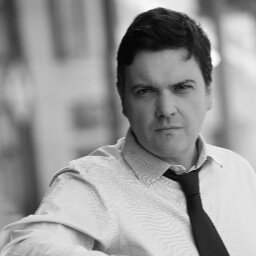 Colin Marshall sits down above downtown Los Angeles in the U.S. Bank tower with Stephen Gee, senior producer at ITV Studios and author of Iconic Vision: John Parkinson, Architect of Los Angeles, the first book on the man who designed such landmark structures in the city as Union Station, the Memorial Coliseum, Bullock’s Wilshire, and City Hall. They discuss how such a visionary could have gone unknown so long; Los Angeles’ relationship to its public buildings; Parkinson’s notion, during a time when Los Angeles set about defining itself, of putting up a built environment that would leave people inspired; the neatness, elegance, and organization that characterize a Parkinson building; the city’s assumption that Parkinson would remain a household name for generations to come, and how World War II and the years after threw that off; Parkinson’s move from England, and his own move from England in 1995; his struggle to find information related to the architect, and how everything new he learned made him want to learn more (as also happens with knowledge about the city of Los Angeles itself); how you engage better with Los Angeles after coming to understand its original intention; how to break down the false images of the city the rest of the world gets fed; Los Angeles as “the city of the future” in most or all eras of its existence; the modern repurposing of Parkinson buildings, into apartments and retail spaces and law schools; Iconic Vision‘s origin as, and possible future as, a television documentary; the new relevance of Parkinson buildings in an era when Angelenos have begun to regard and use the city differently; what he learned when he assembled of Parkinson’s buildings, from Los Angeles and elsewhere, “in one place”; and what might architecturally excite the always forward-looking Parkinson in this always forward-looking city today.
Download the interview here as an MP3 or on iTunes.
Tuesday, October 22, 2013

The homes of Hancock Park, while nostalgic, didn’t set off Los Angeles’ interest in architectural revival. Some builders looked backward here even as others looked most enthusiastically forward, and their collective effect on the environment remains in the hills of Los Feliz, five miles to the northeast. There you find examples of Beaux-Arts, Art Deco, Spanish, Mediterranean, Moderne, Mayanesque, Tudor, Italian Renaissance, Doric, Ionic, International, an odd kind of alpine Mitteleuropa, and much else besides, the most notable of which went up in the twenties, thirties, and forties. Where the higher elevations of Silver Lake provides the low-profile Los Angeles residential architecture tour, those of Los Feliz provide the high-profile one. The prepared architectural tourist will turn up ready to seek out such well-known residences, often photographed and sometimes used in movies, as Frank Lloyd Wright’s Ennis House, Gregory Ain’s Ernest and Edwards Houses, and Richard Neutra’s Lovell Health House. They will, most likely, do it with a copy of David Gebhard and Robert Winter’s “An Architectural Guide to Los Angeles” in hand.
Gebhard and Winter diligently map out Los Feliz’s numerous homes of aesthetic interest in Los Feliz, then dismiss much of the neighborhood — namely the commercial and medical developments centered around Vermont Avenue and Sunset Boulevard — with the unusual term “skulchpile.” You’ll find no more peaceful vantage point from which to view this skulchpile than Frank Lloyd Wright and Rudolph Schindler’s Barnsdall House, also known as the Hollyhock House, now known as the main set of structures in what has become Barnsdall Park, or Barnsdall Art Park, or Barnsdall Arts Park, depending on which sign you read. Despite those, and despite how unignorably the bold angularity of the house itself looms over Vermont, Barnsdall Park remains one of the strangely little-known assets of Los Feliz — indeed, of all Los Angeles. The first time someone told me to meet them there, I had to look the place up; now most friends, even those who’ve logged many more years in the city than I have, look surprised then I take them up there. Perhaps those who lift their gazes from the streets of Los Feliz get distracted by other sights: the Hollywood sign, for instance, or the Griffith Observatory, whose vast eponymous park people do tend to know something about.
Read the whole thing at KCET Departures.

Vital stats:
Format: various segments, mostly interviews, on subjects like guns, cycles, rebels, and unemployment
Episode duration: ~1h
Frequency: monthly
Nearly a decade into the medium’s existence, quitting one’s first podcast and starting a second continues to produce intriguing results. It did for Caleb Bacon, whose The Gentlemen’s Club gave way to Man School. I like to think it did for yours truly, whose The Marketplace of Ideas gave way Notebook on Cities and Culture. And it seems to have for Edward Champion, a man even earlier into the podcast game, first known for The Bat Segundo Show. When he decided to put an end to that cultural interview program, he didn’t wait long to bounce back with Follow Your Ears, a podcast dealing not with individual guests, but with concepts: guns,cycles, aid, rebels, bullies, unemployment. (I’d have done lawyers, then guns, then money, but only out of personal preference.) Each of these episodes comprises not just an interview, but several different segments around the day’s theme. It reminded me, even when first I heard of it, of certain topical This American Life episodes, which appear whenever that show decides to ask questions about large-scale problems of war, politics, health, finance, what have you.
Despite having always done a solid job with those sorts of topics, This American Life never struck me as fully suited to that territory. (I found myself tuning in least often — or tuning out most often — in the stretch when they might as well have titled the show This American Foreign Policy.) Perhaps Follow Your Ears, seemingly born out of such an investigative nature, might offer a less awkward integration of forum, if you will, and substance. But This American Life operates, as I’ve heard major public radio programs tend to, with a staff and an office and legitimacy and everything. From what I can tell, Champion runs Follow Your Ears pretty much the way he ran Bat Segundo, as a one-man show. A tall order indeed, but you’ve got to respect the willing acceptance of that challenge, especially in podcasting. If I had to name one consistent source of disappointment during this five-and-a-half-year-long-and-almost-over tour of Podthinking duty, I’d point my finger straight at podcasters’ tendency to avoid challenge: to talk to people they already know, to talk about things they already know about, to fall into forms already familiar — to hang their proverbial pictures wherever they happen find the nails.
Read the whole thing at Maximum Fun.