Skip to content

Podthoughts: Excess Baggage

 
Vital stats:
Format: talk with travelers, and talk while traveling
Episode duration: ~28m
Frequency: not a going concern, but 85 episodes exist

Cultural England seems to have always loved a traveler. Perhaps this affinity lingers from the days of Empire, or maybe an island people instinctively understand wanderlust. Just behold the gallery of luminaries that is Wikipedia’s English travel writers page. If its seemingly broad definition of “travel writer” bothers you, any designation that encompasses the likes of Geoff Dyer, Graham Greene, Aldous Huxley, Pico Iyer, Michael Palin, and Evelyn Waugh can’t go far wrong. None of them seem freighted with the same burdens which Sisyphize many of the unfortunates we regard as travel writers in America, haphazardly collecting a third of the information they need in half the time they need so as to make the word count for an “If You Go…” box. Something tells me Colin Thubron never put up with that.

A traveler like Thubron, of course, deals with challenges all his own, and you can hear about them on BBC Radio 4’s Excess Baggage [RSS] [iTunes]. He shows up to discuss his journey up a Tibetan mountain so sacred that the truly faithful can never ascend; they just sort of go around and around the base. [MP3] Such a story could almost have come ripped from the diary of any of the Empire’s finest, but Excess Baggage as a whole attempts to cover a width of the traveling spectrum between these forcefully soul-searching Thubronic adventures to, say, the lure of moonlight [MP3], or knitting in Iceland [MP3].

Read the whole thing at Maximum Fun.

Notebook on Cities and Culture S2E3: Jetpacks and Flying Cars with Chris Nichols

Colin Marshall sits down below the mid-Wilshire offices of Los Angeles magazine with its associate editor Chris Nichols, the man behind the Ask Chris column and blog, former chair of the Los Angeles Conservancy Modern Committee, and author of The Leisure Architecture of Wayne McAllister. They discuss the importance of the now-empty Johnie’s Coffee Shop on Wilshire and Fairfax; what being a civic booster means in Los Angeles; the remains of the postwar American car culture of easy, breezy livin’, and their enduring value; the preponderance of hard-to-explain objects across the Los Angeles landscape, and how he explains them in his writing; the richness and strange inhospitability of La Brea Avenue, currently caught between old and new ideas of the city; architectural preservation, and how much of it in Los Angeles is too much; the surviving Googie coffee shops like Pann’s and Norms, Wayne McAllister’s pre-Googie creations, and their place in the city’s historical palimpsest; his determination to help tourists determine and discover their fantasy of Los Angeles, of which countless many exist; why you have to go out and find the city, and why it will simply never come to you; the wonders of Cucamonga; how he’s used Los Angeles as his own personal party space; the Dutch chocolate shop that became a swap meet, and the spectacular twenties movie palace that became a storeroom; how things filled out when “the world moved in” to places like Koreatown, where you can find, for instance, a cafe that is also a boat; what meaning, if any, Frank Gehry’s much-discussed Disney Concert Hall has; and his desire to get lost in Los Angeles once again.

Download the interview from Notebook on Cities and Culture’s feed or on iTunes.

Notebook on Cities and Culture S2E2: The Crushing Burden of History with Frances Anderton

Colin Marshall sits down in Ocean Park with Frances Anderton, host of KCRW’s Design and Architecture and Dwell magazine’s Los Angeles editor. They discuss how her countrymen Reyner Banham, David Hockney, and Christopher Isherwood opened up the idea of Los Angeles to England, vague as the understanding of its cityscape remained; the modernism of Los Angeles then emblematized by its freeways and its architectural freedom from the crushing burden of history, as unlike her native Bath as possible; how Paris’ Pompidou Centre and the mere image of sliding glass patio doors shaped her architectural consciousness; the rise of preservation in Los Angeles, and how it might take an outsider to clearly see the movement’s potential to hinder eccentricity; the American tendency to prostrate ourselves before whatever seems sufficiently old; how stark early-sixties modernism rose in Los Angeles without actually displacing anything, except on Bunker Hill; Chris Burden‘s ideas about the super-fast self-driving car as the transportation of his future, and his generation’s implicit yearning to bring back 1962; how she figured out that radio was indeed a suitable medium for the discussion of design, architecture, and aesthetics, especially when it can include conversations about such subjects with the likes of Moby; and what Moby’s architecture blog says about the surreality of Los Angeles, as well as where she still finds that surreality herself after 21 years in the city.

Download the interview from Notebook on Cities and Culture’s feed or on iTunes.

Notebook on Cities and Culture S2E1: Affinity for the Dead with Nate DiMeo

Colin Marshall sits down at the West Hollywood Library with Nate DiMeo, public radio producer and creator of the podcast The Memory Palace. They discuss American history’s unique wealth of inventors, fakes, geniuses and eccentrics, such as serial impostor Stanley Clifford Weyman and child prodigy turned streetcar transfer taxonomist William James Sidis; the odd satisfaction of stories that arrive at “close enough” rather than classic success; the issue of the right historical moment for a creation, whether that creation is a podcast, a radio show, or the music of Slash; podcasting’s theoretically ideal function as public radio’s “indie underground” feeder system, and its failure thus far to perform that function; his own realization that The Memory Palace probably wouldn’t take the public radio path, and the freedom that gave him; the enduring appeal, no matter podcasting advantages, of the “kismet” of radio, which can deliver unexpected information, entertainment, and delight; why a relatively high degree of public radio innovation has gone on in Los Angeles, and how a public radio producer can become the hit of any entertainment-industry party here; why the older public radio generation hasn’t yielded to the younger; and what it takes for him, as an avowed non-history buff, to draw certain feelings from moments in American history and then reconstitute those feelings in audio form.

Download the interview from Notebook on Cities and Culture’s feed or on iTunes.

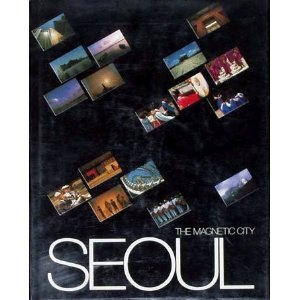
Peter Hyun and the Space Group of Korea: Seoul: The Magnetic City

“Taller and more ruggedly built than their counterparts in Tokyo, Manila, or Bangkok, the people of Seoul exude a sense of resiliency and vitality,” writes Peter Hyun in this book’s introduction, “so much so that they make the other Asians look downright indolent.” Ah, perhaps we have here a publication of the Korean History Channel. “Seoul’s women, with their well-scrubbed, rosy-cheeked faces, look strikingly healthy and beautiful.” Read books from Korea on Korea printed in a certain era, and you’re never far from propaganda, but the country’s peculiar flavor of nationalism merits study. “The Koreans are a people with a strong sense of historically justified fear that their own fate has rarely been in their own hands,” Hyun writes toward the end. “This sober fact explains much of their drive to build economic and social stability as well as to preserve their own cultural identity.” A few pages on, he finds room for a parting shot: “Furthermore, the Koreans are the only people in the world who make even the Japanese — often accused by Westerners of being maniacally devoted to their work — look lazy.”

In between Hyun’s words come pages and pages of pictures, making Seoul: The Magnetic City essentially a photo book sandwiched between a few very short essays. The images cover the usual stuff: weddings, festivals, street scenes, colorful traditional dances, kids running around, old people shopping in complicated-looking grain markets, rush-hour traffic, historical landmarks, hulking new towers sometimes still under construction. While traveling, I, like many others, tend to turn my head for new things amid old or old things amid new. The long-standing (for varying definitions of “standing”) but rapidly and recently developed Seoul, with its gates and temples surrounded by sweeping infrastructure and futuristic high-rises, seems to provide just these sort of contrasts in great abundance. On a side-trip to Seoul during a stretch in Taipei, my friend Nick filled an entire blog post with pictures of the traditional and the modern coexisting there.

Written — or shot, if you like — in 1984, the book examines a Seoul clearly on a bewilderingly fast rise but still not quite as far open as it would crack after the 1988 Summer Olympics. East Asia of the eighties fascinates me; I’ll read any book or watch any film from that slice of the space-time continuum. (Most of the language-learning videos I use date from that era, too, and I watch them every day.) Don’t let the Korean History Channel hear, but eighties Japan fascinates me most of all. Presented with the opportunity to simply drop myself into a time and place, I feel I’d have no choice but Tokyo from about 1960 through 1990. Until that technology comes along, though, good old photo books still offer the next best experience. Using Seoul: The Magnetic City’s sometimes strangely dim and indistinct but large and often striking pictures for that purpose, I found myself surprised by the look of the townswomen. Well-scrubbed and apple-cheeked though they may have been, they dressed so… frumpy. The ladies of the Japanese eighties must have inflated my expectations for aesthetic boldness.

Then again, Korea had to more or less rebuild itself from the early fifties, after the Korean War; Japan had more to work with after the Second World War. In any other country facing the kind of historical setbacks Korea has, you’d expect the women to look dowdy even today. In 1984, their style, usually a reliable reflection of development, seems to have been a lagging indicator. The dullness of their dress, then — if you’ll allow me to emulate the voice of this book’s most boosterist passages — stands as a testament to the South Korean “Miracle on the Han River,” an industrialization, technical specialization, and lifestyle modernization so forceful that it left even a sector as aggressively au courant as women’s fashion panting to catch its breath. All reports from the streets of Seoul today, however, assure me the issue has been corrected — possibly too corrected. You can cool it on the plastic surgery, ladies. That eyelid one freaks us out.

My Chris Marker tribute post for Open Culture


The filmmaker Chris Marker, who passed away Sunday on his 91st birthday, rose to cinematic respectability amid the storm of press surrounding the French New Wave and Left Bank Film Movement in the fifties and sixties. Publicity-averse and deliberately enigmatic, he always seemed to stand, untroubled, within the storm’s eye, and there found just enough space for his enduring productivity. “Marker struck foreign observers as being by far the best [political] mind of the movement,” wrote Clive James in an essay on the director in his book Cultural Amnesia. “Admittedly the competition wasn’t strong.” Having made such favorites of the international hard left as Letters from Siberia and ¡Cuba Sí!, Marker at some point lost the will to promote the notion that, in James’ words, “there might be such a thing as a totalitarian answer to the world’s miseries.” Only after rejecting the overtly political did he make the picture for which history will most readily remember him: 1962′s La jetée, a science-fiction short on the nature of memory and the fate of humanity (two career-long preoccupations) shot almost entirely with a simple still camera.


When Marker began traveling to Japan, his work deepened again. In Tokyo to shoot the 1964 Summer Olympics (a project that ultimately fell to Kon Ichikawa), he met Koumiko Muraoka, “over 20, but less than 30,” “not an example of anything, either class or race.” Marker’s investigation into this young lady’s inner life became a documentary — bearing in mind that the form turns into something considerably more elusive in this director’s hands — called Le mystère Koumiko. Through Marker’s camera, we see Koumiko stroll the streets of Tokyo, get her fortune told by phone, light incense at a temple, and stare at westernized department-store mannequins. At the same time, we hear Marker ask her about her experiences, her culture’s changing fashions, and the “mixed up” mind that comes from being a Manchuria-born, French-speaking, postwar Japanese woman. Even in the less-than-ideal condition of the video above, the film retains its stark, untroubled beauty, much like that of the classical, ukiyo-e angles of Koumiko’s face. “I ought to have been born very much earlier,” she laments.


As for Marker, cinematic colleague Alain Resnais called him “the prototype of the twenty-first-century man.” James wrote that “he was really born for the internet, but arrived in the world of universal information a few decades too early,” citing especially his “brave attempt at the synthetic work that gets everything in,” 1983′s Sans Soleil.  No single medium could contain Marker’s impulse to get everything in, and going into detail about every kind of work it drove him to — from his visual-art installations to his photo book on North Korean women to his CD-ROM Immemory — would take all day. But the ten-minute profile from Short Attention Span Cinema above, featuring interviews with directors Michael Shamberg and Terry Gilliam (whose 12 Monkeys took La jetée as an inspiration), gives you an overview. It even includes a reflection from the man himself: ”The La Jetée bar in Tokyo is one of the things of which I’m proudest. To think that Japanese cinephiles came every night to drink, often more than reason demands, beneath images from this film.”

[I write on Open Culture five days a week, by the way.]

The final day of Notebook on Cities and Culture’s season-two Kickstarter drive is upon us

Here it comes — the end of the Kickstarter fund drive for Notebook on Cities and Culture‘s second season. As of this writing, we’ve raised $2886 from 41 backers with 28 hours to go. (For comparison’s sake, the first season ended its drive with $3000 from 46 backers.) Of course, if we don’t reach $3000 by August 1st, you all get to keep your money and spend it on other neat stuff. Collectibles and whatnot. Food. Shelter. But if we do, then I’ll fire up the new season as soon as possible, which will feature not only more conversations with the most fascinating cultural creators, internationalists, and observers of the urban scene I can find in Los Angeles, but in San Francisco and Portland as well.

The remaining day also brings your last chance to sponsor an episode of the show or its entire coming season, meaning that you’ll get your own project or message announced at the top of one or every interview. A $75 pledge gets you one episode, and a $400 pledge gets you all of ’em. (The $1000 pledge option, which would have made you a guest on the show, got snapped up almost immediately.) For every $200 over the goal we raise, I’ll add another episode onto the season’s scheduled 24. Would it amuse you to force me to keep  season two running for a solid year? Fifteen grand ought to do it.

But please, don’t take my word for it. Why not read blog posts from a couple nice young men who can break it down for you? Erik G. writes that, in Notebook on Cities and Culture‘s conversations, “a lot of ground is covered in a way that other interviewers can’t hope to manage on a broadcast interview show,” and that “this is a show that could only be done in podcast form (despite the high level of polish and production).” He concedes that “that 25 dollars might be a lot to ask, but any amount of money donated will be to an independent voice with a unique perspective that enriches my life and many, many others.”

Timothy Nunan calls the show “exactly the kind of intellectual and sophisticated but still eminently accessible conversation about books and contemporary culture that I had been looking for for a long time,” adding that, “in an age when, bizarrely, cultural critics see in nepotistically-cast, New York-centric, navel-gazing television shows the great message for American women” — his links, by the way — “Marshall is a refreshing voice: outward looking, not the scion of Society, and based in Los Angeles, a city whose many charms once escaped me but Marshall helps to rediscover.” Sound like something worth continuing to you? If so, let’s take it to the finish line and then rack up some bonus rounds.

Podthoughts: The Champs

Vital stats:
Format: two white comedians and a DJ interview black guys, a pornstar, and Jose Canseco
Episode duration: 45m-1h35m
Frequency: 2-5 per month

Moshe Kasher, a comedian I’ve seen here and there in Los Angeles, wrote a memoir and became one of the very, very few nonfiction authors to appear for an interview on KCRW’s Bookworm. This alone got me interested in his other projects, a group which includes a podcast called The Champs[RSS] [iTunes]. He hosts it with fellow comedian Neal Brennan, known as the co-creator ofChapelle’s Show, and someone named DJ Douggpound, who seldom verbally interjects but fires off many a sound clip — “drops,” as the radio industry calls them, or called them long ago when the technology was a novelty — using his iPad. So you have these three guys, and then they’re doing an interview show, questioning a different guest each week and everything. While none of these qualities sounded particularly innovative in and of itself, they all combined to give me reason to suspect something… alive in this podcast. Something spirited.

Downloading episodes, I found interviews with quite a few creators, celebrities, and other public figures I don’t normally hear dropping by podcasts: Hollywood Shuffle director (and Meteor Manhimself) Robert Townsend [MP3], noted Eddie Murphy sibling Charlie Murphy [MP3], genre-defeating electronic musician Flying Lotus [MP3 1] [MP3 2]. David Alan Grier [MP3], to whose every appearance on Adam Carolla’s show I download, and The Roots’ Questlove [MP3], whom I still remember enjoying on Aisha Tyler’s Girl on Guy, also grabbed my attention. All guys with brains worth picking, and Kasher, Brennan, and Douggpound do a sharp and energetic job of it, but for a while I just couldn’t see the unifying concept.

Read the whole thing at Maximum Fun.

Halfway through Notebook on Cities and Culture’s S2 Kickstarter drive — with $1091 to go

We’re three and a half days through the week-long Kickstarter fund drive for Notebook on Cities and Culture‘s second season, featuring interviews in San Francisco and Portland. If we can raise $3000 by the end of it, the show will go on. As of now, we’ve raised $1909, with 15 backers. (For reference, the first season’s fund drive raised $3000 with 42 backers.)

If you’d like to get a hand in, you’ve got three and a half days left. Opportunities remain to sponsor individual episodes or the entire season, which means your project or message will get talked about at the top of one or all of the season’s interviews. And after we reach the $3000 goal, each additional $200 means I add another episode to the planned 24. (So if you’ve ever wanted to indefinitely prolong a podcast, then, now’s your chance!) You’ll find all the details on the show’s Kickstarter page. Thanks.

The Novel Cafe (Koreatown)

Give the Koreatown Novel Cafe this: nobody can object. Now, I wouldn’t necessarily trust an Angeleno who claims to love the place — show me a man who eats here every time they come to the neighborhood, and I’ll show you a man who’s given up — but if you’re meeting someone you don’t know very well for lunch, here’s your effortless go-to. I did just that recently, in fact. She got delayed coming out of LAX — try not to look surprised — so I sat at a table and waited, reading a Murakami novel and drinking their no-frills cappuccinos. “Have you got another person coming?” a waitress asked. “Be fifteen minutes,” I replied, not lying but not exactly not lying either. I think I sat there for a reasonably enjoyable hour and a half, and then for another two after she turned up. In Tokyo they’d surely lock me up for squatting on table real estate like this, but the Novel Cafe staff didn’t seem to mind.

What do you eat here? Oh, salads. Pesto sandwiches. Chicken wraps with lots of beans, corn, and lettuce. Complimentary bread with the faintest sweetness. Nothing to get excited about, and even slightly on the bland side, but somehow an unimprovable exemplar of this modern genre of California lunch food that bothers nobody and actually sounds just about ideal one hot day out of every two or three weeks. The Wilshire-facing window prominently advertises free wi-fi, and I think I glimpsed a room of vinyl records one time I really looked around, but I don’t know if this location qualifies as a much of a workspace or a hangout. If I set myself up to do bear down on some serious writing, I suspect that a staff member — they walk right up to your table and everything — would ask me why I haven’t ordered a wrap yet. I would get over this awkwardness quickly, but not everyone does. Then again, elements of the place do seem geared-toward the hanger-out; I notice many a wall-mounted sports-glowing television and a concert stage with a drum kit already on it, though I don’t know when it sees use.

Those who meet the semi-unknown for lunch all over town, especially on the westside, know that Novel Cafes have multiplied: you’ll find one in Westwood, an astonishing three in Santa Monica, and even one way over in Pasadena. I can’t vouch for those branches, but the Arts District location downtown, more a coffee shop than a full-service cafe, has on many days provided me a space to work and the drinkables to go with it. You can technically get lunch there, too — I ate a burrito of some kind there once, almost certainly containing avocado, and I’d recommend it — but nobody brings it to you. The Koreatown Novel Cafe has more “cool” going for it, or rather, a different kind of cool, a slicker, just-up-the-scale cool. The Arts District Novel Cafe’s cool is the cool of old typewriters used decoratively, a wall of loose-leaf tea, and a wide take-a-paperback-leave-a-paperback shelf. I get the sense that whoever’s running things thinks the Koreatown crowd — a crowd with different aspirations, to be sure — doesn’t want to see that stuff out in the open. They’ve got pesto to eat. But I, too, often have pesto to eat.

(More such writeups on Yelp.)