Skip to content

Notebook on Cities and Culture season two in San Francisco and Portland Kickstarts now


Six months ago, we raised $3000 in a week to fund 32 episodes of Notebook on Cities and Culture‘s premiere season: 32 long-form interviews with cultural creators, internationalists, and observers of the urban scene all over Los Angeles. Starting right now, we’re aiming to raise another $3000 in a week for Notebook on Cities and Culture‘s second season, which will not only offer more of what you enjoyed last season, but will begin the show’s world tour. We’ll take this operation up the west coast to Portland and San Francisco, exploring those cities and getting down into it with their most interesting luminaries.

Kickstarter, as you may already know, makes it exceedingly easy to fund projects like this. If we don’t reach $3000 within the week, you keep whatever money you’ve pledged. Give certain amounts, and you can sponsor the show in a variety of different ways:

  • For $25 or more, I’ll thank you by name in all of season two’s episodes.
  • For $75 or more, I’ll mention your own project or message at the top of one of season’s two’s episodes, and thank you by name in all of them.
  • For $400 or more, I’ll mention your own project or message at the top of all of season two’s episodes.
  • For $1000 or more, you’ll be the guest in one of season two’s episodes. I’ll come to you (within North America only, at least for this season) and we’ll record a conversation about the culture you create and the city you create it in. I’ll also thank you by name in all of season two’s episodes. This sounds like a joke, and I partially made it an option so the other options would look cheaper by comparison, but in the unlikely event of a $1000 pledge, I will totally do it.

For every $200 raised above the $3000 goal, I’ll add one more episode onto the season than the planned 24. (If we raise $5,000, for example, season two will run for 34 episodes.) Want to fund Notebook on Cities and Culture‘s second season? Click here. This season, San Francisco and Portland; next season, the world.

Notebook on Cities and Culture S1E32: Genuine New York Novelist with Joshua Henkin

Colin Marshall sits down in West Hollywood with novelist Joshua Henkin, author most recently of The World Without You, for their first conversation in four and a half years since his previous appearance on The Marketplace of Ideas. They discuss how the new book makes a space for characters to converge rather than occupying the space between two people, like his last one; the authorial balance between knowing too much and knowing too little, and the need to address the same question in fiction you would on Passover of “why this night is different from all other nights”; his bringing in a divorce, a death, the war in Iraq, and July 4th, and how much is too much; his tendency to throw away thousands of pages when refining each novel, observing the economist’s principle of sunk costs; how character is plot, and how stories go wrong when character isn’t plot; his ways of fictionally repurposing pieces of his own life that few readers would guess; the dangers of writing about recent-past events, and doing so while achieving the universal with a laserlike focus on the particular; the importance of writing no character as an authorial mouthpiece, especially when dealing with sensitive political and religious issues as The World Without You does; his use of teaching as a feedback look for his own writing, and how early in his career he managed to expose himself to a great amount of what doesn’t work in fiction; his writer’s life in Brooklyn, and why that borough has become such a writerly place; his childhood in and return to New York, and what that has to do with his characters existing in perpetual relationships to the place; the writer’s need to hang out primarily with non-writers; his techniques for achieving a sense of place, and the American difficulty of having any sense of place at all about somewhere as distant as Iraq, which seems to have become a theme of the war itself; the press’ eagerness and the author’s wariness to discuss the “aboutness” of a book; and the irreducibility of fiction meaning that the easier you can summarize a novel, the worse that novel is.

Download the interview from Notebook on Cities and Culture’s feed here or on iTunes here.

(Photo: Matthew Polis)

Bricks & Scones (Larchmont)

Santa Barbara lacks many things, but when I lived there, never did I want for pleasant coffee shops in which to work. Coffee Cat on Anacapa, The Daily Grind on Mission, The French Press on Carrillo, Cafe Zoma on State, Santa Barbara Roasting Company on Motor Way, Hot Spots on lower-lower State if the wee hours came and you didn’t mind the scuzz factor… and that was just downtown. While I feel convinced that Los Angeles has equivalents aplenty, it doesn’t present them in any obvious manner (not Los Angeles’ way), nor do they sit particularly close to one another (certainly not Los Angeles’ way). After nearly a year of trial and error, I’ve found that, every day I have several hours of reading, writing, and internet-y work to do, a slight hunger, and no food at home nor any desire to remain at home even if it did have food, I face the same question: do I go to Bricks & Scones, or do I go somewhere else?

Bricks & Scones has become, in other words, my default “third place.” Urban theorist Ray Oldenburg defined third places as, roughly speaking, areas that aren’t your home or your work (this “work” you speak of… ?), and which offer such characteristics as neutrality, status-leveling, conversation, accessibility, regulars, and a low profile. This particular third place also offers a baked good called a “sesame chewy roll,” for which I keep coming back in spite of myself. They charge well over three bucks for the thing, or so I believe; I try not to think about the prices. Little Tokyo’s Cafe Dulce offers a cheaper, arguably superior version — less hollow, with walnuts, and bright green to boot — but that’s five miles in the opposite direction. Bricks & Scones’ Larchmont location does at first seem awfully inconvenient to a Koreatowner such as myself: two and a half miles away, with no direct train route. (You have to connect to the low-frequency local bus on Beverly, and even then you won’t be happy about it.) But the bike ride through Hancock Park lasts just long enough to qualify as “invigorating,” and you can usually lock up right out front.

You can order actual food here — sandwiches, soups, wraps — although eating a quick lunch and splitting won’t really get you the value. I often set up camp, eat a half mango curry chicken sandwich (fruit on the side), work for a few hours, then enter the second phase with a cappuccino and sesame roll. I figure I drop about twenty bucks, all told. Not a painful price to pay for the accommodations, I would argue, to the implicit agreement of Bricks & Scones’ strikingly young crowd: the inner-ish fringe of The Industry, college students, Korean twentysomethings. Sometimes the place starts to feel, comfortably, like an outpost of Koreatown; though no bargain, it does represent a discount from the sometimes flamboyantly expensive coffee shops of my own neighborhood. I willingly pay for the vibe of productivity, though; it just feels like, as slowly as they’re nursing their coffees, people are getting a lot accomplished here. I’ve even recorded interviews on the premises. But given the effects of all work and no play, I’ve promised myself that when next I bring someone here, I’m ordering the menu’s “afternoon tea,” complete with scones and jam. Genuine Britons (or even just people from Victoria) might consider it a travesty, but that’s how we do it in the colonies.

(More such writeups on Yelp.)

Podthoughts: The Dana Gould Hour

 
Vital stats:
Format: thematic comedy gab, broken up with prepared segments
Episode duration: 1h-1h30m
Frequency: 1-2 per month

“Why do you want to do a podcast? You ain’t gonna do no podcast. You just a johnny-come-lately. You spent too much time on The Simpsons and you lost it, and now you’re trying to get it back, and everybody thinks it’s pathetic. You ain’t no Marc Maron.” Those words come in the voice of Little Richard, as performed by Dana Gould, to convey to us what the discouraging disapproving-dad voice inside his head sounds like. (His theory says that such a voice gets much easier to ignore when it sounds like Little Richard.) This happens on the very podcast that discourages, The Dana Gould Hour [RSS] [iTunes]. Luckily for Gould, and for us, Little Richard can only take that Marc Maron comparison so far. It pleases me to report that Gould has opted not to crank out yet another comedian-interviews-comedians podcast, but to put on more of a… production.

Its episodes, with come out once or twice a month, offer segments, scripted stories, recurring characters, and historical sound clips. I would draw a comparison to Paul F. Tompkins’ Paul F. Tompkast, but I haven’t heard that show yet. The Dana Gould Hour makes the unusual structural choice of interweaving these bits and pieces with group conversations like you’d hear on more standard comedy-gab shows. Each time out, Gould surrounds himself with colleagues — Eddie Pepitone usually shows up, to my increasing delight — and they all riff on a theme. These themes have included the apocalypse [MP3], carnies and theme parks [MP3], and Woody Allen’s wife, Soon-Yi Previn [MP3]. That last one usually gets me onboard, whatever the situation.

Read the whole thing at Maximum Fun.

Richard Meltzer: L.A. is the Capital of Kansas

This book came recommended by no less an authority than Los Angeles Times book critic David L. Ulin when last I interviewed him. It’d intrigued me on runs to the downtown library to replenish my supply of Los Angeles-related reading, but I kept reshelving it; the subtitle Painful Lessons in Post-New York Living made me envision chapter after chapter of ragging on Hollywood provincials by, worse, a Manhattan provincial. Sure, Meltzer rags on Los Angeles, David explained, but he rags on everything. While ceaseless rendering of harsh judgment does not itself intrigue me, Meltzer’s credentials did: wunderkind rock critic of the late sixties and early seventies, writer for such “cool” publications at the Los Angeles Reader, alleged suggester of the umlaut in Blue Öyster Cult.

Meltzer’s thinking on aesthetics also seemed to stretch well beyond music — beyond, as the title of his famous debut put it, The Aesthetics of Rock. After reading (other interviewee of mine) Christopher Hawthorne’s writeup of the much lesser-known Richard Meltzer’s Guide to the Ugliest Buildings of Los Angeles, I made a mental note to really check this guy out. Even if he just complains about Los Angeles, I figured, he complains about it in the eighties (he left for Portland in the nineties), a period in this city that still seems not only opaque to me but probably actually relatively crappy.

Opening my checked-out copy of L.A. is the Capital of Kansas, I found it not only signed by the author (“MATT — THANKS, MAN, Richard Meltzer,” beside a doodle of a rabbit head. Could he have meant it for his onetime Reader colleague and author of that rabbit-populated comic strip Life in Hell, Matt Groening?) but defaced by an irked reader. “A stupid, offensive title,” she wrote on the page. Perhaps I’ve judged unfairly in going straight to that particular pronoun, but I can assure you of the message’s neat, rounded hand. And what man — what man without a woman watching, that is — would ever denounce anything for being stupid or offensive?

So I’d gotten the overall impression that, whatever my reservations, Meltzer was doing something right. The jacket copy describes him as “writing in a wildly expressive, disarmingly casual idiom,” and I don’t have any better words for it. Here, flipped to at random, is a sample of Meltzer’s prose:

You sit for five minutes, at most ten, in the Farmer’s Market off Fairfax, all these tourist-priced postcard and jade ashtray shops, you’re reading the paper, sippin’ your tourist-priced carrot-coconut juice and without fail (it matters not what day, season or week) a full-fledged YOKEL from Des Moines, Sioux City, or Dubuque (for inst) will exclaim to a fellow hick he or she has met on the Gray Line bus: “Lookit what I got, Irma — a Bo Derek poster!!!” As if they don’t got ’em back in Walnut Falls and maybe they don’t; I’ve never asked. Three years ago it was blowups of Farrah, the Fonz, now Bo, and they go home smiling that appleknocker SMILE (you’ve seen it in films), blowup in hand and tales on their lips of an unforgettable visit to the land of Dreams: a scumbag town that it beats me how anyone but a walking metaphor from Des Moines or Walnut Falls could actually be dreamin’ about. REAL-LIFE HICKS AS METAPHORS INCARNATE (AS REAL-LIFE HICKS-AND-A-HALF). Or something like that.

Some passages read easier; others come off like Finnegans Wake. But unlike Joyce, Meltzer — and I only figured this out a hundred pages in — writes to be read quickly, not deliberately. (William Burroughs might make a more suitable comparison: “He writes about hanging, he writes about colors, he writes about virus,” as Meltzer describes him. “Got (I have) next to no int’rest in such stuff as content, whole lot of int. in such as voice.”) At least I imagine that as his intent. I like to envision myself in 1981, nonchalantly scanning through one of his Reader columns on burgers, easy women, UHF television, or boxing at the Olympic Auditorium while scarfing down an Oki-Dog in the car before flooring it over to a punk show, during that brief moment when, in Meltzer’s words, “this shithole came as close to being a fertile musical oasis as any I’ve stumbled over.”

“Obviously, I hate the place,” he claims, “but I seem to recall hating that other place — what was it called? (starts with an N) — as well.” If Los Angeles holds little appeal for him, his birthplace, the “Smart Town” of New York City, holds even less. The past 25 years of change in Los Angeles and Meltzer’s tendency to deliberately expose himself to only the dumbest, ugliest, and crassest means his experience has little in common with my own, although, as with most writers on this town, his observations on life in motion ring true. Prefacing his trip to Watts Towers, he writes that, “for a town with so many people driving so many vehicles so many places nine days a week, L.A. is still basically mired in a zero sense of automotive adventure. Everybody and his/her aunt/uncle’s always taking the customary spin to job x, restaurant y, and party z [ … ] just about nobody’s willing to follow his/her nose and/or instincts or just pick up a Triple-A map and say, ‘Today I’m driving to Hawaiian Gardens — wherever (and whatever) in hell that may be.'”

Los Angeles punk, I gather, ain’t what it used to be. (You can now buy the building that once housed the Atomic Cafe — and thus Bowie and Byrne and Devo and X — for a dollar, but you have to pick it up yourself.) The freest driving seems to have drained away before I was born; “individual places sometimes griefed me,” Meltzer recalls, “but rarely the drive itself, the process. In those days, up ’til just after the ’84 Olympics (when the world started moving in), there was basically no non-rush hour traffic.” But I can’t imagine Los Angeles ever having been about these things, a home for these things, or for anything, ever, in particular. “Livingwise, home is an overrated concept,” declares Meltzer. “Anyone expecting redemption at home is fucked from the start to, uh, finish.” Amen.
Notebook on Cities and Culture S1E31: Freedom and Ugliness with Christopher Hawthorne

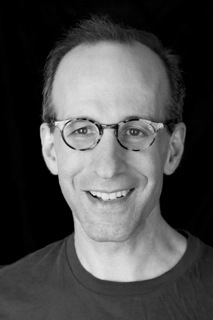
Colin Marshall sits down on top of the Walt Disney Concert Hall in downtown Los Angeles with Christopher Hawthorne, architecture critic at the Los Angeles Times and co-author of The Green House: New Directions in Sustainable Architecture. Last year, he conducted Reading Los Angeles, a yearlong study of the city through the books written about it. This year, he’s doing a series of essays and video explorations of Los Angeles’ boulevards: first Atlantic, then Sunset, and soon Crenshaw and beyond. They discuss the break from the city’s previous connection with the automobile, the single-family house, and private amenity; the unusual number of existential questions Los Angeles has faced and continues to face; outsiders’ visceral reaction to Los Angeles “inconsistent” architecture (especially as manifested by Randy’s and Dale’s Donuts), and the way freedom and ugliness can go hand-in-hand; his having grown up in Berkeley, a process that subjected him to a certain anti-Los Angeles “indoctrination”; the sense that Los Angeles is its “own thing,” and how that motivates deadening choices like freeways as well as enlivening choices like turning away from Europe and toward Latin America and Asia; Woody Allen and his attitudes about cities and urbanism, as revealed in films like Annie Hall and Midnight in Paris; how the stereotype of Los Angeles’ superficiality conceals its layered nature, and whether the city’s best elements can ever be made directly accessible; how to read cities versus reading objects, and how familiarity with Los Angeles helped him read a city like Houston; the complicated relationship between public and private space in Los Angeles, as exemplified by streets that simply give up on sidewalks and beloved midcentury modern houses in terribly alienating locations; and the tendency of tourists to see only the worst of Los Angeles and go no further — unless they go much, much further.

Download the interview from Notebook on Cities and Culture’s feed here or on iTunes here.

Notebook on Cities and Culture S2, in Portland and San Francisco, Kickstarts next week

Thanks very much indeed, listeners, for a first season of Notebook on Cities and Culture that has exceeded all my expectations. And special thanks to those who backed the first season on Kickstarter; in a mathematically demonstrable way, you exceeded my expectations threefold. That drive raised enough to extend this season to 32 episodes, but since episode 31 comes out today, the time has come to prepare for season two.
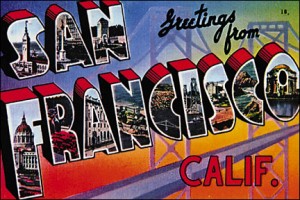
I’ve set the fundraising goal for the exact same amount we raised for the first season: $3000. But I’m upping the ante, content-wise. The show’s very title tells you that it’s intended to be a notebook on cities and culture, and its journey outside Los Angeles (and, ultimately, all over the world) begins this coming season. I’ll take my gear up the west coast and record with the most fascinating cultural creators, internationalists, and observers of the urban scene in San Francisco, California and Portland, Oregon. Interesting cities, so I understand, with a few interesting people between ’em. Let’s find out for sure.

The Notebook on Cities and Culture season two fund drive begins next week, on Wednesday, July 25. It’ll run for seven days. You’ll get the chance again to sponsor individual episodes or the whole season, plus a new top-tier donation option that might seem like a joke but I assure you is real. I’ll post a link to the Kickstarter page right here the moment it goes live. Tell all your most urbane, observational, conversationally inclined friends!
Spencer Crump: Ride the Big Red Cars

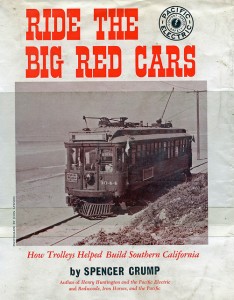
We used to have the greatest public transportation system in the world, so goes the oft-told Los Angeles lore. Then, a shady consortium, their own strings pulled by automakers and road-builders, bought all the trains and the tracks just to rip them out and scrap them. I don’t know about that; I sense a few too many viewings of Who Framed Roger Rabbit stoking a conspiracy-minded fire. We do know that, in the Pacific Electric and Los Angeles railways of the early twentieth century, this city did indeed boast the most extensive and beloved local and interurban train service anywhere. And we know that, by the early sixties, all of that had gone. But I figured the hows and the whys of the five decades in between were more complicated than the bitter, empty laments for the old trains I hear from those too young to have ridden them — or that, a few drinks into the night, I’d probably deliver myself.
Spencer Crump’s Ride the Big Red Cars comes recommended by, of all people, Reyner Banham, the well-known English architectural critic and Los Angeles lover who wrote The Architecture of Four Ecologies. Banham found great joy and fascination in freeway driving — he learned to do it so he could “read Los Angeles in the original” — and held out little hope for traditional rapid transit. “Even though [the Los Angeles freeways are] vastly better than any other urban motorway system of my acquaintance,” he wrote, “it is inconceivable to Angelenos that it should not be replaced by an even better system nearer to the perfection they are always seeking. A rapid-rail system is the oldest candidate for the succession, but nothing had happened so far. The core of the problem, I suspect, is that when the socially necessary branch has been built, to Watts, and the profitable branch, along Wilshire, little more will be done and most Angelenos will be an average of fifteen miles from a rapid-transit station.”

Things have happened now. The Red Line subway under Wilshire, having made agonizingly slow progress over the past two decades, still has twelve miles to go, but the Blue Line train, though — the “socially necessary branch” — runs to Watts and all the way to Long Beach besides. It actually does so along the same path of the very first Pacific Electric line Southern California-building magnate Henry Huntington opened in 1902. In Crump’s telling, Huntington took only nine months to build it, and build it well; the Blue line took five years. “Crump thinks Los Angeles’ Blue Line is a step in the right direction,” wrote Jim Washburn in a 1992 Los Angeles Times article catching up with the author, ”but says that by running it at street level, it is crippled same the way the PE eventually was by having to contend with automotive traffic crossing its path.”

Here we have one clue as to how Los Angeles let rail transit slip from its hands. Crump’s book covers, in great detail, how the region’s interurban lines and trolleys expanded so quickly and won such a large, admiring ridership. The system’s peak seems to have come in the twenties to perhaps the early thirties, after which, a brief revival during the Second World War notwithstanding, it was all downhill for Pacific Electric’s red cars (and presumably the Los Angeles Railway’s yellow ones, too). Building in the days when automobiles were scarce and roads suitable for automobiles scarcer still, Huntington laid most of his track either at street level or on the streets themselves. But when car ownership came to the everyman, a savage battle for road rights ensued. Badly slowed by having to move in mixed traffic and stop at many new vehicle crossings, the trains went from a public perception as the height of efficiency to its nadir. Soon, the per-mile operating cost of a personal car fell below the equivalent Pacific Electric fares. Then, after the war, came the freeways.

“We’ve created sort of a hell here,” said Crump in that Times article. “We are only faced with a tremendous and complete traffic jam that doesn’t give us anything. This freeway driving is not only lonely, but it makes me uptight and stressed being in that bumper-to-bumper traffic.” But I can understand how appealing a city of gleaming new cars and soaring new motorways must once have seemed. Few foresaw the debased, utilitarian condition of American motoring ahead, and fewer still understood that the further backward a place bends to accommodate the automobile, the less it merits a visit in the first place. If anything has made Los Angeles second-class in the past fifty years, that has. I can’t say I suffer much New York envy, except when it comes to their transit. Yes, New Yorkers complain ceaselessly about it — when asked what he dislikes about living there, Tao Lin memorably cited “the comically unreliable/loud/dirty subway-system” — but at least it’s there.

Both New York and Los Angeles’ “public” transit systems were, before 1940, wholly or in large part, privately owned. But New York City bought and continued to operate the subway lines, whereas the City of Los Angeles passed on the trains in its territory. “The greatest failure,” Crump writes, “came in the slowness of the public and public officials to grasp the fact that the role of providing transportation could not be filled by private enterprise.” The libertarian in me honestly wonders about that, but the deal is done: Los Angeles now has a public agency to handle its trains, and that agency does seem to be building and running new lines. These take their sweet time to materialize — evidently you can’t just throw thousands of Irishmen at the problem anymore — and tend to do so on whichever old rights-of-way happen to remain, the location of current centers of commerce be damned. Yet at this point I see reasons to remain just on the side of optimism, and I imagine Crump — whether he’s still with us, I don’t know — would too.

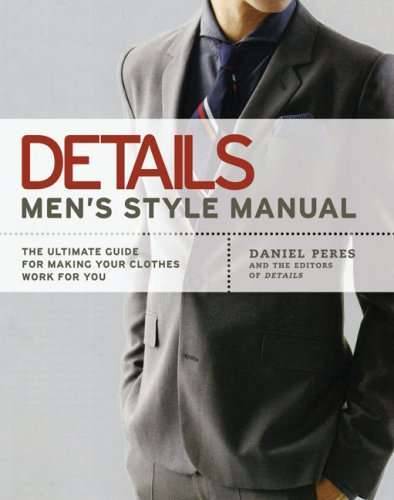
Menswear books: Daniel Peres, The Details Men’s Style Manual

I confess to not quite knowing Details’ place on the landscape of gentlemen’s magazines. While glancing at its issues reveals a more deliberately tasteful publication than blunter, intensively airbrushed “lad’s mags” like Maxim (or its countless late imitators), it also lacks the pedigree of comparatively venerable midcentury-man staples like GQ or Esquire. Yet Details must harbor comparable aspirations to style authority, since it, like those two older brothers, has a whole book out on the subject: the Details Men’s Style Manual, by the magazine’s editor-in-chief Dan Peres. “In a world of skinny suits and pointy shoes, I was rather content dressing down,” he writes of recently bygone days. “I had adopted a uniform of jeans, sweaters, and tattered Chucks — and the occasional button-down shirt, untucked, of course. I even wore a fleece to a Versace fashion show once.” So we’re working from square one, then.

The unaddressed question of how someone who inspired an entire New York Times trend piece rose so high in the first place does shake one’s confidence in the Details imprimatur. But combine his history of willful disregard with the presumably high caliber of stylistic consultancy at his fingertips, and Peres looks ideal to write a beginner-level manual on men’s dress. Having undergone a Damascene conversion on the road between European fashion shows, he decided to set his own house — or rather, closet — in order, and what he learned from his magazine’s specialized style editors he organizes into this book’s thirteen chapters. All this he explains in the introduction, which spreads fewer than 700 words across four pages in two colors and three different large fonts. It gets noisier: the two-page spread immediately following presents a list of “rules of style” in a flurry of bolding, boxing, unconventional capitalization, and other formatting tricks.

Read the whole thing at Put This On.

Podthoughts: Ask Brooklyn

Vital stats:
Format: interviews with Brooklyn-based experts about their expertise and how it relates to Brooklyn
Episode duration: ~30m
Frequency: 1-4 per month

When one of my peers — i.e., anyone in that vast age group, “about thirty” — tells me they live in New York, I just assume they live in Brooklyn. Thirty years ago, I suppose they would have lived in one of the more run-down parts of Manhattan, David Byrne territory. But something tells me that no “more run-down parts of Manhattan” remain. I’ve talked to the occasional youngish person who lives in Queens, but they always make it sound as remote as Guam. I’ve never encountered anyone from the Bronx or Staten Island. Then again, I live in Los Angeles, a haven for the rootless, and I suspect Brooklyn provides the same solace. You see a lot of traffic back and forth; for every Brooklynite aspiring to Angelenohood, an Angeleno aspires to Brooklynism.

“Ah, Brooklyn,” I remember Buddy Bradley, protagonist of Peter Bagge’s comic series Hate, saying upon setting foot there. “The worst place in the world.” That issue formed, in large part, my early impression of that part of New York: crowded, inconvenient, dangerous, dirty. I still haven’t visited, though I understand that, somewhere in the past fifteen years, Brooklyn made the transition fromCrooklyn to something of a Portland East. Over this same span of time, though, my appreciation for the crowded, inconvenient, dangerous, and dirty has only grown, so I don’t quite know what to do. Correcting my years of built-up inaccurate third-hand impressions by listening to Ask Brooklyn [iTunes] seemed like the beginning of a solution.

Read the whole thing at Maximum Fun.