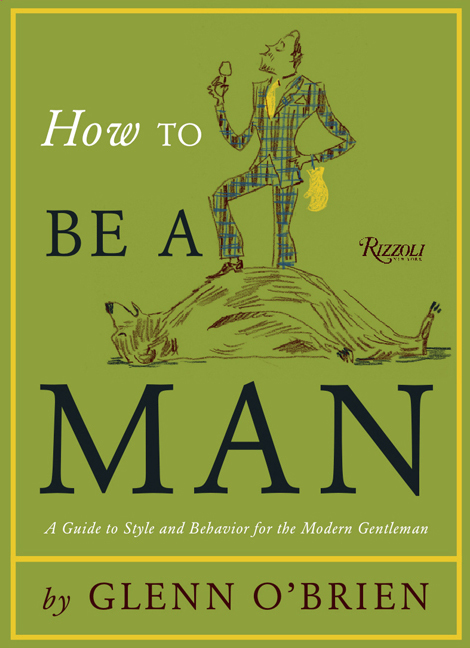
 I knew little about Glenn O’Brien before hearing Jesse Thorn interview him on The Sound of Young America, but now my mental shelf of examples of career-life unity couldn’t do without him. Assemble what you can of the man’s résumé, and the full picture looks colorful to the point of unreality: host of the punkisly and cultishly beloved public-access show TV Party, music critic at Interview, creative director at Barneys, writer and producer of the film Downtown 81, associate of Andy Warhol, Artforum columnist, High Times editor-at-large (allegedly he coined the title), stand-up comedian, editor of Madonna’s infamous Sex, and, more recently, GQ‘s “Style Guy.” This winding path leads to How to Be a Man, a handsome green hardcover filled with short essays ostensibly about dressing, decorating, smoking (or not), eating, marrying (or not), drinking, and dying (or not), but effectively about how best, in the mind of Glenn O’Brien, to lead one’s life.
O’Brien has admitted to this thematic sleight of hand. You can’t write like Montaigne anymore, so he and other essayists have lamented; today’s readers shrink away from overt discussion of How to Live. The reasons for this shift in popular taste over the last 400 years remain opaque, but it forces those who would dare to think, speak, and write directly on life into a kind of fake specialization. O’Brien, having accrued experience and notoriety from years of answering letters from GQ readers nervous about whether to match their socks to their shoes or their pants, surely saw his strategy with all possible clarity: sell a style book, write a life book.
But he wrote How to Be a Man for those of us for whom life and style have grown inseparable, men for whom the major questions — what to wear and how to wear it, what to eat and how to eat it, what to work on and how to work on it, where to go and how to get there, when to stare and whom to stare at — all come, of a piece, as the enterprise of existence. Despite the fun of making broad pronouncements about life in general, though, rarely do I find said pronouncements coming in handy in the day-to-day — or, for that matter, sticking in my memory as anything more substantial than a profound-smelling mist. O’Brien spends the most useful half of his book on the details, the specifics, the nuts and bolts of all this. And he accepts, with evident rue, that he must first do some damage control.
“Man has been reduced everywhere,” O’Brien writes, “serving the hive like an ant or bee, toiling away at mechanical tasks and never approaching a knowledge of the whole, or performing the great work. There are no Renaissance men because there is no Renaissance. Or is it the other way around?” He spies both signal and cause of man’s fall — a devastating feedback loop indeed — in man’s wardrobe. “The barbarian revolution of the last half-century” has, in O’Brien’s assessment, made it “possible for men to dress like boys or adolescents for life. We see these fellows around us every day. They are the chaps in comfy running shoes, worn jeans, tracksuits, sweats, t-shirts, and caps advertising the sports teams to which they hold allegiance. These men are dressed not for success but for existence.”
Hence the presence of one essay titled, simply, “How Not to Look Stupid,” and the presence of a couple dozen others with similar pedagogical goals. You might now think of O’Brien — and, by association, me — as a bitter crank who longs for nothing more than the days when gray-flanneled husbands marched from the house every morning anticipating a two-martini lunch, an afternoon of light sexism, and a roast already glistening on the table upon their return home. But we’ve read Richard Yates; we know how often midcentury man desperately concealed, behind his blustering, boozy façade, an abyss of weakness and shame. This same faulty core rolled out the carpet for Company Man conformity, shot the notion of aesthetic agency full of holes, and reinforced the ultimate suppression of the modernist impulse. It brought us to a generation of men lost in their own ambivalence about being men, the shocking depth of their self-loathing on brazen sartorial display. In an interview, O’Brien reduced it to a question that never drifts far from my mind: “Supposedly we’re created in the image of God, and you’re gonna put on a Steelers Jersey?”
I don’t fully blame my fellow twentysomethings, or even the former iterations (or, I can assure you, the many iterations to go) of myself, for their negligence. Having imprinted on the strange, complicated geldedness of our immediate predecessors, we on one morning or another wake up to the sudden, overwhelming feeling of being unequipped. How could we have reached our age, we ask in panic, without knowing how to find lasting furniture, how to drive a five-speed, how to poach an egg, how to distinguish friendship from (choke) “networking,” how to tie a four-in-hand? And if we lack so much as that foundation, how can we hope to advance ourselves along more nebulous lines: refining our taste, extending ourselves across times and traditions, and crafting our very presence in this world?
Despite his book’s title — and could I go far wrong in suspecting a clumsy yet insistent pair of hands at the publishing house? — O’Brien has not written a straight-ahead manual for manhood, nor would I trust any such product. If he’s working in the tradition of crypto-Montaigne, he’s working even harder in the tradition of crypto-memoir. His essays present the lessons that one man and one man only has learned, internalized, and re-expressed over sixty-odd years. This one man asks barbers to make him look like a Roman emperor, strictly orchestrates his dinner-party seating arrangements to spark maximum interestingness, urges his ideas to “bubble up” by walking city streets, drinks only wine due to its ancient provenance, marshals Nietzsche to describe the new Prada collection, courts the preferential treatment of a regular at his choicest eateries, advocates a generation gap between man and wife, does not smoke yet maintains household ashtrays, mixes time periods with reckless abandon, and once got turned away from a gay bar in the company of John Waters. Plus, he’s flown on the Concorde, “whose passing seemed to mark a permanent turn for the worse, not only in travel but also in the history of modernism itself.” You either know you can use his experience or you can’t.
It all seems to return, as O’Brien writes it, to aesthetics, and most immediately to clothes. He references in several places the 18th-century code of the dandy, who, per Baudelaire, presents himself with such concentrated attention not out of “excessive delight in clothes and material elegance” but as one manifestation of “the aristocratic superiority of his mind.” Unusually — and for me, refreshingly — O’Brien expresses little regard for the concept of authenticity, highlighting instead the usefulness of the dandy’s fake-it-’til-you-make-it enthusiasm. “A dandy may begin as a poseur,” he writes, “but gradually the pose takes hold and gives him strength, and though he may have begun as a phony, by affecting a grand posture, the power of the posture reforms him and he becomes a real phony.”
The dandy, in other words, takes the career counselor’s recommendation to “dress for the job you want,” a pointer weary for the glue factory, and applies it not just to “the job” but to the life — and how, of course, could he separate the two? This way of thinking and acting, as O’Brien explains it, “applies everything we have learned about aesthetics and from philosophy to our persons and to our environments.” Time and time again, he uses the phrase “sense of occasion” to evoke what we’ve lost and what a man must regain in order to prove himself worthy of the demographic designation. Every facet of our relationship with the world reveals our sense of occasion, though I find it difficult to infer what occasion most fellow guys on the street could possibly have prepared themselves for. Masturbation?
So, sure, sure, sure — we’ve all slacked off on our masculine duties, and we need to act better and dress better and live better and just display a whole hell of a lot more discernment. But if O’Brien writes about what’s gone south about manhood, how our taste reveals it, and how finally paying attention to the latter can patch the holes in the former, he writes equally about taste as a non-normative lens that, peered through, can make your environment that much more interestingness-rich: “Taste sums up what a person is thinking and not thinking. Your carpet and drapes tell us more about you than anything you could possibly say. The books on your shelf, the black plastic twirling on your turntable, the condiment rack in your fridge, your sock drawer: these are the auguries by which we navigate society. Taste is the fingerprint of intelligence and the visible manifestation of personality.” Learn to read the codes instinctively, and I bet it’ll feel like you’ve gained a flâneur’s superpower.
How O’Brien diagnoses the ills of 21st-century man might not sit right with everyone; MetaFilter’s reaction to Jesse Thorn launching his menswear-focused enterprise Put This On (“A Webseries About Dressing Like a Grownup”) comes to mind. Weren’t we assured that the skinless meritocracy was dead ahead? Shouldn’t we have dispensed with superficial concerns the moment we put a man into outer space — or even the moment we built the first aqueduct? Can’t we relinquish this snobbery? Yet it increasingly appears to me that phase one of growing up involves accepting that the skinless meritocracy won’t come to pass; phase two surely must involve accepting that we didn’t really want it to in the first place. How to Be a Man offers a redemption of the snob by redefinition, or by a return to the term’s roots in the phrase sine nobilitate: “We’re all snobs, one way or another. The good snob is the one who uses his upward mobility to improve himself, to develop real character, and to graduate and lose that ‘sine‘ and become ‘nobilitate.’ Since nobility is extinct, we have to invent it. We have to nobilitate ourselves.” So that’s what we’re calling it now.
 Colin Marshall sits down at Fat Dog in West Hollywood with comedian and actor Jordan Morris, co-host of the comedy podcast Jordan, Jesse, Go!, writer on the web series MyMusic, former host of Fuel TV’s The Daily Habit, and creator of satirical commercials for “Gamewave” and the “Action Circle.” They talk about growing up in Orange County with the solace of ska music; The Simpsons‘ un-overstatable influence on the current generation of young comedy writers; whether and how “Family-Guyization” is affecting comedic culture; the usefulness of college as “a place to be bad for a while”; how those who move to Los Angeles from other major cities have gone blind to their hometowns’ sources of suckiness; the prohibitive cost of a bedazzled T-shirt; what kind of a golden calf Conan O’Brien’s show represents for today’s comedic minds; “gab podcasts” and the rapidly diminishing viability thereof; the temptation to pander to your audience, whichever audience your medium determines you have; whether working at an “action sports” channel made for a living hell; how and why fifteen-year-olds maintain their alienness to non-fifteen-year-olds; and how best to satirize the troubled relationship some hardcore gamers have with human sexuality.
 Colin Marshall sits down at the La Brea Tar Pits with David L. Ulin, Los Angeles Times book critic, editor of the anthologies Writing Los Angeles, Another City, and Cape Cod Noir, and author of The Myth of Solid Ground, The Lost Art of Reading, and the upcoming novella Labyrinth. They talk about his attitude as a young New Yorker moving to Los Angeles; his approach to everything in life through the filter of books; his “graduate education” writing for the mythologized oasis of writerly cool that was the Los Angeles Reader; the importance of competition in print journalism; criticism as the search for the most important questions; how to talk about a city that doesn’t know how to talk about itself; how to have a coherent conversation about a city that resists coherent conversation; the “sacred ordinariness” of Los Angeles; how literature of exile became literature of place; ersatz public and protected pseudo-urban space; whether the city will feel the same ten years from now; whether we’ll still have what architectural critic Reyner Banham described as an “autopia” ten years from now; how narrative offers our only hope of meaning, yet only offers meaning up to a point; and what happens when our narratives go bad, assuming we notice.
 I don’t know — I just feel like the most authoritative guide to gentlemanism must come translated from the German. Despite, or maybe thanks to, four credited translators, Bernhard Roetzel’s Gentleman’s Guide to Grooming and Style (known in other editions as Gentleman: A Timeless Fashion) retains a certain steely yet askew exactitude. When the translated Roetzel pronounces that, putting on a pair of genuinely good shoes for the first time, “as a consequence the need for a good suit arises almost out of necessity,” or that “creative professional groups wear the black polo-neck sweater almost exclusively,” or that a gentleman “will not profane his frugal but perfect breakfast by consuming it in a baggy T-shirt, boxer shorts, and rubber bathroom slippers,” I unquestioningly believe him.
 Colin Marshall sits down in Hollywood with comedian, actor, and novelist