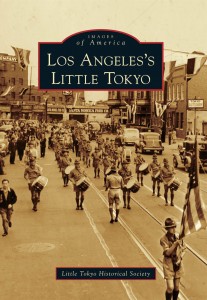
 Only natural, I figure, to go from the Images of America book on where I live in Los Angeles to the Images of America book on a neighborhood that first fired up my interest in Los Angeles. Before I moved, visits to Little Tokyo underscored Santa Barbara’s failure to provide certain necessities: ramen shops, sit-down arcade machines, Kinokuniya, fresh-griddled imagawayaki, 1-Man Band Arthur Nakane. After I moved, I would often ride the subway to Little Tokyo in the mornings just to eat snacks and explore. Some Los Angeles visitors might ask what there is to explore, given that, even at its height, Little Tokyo covered not much more than a square mile. I reply that the neighborhood’s tininess and the distance from its boom years make it a richer experience, not a poorer one. As I wrote about the view from Cafe Dulce, a Little Tokyo coffee shop I frequent, you sit below the hotels Miyako and Kyoto Grand, those aging hulks of near-colonial seventies and eighties Japanese prosperity, you defocus your eyes a little, and you almost feel like that Bubble never burst.
A friend once asked me what I’d change about Little Tokyo. “Nothing,” I replied. He followed up, incredulous: “So you think it’s perfect?” Well… certainly not, but better to live amid distinctive imperfection than perfection, am I right? This makes intuitive sense to me, but I remain unsure quite how to explain it. I suppose it fits in with that whole notion of wabi-sabi — the appreciation of beauty in the imperfect, impermanent, and incomplete — which, in this context, at least has the credibility of coming from Japan. As in Little Tokyo, so in greater Los Angeles: an interviewee once observed that, looking at the city, you often can’t tell whether it’s coming up or falling down. To get the most out of either the larger or the smaller place, you must appreciate that ambiguity in itself. You must also lay down enough shoe leather to get closely acquainted with the streets. To know Los Angeles or Little Tokyo is not necessarily to love them, but if you don’t know them, you won’t even stand a fighting chance of liking them.
 It helped that, before even moving to California, I’d logged years of listening to Hiroshima, the Japanese-American jazz-funk band known for their allegiance to Los Angeles in general and Little Tokyo in particular. They named their eighth album after the city, and their fourteenth after the neighborhood. At least every couple weeks, I drop the needle on their second album Odori (featuring a piece of cover photography, shot on a downtown Los Angeles rooftop, which still ranks among the most strangely compelling I’ve seen) and hear it begin with a number called “Cruisin’ J-Town.” J-Town is another name for Little Tokyo, and Cruisin’ J-Town is also a short documentary about the band; I recently caught a screening, totally by accident, when volunteering at a Sunday-afternoon Filmforum show. Hiroshima also put out a ninja-themed music video for their 1983 song “San Say,” parts of which look to have been shot in or near Little Tokyo.
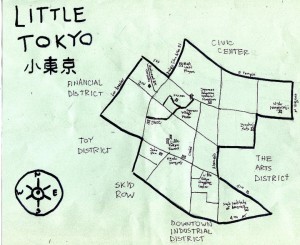
A group photo of Hiroshima in front of a well-known Little Tokyo mural appears in Los Angeles’s Little Tokyo, as does one of a lady at the Mitsuru Café making the aforementioned imagawayaki. Those aside, the book actually depicts fairly few of what I would consider the pleasures of Little Tokyo, focusing instead on the ever-shifting social order that made and remade the neighborhood. Some sort of housing discrimination pushed the first wave of Japanese immigration in the late 19th century toward this particular corner of downtown, and when post-Pearl Harbor internment cleared the place out, Little Tokyo briefly became a black neighborhood called Bronzeville; I hear Orson Welles loved to hit the jazz clubs that sprouted along Central Avenue. Despite the local government’s strongest efforts to avoid the reformation of “ethnic enclaves,” Little Tokyo went Japanese again after the war. A great deal of investment rode in on the crest of that high wave Japan set off in the late seventies, creating elements of that still define the neighborhood’s built environment, like the blue-roofed Japanese Village Plaza (which houses the likes of Mitsuru Café, Cafe Dulce, and, usually, Arthur Nakane) and the New Otani Hotel, which would become the Kyoto Grand in 2007 (and inside of which, so I’ve heard, it remains 1987).
Given how heavily Los Angeles’s Koreatown leaned on group pictures of Korean and Korean-American churches, sports teams, social clubs, it comes as no surprise that Los Angeles’s Little Tokyo triples down on that sort of thing. Little Tokyo’s history stretches further back in time than Koreatown’s, and thus it stretches further into the era when, to warrant something as flamboyantly high-tech as a photograph, you really needed to assemble at least a dozen people, all in their Sunday best. Not being much of a historian, I know little about how to read these photos for significant, non-menswear-related information. Luckily, a photographer by the name of Tōyō Miyatake roamed Little Tokyo in the early 20th century, beret on head and camera in hand, capturing the look and feel of his corner of Los Angeles even when on wedding detail. Such dedication did he cultivate for his craft that, when he got shipped off to Manzanar, he actually secreted his gear in with him and shot internment camp life. Something about the idea of a tireless, faintly eccentric, ever-recognizable documenter of place very much appeals to me. Does Little Tokyo still have them? Does any place? And assuming the oft-told story of the California roll being invented in Little Tokyo is true — there’s the day that will really live in infamy — did Miyatake capture it?
 Colin Marshall sits down in the Los Angeles Central Library’s courtyard with John Rabe, host of
  Colin Marshall sits down in North Hollywood with film and television critic David Bax, co-host of the podcasts
  If I didn’t know the name Alan Flusser, I’d still trust
 Colin Marshall sits down in North Hollywood at midnight with film critic Tyler Smith, co-host of the podcast
  Colin Marshall sits down at the Los Angeles Central Library downtown with Map Librarian Glen Creason, author of Los Angeles in Maps. They discuss the point at which Los Angeles becomes not just a place to live but a subject; riding the old Pacific Electric streetcars that prompted the city to grow so large in the firs place; using maps to see the influence of trains, water, the movies, and oil on the city’s spread, growing up in the “Leave it to Beaver territory” of South Gate; early Los Angeles-boosters selling the city by employing mapmakers’ sleight of hand; downtown’s death in the sixties and seventies, and its more recent revival; learning little but having a lot of fun at UCLA during the Summer of Love; when the city “took a breath and reinvented itself,” Los Angeles’ uniquely dramatic geographical setting; how multiculturalism took hold from the very beginning; what it took to build the Third Street Tunnel; how miracles of civic engineering turned into freeway frustration; the non-disaster of “Carmageddon”; where the water in the Los Angeles River went, and how it remains useful as a navigational aid; the American notion of creating an Eden; whether Los Angeles is, as the posters say, “a world in itself”; former Italian and German communities, and current Indian and Chinese ones; the city’s surprising new walkability; whether the “driver’s paradise” days of twenty minutes to everywhere really happened at all; becoming the Map Librarian serendipitously; Los Angeles’ past of rabbits, gambling ships, and Central Avenue jazz clubs; what happened in Chavez Ravine; how good intentions in Los Angeles’ development have often led to reconsideration; how even longtime Angelenos learn from the ways the constant influx of new Angelenos approach the city; and the endless last rites given to Los Angeles that it never quite needs.

 Colin Marshall sits down at Bourgeois Pig in Hollywood with
