Skip to content

The Korea Blog: The Poetry of, or Rather in, the Seoul Subway

When I want to learn about a city, whether researching it on the internet or stepping out into it in reality, I first look to its subway. It might surprise you how much you can infer about the overall personality of any given metropolis just from riding its trains, be that metropolis Los Angeles (incomplete and inconsistent, but still new and promising) or San Francisco (charming and infuriating in equal measure), New York (often old and dirty, but nevertheless an attraction for all walks of life) or London (highly serviceable, as long as you can enjoy grumbling about it), Mexico City (lively, brightly colored, enjoyably strange, and subject to sudden dysfunction) or Copenhagen (expensive).

I’ve ridden a good deal of urban transit in my time, none superior, thus far, to Seoul’s. Angelenos, who can count themselves as having a good day if their train shows up within fifteen minutes — assuming they need to go someplace a train actually goes, and assuming they know their city’s rail network exists in the first place — can only marvel at not just the system’s range, frequency, and cleanliness, but a host of features they’d never dared imagine: unbroken cell and wi-fi signals, displays that map the next few trains on the way in accurate real time, heated seats, and a variety of shops and cafés, or at least decently stocked stalls and vending machines (as well as non-horrifying bathrooms, the one true marker of civilization) in every station.

Once they adjust to all that, they might then notice, especially if they study the Korean language, how often they see poetry during their short waits for trains. And I don’t mean that metaphorically, as in the “poetry” of bustling, well-orchestrated urban life or what have you — I mean it literally, as in actual poems put up for everyone to read. The program that did it began in 2008, ostensibly to provide the harried citizens of Seoul with opportunities to pause and reflect amid all their underground to-ing and fro-ing. Today, theses poems have made their way up in nearly 5,000 locations in about 300 different stations.

Read the whole thing at the Los Angeles Review of Books.

The Korea Blog: Korea Through the Eyes of Hong Sangsoo

When we moved to Seoul, my girlfriend and I, not unstrategically, chose an apartment located near several major universities. This guaranteed a robust level of cultural amenity; imagine, if you will, the features of several American “college towns” all stacked up within a few square miles. One morning after getting settled in, we took a walk up toward the Film Forum, a kind of miniature art-house multiplex right across the street from Ewha Womans University. There we caught a screening of what, for me, made for the ideal first movie with which to begin my life in Korea: Hong Sangsoo’s Right Now, Wrong Then (지금은 맞고 그때는 틀리다).

Koreans often ask me what got me interested in their country, a question that inevitably leads to Hong Sangsoo. Nothing has motivated me to immerse myself in things Korean as much as the language itself (about which more another day), but my first exposure to the language came through the movies. I got that exposure when Korean cinema enjoyed its first international boom in the early 2000s, which flung out into the world such slick but thematically and tonally distinctive pictures as Park Chan-wook’sJoint Security Area (공동경비구역) and Oldboy (올드보이), Bong Joon-ho’s Memories of Murder (살인의 추억) and The Host (괴물), and Kim Ki-duk’s Spring, Summer, Fall, Winter… and Spring (봄 여름 가을 겨울 그리고 봄) and 3-Iron (빈 집).

Having watched through the filmographies of those Korean auteurs, I found my way to Hong, perhaps the auteur-iest of all Korean auteurs. By that I don’t mean to call him the absolute best filmmaker of the bunch (though I do follow his work with by far the most enthusiasm), but the one who — having made a movie a year for almost the past two decades now, each on a shoestring budget and some with scripts written shooting day by shooting day — has arrived at the most developed style, one he uses to examine, with clear eyes from many different angles, the stories that unfold when a certain type of man (often an filmmaker or academic) and a certain type of woman (often an artist) collide in modern Korea.

Read the whole thing at the Los Angeles Review of Books.

The Korea Blog: How I Learned to Stop Worrying and Love I.Seoul.U

Just before I came to live in Korea, the capital introduced a brand new English-language slogan, the fruit of a much-publicized process wherein real, everyday citizens — alongside a panel of nine “experts” — got to vote on ideas submitted by other real, everyday citizens. The victorious entry, which originally came from a philosophy student, won over not just 682 of the 1,140 Seoulites who turned up to Seoul Plaza to cast their vote, but the entire expert panel as well. And so, beating out rival candidates “Seoulmate” and “SEOULing,” emerged the city’s next global banner: “I.Seoul.U.”

I watched all this happen from a distance, back in Los Angeles, and when I say “watched,” I mean I watched my Facebook news feed explode with ridicule. (One wag wasted no time Photoshopping a version of the slogan for the village of Fucking, Austria.) I.Seoul.U proved controversial from the get-go, but I daresay that the loudest of the controversy — and even my view from Facebook made this clear — erupted among Seoul-based expatriates, especially those from English-speaking countries, a group on whom you can always count to get powerlessly worked up over matters of Korean policy.

“It doesn’t make any sense,” goes the mildest of the objections. Indeed not, but that just puts I.Seoul.U on the long list of the English slogans adopted by Korean cities that hit the native English speaker’s ear somewhat askew. These range from the bland (“Amazing Iksan,” “Beautiful Gyeongju,” “Good Chungju,” “It’s Daejeon”) to the unpromising (“Fine City Hwaseong,” “Just Sangju,” “Namyangju: The Slow City”) to the ungrammatical (“Amenity Seocheon,” “Do Dream Dongducheon,” “Wonderfull [sic] Samcheok”) to the threatening (“Bucheon Hands Up!”).

Read the whole thing at the Los Angeles Review of Books.

The Los Angeles Review of Books Podcast: Brad Listi

Colin Marshall talks with Brad Listi, founder of literary and culture site The Nervous Breakdown and author of the novel Attention. Deficit. Disorder. He also hosts the podcast Otherppl, on which, right here in Los Angeles, he has conducted “in-depth, inappropriate interviews” with over 400 writers about their lives, their working methods, their social media habits, and what they think happens when we die — among many, many other topics.

You can stream the conversation just above, listen to it on the LARB’s site, download it on iTunes.

The Korea Blog: Protest, Korean-Style

The first piece of writing I ever read on Korea had to have been P.J. O’Rourke’s “Seoul Brothers,” originally published in Rolling Stone in 1988. O’Rourke, whose work in many ways inspired me to get into writing myself, back then had the beat of the troubled parts of the world; I first read this particular article in a collection called Holidays in Hell. It opens as follows: “When the kid in the front row at the rally bit off the tip of his little finger and wrote KIM DAE JUNG in blood on his fancy white ski jacket — I think that was the first time I ever really felt like a foreign correspondent. I mean, here was something really fucking foreign.”

O’Rourke had come to Korea to cover the turmoil around the country’s first free direct presidential election. A Korean friend of mine, an economist as well as a fan The Economist, remembers opening up that magazine some time ago and reading an article which began with words like, “South Korea, which became a democracy in 1987…” — words which startled her. She on one level knew, of course, that her homeland held its first genuinely democratic (or close-enough) elections in that relatively recent-sounding year, but it’s one thing to know it, and quite another to have it plainly stated back at you as an acknowledged fact by a respected international news outlet.

History remembers Kim Dae-jung as an icon of Korean democracy, but despite having proven inspirational enough in December of 1987 to get his supporters writing his name in their own blood, he wouldn’t win the presidency until 1998. He ran against the late Kim Young-sam, who would serve as President first, from 1993 to 1998, and they both lost to Roh Tae-woo, President from 1988 to 1993, though rumors of vote fraud swirled around his victory fast enough that O’Rourke had the opportunity to don a helmet against the hail of thrown stones and a ventilator mask against the tear gas (which seems to have constituted a basic element of Seoul’s atmosphere in the 1980s) and make his way into a ward office occupied by enraged student radicals and under siege by the police.

Read the whole thing at The Los Angeles Review of Books.

The Korea Blog: Why I Left Los Angeles for Seoul

I’ve started a new Korea Blog for the Los Angeles Review of Books, and my first post there addresses the question of why I left Los Angeles for Seoul in the first place:

Three weeks ago, I moved from Los Angeles’ Koreatown to Korea itself. The relocation happened not suddenly but after years of planning, and as the date of the one-way flight came within a few months’ time, I found myself more and more frequently pressed to answer the same question: why? Why did I want to move across the Pacific Ocean to a country the size of Indiana, a country many Americans know only for a poorly understood war back in the 1950s (and then mainly through the 1970s television dramedy ostensibly set in it), an impoverished and feistily militaristic northern neighbor, and, more recently, squadrons of pop singers often sonically and visually indistinguishable from one another?

But I’ve hardly gone to Korea without precedent. Nowadays, most of those Americans who couldn’t describe Korea in even the broadest strokes themselves know a few other people who’ve been, whether as members of the U.S. military stationed here or, more often among Californians, college graduates who do a year or two of English teaching here to pay off student loans. The soldiers and English teachers still do more than their part to color the Westerner presence in Korea, but I didn’t want to join their ranks; I had to come on my own terms, outside of the established roles and acknowledged types.

This sort of venture has more of an association with Japan, inspirer of so many English-language expatriate memoirs and observational writings since the Second World War. I’ve enjoyed those books, and even taken their tradition as something of a research interest, but the Westerner-in-Japan narrative has, by now, assumed a pretty standard form. The Westerner-in-Korea narrative, however — essayed by Isabella Bird Bishop and the astronomer Percival Lowell in the late 19th century as well as Simon Winchester, Michael Stephens, and Clive Leatherdale in the late 20th, though none of them made a permanent home in the country — has yet to really take shape. The desire to experience that narrative for myself counted as one reason to leave America.

Read the whole thing at the Korea Blog.

The Los Angeles Review of Books Podcast: J. Ryan Stradal

Colin Marshall talks with J. Ryan Stradal, fiction editor at The Nervous Breakdown, editor-at-large at Unnamed Press, and advisory board member at 826LA. He is also the author of Kitchens of the Great Midwest, which offers at once its own spin on the modern food novel and its own spin on the modern family novel, telling dozens of stories about Midwesterners and the food they eat through the rise of one young girl, connected to all of them, who becomes one of the most respected chefs in America.

You can stream the conversation just above, listen to it on the LARB’s site, download it on iTunes.

Portland, the City in Cinema


Portland hardly runs the risk of cinematic overexposure, but when we see real a Portland movie, one with a sense of place, we remember it. These run the gamut from the 1950s noir morality play
Portland Exposé and nuclear-strike preparedness special A Day Called X to Penny Allen’s 1978 land-use satire Property to the work of such Portland auteurs as Gus van Sant, Kelly Reichardt, and Aaron Katz — not to mention the unerotic erotic thriller Body of Evidence, the pseudoscientific docudrama What the Bleep Do We Know!?, and B-movie master Albert Pyun’s Andrew Dice Clay vehicle Brain Smasher… a Love Story. All of them take the elements of Portland’s urban space — the bridges, the MAX trains, Big Pink, the woods just outside the city — to constitute a fascinating body of modern Portland urban cinema.

For more The City in Cinema video essays, visit its Vimeo page.

This Friday: a free screening of Blade Runner in San Francisco, introduced by yours truly

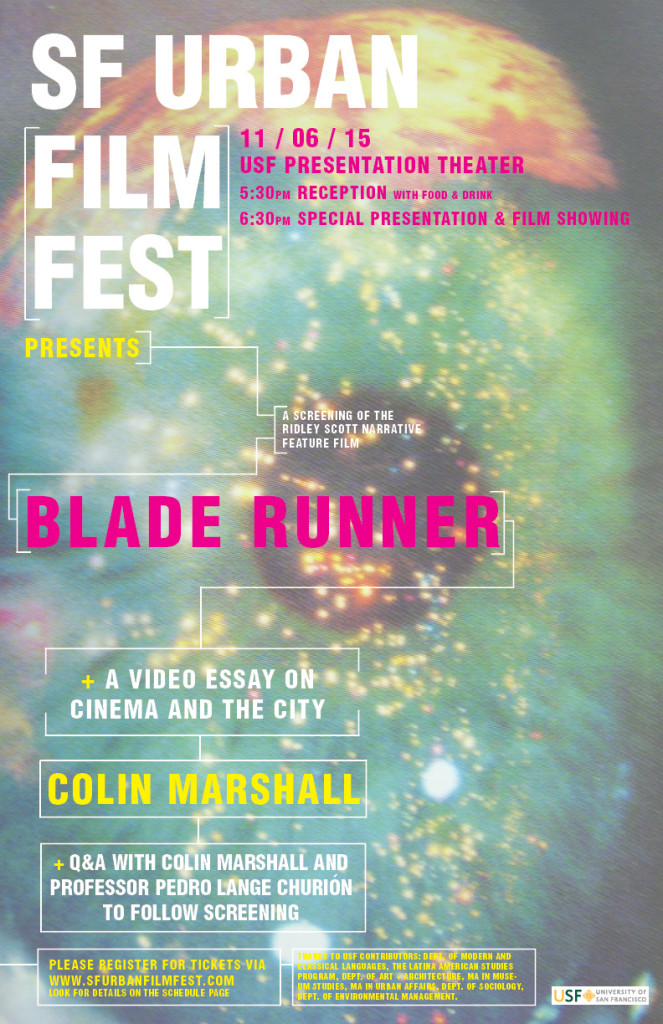
FILM_FEST_POSTER.finalSan Francisco urbanist-cinephiles! This Friday at the second annual San Francisco Urban Film Festival, with its theme of going “beyond dystopia,” you can catch a free screening of Ridley Scott’s Blade Runner, whose vision of 2019 Los Angeles established our aesthetic vocabulary for urban dystopia — but how dystopian does it really look these days?

I’ll show up to give a talk about that and other questions before the screening, and do a Q&A with professor Pedro Lange-Churion afterward. You’ll find all the details (especially those about getting your free tickets) here. You can follow the San Francisco Urban Film Festival on Twitter @SFUrbanFilmFest. And if you like, have a look at my City in Cinema video on Blade Runner beforehand. Start thinking dystopian now, and I’ll see you in San Francisco.

It’s the Final Day to Fund “Where Is the City of the Future?” — But Will This Urbanist-Travel-Cultural Journalistic Journey Happen?


Where is the city of the future? Unless we raise at least $860 today, we can’t even begin to find out. The final day of the funding period for this in-depth experiment in crowdfunded interactive urbanist-travel-cultural journalism across the Pacific Rim has come, and it all hangs in the balance. If you’ve already joined in but have friends who might want to get involved as well — friends who love cities, friends into travel on the Pacific Rim, friends who enjoy receiving postcards from exotic places (wherever they would consider “exotic,” from Sydney to Santiago to Seoul to Seattle), this is the time to bring them on over — specifically, to the project’s page on Byline, the new platform especially for crowdfunded journalism.

As I’ve previously mentioned, each $2000 “Where Is the City of the Future?” raises on Byline will produce one report, or long-form series of articles, on one particular Pacific Rim city that could serve as a model for the city of the future. We’ll begin with Los Angeles and Seoul, then move on, depending on the budget raised, to the other world cities of the Pacific Rim, in an order voted on by you, the supporters. And if you support the project at the top level, you can simply name the Pacific Rim city of your choice, and I’ll head over and do a report on it — after, of course, consulting you for your own thoughts on the place!

It goes without saying that “Where Is the City of the Future?” works best — indeed, works only — with the comparative aspect intact. You can’t really look for the city of the future among only one or two or three cities; you’ve got to cast a wider net, and this project intends to cast as wide a net as it can across the urban Pacific Rim. And so the bigger the budget we raise, the more interesting a reading (and viewing, and listening) experience the final product can become. Let’s make it as interesting as possible — in the urbanistic sense, the exploratory sense, the cultural sense, the culinary sense, the architectural sense, and all others besides — today. Thanks very much indeed, and I’ll see you over at Byline.