Skip to content

Archinect: What Died with John Portman and Syd Mead, America’s Last Urban Optimists?

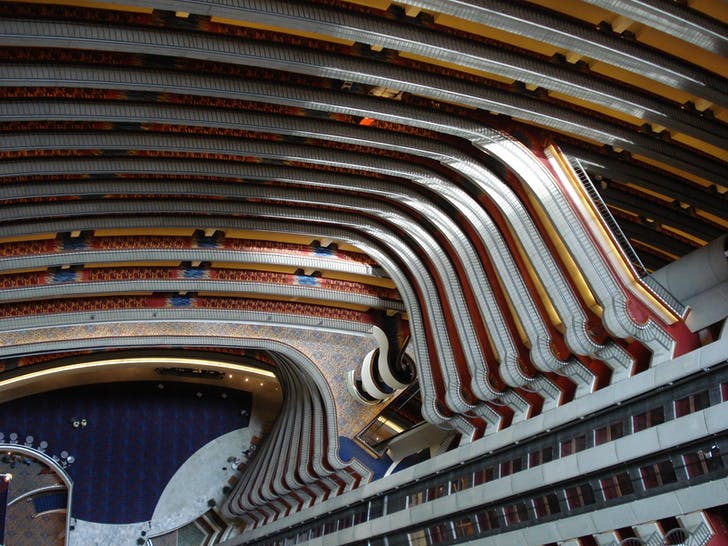
“The science-fiction world of Buck Rogers and the twenty-first century have not left us,” write David Gebhard and Robert Winter in their Architectural Guidebook to Los Angeles. “Five bronze-clad glass towers rise from their podium base, just like one of the 1940s drawings by Frank R. Paul for Amazing Stories.” The work in question is the Westin Bonaventure Hotel, one of the most distinctive-looking structures in a city once known for idiosyncratic architecture. Yet no matter how often they see it, standing as it does on a downtown hill right beside a major freeway, fewer than one in ten thousand Angelenos could name the building, let alone the man who designed it. But to those of us interested in such niche subjects as Los Angeles in film or urban redevelopment in mid-20th-century America, the Bonaventure looms large — larger, indeed, than it does on the ever taller and denser downtown skyline — as does the legacy of its architect, John C. Portman, Jr.

The Bonaventure will look familiar even to those who have never set foot in Los Angeles, provided they watch enough movies. Since opening in 1976 it has appeared onscreen with some frequency, playing a getaway driver’s midnight rendezvous point, the final destination of a scavenger hunt, the site of a political assassination, the first casualty of a massive earthquake. As these roles suggest, the productions that use the Bonaventure tend to be genre pictures, often often unsubtle ones even by that standard (all of which I watched as research for a video essay on the subject). But then, the Bonaventure is an unsubtle building, Buck Rogers in its interior as well as its exterior — both of which appeared, naturally enough, in 1979’s Buck Rogers in the 25th Century, among the very first films to feature either. As well as the Bonaventure would seem to lend itself to such visions of the future, however, most of the films to feature it have been set in contemporary Los Angeles.

Though we haven’t yet reached the 25th century, our year 2020 surely counts as “the future” as anyone in 1976 would have defined it. The real calendar has now officially passed 2019, the year envisioned by Ridley Scott’s Blade Runner, which since it came out in 1982 has stood as the definitive cinematic vision of the Los Angeles to come. Notably for a Los Angeles-set genre picture (albeit an elevated one), its cityscape does not include the Bonaventure: the elements of the real Los Angeles incorporated by Scott and his collaborators tend toward the mundane, like the 2nd Street Tunnel, and even the clichéd, like Union Station and Bradbury Building, a go-to location since the silent era. But Blade Runner presents those locations as no other film had done before, stripping them of any lingering glamor and juxtaposing them against jagged skyscrapers festooned with colossal video screens and street-level warrens glowing with neon Japanese lettering.

Read the whole thing at Archinect.
New Yorker: the Comforts of South Korea’s Coronavirus Response

Asked why I moved from the United States to South Korea, I often say that it was because I wanted to live in the First World. Though it began as a half joke, this response has recently gained a new and discomfiting plausibility. Visiting Americans always express envy at Seoul’s subway system, perhaps the finest in the world, and also at a host of other major pieces of infrastructure and minor everyday conveniences unimaginable back home. Still, just a few weeks ago, when I was receiving concerned messages about the coronavirus outbreak here from friends, family, and even editors, it was possible to believe American life was the safer, more stable option over all—a belief that the pandemic’s Stateside rampage has made untenable.

covid-19 has been unavoidable in the Korean news media since the country’s first confirmed case, in late January. “Kim Eo-jun’s News Factory,” a radio program I listen to every weekday morning, now leads with nothing else, though the improving domestic situation has widened the show’s purview to include other countries’ coronavirus struggles. On some days, the show incorporates clips of speeches by American officials, from the Centers for Disease Control and other organizations, praising South Korea’s testing and containment strategies and asking why the United States can’t replicate them. Kim, the program’s outspoken host, has more than once followed up with this comment: “Don’t you think we’re a developed nation now?,” spoken with a faintly startled satisfaction, as if he’d only just realized that fact himself.

Of course, Kim doesn’t say “developed nation”: he uses the Korean word seonjinguk, a term for the advanced countries of the world, as opposed to all the hujinguklagging behind. Though South Korea has been seen for well over a decade as one of the most strenuously impressive of all seonjinguk—with its unceasing production of pop-music spectacles, its “wiredness” across all sectors of society, its recently demonstrated ability to clean up at the Academy Awards—South Koreans themselves have a tendency to see their country as, in essence, still a hujinguk. A Korean friend, a prominent economist, once described this to me as a national inferiority complex; it flares up in times of disaster, such as the 2014 sinking of the M.V. Sewol, the kind of accident seen as embarrassingly characteristic of an underdeveloped society.

Read the whole thing at the New Yorker.

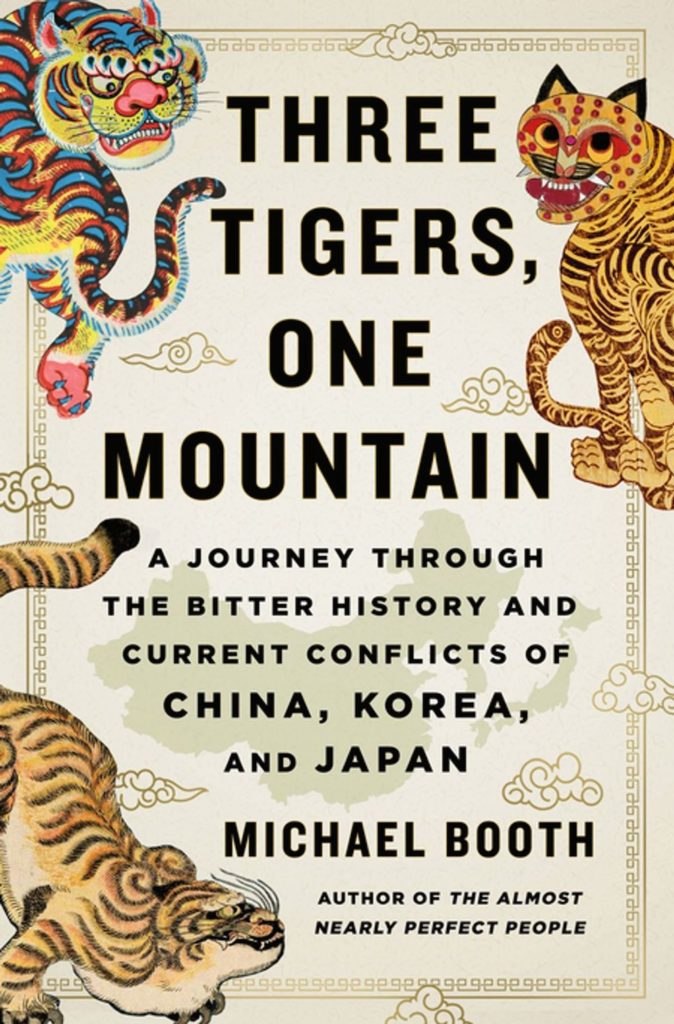
Korea Blog: British Denmark Expat Michael Booth Takes the Measure of Korea in “Three Tigers, One Mountain”

Michael Booth’s Three Tigers, One Mountain isn’t a book about Korea, but in a sense it contains a book about Korea. Subtitled A Journey through the Bitter History and Current Conflicts of China, Korea, and Japan, it takes on an entire region in the form of a travelogue driven by one question: “Why can’t the nations of east Asia get on?” Commissioned last year to review the book for another publication, I had enough space to deal with its largest emergent theme, the origin and persistence of anti-Japanese sentiment in Asia, but not to get into depth on Booth’s treatment of any one tiger in particular. Japan has drawn on-again-off-again interest in Western publishing since the days of Lafcadio Hearn, and in recent years almost too much has been said about the rise of “the Dragon.” But the rarity of books on Korea, even these days when the place makes political, economic, and cultural news, compels me to consideration even when Korea shares a book with other countries.

Though the English-language press now gives space to Korea, much of that space is occupied by the same subjects as if they’re set on repeat: the increasing global popularity of K-pop, K-dramas, and the rest of the “Korean Wave”; the dominance of hulking corporate chaebol like Samsung, Hyundai, and LG; the discomfiting enthusiasm for plastic surgery among Koreans; the periodic resurfacing of South Koreans’ animus toward the Japanese; the surprising indifference of South Koreans toward North Korea; the constant pressure faced by Korean students; the thoroughgoing unhappiness of the Korean population. I may joke with reporter friends about how clapped-out such topics have become, but — as the foregoing links suggest — I’ve also gone to those wells once or twice myself, despite not being a journalist. I do my  best to approach the clichés of 21st-century Korea from unusual angles, but the fact remains that much of what’s interesting about Korea still gets ignored in favor of what may once have been interesting.

Booth also hits all these points, as well as others that might be expected from a broad introduction to modern Korea. What elevates this above standard reportage is his use of the first person: Booth has built his reputation in part as a travel writer, and the most illuminating parts of his book convey Korea as seen through his eyes as he motors around the country. (It feels at times like an automotive version of Korean journeys previously undertaken by his fellow Englishmen: Simon Winchester in Korea: A Walk through the Land of Miracles, Clive Leatherdale in To Dream of Pigs, Graham Holliday in Eating Korea.) As the travel-narrative genre dictates, Booth doesn’t just observe, he experiences. In the obligatory cosmetic-surgery chapter he goes to Gangnam to get his nose worked on. (He doesn’t just seek an intellectual understanding of the industry but, to take a common Korean saying literally, “feels it on his skin.”) Discussing tae kwon do, he doesn’t just frame it as “the country’s first post-war attempt at cultural branding” — something well worth noting — he puts on a set of “white pajamas” and takes a lesson himself, much as Anthony Bourdain did when he showed up here.

Read the whole thing at the Los Angeles Review of Books.

Korea Blog: Everything Turns into ASMR in Korea, Even Cultural Heritage

Last weekend I took my first trip to Korea’s Jeju Island, a vacation spot popular enough to make the air route between it and Seoul the busiest in the world. But I wasn’t going on vacation, nor, strictly speaking, was I going to Jeju: my destination was Gapado, a much smaller island off Jeju’s south coast, the kind of featured now and then on Travelogue Korea. There the conglomerate-owned credit issuer Hyundai Card, known for exclusive cultural facilities in Seoul like the Hyundai Card Music Library and the Hyundai Card Design Library, has spent the past eight years remodeling buildings throughout the island’s depopulated village. When an architectural magazine asked me to go have a look at the project’s results, I dug into the available promotional materials and found, among other things, Gapado-themed ASMR videos. This may surprise you more than it surprised me — or at least it may if you live anywhere other than South Korea.

Most in the English-speaking world have by now heard the term ASMR; some even know that it stands for “autonomous sensory meridian response.” Even among those of who’ve never watched a single ASMR video, many know that such productions involve whispering, brushing hair, tapping wood, crumpling plastic wrap, and other actions that generate the kinds of sounds ASMR enthusiasts find pleasurable. “Its triggers were as varied as watching someone fill out a form, listening to whispering sounds or seeing Bob Ross paint landscapes on TV,” The New York Times‘ Jamie Lauren Keiles writes of early discoveries of ASMR. The term itself was coined in 2010, displacing such less scientific-sounding also-rans as “brain-gasm.” Soon thereafter, deliberately ASMR-inducing videos exploded as a genre unto themselves on Youtube, where, Keiles writes, “legions of (mostly female) creators release, by my count, around 500 new videos each day.”

Though a notoriously trend-sensitive society, Korea developed its own ASMR scene later than much of the word did. Last year The Korea Herald‘s Choi Ji-won profiled the country’s acknowledged first “ASMRtist,” a young lady named Yu Min-jung, known on Youtube as Miniyu. “In 2013, Yu, who had longed to become an actor, was having a hard time after graduating with a degree totally unrelated to her initial goal,” writes Choi. It was then that she discovered the foreign world of ASMR on Youtube and began making her own contributions in Korean. Some ASMR videos use not just sound but actual language, or at least the kind of role-playing ASMR videos Yu makes — and that have subsequently succeeded here — certainly do. “From a late-night barber to a dermatologist, then from a scalp therapist to a caring friend removing makeup from a roommate’s face,” writes Choi, “Yu becomes a ‘healer’ for those craving sounds of comfort.”

Read the whole thing at the Los Angeles Review of Books.

Korea Blog: Reading Albert Camus’s “The Plague” in the Time of the Coronavirus

Nearly every day of the past few weeks, all the mobile phones in Seoul have gone off at the same time: some days once, some twice, some more than that. The cause is Korea’s emergency alert system, which in the years I’ve lived here has warned of flood risks, heat waves, and exceptional densities of air pollution. But now, in the time of the novel coronavirus or COVID-19, it announces each new outbreak, with details running to the area of the city in which it occurred. (Other regions of the country get announcements of their own.) The increased frequency of these simultaneous rings and vibrations colors life in Seoul these days, as do the thousands of surgical-masked faces seen in the street, the Mandarin-speakers wearing “I AM FROM TAIWAN” buttons, and the subway-station announcements — repeated over and over again in various languages including an especially loud English — about the importance of thorough hand-washing.

Though I can hardly complain about the greatly increased ease of getting a seat on the subway, nobody can ignore how much more subdued life in Seoul has become, and how quickly. But Seoulites can at least take comfort in the fact that they’re not in Daegu, the city roughly 150 miles to the southeast where the coronavirus made its dramatic Korean debut. (It now seems members of Daegu’s Shincheonji Church of Jesus, one the many religious sects thriving in this country, carried the virus back after a visit to a branch in Wuhan, the Chinese city from which it originated.) Last week I asked an acquaintance from Daegu, who had to make a trip to his hometown for dental work, what the city looks like nowadays: he compared it to I Am Legend, the movie about the aftermath of a virus that kills off 90 percent of humanity.

Fans of Los Angeles cinema may be more familiar with an earlier telling of the same story: 1971’s The Omega Man, which stars Charlton Heston as the last man alive in the city — apart, that is, from a group of nocturnal albino mutants. Both films are based on Richard Matheson’s 1954 novel I Am Legend, one of the works of literature to which the coronavirus promises a renewed readership. The wide spread of the virus means this now obtains not just in Asia but in the West, in whose oldest major pandemic novel A Journal of the Plague Year Daniel Defoe fictionalizes the diary of a survivor of the Black Death that swept through London in 1665. Though remembered as a European disease, the bubonic plague left its mark elsewhere, sometimes repeatedly: Oran, the second-largest city in Algeria, lost much of its population to the disease in 1556 and 1678, with three smaller-scale outbreaks in the 20th century.

Read the whole thing at the Los Angeles Review of Books.

Korea Blog: Bong Joon-ho’s Biggest Victory, Accepting His Oscars in Korean

When we cinephiles of a certain age remember our discovery of film, we remember browsing video-store shelves in search of interesting movies to rent. But explaining the facts of that era in the face of disbelief from the young — You mean you couldn’t watch a movie someone else was watching? You had to pay “late fees”? — should keep us from looking back with excessive fondness. Not only did we have to contend with the contingencies of physical media, from unwound VHS tapes to scratched DVDs, we had to accept whatever our local video store happened to carry. Some of us could expand our cinematic horizons with trip to the nearest major city’s speciality rental shop, with its large and intensively curated stock organized by director, by movement, by country. But most of the time we had to make do with suburban chain stores, who broke down their Hollywood-dominated selection into crude genres like “action/adventure,” “drama,” “comedy,” — and, over in the back, “foreign.”

I’d like to say I discovered Korean cinema back then, but in fact it took another decade before I came upon the fateful cache of Korean Film Council releases in my university’s media library. Still, my near-random picks from the foreign section, usually from Japan or Hong Kong, got me used to two aspects of cinematically faithful home video, both of which bothered viewers across America at the time. The first was letterboxing, which fit a film’s entire rectangular frame within the then-square frame of television screens, causing some to insist that part of the image was actually hidden by “black bars.” The second was subtitling, which obviated the need to dub a film not originally shot in English into English, much to the consternation of those unwilling to “read a movie.” But not long thereafter, Ang Lee’s Crouching Tiger, Hidden Dragon proved that a subtitled movie could succeed in the United States, in not just its urban “art houses” but its anonymous multiplexes as well.

Or rather I’d thought it did, not least because I haven’t encountered a single English-dubbed film this century. Hence my surprise when I heard Korean filmmaker Bong Joon-ho poking fun at the non-movie-readers of America after accepting his Golden Globe Award for Best Foreign Language Film. He won it with Parasite, a suspenseful, funny, violent, and tightly crafted and tale of class warfare I wrote about here on the Korea Blog after it won the Palme d’Or last May. The audience at Cannes, whose last few big winners have come from Japan, Sweden, England, France, and Turkey, are presumably no strangers to subtitles. The same, perhaps, cannot be said of the audience at the Golden Globes, to whom Bong gave these words of advice: “Once you overcome the one-inch-tall barrier of subtitles, you will be introduced to so many more amazing films.” I admit to never having made a habit of overestimating the cultural acumen of my fellow Americans, but still I wondered: how many of us really had yet to step over that barrier?

Read the whole thing at the Los Angeles Review of Books.

Open Culture posts on Hunter S. Thompson

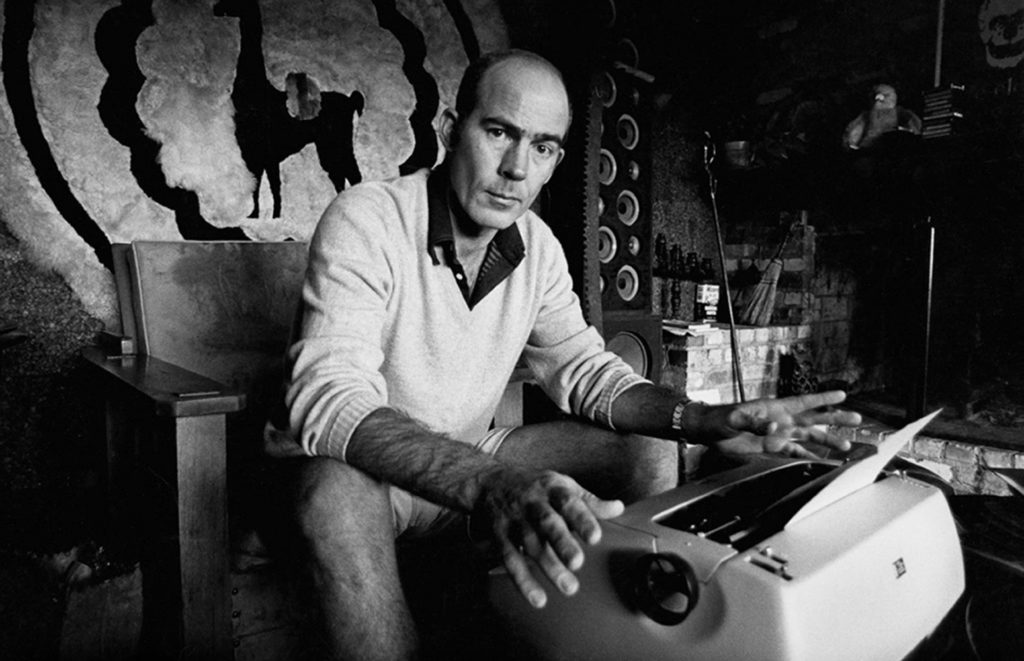
Today marks the 15th anniversary of the death of Hunter S. Thompson, author of Hell’s Angels, “The Kentucky Derby Is Decadent and Depraved,” Fear and Loathing in Las Vegas, The Curse of Lono, and other equally harrowing and inimitable gonzo-journalistic views of the American scene. Here follow the posts I’ve written about Thompson and his work for Open Culture over the past eight years:

You’ll find much more about Thompson in the site’s archives. You can also find a selection of some of my other favorite posts in the Open Culture section of my essays page.

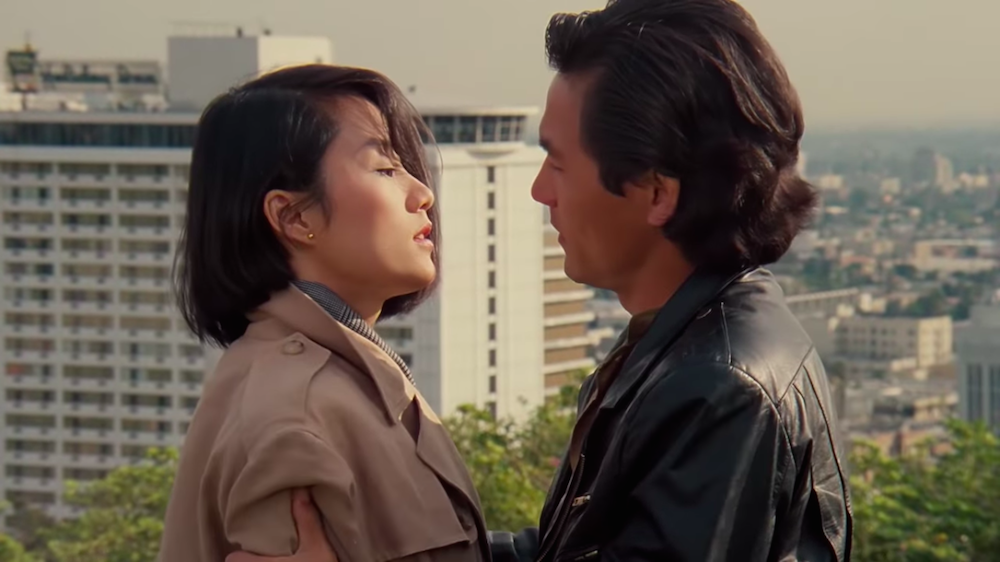
Korea Blog: The American Dream Dies in Los Angeles in Bae Chang-Ho’s “Deep Blue Night”

Speeding through the desert in a convertible, blasting “Highway Star” on the radio: as much appeal as that fantasy has held for Americans, it’s held even more for non-Americans. Such a scene opens Deep Blue Night (깊고 푸른 밤), a Korean film shot entirely in the US and intensely, even grimly concerned with the broader notion of the “American dream.” At the wheel of the car — incongruously, not an American classic like a Mustang or a Corvette, but a Mercedes — is a Korean man of about thirty. In the passenger’s seat is a girl, another essential element of the fantasy, but before long the man will have abandoned her in Death Valley, having roughed her up, relieved her of an envelope full of cash and, deaf to her entreaties, continued on his way. What looked like a simple living of the dream turns out to be part of a mission before which morality is clearly no object.

The man’s name is Baek Ho-bin, and Los Angeles is the destination of a months-long journey that began in his homeland. From there he first made his way to Mexico, then crossed the border into San Diego, where he met the young lady, a fellow Korean, whom he left in the desert. In Los Angeles he connects with another Korean woman, a bartender who introduces herself only as “Jane.” An American citizen, Jane runs a side business entering into sham green-card marriages in exchange for money, just the service for a man like Ho-bin eager to bring his wife and unborn child over from Korea. In time she lets Ho-bin live in her hillside house, and even sets him up with a job at a convenience store. That the cynical operator eventually develops genuine feelings for the handsome rogue may at first seem like a cliché straight out of a romantic comedy with Julia Roberts and Richard Gere — whom Ahn Sung-ki, a child star in the 1950s and now an icon of Korean cinema, resembles in the role of Ho-bin.

Ahn looks and acts most like Gere as he appears in movie that certainly doesn’t count as romantic comedy, but does count among the underrated Los Angeles movies of the 1980s: Jim McBride’s American remake of Jean-Luc Godard’s Breathless, which is more respectable than it sounds. Whereas most American versions of foreign films lighten up the originals, McBride’s Breathless darkens Godard’s debut down, replacing its doomed romantic flair with a nihilistic seediness befitting the change of setting. It also swaps the nationalities of the main characters: Jean Seberg’s Patricia becomes Valérie Kaprisky’s French UCLA student Monica, and Jean-Pierre Belmondo’s Michel becomes Gere’s murderous drifter Jesse. Each in his own way, both Jesse and Ho-bin are archetypes of the aggressive young man in America, the former native-born and full of aimless vitality, the latter a new arrival on the make. Neither show any compunction when dealing — sexually, violently, or both — with those in the way.

Read the whole thing at the Los Angeles Review of Books.

Pretty Much Pop podcast: Martin Scorsese the Auteur

I appear on the latest episode of Pretty Much Pop, a podcast curated by Open Culture, to discuss the films of Martin Scorsese. Though prompted by the release last year of Scorsese’s latest feature The Irishman, preparation for the discussion convinced me to launch into a complete re-watch of Scorsese’s filmography. Here’s the official episode description:

We consider the highly lauded 2019 film The Irishman in the context of Scorsese’s body of work and the styles and themes that his films tend to exhibit. Writer/podcaster Colin Marshall joins Mark, Erica, and Brian to talk about what we do and don’t connect with in Scorsese’s work and how these films qualify as “art films” despite their watchability, not to mention the big budgets and stars. We cover CGI age alteration, the connection to The Joker, his comments about the Marvel franchise vs. him being a franchise unto himself, his use of music, and making films as an old guy. We hit particularly on Raging BullTaxi DriverBringing out the DeadThe King of ComedyGoodfellasGangs of New York,  The DepartedCasinoSilence, and Cape Fear.

You can also follow my Scorsese filmography Twitter thread (still a work in progress) here.

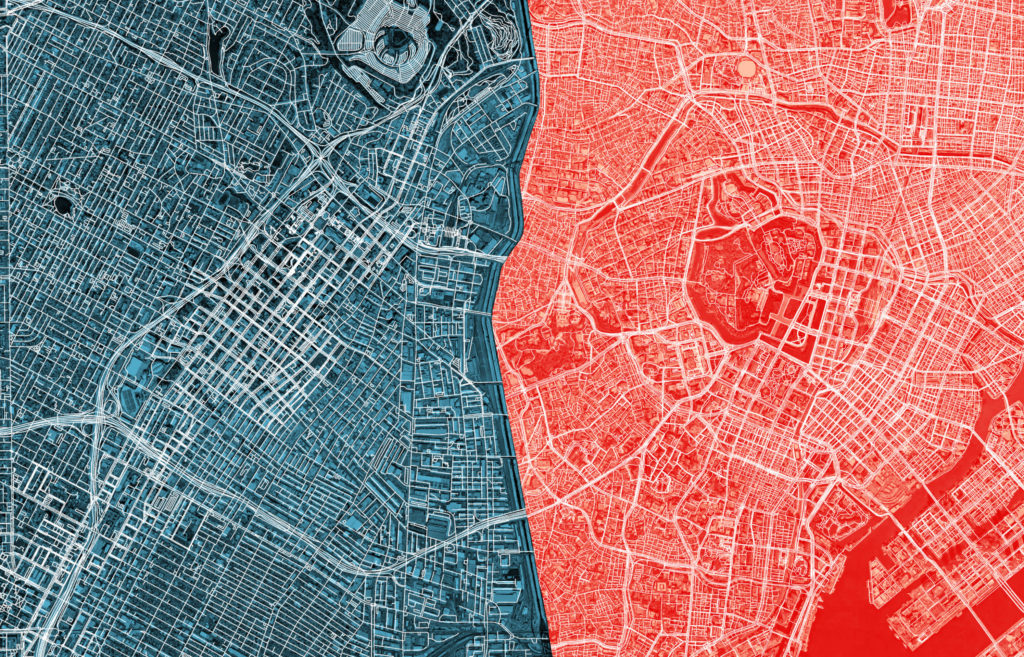
Archinect: For Los Angeles’ Future, See Tokyo’s Present

On the very first morning of my life in Los Angeles, I went to Little Tokyo. With its Japanese bookstores, its undigested chunks of 1980s architecture, and its late-night East-Meets west diners, the neighborhood had done much to draw my attention to the southern Californian metropolis in the first place. Los Angeles, a banner at its airport once proclaimed, is “a World in Itself,” and indeed, it held out to me not just the promise of the city, but of elements of the East Asian city as well. After a few years in Los Angeles I moved to Asia itself, from Koreatown to Korea, but even living on the other side of the Pacific I haven’t stopped thinking about Los Angeles. Nor have I stopped chiseling away, albeit remotely, at the exhilaratingly hopeless task of figuring the city-that’s-a-world-in-itself out. 

Not that I make it to Los Angeles much these days; I’ve been seeing far less of Little Tokyo than I have of the original Tokyo. When I first moved to Los Angeles I’d never set foot in Japan, but when I made my first visit back to Los Angeles, it brought the Japanese capital immediately and vividly to mind. Or rather, one particular Los Angeles vista did: the city as seen from the 70th floor of the InterContinental Hotel downtown. My attempts to master Los Angeles while living there included seeing it laid out from every high-elevation viewpoint I could: the Griffith Observatory, the Getty Center, the Bonaventure Hotel. But I left town before the opening of the Wilshire Grand Center, now the tallest building in the city — at least technically, thanks to the thin spike on top  — and the one whose 70th floor the InterContinental’s panoramic “Sky Lobby” occupies.

This view, a clearer and more expansive one than I’d ever thought possible of Los Angeles, took me back to the observation deck of Tokyo Tower. Originally built in 1958 as a broadcasting antenna (with the dual function of signaling to the world Japan’s rapid rise from wartime devastation), Tokyo Tower is downright venerable compared to the Wilshire Grand Center. But whatever the historical and architectural differences between the two structures — to say nothing of the cities that spread out below them — as vantage points they felt unexpectedly similar. The visit, my first to anywhere touristic in Tokyo after half a dozen trips there, simultaneously indulged my love of all things of the mid- to late Shōwa era (the reign of Emperor Hirohito, which lasted from 1926 to 1989) and my desire to grasp the structure of Tokyo. But it also made me realize that, by comparison to all the cities one could try to understand, Tokyo and Los Angeles aren’t entirely different endeavors.

Read the whole thing at Archinect.