Skip to content

Abbas Kiarostami: Certified Copy


Having slouched around screenings of midcentury Godard, Truffaut, and Antonioni, all of whom have enjoyed a recent surge of popularity at Los Angeles revival houses, I can’t stifle my standard lament about why They Don’t Make Movies Like These Anymore. But a more accurate lament would ask why They Never Really Made Movies That Built on These. We’d surely have tired of 45 years of Blowup clones by now, but I suspect the medium never bothered to learn the lessons of the original. Whatever its motivation, the muse of cinematic exhilaration has drifted on from continental Europe. Few young filmmakers seem to draw inspiration from anything coming out of France today, and Italy’s silence has grown sufficiently eerie to inspire at least one investigative documentary. For a while there, it was looking like we cinephiles would have to turn for sustenance the Middle East; though the region isn’t known, artistically or otherwise, for its joie de vivre, at least it produced Abbas Kiarostami.

You might object to my unrealistically empty image of foreign cinema, one as barren as the waterless brown landscapes across which Kiarostami drives his players. (Though more often, he has them drive themselves.) The notion that we once had Europe, we now have this potential savior from Iran, and we’ll soon have nothing sounds a little hasty when you consider what’s gone on on in East Asia for the last twenty years. Korea’s Hong Sangsoo, Taiwan’s Tsai Ming-liang and Hou Hsiao-hsien, Hong Hong’s Wong Kar-wai; these filmmakers and many of their compatriots besides have heartily assumed the aesthetic and intellectual mandate left by those iconoclastic filmmakers who thrilled American urbanites half a century ago.

In the past decade, many of them have gone so far as to set up camp in Europe itself. In Night and Day, Hong filled a Paris boarding house with his countrymen, each more disoriented than the last, all less disoriented than his characteristically hapless painter protagonist. Hou took it to the same city in Flight of the Red Balloon, dropping but a single Chinese player into an insular French family drama. Tsai’s Face entered the world as a French film in all but directorial heritage. Wong — well, Wong made My Blueberry Nights in America, but the film itself seems to take place in a distinctly Europeanized version thereof. And Kiarostami, whether out of desire or necessity, conceived Certified Copy, a project necessitating a move from Tehran to Tuscany.

Watchers of Iranian cinema — and indeed of Iran — note that Kiarostami could barely have have dreamt of producing such a scandalous picture in the old country. He pushed the envelope far enough a decade ago with Ten, where he took his standard road-weary middle-aged man out from behind the wheel, replacing him with, of all things, a woman. In Certified Copy, not only do we find a woman still in a driver’s seat, but a woman shamelessly dressed to Western Europe’s standard of exposure (and with what Madelaine called a “single-mother visible bra strap” at that). Relegated to the passenger’s seat? A man. If these two weren’t Juliette Binoche, returning to a second tour of Kiarostami duty after portraying the final watching head in Shirin, and opera singer William Shimell, those censors back home would surely have felt their heads explode.

They might console themselves with the film’s lack of sex, but depending on their perceptual choices, they might have to deal with a lack of marriage. I felt the whoosh of a thousand not-quite-appropriate invocations of quantum physics in post-screening coffee discussions, for whether Binoche and Shimell’s characters are married, aren’t married, were married or — might as well consider it — will be married depends on when and where you take your observation. At first, we simply see an art theorist with a few ideas about the value of copied artworks versus that of originals — which, for thematic reasons, you may want to jot down now — being driven through scenes of rustic idyll by an admiring fan; at the end, we see two people fifteen years married with a teenage son, their rapport clouded by a haze of reflection and pitted by bitter potshots at several different subspecies, real and imagined, of emotional unavailability.

Kiarostami orchestrates the transition in a manner somehow neither sudden nor gradual. Several of Binoche and Shimell’s exchanges in the movie’s first half could, stripped of context (not that Kiarostami provides a great deal in the first place), go on between a genuine married couple. In certain moments in the second half, you’d swear they’d fallen back into the distance of acquaintances. A rigorously realist explanation of Certified Copy’s events has a lot of explaining to do around the midpoint, when the two stop into a café, Shimell steps out to take a phone call, and the proprietress strikes up a conversation with Binoche about that man she assumes is her husband.

The matron insists, in her thoroughly old-world fashion, that she senses in him the kind of basic goodness within that — to hell with his obvious distraction, to hell with his customary mistress or three — makes solid husband material. “Well, why not?” we seem to see Binoche think to herself as she begins playing along. But when Shimell returns, he too slides into his assumed role with little prompting, going as far as to speak in Binoche’s native French. Trying to explain his lack of Italian, he claims to have studied French in school, but I imagine you’d pick up a great deal of functionality in fifteen domestic years, even made-up ones.

You can all too easily envision viewers desperately attempting to square it: “So were they married, or weren’t they?” But, doomed by design to futility, these attempts to stack up evidence in the “For” and “Against” columns can only make yet more heads explode. (For a deeply nonviolent filmmaker, Kiarostami displays serious body-count potential this time out.) Michael Haneke’s Caché, if we’re sticking to ultimately ambiguous Juliette Binoche showcases, previously provoked the same kind of consternation. Viewers who obsessed over figuring out who sent all those creepy tapes, or those who called betrayal on Haneke’s own apparent lack of concern over same, missed out on the picture’s richness.

This mindset, liable to reduce a Caché or a Certified Copy to nothing but a cheap trick, ignores the filmmakers’ considerable skill in creating, manipulating, and — a word that means something decidedly different to Kiarostami than to Haneke — aestheticizing a reality around propositions so simple but so excitingly at odds with our storytelling habits. Part of me wishes that audiences had fully digested this sort of thing back when those sixties Euro-auteurs were were doing it, forcing today’s cinema to explore creative frontiers much farther out. But surely the chance to watch Kiarostami try his hand at it counts for something.

Podthoughts: Roderick on the Line

I haven’t posted much here about Podthoughts, the podcast-review column I’ve written for the past three years at MaximumFun.org. (You’ll know them for their own podcasts like Bullseye, a.k.a. the former Sound of Young America, and Jordan, Jesse, Go!) Perhaps I should. This week’s column examines (two-time Marketplace of Ideas) guest Merlin Mann’s latest podcasting project, Roderick on the Line:


Vital stats:
Format: Skype conversations between Merlin Mann and John Roderick
Episode duration: 50m-1h30m
Frequency: weekly

Time was, Merlin Mann’s followers — a square-framed group in which I count myself — suffered a perpetual drought. You’d get your luminary’s guest appearances on podcasts now and again or, on extra-special days, recordings of his speeches at tech industry conferences and company retreats. Though half of these would slice off into the rough of open-source application minutia or techniques for executing semi-documented five-keystroke Mac OS commands, Mann would still work in incisive and eerily useful observations about life, work, and the overlap between them. These came propelled by his rocket-fueled Gen-X wit, guided by cultural landmarks on maps printed by independent record labels of the early nineties. Out its back blew a noxious vapor trail meant to cloud and choke the forces of internet-enabled hucksterism and complacency. To what scraps we received, we paid the attention of Talmudic scholars.

Now, even the most compulsive admirers surely struggle to keep up with more Merlin Mann media than they can handle. Those who always approached his output buffet-style, paying attention to his indictments of certain things and ignoring his indictments of others, must see this as a boon. Those who desire only his thoughts about using your mind to create things that actually matter in a less twitchy, fearful manner can stick to Back to Work with Dan Benjamin. Those who prefer Mann’s rapid-fire cracks — not fully orchestrated jokes, exactly, but something subtler, more tonal, and further askew — about German sex tourism, fruit cocktails, John Wayne Gacy, and insistently ragtag but highly educated guitar bands hailing from the first Bush administration — now have something to download as well.

Read the whole thing here.

Pedro Almodóvar: The Flower of My Secret

Freshly up on 3QuarksDaily, my latest Humanists film column on Pedro Almodóvar’s’s The Flower of My Secret:

Pedro Almodóvar’s overarching project, spanning three decades and counting, makes the most sense to me as the redemption of the soap-operatic. I see it in his films’ bright colors; in their plots driven by the sturm und drang of love, death, and betrayal; and in their besieged women who balance a certain noble endurance with a hint of trashiness. (Over time, the noble endurance has taken the edge over the trashiness.) Watching the entire Almodóvar canon, my brain files each movie as one episode of a single, melodramatic story, albeit a complicated, ever-shifting one which begins in extremity and will surely end in relative mildness. While the filmmaker doesn’t encourage this way of thinking — characters from one film don’t seem acquainted with characters from the others, though my, what notes they’d have to compare — neither does he discourage it. Formal, thematic, visual, and even verbal echoes resonate across his pictures, and in The Flower of My Secret, a few of them crash right up against each other.

Almodóvar builds the film around Leocadia Macias, known to her public — and to her public, only — as romance novelist Amanda Gris. Frustrated by a emerging dissatisfaction with her literarily unchallenging racket, a military-strategist husband who’s grown both emotionally and geographically distant, and the unquenchable aphrodisiac side-effects of one of her medications, Leo lets Amanda Gris’ novels go bleak. Bleak in a way, in fact, that meets the standards of Pedro Almodóvar pictures, although Leo’s sensibility, as reflected in an article she anonymously publishes against Amanda Gris’ latest opus, may have permanently taken this turn toward the Almodóvarian. Her life then takes its own swerve in the same direction.

Man thievery, drug addiction, crime, attempted suicide, family squabbles, a retreat to the village, difficulties with the maid, sudden revelations of artistic potential: Almodóvar’s followers, among whom I count myself, have come to expect all these developments from him and more. This film delivers them without doubt or hesitation, but some smell in it a whiff of the bitterness of an auteur chafing against his reputation. “We have the materials here for a comedy, but not the willingness,” Roger Ebert writes, “and gradually the awful suspicion dawns that Almodóvar himself, like Leo, is tired of his success and despairs that his producers will ever let him do something ‘serious.’”

Read the whole thing here.

Watch Observer, my previous short


I give you Observer, the short film I shot in the summer of 2010, now unlocked for your viewing pleasure. It stayed under password-protected wraps for a while there due to the rules of the various film festivals I submitted it to. Now that I’ve fallen into absolute confusion about the very purpose of the short-film festival circuit, I figured I might as well make the thing available to everyone. Seems like a more efficient way to attract informative feedback and interesting collaborators.

For months now, I’ve been working on my next short, a Borges-inspired story called א about, yes, a point that contains all points. It’s taking so long because I’m shooting it all on Super 8 — don’t ask me why, but I like the look, and the limitations of the format make me work in a psychologically different way — and mostly in Santa Barbara, so each shooting day means a mini-road trip.


The Ubuweb Experimental Video Project 49: John Baldessari’s Time/Temperature


John Baldessari, Time/Temperature, 1972-73

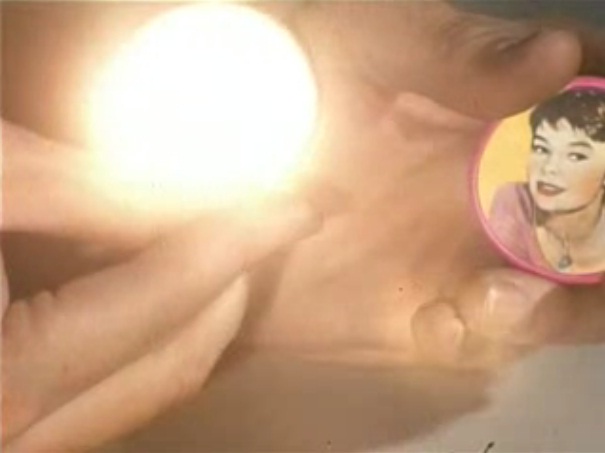
Here we see hands — presumably John Baldessari’s, but who knows — handling a variety of little objects. First, they hold a blue-sanded hourglass and a red-mercury’d thermometer, the contents of the former slowly falling as that of the latter slowly rises. Second, the hold a pair of plastic circles emblazoned, in a midcentury reduced color scheme, with the faces of two starlets. The hands turn the circles one by one, revealing the lens flare-inducing mirrors on their reverse sides.

Third, a trio of wine glasses appear, two empties followed by a third half-full of clear liquid. One of the hands pours whatever’s in the third glass into the second, in which it inexplicably appears red. Then the hand pours the liquid into the first glass, in which it appears at first light purple, then clear again. What I’ve thus far ascertained about Baldessari’s personality from his work tells me that he would go in for artistically repurposed versions of these dime-store ricks, but I shamefully admit that I remain impressed by this one. How does it work? Maybe nobody knows. Finally, one of the hands plunges its fingers into cylinders of easel powder steadied by the other. The thumb goes into the yellow powder, then the next finger goes into the green powder, then the finger after that goes into the yellow powder, and so on. The hand winds up with alternating digits of green and gold, a color scheme some minor holiday must surely have claimed by now.

As with many entries in the Ubuweb Experimental Video Project, one question looms: what to make of this? Alas, as with almost as many entries in the Ubuweb Experimental Video Project, the piece’s accompanying text makes matters even less clear: “Like the camera, these are indexical instruments,” so the anonymous words claim, “but where the camera would ordinarily be taken for granted, these devices seem self-evident. ” That refers specifically to the video’s first set of objects, the hourglass and the thermometer, and nothing in the blurb acknowledges anything else that follows. Maybe the writer had a dinner to get that kept him from sticking around all six minutes?

Hello 2012, goodbye Marketplace of Ideas

All good conversations, it seems, must come to an end. Late in 2010, I announced that, unless The Marketplace of Ideas reached 10,000 podcast subscribers by 2012, the show would come to an end. I regret to inform you that, in the choice between 10,000 or bust, we now have no choice to but to bust. While every Marketplace of Ideas conversation ever recorded should remain available for your downloading pleasure at colinmarshallradio.com and on iTunes, no more material will be released under that banner.

But don’t get too quick on the trigger about unsubscribing from whichever of the show’s feeds you subscribe to. Even now, something new inches its way over the horizon. You might keep any eye on this space to find out what. You might also pay attention to my recent guest appearances on other podcasts. By way of preparation, you might also re-listen to certain Marketplace of Ideas interviews: Momus (and Momus again), Michael Silverblatt, Pico Iyer, David Lida, Geoff Dyer, Merlin Mann (and Merlin Mann again), Jesse Thorn (and Jesse Thorn again, with Adam Lisagor), and Alan Nakagawa, to name an aesthetically, intellectually, and thematically appropriate few.

Further details to come. Until then, stay tuned and stay curious.


Some things in life

The shingle’s out

Soot Bull Jeep has fast become my go-to joint for friends who visit me in Koreatown filled with curiosity about this “Korean barbecue” stuff. Repeated endorsements from no less a food luminary than Jonathan Gold got me in the door in the first place. “Dinner at Soot Bull Jeep is an atavistic thing,” he writes, “not just good liquor and platters of raw meat, but also smoke and fire, and showers of small cinders that can leave your shirt looking like a cartoon bulldog right after an encounter with an exploding cigar.” That article appeared in the Los Angeles Times in 1993. Since then, Koreatown’s bewildering array of barbecue houses has grown more bewildering still, but I haven’t visited one yet that matches Soot Bull Jeep’s all-around sensory impact.

The most obvious vehicle of this impact comes in the form, of course, of dark wood wall paneling, maroon plastic upholstery over cheap metal chair frames, and vast tracts of brown Formica. You’d think such decor would directly evoke the seventies, but it ultimately comes off as idiosyncratic rather than purely retro. Besides, the place only opened in the late eighties; it must have just seemed unfashionable then. I like to think I genuinely appreciate the dining room’s faintly Spartan midcentury high school feel, but its visual aesthetics seem to function more as a means of focusing one’s attention elsewhere, to the main event: the grill, the meat, the flames, the smoke.

Korean barbecue aficionados make much, and rightly so, of Soot Bull Jeep’s hardwood charcoal-fired table grills. This makes for a richer dining experience — richer smells, richer crackly noises, richer showers of sparks, and hell, probably even somewhat richer flavors — than what you get from those just-flick-on gas grills used at even other Korean barbecue joints regarded as the crème de la crème. You can tell the waitresses to load these grills with run-of-the-mill beef and chicken, but given the context, why would you want to? Order up a couple piles of Korean surf-and-turf: tongue will represent the land, of course, but consider yourself free to choose between squid and eel as your envoy from the sea.

I often wonder why I don’t run across more Korean barbecues that grill with wood, although the answer probably lays in people actually meaning it when they complain about the smoke smell clinging to their clothes. While they may, on some level, have a point, these people have exchanged the very concept of joie de vivre for a sort of anxiety-driven waking death. This also holds true for those who complain that Soot Bull Jeep doesn’t offer all the meat you can eat, doesn’t have a big enough parking lot, or operates out of a “bad neighborhood”. Tell you what: move within three blocks of the place, like I did — straight into the belly of this urban beast! — and you won’t have to deal with parking. You can go to Soot Bull Jeep every week and try everything. I’ll teach you how to live again. I’m serious.

* * *

Lunching at Soot Bull Jeep earlier this week, Creative Destruction host and documentarian Rob Montz asked me an important question: what in the hell am I doing for a career? Sure, I flagrantly paraphrase, but his core curiosity remains valid indeed. To keep dressing and enjoying shelter and going out for wood-grilled squid and such, I’ll soon need a job. Actually, that’s not quite how I frame it; quoth Adam Cadre, “Our current economic clusterfuck has led to the predictable call for ‘job creation’: unemployment is skyrocketing, people need jobs, etc. But people don’t need jobs — they need food and shelter and transportation and such.”

Or, perhaps more to the point, quoth Glenn O’Brien: “People now realize that they have to be entrepreneurs, because there are no jobs. If there was a job you wouldn’t want it, because you have to be such a tool to do it.”

So, more simply put, how to get money? Though I have very, very little of the stuff, never have I felt “poor,” per se. In fact, since I try my damndest not to let a day go by without cultivating my store of knowledge or abilities in some way, I feel richer,  in some potential sense, all the time. So what if I gaze upon an eighty-dollar bank account balance one morning? These are, in life’s broader context, the lean years, and one hastens the lean years’ end with each and every bit of practice accomplished and experience accrued.

If anything like a career model emerged (not that I see conducting a career as distinct from living life, but that’s a whole other post) as we chewed our lettuce leaves crammed with kimchi, garlic, various pastes, and tiny sea critters, it was (Marketplace of Ideas guest) Clive James, the polymathic Metropolitan Critic himself. He writes, he broadcasts, he hosts. He moves between various forms of culture “high” and “low” as if he didn’t believe in the distinctions, which I believe he doesn’t. He has many fervent fans and many fervent detractors, which strikes me as a sign of vitality. He can get directly evaluative in a way that would make me feel vulgar, but his opinions change enough over time that I can look the other way.

But I only adapt James’ example to my own life loosely, since we operate on different cultural territories, to say the least. Anyway, if you feel like hiring me to write up an experimental video or a thousand; to shoot short films based on the least filmable of Borges’ short stories; to Podthink; to collect urban field recordings and assemble them in both aesthetic and linguistic patterns; to crank out an article about Oaxacan mole, Los Angeles subway lines and Abbas Kiarostami; or to conduct a cultural conversation of the depth you demand, please feel free. The shingle’s out.

The Ubuweb Experimental Video Project 48: John Baldessari’s Baldessari Sings LeWitt


John Baldessari, Baldessari Sings Lewitt, 1972.

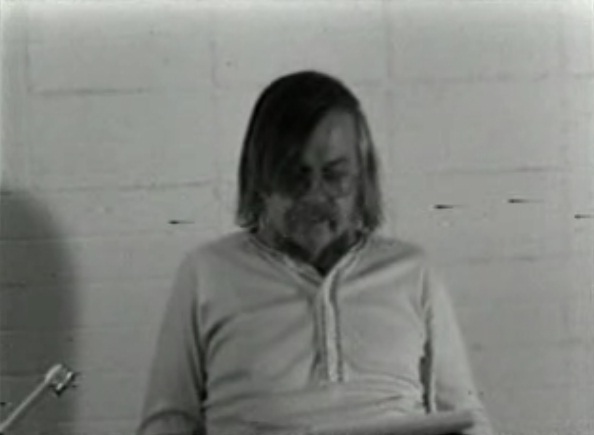
I come away from this video wanting to read some Sol LeWitt. In it, Baldessari, shot in classically muddy Portapak style, sits down and reads a selection of lines from Lewitt’s writing on modern art. Well, I suppose he technically sings the lines, but his delivery strikes me as more of a recital. He does a shambling sort of sprechgesang, loosely hanging LeWitt’s words on vague approximations of the melodies of various popular songs. “Camptown Races” really trips him up. He delivers one line to the tune of a Beatles song that’s famous even by the standards of Beatles songs, my failure to summon the name of which makes me realize just how badly I’ve shirked my cultural duty of Beatle familiarity.

Cogent, truthful, non-trivial writing on visual art being somewhat hard to come by, I keep myself on perpetual lookout for anyone whose words even faintly promise it. Some of the LeWitt sentences Baldessari sings, when they come out clearly, hint that I should do some further reading. The claim that “irrational thoughts should be followed absolutely and logically” struck me as particularly worthy of consideration. But now that I think about it, isn’t that just the program Baldessari follows here? At the video’s beginning, he announces his intention to honor LeWitt’s words by bringing them out of the exhibition catalogs and into song, and he follows that perhaps irrational premise absolutely and logically.

Baldessari also sings of the process whereby a concept becomes an idea becomes a work. At least my notes describe the process that way; maybe an idea becomes a concept becomes a work. But I mostly want to hear more of LeWitt’s thoughts on the step that comes after that. “A conductor from the artist’s mind to the viewers,” Baldessari sing-quotes LeWitt’s definition of a work. He also converts into song an intriguing passage about how the perception of others’ ideas leads to new ideas, and how new ideas come from the misperception and/or misconstrual of existing ideas expressed in existing works. Most of my own ideas come from misperception and/or misconstrual. Heck, I’m probably misperceiving and misconstruing Baldessari Sings LeWitt right now.

Will I find the clarity of thought and expression I so desire in Sol LeWitt’s original, non-sung writings on modern art? There’s a chance, although on the basis of Baldessari’s selections alone, I can’t rule out the possibility that his observations might turn out to be ultimately untestable or at least not usefully evaluable. But boy, did the man make some cool geometrical art!

How the iPhone got me

So what pushed me to finally get an iPhone, even though I lack so much as a multi-digit income?

  • I nearly slapped down the howevermany hundred dollars a first-generation iPhone cost when Brian Eno and Peter Chilvers’ Bloom hit the App Store. Having read Eno’s A Year with Swollen Appendices at least three times by that point, I’d grown familiar indeed with his enthusiasm for algorithms and devices that use randomness to create ever-changing music in real time. But he wrote the diaries that book comprises in 1995, and as such bemoans in them the limits the era’s hardware and software imposed on such “generative music” systems. Fewer such problems on the iPhone, which can handle the numerical processing and sonic synthesizing even as it takes its input — the “seed” of the music — from the patterns you tap into its touchscreen. This video gives you an idea of how the thing actually sounds. Eno and Chilvers released a follow-up, Trope, which expands on the Bloom idea by converting into music the motions of your finger across the screen, rather than just using individual points of tapping.
  • The second dimension of irresistibility came in the iPhone’s mapping capabilities. Maps, as a form, keep drawing me back with their distinctive balance between the qualitative and the quantitative. (Edward Tufte‘s books on information design keep drawing me back for similar reasons, to the point that I did pay the howevermany hundreds of dollars for his experimental two-day course in Palo Alto.) So how was I going to resist the ability to scroll around scalable maps, overlayable with all sorts of data, of almost any corner of the Earth? That the iPhone offers the user GPS-based navigation of these maps didn’t matter so much in a town as small as Santa Barbara, but now that I navigate a new slice of Los Angeles almost every day, the iPhone’s onboard mapping software or any of hundreds of related apps add a great deal of value. I foresee this coming in very handy in the next foreign metropolis I explore, though I realize I’ll have to perform some sort of h@x0ring beforehand.
  • As with any still-toddling technology, the first popular uses of the camera-phone — enthusiastic diners photographing their restaurant meals, Asian girls taking topless shots of themselves in bathroom mirrors — struck me as rather less impressive than I’d hoped. But at some point, the convenience the iPhone camera offers in documenting one’s peregrinations seemed too attractive to pass up. How else, I ask you, could I snap something like this on the go:

  • But finally, my friends, the field recording did it. I had my doubts about how rich a sonic environment a microphone as small as the iPhone’s could really capture, but when sound artist (and Marketplace of Ideas guest) Alan Nakagawa played me some of the recordings he’d picked up with it, I knew immediately what I had to do. I don’t know if I’ll make the next New Zealand Stories with it or anything, but I’m sure it’ll earn its keep when I record impromptu interviews or travel podcasts like (twotime Marketplace of Ideas guest) Momus used to do.

Oh, and now that the iPhone 4S has all the kids talking, AT&T will cough up a 3GS for nothing more than your signature on a two-year contract and the cost of tax. I suppose I should mention the formidable aesthetic sense with which the iPhone is both imbued and associated, aesthetics being pretty much the only thing I ultimately care about, but you’ve probably heard enough on that subject already. Despite all the grand claims about the myriad technological advantages of, say, Android phones, Android fans tend to dress like they’ve just stepped out to get the paper.