Skip to content

To Los Angeles by iPhone

I have entered an esteemed rank: unemployed people with iPhones. More on that tomorrow, but in the meantime, observe a bit of what I’ve been doing with it:


Los Feliz

Koreatown

Miracle Mile

Koreatown

Santa Monica

Koreatown

Hollywood

Koreatown

Echo Park

Koreatown

Downtown

Koreatown

Hancock Park

Koreatown

Koreatown

Koreatown

Koreatown

Katherine Yungmee Kim: Los Angeles’ Koreatown

You see these thin, sepia-toned “Images of America” books for sale everywhere in Los Angeles. Each one covers a different corner of the city: Bel-Air, Little Tokyo, Chinatown, Boyle Heights, Palms, Historic Filipinotown, etc. I’ve even flipped through more than one volume on the old Pacific Electric streetcar system that would eventually become an integral piece of the plot Who Framed Roger Rabbit? With their sub-200 page counts and abundance of pictures, these books give off a definite gift-item vibe, like they belong on the almost-bare shelves of people who don’t actually read books, but they nevertheless strike me as a convenient place to start building a knowledge base about individual Los Angeles neighborhoods. Which else to read about first but my home, Koreatown?

Imagine a hip hangout for sloshed celebrities from the thirties. Now imagine a mass celebrity exodus from the neighborhood. Now imagine Koreans immigrants taking over the very same structures these thirties celebrities vacate, keeping most intact and even restoring many but always repurposing them toward culturally hybrid ends. That’s Koreatown, the most elegant explanation of which I’ve read comes from famed food critic Jonathan Gold, who lived in Koreatown before it became Koreatown:

My neighbors then were mostly elderly white people who had lived in the neighborhood since the ’30s, when the old ballroom around the corner hosted big bands, when a romantic night out in the neighborhood might have involved a show at the Cocoanut Grove, big steaks at the Brown Derby, maybe cocktails afterward at the Town House or the Cove. The neighborhood had become slightly shabby since then — the big insurance houses down on Wilshire seemed to be all that was keeping the area alive — but it was a genteel shabbiness, and something of the old rhythms were still alive.

Not long after, the Koreans started moving in: a few families at a time at first, then into most of the block. [ … ] When I went to a Wilshire high-rise to sign [my new apartment lease], one wall of their agent’s conference room was covered with a large-scale map of the Mid-Wilshire area on which each Korean-owned property was marked with a pushpin. Entire swaths of the city, including much of Hancock Park, Country Club Park, the Ambassador district and the Pico-Union area, were paved with the pins, solid, shiny surfaces pebbled like the skin of a basketball — neighborhoods where the fire escapes now were blanketed with cabbage leaves in the fall, clotheslines (like mine) bristled with drying fish, the silence of dawn punctuated with the steady, rhythmic pounding of garlic in wooden mortars. I came to love that sound. In a way that I neither had been nor could be, my Korean neighbors were at home.

In Los Angeles’ Koreatown, Katherine Yungmee Kim tells the neighborhood’s story from 1895, with a photo of some dandies on slightly old-timey bicycles hanging out on what looks like an endless, featureless plain of dirt — which turns out to be Pico and Western. By 1915, the place had some alive with buildings and motorcars. The area’s rapid growth bestowed upon it a few Guinness-type distinctions that seem almost hard to believe: the first neon sign in America, the first all-electric building in America, the first Korean restaurant in California (less of a surprise, admittedly), the two longest escalators in America. (Actually, they built those more recently. They’re the ones to the lower platform at the Wilshire-Vermont subway station. I can confirm: long.)

The very first Koreans in Los Angeles arrived in 1903 or so. Students and labors followed them over the next couple decades, just as midcentury icons like the Ambassador Hotel and the Brown Derby opened their doors. (People actually used to call the specific place I live the “Ambassador District.” As for the Brown Derby, I still wish I could eat in the hat, but it’s a Korean plaza now.) Later in the thirties, the Koreans moved from the Bunker Hill-ish area this book has so many group photos of their social clubs taken in to an area just south of modern Koreatown, in what most of us still call South Central.

World War II and the Korean War brought further waves of Korean immigration. Somewhere in the late sixties to mid-seventies, Koreatown began a geographical shift north to its current location. Some of this must owe to a fellow named Hi Duk Lee, who came to the States in 1968 by way of Germany, filled for some reason with ideas about how to build up and legitimize the Korean presence in Los Angeles. Kim doesn’t give this much mention, but Lee seems to have dreamed of an architecturally traditional Koreatown, but what with the American economy of the late seventies, it didn’t quite happen.

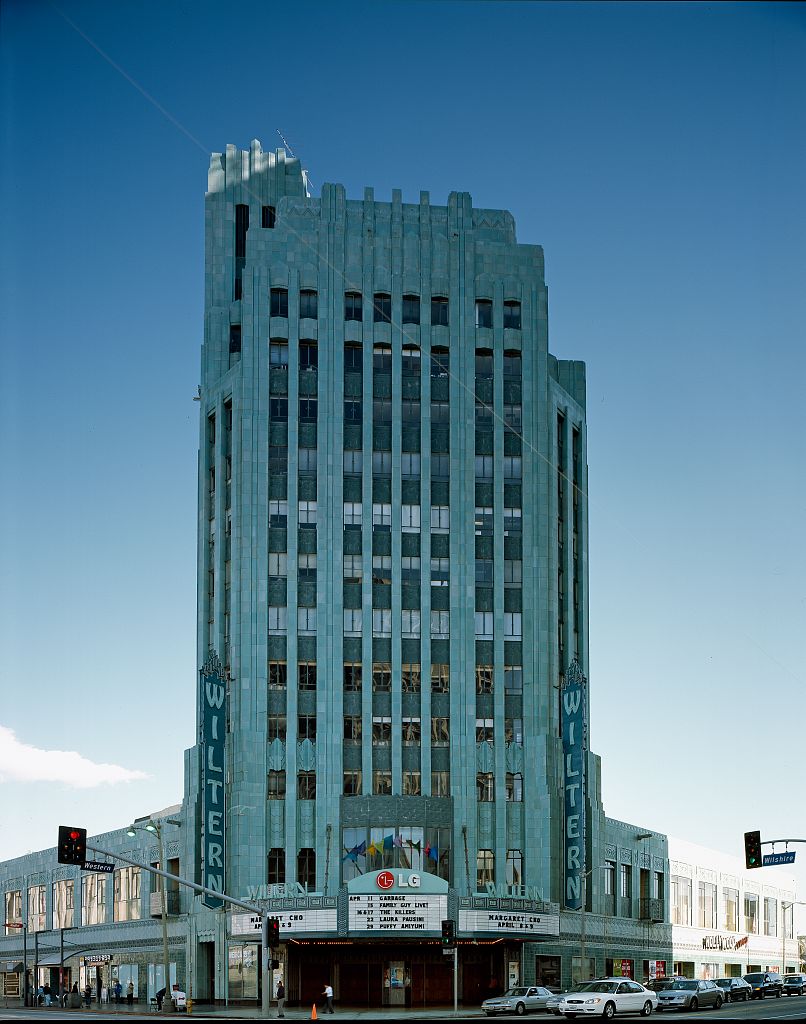
Lee did get a lot done to realize the Koreatown project in general, though, and the traditional edifice he built to house his restaurant the VIP Plaza still stands — except it now contains a popular Oaxacan eatery, La Guelaguetza. You could call this a shame, but isn’t it more interesting when you can find the bright colors and distinctive moles of southern Mexico in an elaborately old-school Korean shell in one of the biggest cities in the United States? And how about when that lays walking distance from vintage Los Angeliana like the Gaylord (with its H.M.S. Bounty), the Wiltern, the Chapman Market, and mainstays of the photographed landscape like the Sterling Ambassador Tower, which I just saw once again in Zabriskie Point?

And ah, The Prince: a bar I live two blocks from, a shooting location Mad Men has found rather useful, and an ideal synecdoche for the special kind of commercial miscegenation that makes me want to live nowhere but Koreatown. Take it away, J-Gold:

Imagine a Korean pub shoehorned into the fanciest restaurant in Los Angeles circa 1953, complete with the lawn jockeys at the top of the stairs and oil paintings of earls above the oxblood leather banquettes. The food, you understand, is not exactly the point at the Prince, which seems to specialize in sugary stir-fries and American dishes that might have been inspired by Quad Cities Rotary banquet menus. The basic unit of currency here is the kimchi pancake, a thin mass of egg batter laced with fermented cabbage, lashed together with scallions, then fried to an exquisite, oily crispness. Kimchi pancakes come free with your drinks, which makes sense, because the greasy heat of the things is enough to power you through an entire double-size bottle of Korean Hite beer.

Since he wrote that, the Prince has added Korean fried chicken to their menu in a big way, and boy, do I dig it.

The Ubuweb Experimental Video Project 47: John Baldessari’s Title

[For installments 1-46 of The Ubuweb Experimental Video Project, see either my Typepad or Livejournal accounts.]


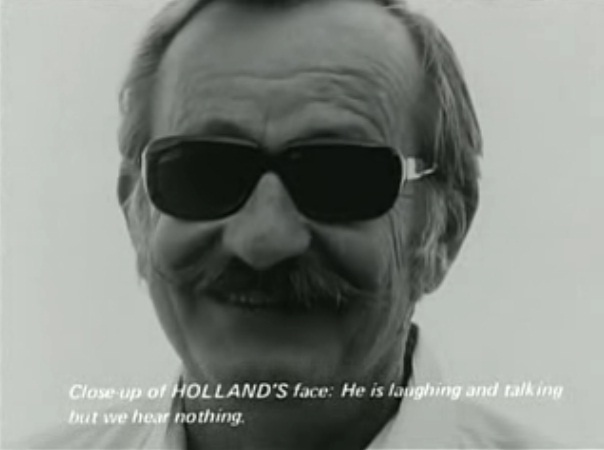
John Baldessari, Title, 1971.

Title isolates, in a bunch of different permutations, the elements of motion pictures: objects, sounds, people, spoken words, actions, screenplay directions. Baldessari builds things up as the piece’s ten episodes, so while at first you only get to see silent shots of individual chairs, rocks, puppies and fields, by the end you’ve got human actors doing things and saying audible lines. The relevant scrap of their script appears at the bottom of the frame: “KELVIN puts the phone down on the table, with RUTH still talking. He lights a cigarette,” or “MOSSIE: (camera still over her shoulder) Over there.”

You might find Baldessari’s mission here a tad unambitious — who today doesn’t know that films emerge out of separate and sometimes only indirectly related audiovisual and human parts, or for that matter didn’t know in the early seventies? — but it still points toward a deliberately alternative way to watch movies that I’ve found myself practicing more and more with time. Maybe the fact that I make films myself and thus struggle to understand all the nuts and bolts of the operation has something to do with this, but even if you watch movies casually, doesn’t taking in the whole product at once — sound, image, dialogue, editing, music, action, humanity — sometimes get… overwhelming?

So when I run across a film or video that particularly impresses me, that stokes within me a desire to understand how it works or even replicate those workings, I often use a Baldessarian viewing method — or at least the viewing method of the John Baldessari who made Title. At any given time, I concentrate only on the image onscreen, or only on the sounds of the audio track, or only on the rhythm of the editing, or only on the motion of the actors. Do this with films of exceptionally rich craft, and you can get five, six, seven whole viewings that all feel different, and that all teach you different lessons about cinema. And which films would you want to watch over and over again, after all, but those of exceptionally rich craft?

The Marketplace of Ideas: into sound, food, performance, Japan, and the world city with Alan Nakagawa

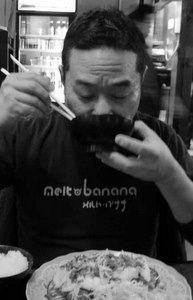
This week on The Marketplace of Ideas, I talk to Alan Nakagawa; sound artist; visual artist; installation artist; founding member of Los Angeles’ long-running, multi-disciplinary, multi-ethnic, soon-to-be-dissolved arts collective Collage Ensemble; director of the experimental music Ear Meal webcast; L.A. Metro public art executive; member of Otonomiyaki, the Southern California Soundscape Ensemble and Ear Diorama Ear; and very serious eater indeed.

Soon after moving the center of Marketplace of Ideas production to Los Angeles, I realized that the here-based Alan Nakagawa pretty much embodied the show’s evolving sensibility. Trained in both the United States and Japan and experienced in collaborations with fellow creators from all over the globe, he works in the territory where sonics meet aesthetics meet the built, social, and artistic worlds around us. In our conversation, we cover what’s most interesting to listen to in this city, how a three-year-old found drawing behind the couch goes on to diversify into as many different art forms as possible in as unified a way as possible, how best to move between the countless separate cultural spheres that a metropolis like L.A. comprises, and what it actually means for an artist to experiment — and to offer that experimentation to the outside world.

Download the conversation on iTunes here or on the web site here.

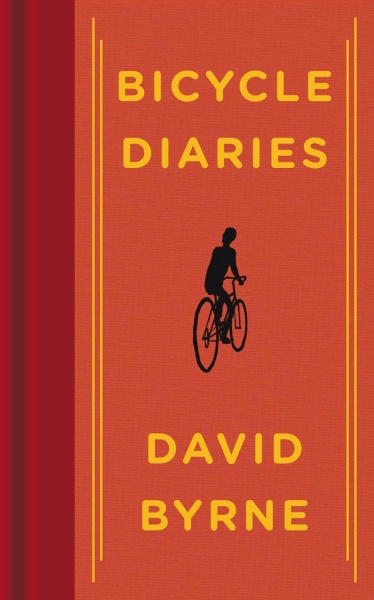
David Byrne: Bicycle Diaries

Sometimes you run across books that happen to ring a whole row of your intellectual cherries. I’ve actually had Bicycle Diaries on my shelf for a couple years, slowly fueling the fire of my readerly anticipation all the while. When my interests came into unprecedentedly close alignment with the book’s own, I couldn’t resist de-prioritizing all other projects and pulling it down.

The book resonates strongly with, off the top of my head, at least ten of my current enthusiasms:

  • Cycling as transportation
  • Cities and their structures
  • The effects of mixed human interaction on creative output and vice versa
  • Internationalism and foreign travel
  • Experimental music
  • Unconventional uses of irony
  • The nature of normality
  • Late-seventies/early-eighties alternative pop culture, especially when partially U.K.-derived (as Byrne is)
  • Diarism
  • Meditative practices that aren’t actual meditation

Byrne took up cycling back in the early eighties, a time when it got him strange looks. He observes that, on a bike, “your unconscious is free to kind of mull over what it is you’ve got to deal with that day or whatever creative stuff you’re working on. Sometimes the problems get a little closer to being solved by the time you get to where you’re going.” He even blocks out time on trips for bike-based “random wandering,” which “clears the head of worries and the concerns that might be lurking, and sometimes it’s even inspiring.”

These writings on cycling (and every subject the mind of David Byrne can connect to cycling) reveal that he uses his bike not just for meditative practice, but as a means of transport and a delivery system for urban aesthetic experiences. He mentions several times the joy of gliding around a city on two wheels, gazing out from a perspective above a pedestrian’s and above most drivers’ as well. Observations made prom this perspective provide jumping-off points for chapters on such variously bikeable cities as Berlin, Istanbul, Buenos Aires, Manila, Sydney, London, and New York. (Disappointingly, he makes mention of neither Los Angeles nor Mexico City, except in passing references to their non-density.)

Byrne’s love of cycling purely as a means of transit might not sound notable, unless you, like me, have looked around the street and noticed that almost every other rider looks like a crypto-competitor, dramatically bent over and partially kitted out with toe clips, wraparound shades, and maybe specialized pants. I found some measure of validation for my habit of dressing normally on my bike when I read that Byrne does it too (“You don’t really need the spandex”), thought I wonder how far “But David Byrne does it!” will take me as a life strategy. (Pretty far, I bet.)

Noting down how well each city he visits accommodates his cycling and what he thinks they could do better, Byrne takes a bike advocate’s position, certainly, but an advocate of bikes as almost another form of public transportation. This idea doesn’t strike me as especially far out; I use my bike effectively as an extension of the L.A. Metro (because there’s almost always room to take your bike onboard), and I noticed that the bikes of Mexico City’s Ecobici rental system (for D.F. residents only, unfortunately, but very similar to some of the schemes Byrne tries out in his travels) bear the words “Sistema de Transporte Individual,” echoing the subway’s “Sistema de Transporte Colectivo.”

This means he reserves special praise for towns full of carefully thought-out bike lanes, like Copenhagen has. I’ve been happy with L.A.’s bikeability — I find it even easier to get around that way here than I did in Santa Barbara or Seattle — but I do have to devote a chunk of my mental bandwith to getting around or through the next unusual or unpredictable obstacle. I oscillate between the road and the sidewalks (legal to ride on here), take unusual positions within lanes, and use routes that look wonky mapped out. Rarely without a helmet, I take a certain pleasure in this hint of extreme sportiness — as does Byrne — but the image of all those freely biking, utterly unprotected Copenhageners, toddling and septuagenarian alike, gives me pause.

In L.A., such a caliber of bike lane remains, uh, eventually forthcoming, but I choose to deal with the inconveniences and ride this city for the same reasons Byrne rides his hometown of New York and and well beyond, especially the ones to do with experiencing the urban fabric more directly. The natural exposure and flexibility of cycling, so Byrne argues in a way that persuades me well enough, offer the higest-bandwidth connection. But he’s got thoughts on the fabric itself as well.

Many of these thoughts have to do with diversity — financial, racial, aesthetic, industrial, artistic — and the liveliness it generates, the sort of liveliness that presumably did its part to forge Byrne’s creative persona decades ago. “A neighborhood that has many kinds of people and businesses in it is usually a good place to live,” he writes. “If there were some legislation that ensured that a mixed-use and mixed-income neighborhood would emerge when developers move in, it would be wise, because those are the liveliest and healthiest kinds of communities. [ … ] Creativity gets a boost when people rub shoulders, when they collide in bars and cafes and have an tentative sense of community. [ … ] Creativity will be extinguished in New York if random and frequent social contact is eliminated.”

I’ve left my own jury out on the matter of whether legislation is the way to accomplish this, since I get nervous about any solution that premised upon giving politicians and bureaucrats more power. Sure, maybe you’ve got a far-sighted, forward-thinking visionary in office now, but what about the guy who succeeds him? But for all its much-discussed fragmentation, L.A. certainly seems to have more and more neighborhoods moving in just this direction.  I feel excited to see how that changes the sort of culture this city generates over the next decade or so, especially if I can observe it, as much as possible, from a vantage point that isn’t the inside of a car. As Byrne frames it, “the city is a 3D manifestation of the social and personal — and I’m suggesting that, in turn, a city, its physical being, reinforces those ethics and re-created them in successive generations and in those who have immigrated to the city. Cities self-perpetuate the mind-set that made them.”

Aki Kaurismäki: La Vie de Bohème

Up today, my latest Humanists column for 3Quarksdaily on Aki Kaurismäki’s La Vie de Bohème:

Do even lovers of world cinema think much about Finland’s working class? Does Aki Kaurismäki think about much else? Clearly, when not thinking about Finland’s working class, he thinks about world cinema, even going so far as to produce a short film thanking Yasujirō Ozu for his influence. “So far I’ve made eleven lousy films,” the Finn says to a pair of portraits of the Japanese master, “and I’ve decided to make another thirty, because I refuse to go to my grave until I have proved to myself that I’ll never reach your level, Mr. Ozu.”

But Kaurismäki has reached Ozu’s level, at least by one particularly objective measure: drinking. Both filmmakers have gone on record measuring out their lives by number of glasses and bottles emptied. While Ozu and his collaborator Kōgo Noda might famously have put away 180 liters of sake in the process of writing each and every script, their films usually focused on characters who might only indulge in a couple rounds after work. Ozu’s people tend to operate under a slow but steady upward mobility, albeit one that sends subtly devastating waves through their long-established but delicate familial relationships. Kaurismäki’s people, who might easily drink instead of working, can count themselves lucky to have any kind of relationships at all.

In Finland as Kaurismäki uses it, you might just as well call the working class the drinking class. When he leaves his homeland for La Vie de Bohème, a part of that simple formula goes missing: the French playwright Marcel, the Albanian painter Rodolfo, and the Irish composer Schaunard want to create and want to find women, but above all, they want not to work. At the point the film begins, getting jobs seems to have transcended the position of priority in their lives to become the unquestioned foundational principle of their lives. Though neither successful nor prosperous by any common definitions of the words, they nevertheless hold themselves up higher than, say, the still-teetering wreckages in the Kaurismäki-influenced Helsinki segment of Jim Jarmusch’s Night on Earth. As members of what you could call the non-working class, they skirt the standard set of human obligations with a kind of… style.

Read the whole thing here.

Afri-Cola emphatically rejects anything that is not Afri-, and fully supports anything that is

Madelaine inadvertently released a Proustian memory cascade in my mind when she played me this German soda commercial from 1968. While it looks and sounds like a perfect example of one of those distant cultural artifacts, made strange by time and nationality — which it exactly is, I suppose — it exhumed a part of my own childhood the sands of time had long obscured.

I’d just started fourth grade in a new school. Navigating its unfamiliar cafeteria on a daily basis, I grew more and more captivated by a certain bottle I’d see in the drink fridges. The stark, classy black-and-white design of its label drew me over, but its cultural associations left me bewildered. “Afri-Cola”? So, cola from Africa, right? But then, below the logo: “EINGETRAGENE SCHUTZMARKE.” German, then? Or maybe South African? Or maybe African and German? Both cultures scared me enough that I don’t think I ever actually drank the stuff, as much as my curiosity compelled me to.

No, I didn’t grow up in sixties Berlin; I grew up in nineties Seattle, where, as I’ve since found out, major drink manufacturers tended to test-market new products. When I moved to Santa Barbara and started reminiscing about the Gen-X baiting OK Soda, the blank Californian stares I got in return moved me to do some research. By virtue of growing up in that northwesterly city of marketing guinea pigs, I suppose I spend childhood in a slightly parallel product universe to the ones most American kids experience. But can someone marketing-savvy enlighten me as to why Seattle became such a preferred proving ground?

* * *

Sitting in cafés on Wilshire Boulevard, I often take a moment to watch the long, bendy, red 720 Metro Rapid buses go by. Sometimes I even ride them! If you need to travel west of Koreatown, don’t have a bike, and don’t want to pay the extra dollar to ride one of Santa Monica’s buses, they provide the present moment’s only viable option. They tend to show up less than ten minutes apart, they hold a lot of people, they only stop each mile or so, and they use some sort of technology from the future to extend their green lights (within Los Angeles city limits, that is). As the low, low standards of buses go, they have some neato aspects.

And yet, as with most branches of L.A. public transit, you have to know exactly what you’re doing to use these properly. If you accidentally overshoot your stop, you really overshoot it; often, you just have to stand around waiting for the next Rapid going the other way, which can eat up your day if you get in the habit. Despite numbers that sometimes make them look like a stream of fish migrating along Wilshire, they still take on third world-density crowds at rush hour and at night. And if you’re going to Santa Monica, prepare to spend 45 minutes, an hour, or maybe more doing so. Slick as these Rapid buses may look, buses they remain.

The word “Rapid” comes perilously close to false advertising here, evoking as it does the concept of Bus Rapid Transit (BRT) systems like Metrobús in Mexico City or RIT in Curitiba. While those systems use dedicated lanes, covered stations, and pre-boarding payment technology, L.A. Metro Rapid lines stubbornly cling to most of the qualities that make buses the least appealing form of public transportation: they share the road with cars, their stops usually amount to little more than sticks in the sidewalk, and they expect you to fumble through the standard pay-as-you-board process. (I’ve heard pleasing noises about dedicating a lane to Rapid buses during rush hour, but I can’t even imagine how that’ll work.)

But if they did run in dedicated lanes, into covered stations, carried only pre-paid passengers, etc., would they thus impede the progress of the underground Purple Line? Whenever I board a Rapid 720, it seems to scream, “This is what the subway should be doing by now!” (Or maybe I scream that; if so, I’d blend in with the unmedicated schizophrenics you often see on the buses here.) Until the Purple Line can carry us under Wilshire all the way to Santa Monica, though, you could do worse for a neither-here-nor-there stopgap solution than ride the Rapid. Unless, as I said, you’re on your bike. You’ll at least have more fun pedaling all the way there — and you might well arrive sooner.

Hear me on The Criterioncast, Radio Korea, and G.I.O. Get It On

I appeared on the latest episode of The Criterioncast, the podcast dedicated to discussing the classic and contemporary films issued on video by The Criterion Collection, to talk about Chantal Akerman’s Jeanne Dielman 23 quai du Commerce, 1080 Bruxelles. When the show’s host Ryan Gallagher offered me the chance to return to the show — I last went on for Abbas Kiarostami’s Taste of Cherry — I jumped at the scheduled discussion of this particular movie. A picture so intimately tied up with the mechanics of food preparation would feel perfectly to think about at Thanksgiving time.

But also, I’d already watched Jeanne Dielman four times since Criterion issued it in two or three years ago and had been jonesing to pop it in for a fifth. I’ve watched it more frequently in these recent years than anything but maybe Apichatpong Weerasethakul’s Syndromes and a Century. (You can read my Humanists columns on the former here, and the latter here.) Not everybody feels this way about Jeanne Dielman, apparently, and you’ll get a taste of that in the episode. (You’ll also get a little bit of previously unspoken information about my next project!)

About a month ago, I made my third appearance on G.I.O. Get It On, the podcast of unofficial (but highly dedicated) Loveline archivist Giovanni Giorgio. As two guys in their late-mid-twenties who came up in western Washington state cultivating insatiable desires for the teachings of the radio show’s 1995-2005 “golden age” pairing of Adam Carolla and Dr. Drew, we have a lot to talk about. In this latest conversation, I bring my Podthinking skills to the table and Giovanni brings his voracious podcast-listening skills to the table, and we try to nail down just what makes the best podcasts the best.

Shortly after I moved to L.A., I received an invitation to come on Radio Korea’s only English-language talk show, K-Town Tonight. The intersection of radio, Korea, and Los Angeles? I couldn’t say no. Hosts Mike and Elli ask me about my interest in Korean culture, how I decided to move to Koreatown, and whether I think that one island is called Dokdo or Takeshima. I also say a few words in Korean, which, on a 50,000-watt station, surely has to count for something in my language-learning progress.

So here’s the list of all my guest appearances on other podcasts, publications, radio shows, and television shows to date:

Suketu Mehta: Maximum City

Packing for Mexico City, I briefly considered taking the perverse (as usual) reading route and packing no books about Mexico City at all. Maybe I’d just take the first few on the couch pile: Lonely Planet Japan, In the Dutch Mountains, Maximum City. In the event, I chickened out and stuffed at least five D.F.-centric volumes in my bag, but that third book, subtitled “Bombay Lost and Found,” wouldn’t have made so little sense as it seems. It actually came recommended by a friend who himself writes books about place as a means of preparing myself for Mexico City. Deeply intrigued by the idea of absorbing 542 pages about the Indian megalopolis in order to better understand the Mexican one, I picked it up immediately. (Another friend who writes books about place then disrecommended it, but he was too late.)

Mehta, a Calcutta-born but primarily New York-raised nonresident Indian — or “NRI,” in international parlance — frames his book in the years he and his family moved temporarily to Bombay in the late nineties. But his real project uses what I call the “pointillist portrait” method of writing about a city: accepting the impossibility of getting all Bombay down on paper, he gathers and interprets the stories of citizens he meets all across the social spectrum. Mehta’s focus falls mainly on romantic figures: policemen, gangsters, bar dancers, Bollywood filmmakers, striving slum-swellers, and monks so ascetic they cut their hair by asking someone to pull it out. (They could have walked right out of Vikram Chandra’s Sacred Games, a 900-ish-page novel of cops, robbers, and religion that I devoured when it came out six or seven years ago. Making the web of connections denser still, Chandra himself, a semi-relation of Mehta’s, appears in Maximum City.) These are the Bombayites, as the author puts it, who don’t pay taxes.

Beneath that joke lay the the intricately complex gearworks of Bombay life that interest me — and before Mehta pointed them out, I’d hardly ever thought about Bombay at all. In his description, almost every element of the city’s formal sector either broke a long time ago or never worked in the first place, and as a result, its 18 million people live under rules so informal that they come around the other side to feel like rigid codes. Mehta finds that

You have to break the law to survive. I break the law often and casually. I dislike giving bribes, I dislike buying movie tickets in the black. But since the legal option is so ridiculously arduous — in getting a driver’s license, in buying a movie ticket — I take the easy way out. If the whole country collectively takes the easy way out, an alternate system is established whose rules are more or less known to all, whose rates are fixed. The “parallel economy,” a traveling partner of the official economy, is always there, just turn your head a little to the left or right and you’ll see it. To survive in Bombay, you have to know its habits.  If you have a child, you have to know how much “donation” to give the school to get admission. If you have a traffic accident, you have to know how much to give the cops to dispose of the matter and how much to give to the father of the child you’ve run over to stop the mob from lynching you. If you’re a tenant, you have to know how much to demand in key money from the landlord to move out.

This seems to obtain in any large city that doesn’t care about order in the abstract. I take it you see the opposite, at least for now, in, say, German or Swedish cities. While I’d feel too neat and snappy declaring that the Bombays and the Berlins of the world wind up in the very same web of expected procedures and practices through opposite routes, the observation strikes me as useful. You move somewhere in northern Europe to enjoy trygghet by the thousands of dictates of a central, effective ruling body; you move to Bombay to enjoy something else entirely.

Observers often apply adjectives like “chaotic” to vast third-world metropolises like Bombay. Maybe Mehta does too, but I don’t take an impression of chaos, exactly, from the Bombay of Maximum City. It runs on its own kind of order, but an order that comes from the social behavior of the individual, not the legal behavior of the whole. “We begin making friends again, adding to our wealth,” Mehta writes as he and his wife get with the program:

Other things start changing for us. We begin understanding simple things: how to negotiate with shopkeepers, taxi drivers, and relatives. Sunita’s Hindi gets better, and she learns how not to get ripped off by the servants. We now know never to go to anyone’s place for dinner before nine-thirty. In the first year, we would show up at eight — New York time — and sit around nervously as the hostess attempted to get dressed and cook and make conversation with us all at the same time.

[ … ]

We learn the uses of “influence.”  The WIAA club, when I phone to ask for a reservation for an out-of-town visitor, says there are no rooms available. Then my uncle calls a friend, who uses his influence, and a room miraculously materializes, like the universe manifesting itself from nothing. I had forgotten the crucial difference. There’s very little you can do anonymously, as a member of the vast masses. You have to go through someone. The reservations clerk needs that personal touch of a human being he recognizes. […] You cannot jump the chain by going directly to someone who doesn’t know you, connected only by the phone line. Then it becomes just a buyer and a seller, a transaction rather than a favor. [ … ] This is why people stay on in Bombay, in spite of everything. They have built a network here; they have influence.

I can understand the pleasures to be won operating in such a connection-driven urban space. I can also understand the desire for a society cultivated under fixed, transparent systems subject to minimal individual influence. (The latter variety of cities also seem to come with clean streets, something few Indian cities seem able to even pretend to offer.) Mehta’s Bombay reminds me of those industries where people complain that it’s “all who you know” writ enormously large. This deepens in the sections about Bollywood, the quintessential who-you-know industry within perhaps the ultimate who-you-know city — financed by the mob, the most who-you know organization imaginable.

Introverts wouldn’t do well in Bombay, just as they seem to struggle in Mexico City or in the parts of Los Angeles dominated by the entertainment business (which, incidentally, turn out to be fewer than you’d imagine). I sometimes think about the probable Myers-Briggs personality types of major cities and, while it’s surely the most specifically geeky mental pursuit ever, I think it has some relevance here. Would Bombay come out as, say, an ENFP? Would Mexico City, which feels like it uses a smaller-scale protocol of Bombay’s formal informality, have the same type? And what would Oslo or Helsinki be? ISTJ? Should we think of these as the personalities of the cities’ most suitable inhabitants, or as the personalities of the cities themselves? Does something about the compatibility between them explain, to those who feel like they’ll never understand, why people remain in and even love big cities, enduring or ignoring the famed discomfort and open hostility of New York, the famed seediness and anomie of Los Angeles, or the famed poverty, labyrinthine inconvenience, and “chaos” of Bombay?

“Cities should be examined like countries,” Mehta writes early in Maximum City. “Each has a city culture, as countries possess a national culture.” Toward the book’s end, he adds that “a city is only as thriving or sickly as your place in it. Each Bombayite inhabits his own Bombay.” I don’t plan on relocating there any time soon, but I do hope to attain the same mindset one needs to exist well there. I bet it’d even come in handy in Stockholm.

Probably coming in 2012 to an internet near you

Since it looks increasingly like The Marketplace of Ideas may well take its final bow at the end of this year, I’ve been cranking away in secret, developing the show’s potential replacement. While not at liberty to reveal much of importance, I can unveil its icon:


So stay tuned.