I live in Korea now in large part because I discovered Korean cinema in college — or rather, because I discovered Korean cinema right after graduating college. Though an avid film-viewer since I was a teenager, I somehow passed all four years at my university without partaking of the DVD selection at its library. Whatever I was looking for when I first went to have a look at it, I found something else, something life-changing: a wide selection of Korean movies, dating from the early 1960s to the mid-2000s, all distributed by the Korean Film Council (KOFIC). (One of the university’s librarians, I later heard, was a fan of Korean media, and made sure to receive all of KOFIC’s releases.) I checked out a few of its movies on DVD and, over the following years I stuck around town after graduation, proceeded to watch nearly all of them, intent on understanding this expansive film culture then entirely unknown to me.
Or rather, almost entirely unknown to me: when asked to name my first Korean film, I remembered having seen Park Chan-wook’s Joint Security Area (공동경비구역) as part of my sole film-studies class. Released in 2000, that thriller got traction in the West by dealing with the intrigue at the border between South and North Korea, the latter being the only Korea that interested most of the world at the time. More than a few other enthusiasts may remember Joint Security Area as their gateway into Korean cinema, but nowhere near as many as came in through Park’s 2003 film Oldboy (올드보이). Though based on a Japanese comic book, that tale of incest, abduction, revenge, and more incest did much to define Korean cinema — and to place it, not quite rightfully, under the heading of “extreme Asia” — in the 2000s. I actually screened it myself, at one of my frequent movie nights; as I recall, my friends’ reactions varied.
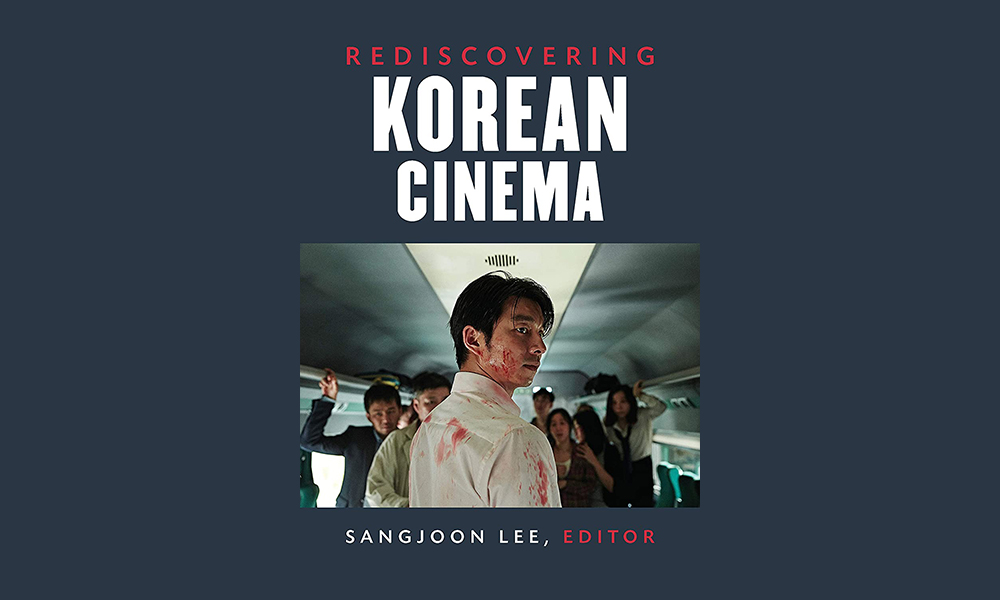
Bong Joon-ho’s politically charged mutant-monster movie The Host (괴물) fared better, as I recall, when it played on campus not long thereafter. Back then few American moviegoers knew Bong’s name; thanks to the performance of his class-warfare satire Parasite (기생충) at this year’s Academy Awards, unprecedented for a non-English-language film, that has changed. Korean cinema just last year marked its official centenary, but the pre-Parasite and post-Parasite divide has the potential to become its new B.C. and A.D., and this new era will see a great many Western viewers looking to get a handle on it. When I was watching through all those KOFIC DVDs, I could find almost nothing in the way of related reading material in English apart from poorly translated monographs on individual directors. But a number of such books have been published since then, including the brief introduction I still recommend most often, Darcy Paquet’s New Korean Cinema: Breaking the Waves.
Until age 24 I lived, as many Americans do, without leaving my native continent. I first applied for a passport out of the humiliating need to go to no farther than Canada, whose entry process had recently become more stringent. But not long thereafter I went genuinely abroad, taking a 25th-birthday trip with my dad to New Zealand. The country appealed by being far enough away to necessitate my first long-haul flight and by not being overhyped as a destination (or at least it wasn’t, before the Lord of the Rings films). Best of all, it was English-speaking, and not just in the sense that its waiters, station attendants, and hostel owners could communicate with twentysomething backpackers. The de jure official Maori native language aside, New Zealanders speak almost nothing but English, and with a fascinating accent and slang as well. (Even as I came to understand the appeal of world travel, the allure of such exotic-sounding beverages as the “long black” and “flat white” convinced me of the appeal of coffee.)
A decade later I write this essay in South Korea, the decidedly non-English-speaking country where I’ve lived for years, motivated in no small part by an interest in its language (its abundance of coffee and coffee shops, so essential to the working process of the essayist, also plays a part). Not long ago I returned from a trip Taiwan, a destination also chosen out of interest in its language, or rather in its lingua franca, Mandarin Chinese (I did consider learning Taiwanese Hokkien, its most widely spoken local language, but couldn’t find much in the way of study materials). Now and again, my Mandarin-learning project has brought to mind a local news segment I saw back in New Zealand. It told of the introduction of immersion Mandarin classes into certain primary schools. Interviewing a teacher, the reporter closed with a question asked out of seemingly genuine concern for the students: “But aren’t you afraid their little brains will explode?”
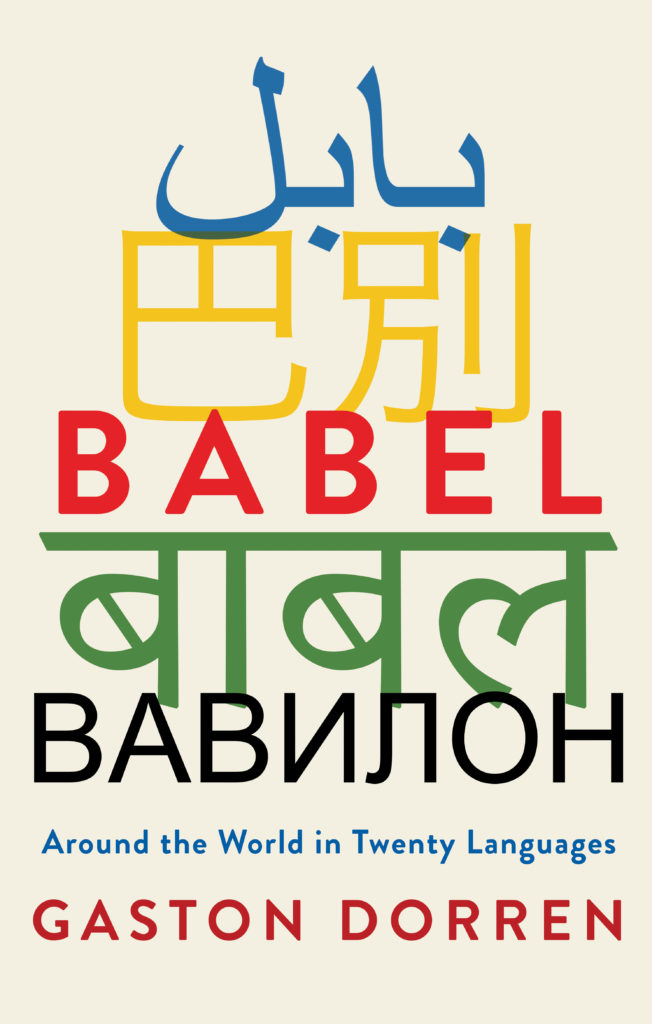
It seems New Zealanders share with Americans and other Anglophones not only the English language, but also the perception of bilingualism as an impressive, potentially life-threatening achievement. Eddie Izzard expressed this attitude best: “Two languages in one head? No one can live at that speed.” That quote appears more than once in the work of Gaston Dorren, a Dutchman who’s made his name over the past 20 years writing books about languages. In his first, 1999’s Nieuwe tongen, he examines the languages of migrants to Benelux, the politico-economic union of Belgium, the Netherlands, and Luxembourg, and in the more recent Vakantie in eigen taal he focuses on his native Dutch. 2012’s Taaltoerisme (“Language Tourism”), a kind of linguistic European travelogue, came out two years later in an expanded English translation as Lingo: Around Europe in Sixty Languages. His latest book Babel: Around the World in Twenty Languages takes Lingo’s concept global, considering the distinctive characteristics of the world’s 20 most spoken languages.
소설가 김영하는 <여행자>라는 책의 마지막 장에서 나는 도시를 사랑한다라고 말했다. 소설가가 아닌 나도 그러한 말로 자기 자신을 묘사할 수 있는지 모르겠다. 내가 강릉 안목해변 작은 서점에서 <여행자>를 산 이유 중 하나는 바로 김영하가 언급한 그 사랑을 느꼈기 때문이다. 김영하의 외국어 번역본도 널리 읽히는 소설들로 유명할 뿐만 아니라 최근에는 성공한 여행 에세이집도 한 두 권을 냈다.
2007년에 출판한 <여행자>는 김영하 작품들의 대부분과 달리 소설도 아니고 에세이집도 아니다. 이 책은 단편소설과 에세이를 혼합한 사진들까지 들어 있는 한 도시를 다방면에서 조망한 그만의 해석을 독자들에게 전달해 주는 새로운 개념의 메개체이다. 그 안에 담긴 소설과 에세이 그리고 사진들을 모두 조화롭게 연결해주는 독일에 있는 하이델베르크시의 매력은 <여행자>의 전반적인 분위기를 만들어 냈다. 뮌헨 공항을 제외하고 독일에 가 본 적이 없는 나는 이 책을 읽기 전에 하이델베르크가 옛 성이 있는 인기가 많은 관광지로만 알고 있었다.
김영하는 이 글을 쓸 때 하이델베르크를 세 번째로 방문했다. 첫 번째 방문은 그가 20대 때 한 유럽 기차 여행이었고 두 번째 방문은 독일 프랑크푸르트의 큰 책 축제에 간 짧은 방문이었다. <여행자>를 장식하고 있는 풍부한 사진들은 김영하가 세 번째 하이델베르크 도보 여행을 하면서 찍은 것이다. 한국인의 시각으로 보는 독일이라는 나라가 가지고 있는 특징들은 나를 김영하와 같은 세대인 배수아 소설가를 생각하게 만들었다. 내가 아는 배수아라는 소설가는 독일어를 잘 하고 유렵에서 많은 시간을 보내면서 독일에 있는 한국인 주인공들이 자주 등장하는 소설을 쓴다.
김영하가 <여행자>에서 들려 주는 단편 소설은 배수아 작품과 마찬가지로 독일 배경과 한국인 인물들을 자연스럽게 녹여낸다. 그 소설의 주인공은 전문적인 작가로써 매년 프랑크푸르트 책 축제에 참여하는 한국 남자이다. 그는 독일에 갈 때마다 독일에 살고 있는 한국 여자와 불륜 관계로 만난다. 그러나 그 여자의 남편은 카그라 증후근이라는 정신질환을 앓아서 아내가 아내인 척하는 타인으로 착각해서 어떻게 보면 불륜이 아닐 수도 있다.
<여행자>는 두 번째 부분을 구성하는 에세이의 주제가 소설과는 완전히 다르다. 그 에세이에서 사진기에 관심이 많은 김영하는 하이델베르크의 일상 생활 사진을 찍은 콘탁스G1에 대한 개인적인 이야기를 풀어낸다. 브랜드 인지도가 높지 않아서 저렴한 편이지만 품질이 좋은 렌즈가 장착된 콘탁스G1을 소유한 사람은 아마도 사진 덕후일 가능성이 높다. 예를 들면 김영하가 예전에 광화문에서 우연히 마주치게 된 유명한 프랑스 철학가 장 보드리야르가 가진 사진기도 바로 콘탁스G1이었다. 그 이야기에 몰입한 나의 개인적인 관심사와 <여행자>의 내용은 잘 맞았다.
도시에 대한 에세이를 쓰는 직업을 가진 나로써는 김영하 같은 뛰어난 작가가 도시를 어떻게 보는지 또한 글 속에서 도시를 어떻게 이용하는지에 대한 궁금증이 커져만 갔다. 김영하는 불문학자 김화영이 말한 한 번 간 곳을 또 가는 것이야말로 여행의 묘미라고 보는 관점을 인용했다. 어느 도시라도 친구를 방문하는 듯이 긴 기간동안 여러 번 가야 그 도시를 진정으로 안다고 생각하는 나에게 김화영의 관점은 큰 인상을 주었다.
뒷편 책날개의 글에 따르면 <여행자>는 여덟 대의 카메라로 여덟 개 도시를 담는다라는 연재의 첫 번째 책으로 출판되었다. 인터넷을 검색한 후 여전히 일본 동경을 다루는 두 번째 책만 나온 것을 알게 되었다. 만약 김영하가 아름답든 추하든 사진 찍기 좋은 것들이 풍부한 로스 앤젤레스에 간다면 수집한 사진기 중 어느 것을 골라서 가져 갈 것인지 나는 아주 궁금하다. 요즘 김영하의 여행에 대한 새로운 책의 관심이 더욱더 높아지고 있어서 공백 기간이 있었던 <여행자>의 연재를 8편까지 쓰게 되길 바란다.
They say you can find anything in Itaewon. To find Itaewon itself, you need only head toward the very center of Seoul, right next to the old United States Army base. To orient yourself within Itaewon, you need only know three landmarks: “Hooker Hill,” “Homo Hill,” and “Halal Hill.” Though unlikely to appear on an official map of Seoul, those place names hint at the variety of pleasures on offer in Itaewon and almost nowhere else in Korea, at least not in such high concentrations. Visitors come with desires for exotic cuisine, foreign-language reading material, plus-size clothing, and specific varieties of companionship (paid or otherwise) not easily satisfiable in the rest of the city. Just as one can pass a night in Los Angeles’ Koreatown that feels like a night in Seoul, one can pass a night in Itaewon that feels like a night in Los Angeles — a city that, at its best, offers the world in microcosm.
Young Koreans in search of international good times increasingly find them to Itaewon, which now ranks among Seoul’s top date destinations. (Not long after I first met my girlfriend, who went to college in Canada, we went to Itaewon for a taste of Korea’s most credible poutine.) That may surprise those who know other urban areas that have developed next to US military bases, places where a “date” seldom involves dinner. And indeed, the longer a Westerner has lived in Seoul, the more likely that Westerner is to have vivid memories of Itaewon decadence and depravity (whether or not they’re willing to recall them). As recently as the 1980s, such long-term expatriates have told me, the neighborhood really was majority-foreigner, and most of the Koreans one encountered there after dark were, to varying degrees of legality, on the job. But after September 11, 2001, the curfew the US military imposed on its bases, including Seoul’s Yongsan Garrison, leaving Itaewon’s nocturnal economy with no alternative but to attract a Korean clientele.
Today Yongsan Garrison is gone. After a prolonged relocation process, the US Army has as of last year left Seoul for a new, $11 billion camp in the city of Pyongtaek. It leaves behind in Itaewon the other societally indigestible bloc that has, over the past few decades, come to define the image of Westerners in Seoul: English teachers. To the same degree that Korean students “studying” abroad spend their nights and weekends partying in the Koreatowns of the West, Western college graduates who come to Seoul for easily landed jobs in its English “education” industry spend their nights and weekends partying in Itaewon. They may well also run their errands and even live there, attracted by the ease of the area’s lingua franca, a ragged “global English” spoken not just among Westerners and Koreans but Southeast Asians, Middle Easterners, and denizens hailing from every other region of the world besides.
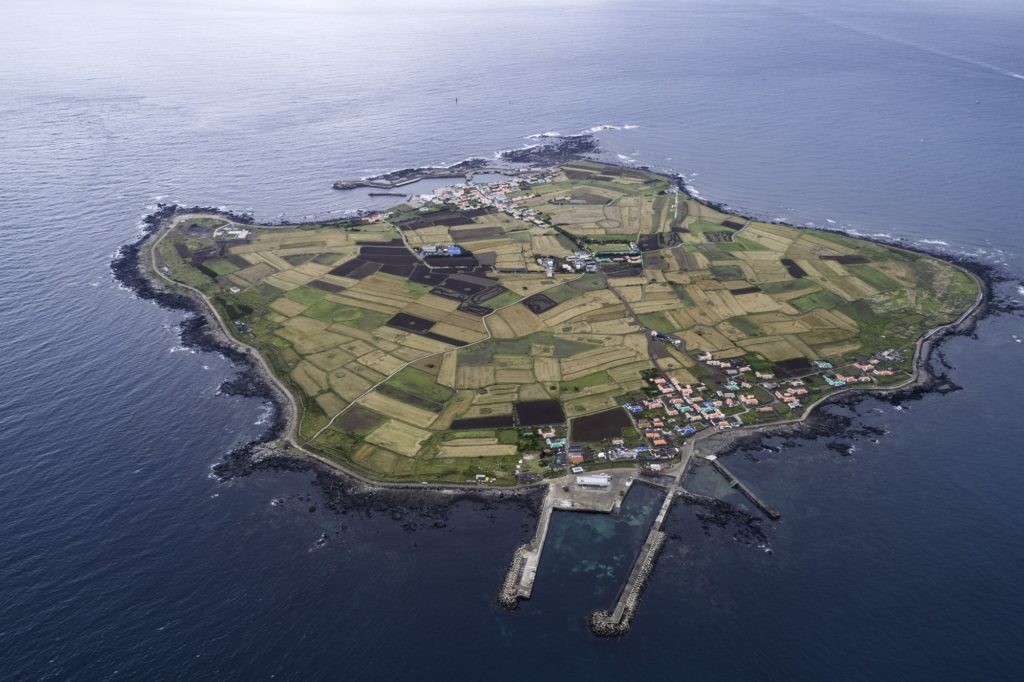
Within South Korea, you can hardly get further from the capital Seoul than the island of Gapado. The journey requires a 70-minute flight to Jejudo, the country’s largest island, then a trip across it by car or bus to a port on its south coast, and from there a 15-minute ferry ride. The first impression is that it is unprepossessing: amounting to less than a third of a square mile of land rising just 67 feet above sea level, Gapado remains barely distinguishable from the horizon until the boat reaches the shore. On arrival, the boat docks at a ferry terminal, its original two storeys reduced to just one and its concrete face adorned with new metal lettering in a distinctive lower-case font which further emphasises the island’s horizontality.
The ferry terminal belongs to a collection of buildings redeveloped on the island over the past eight years by Hyundai Card, the country’s largest credit-card provider and a subsidiary of the Korea-based conglomerate best known for its cars. Its success in the crowded Korean credit-card market has hinged, in part, on the strategy of constructing a profile as a kind of cultural organisation, building cultural facilities for the exclusive use of its customers. In Seoul alone, these include a collection of ‘libraries’ (AR online, 14 February 2018), two of which were designed by local architecture firm One O One, who also worked on the Card Factory at the company’s headquarters. It was natural then that the practice was also selected to handle the architecture of the Gapado project: not just the new ferry terminal, but all of its remodelling and rebuilding efforts across the island.
As soon as one leaves the Seoul metropolitan area, one senses a sharp fall in population density and a sharp rise in that population’s average age, especially pronounced on the 3,358 islands off the South Korean coast. Located between Jejudo, a perennially popular domestic vacation destination, and Marado, another island famous as the country’s southernmost point, Gapado had more than 1,000 residents in the 1980s but its population has fallen in recent years to under 200 – the island’s elementary school has maintained a student body of about 10.
Watch enough Korean movies from the late 1950s through the 80s, and you start to notice what looks like an obsession with prostitution. Pictures from the end of that period — 1988’s Prostitution (매춘), for instance, which has spawned at least five sequels — tend to make it obvious. Earlier ones deal explicitly with prostitution as a theme less often than they tell stories naturally involving prostitutes. In many cases their characters come from the ranks of the so-called “Western princesses,” the working girls of the Korean War’s aftermath whose clientele consisted exclusively of American servicemen. With their uncertain American-style names and American-style dress, they project a combination of abjectness and shrewdness — a distinct shame accompanied by a slightly higher-than-average level of material comfort — in which Korean filmmakers once found a useful symbol of their country and its relationship to the United States.
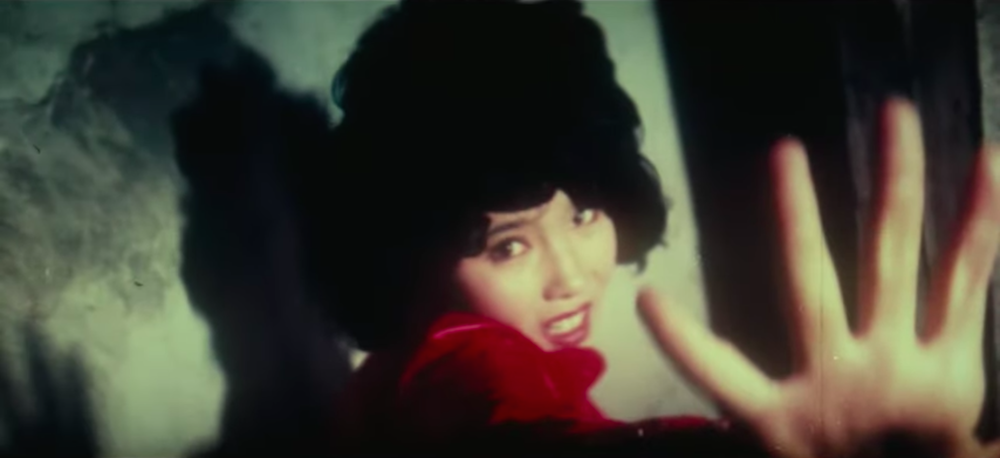
As the movies show it, South Korea changed dramatically in each of the five or six decades following the war, and most of these transformative eras produced their own kind of cinematic prostitute. In the mid-1970s, when the time of the Western princess had passed, the best-known such figure was the title character of Yeong-ja’s Heydays (영자의 전성시대), who doesn’t enter the film in the profession. Or rather, she does — and in the middle of getting arrested in a raid at that — but within minutes we see her as she was before the fall, a nearly unrecognizable young maid fresh from the countryside working at the house of a factory owner. Shyly she greets a worker named Chang-soo, come to make a delivery to his boss; smitten, he resolves that night to make Yeong-ja his. But the wedding will have to wait, given his fast upcoming three-year tour of duty in the Vietnam War.
Service in Vietnam, as more recently depicted in Yoon Je-kyoon’s hit Ode to My Father (국제시장), wasn’t an unappealing option for able-bodied Korean men looking to earn US dollars. For that film’s everyman protagonist, the war is one stop on the semi-sentimental journey through South Korean history that eventually reunites him with his beloved, a Korean nurse he first meets in his time as a coal miner in Germany. For Chang-soo, it’s a prelude to another, more painful and ill-fated struggle: his campaign to win back the heart of Yeong-ja, who in the intervening three years has turned into the foul-mouthed, lip-licking lady of the night incarcerated at the beginning of the film. She’s also minus an arm, the result of a crash during her brief stint as as a bus conductor, one of her attempts to make a living after the factory owner’s wastrel son forces himself on her. (His mother, despite having harshly dressed him down for previous behavior, blames Yeong-ja and fires her on the spot.)
“Are you ever uncomfortable as a foreigner in Korea?” I’ve heard that question, and countless variations on that question, from Koreans and other foreigners alike. The answer is no, in that I don’t feel afflicted by any excessive hassle (at least of the non-administrative variety) as a result of my outsider status. The most frustrating complications of life in Korea come not from my being American, but my being a user of Apple devices. The iPhone, available here for more than a decade now, more or less works, but nothing else is designed for the user of Macintosh computers. That holds especially true for online banking and commerce, whose use of Microsoft’s obsolete Windows-only ActiveX software framework has been mandated by this ostensibly tech-savvy country’s law since the 1990s.
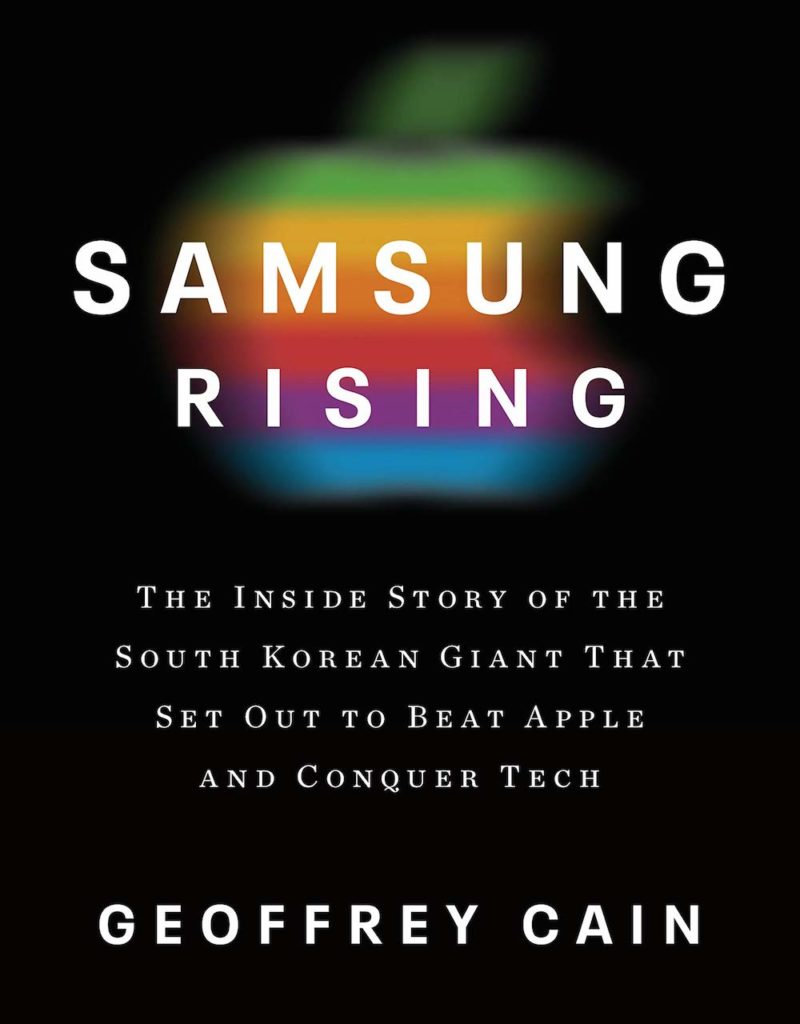
Sticking to Apple in Korea is like trying to stay vegetarian in Korea: sooner or later, your principles will be compromised. Some expatriates break down and buy a cheap Samsung laptop for use when Korean online services absolutely refuse to cooperate. At least they can rest assured that tech support, “after service” (Konglish for repairs), and compatible accessories are never far away in the “Republic of Samsung.” American journalist Geoffrey Cain refers to South Korea that way throughout his new book Samsung Rising: The Inside Story of the South Korean Giant That Set Out to Beat Apple and Conquer Tech. The name reflects not just the fact that Samsung is from Korea — which the company once took no great pains to point out to consumers who assumed it was Japanese — but that, more than any other entity, Samsung has made the country what it is.
On the first page Cain writes of having interviewed more than 400 individuals for the book, including “current and former Samsung employees, executives, politicians, businesspeople, board members, journalists, activists, and analysts.” Asked which they think is more powerful, Samsung or the government of South Korea, I wager that each and every one of them would name the former without hesitation. In one form or another, Samsung has outlasted quite a few ruling regimes. Its founder Lee Byung-chul first applied the brand name to a vegetable and dried fish shop he started in 1938, when the country was still a Japanese colony. Lee continued to expand his ventures when Americans displaced Japanese after World War II, since either power could be worked with; the North Koreans who invaded in 1950 proved to be tougher customers, preferring to loot rather than cooperate.
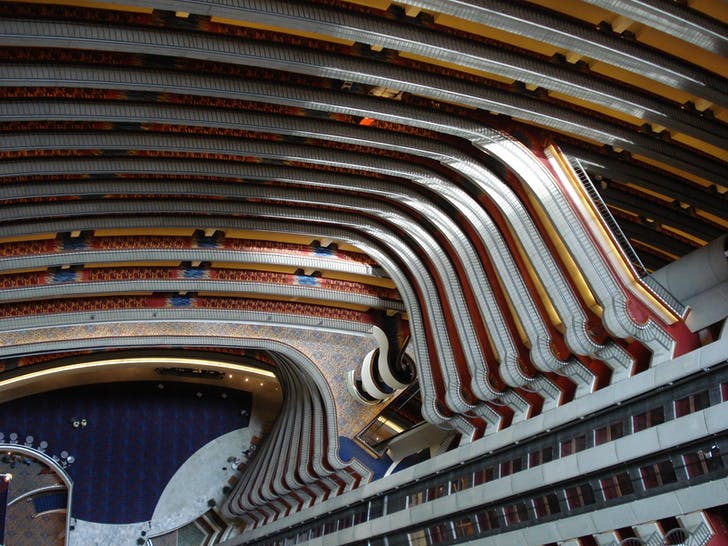
“The science-fiction world of Buck Rogers and the twenty-first century have not left us,” write David Gebhard and Robert Winter in their Architectural Guidebook to Los Angeles. “Five bronze-clad glass towers rise from their podium base, just like one of the 1940s drawings by Frank R. Paul for Amazing Stories.” The work in question is the Westin Bonaventure Hotel, one of the most distinctive-looking structures in a city once known for idiosyncratic architecture. Yet no matter how often they see it, standing as it does on a downtown hill right beside a major freeway, fewer than one in ten thousand Angelenos could name the building, let alone the man who designed it. But to those of us interested in such niche subjects as Los Angeles in film or urban redevelopment in mid-20th-century America, the Bonaventure looms large — larger, indeed, than it does on the ever taller and denser downtown skyline — as does the legacy of its architect, John C. Portman, Jr.
The Bonaventure will look familiar even to those who have never set foot in Los Angeles, provided they watch enough movies. Since opening in 1976 it has appeared onscreen with some frequency, playing a getaway driver’s midnight rendezvous point, the final destination of a scavenger hunt, the site of a political assassination, the first casualty of a massive earthquake. As these roles suggest, the productions that use the Bonaventure tend to be genre pictures, often often unsubtle ones even by that standard (all of which I watched as research for a video essay on the subject). But then, the Bonaventure is an unsubtle building, Buck Rogers in its interior as well as its exterior — both of which appeared, naturally enough, in 1979’s Buck Rogers in the 25th Century, among the very first films to feature either. As well as the Bonaventure would seem to lend itself to such visions of the future, however, most of the films to feature it have been set in contemporary Los Angeles.
Though we haven’t yet reached the 25th century, our year 2020 surely counts as “the future” as anyone in 1976 would have defined it. The real calendar has now officially passed 2019, the year envisioned by Ridley Scott’s Blade Runner, which since it came out in 1982 has stood as the definitive cinematic vision of the Los Angeles to come. Notably for a Los Angeles-set genre picture (albeit an elevated one), its cityscape does not include the Bonaventure: the elements of the real Los Angeles incorporated by Scott and his collaborators tend toward the mundane, like the 2nd Street Tunnel, and even the clichéd, like Union Station and Bradbury Building, a go-to location since the silent era. But Blade Runner presents those locations as no other film had done before, stripping them of any lingering glamor and juxtaposing them against jagged skyscrapers festooned with colossal video screens and street-level warrens glowing with neon Japanese lettering.
Asked why I moved from the United States to South Korea, I often say that it was because I wanted to live in the First World. Though it began as a half joke, this response has recently gained a new and discomfiting plausibility. Visiting Americans always express envy at Seoul’s subway system, perhaps the finest in the world, and also at a host of other major pieces of infrastructure and minor everyday conveniences unimaginable back home. Still, just a few weeks ago, when I was receiving concerned messages about the coronavirus outbreak here from friends, family, and even editors, it was possible to believe American life was the safer, more stable option over all—a belief that the pandemic’s Stateside rampage has made untenable.
covid-19 has been unavoidable in the Korean news media since the country’s first confirmed case, in late January. “Kim Eo-jun’s News Factory,” a radio program I listen to every weekday morning, now leads with nothing else, though the improving domestic situation has widened the show’s purview to include other countries’ coronavirus struggles. On some days, the show incorporates clips of speeches by American officials, from the Centers for Disease Control and other organizations, praising South Korea’s testing and containment strategies and asking why the United States can’t replicate them. Kim, the program’s outspoken host, has more than once followed up with this comment: “Don’t you think we’re a developed nation now?,” spoken with a faintly startled satisfaction, as if he’d only just realized that fact himself.
Of course, Kim doesn’t say “developed nation”: he uses the Korean word seonjinguk, a term for the advanced countries of the world, as opposed to all the hujinguklagging behind. Though South Korea has been seen for well over a decade as one of the most strenuously impressive of all seonjinguk—with its unceasing production of pop-music spectacles, its “wiredness” across all sectors of society, its recently demonstrated ability to clean up at the Academy Awards—South Koreans themselves have a tendency to see their country as, in essence, still a hujinguk. A Korean friend, a prominent economist, once described this to me as a national inferiority complex; it flares up in times of disaster, such as the 2014 sinking of the M.V. Sewol, the kind of accident seen as embarrassingly characteristic of an underdeveloped society.
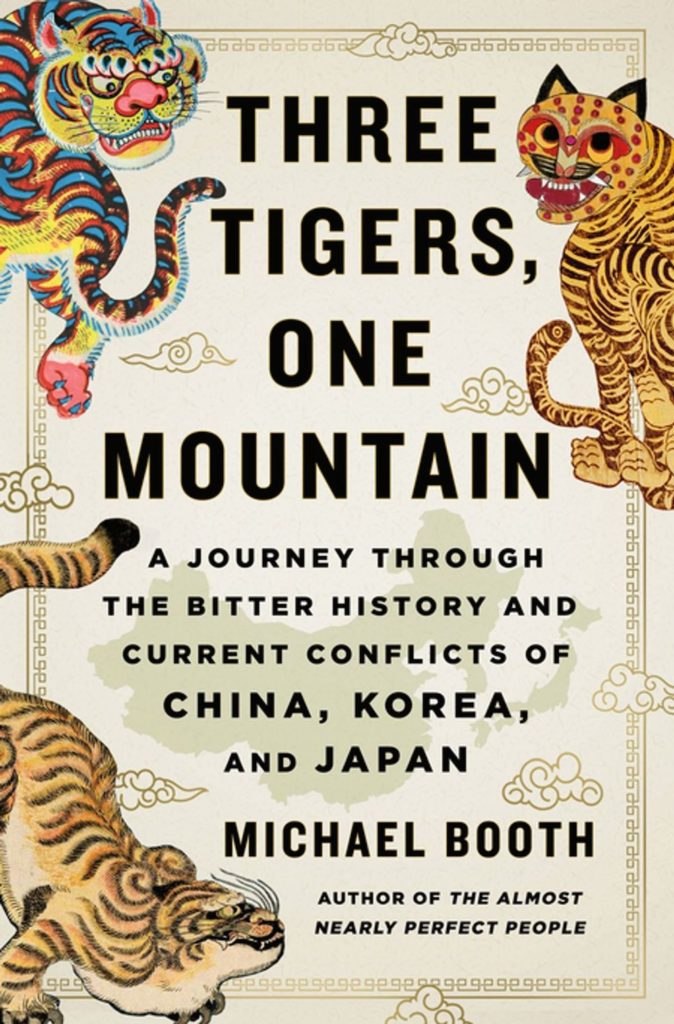
Michael Booth’s Three Tigers, One Mountain isn’t a book about Korea, but in a sense it contains a book about Korea. Subtitled A Journey through the Bitter History and Current Conflicts of China, Korea, and Japan, it takes on an entire region in the form of a travelogue driven by one question: “Why can’t the nations of east Asia get on?” Commissioned last year to review the book for another publication, I had enough space to deal with its largest emergent theme, the origin and persistence of anti-Japanese sentiment in Asia, but not to get into depth on Booth’s treatment of any one tiger in particular. Japan has drawn on-again-off-again interest in Western publishing since the days of Lafcadio Hearn, and in recent years almost too much has been said about the rise of “the Dragon.” But the rarity of books on Korea, even these days when the place makes political, economic, and cultural news, compels me to consideration even when Korea shares a book with other countries.
Though the English-language press now gives space to Korea, much of that space is occupied by the same subjects as if they’re set on repeat: the increasing global popularity of K-pop, K-dramas, and the rest of the “Korean Wave”; the dominance of hulking corporate chaebol like Samsung, Hyundai, and LG; the discomfiting enthusiasm for plastic surgery among Koreans; the periodic resurfacing of South Koreans’ animus toward the Japanese; the surprising indifference of South Koreans toward North Korea; the constant pressure faced by Korean students; the thoroughgoing unhappiness of the Korean population. I may joke with reporter friends about how clapped-out such topics have become, but — as the foregoing links suggest — I’ve also gone to those wells once or twice myself, despite not being a journalist. I do my best to approach the clichés of 21st-century Korea from unusual angles, but the fact remains that much of what’s interesting about Korea still gets ignored in favor of what may once have been interesting.
Booth also hits all these points, as well as others that might be expected from a broad introduction to modern Korea. What elevates this above standard reportage is his use of the first person: Booth has built his reputation in part as a travel writer, and the most illuminating parts of his book convey Korea as seen through his eyes as he motors around the country. (It feels at times like an automotive version of Korean journeys previously undertaken by his fellow Englishmen: Simon Winchester in Korea: A Walk through the Land of Miracles, Clive Leatherdale in To Dream of Pigs, Graham Holliday in Eating Korea.) As the travel-narrative genre dictates, Booth doesn’t just observe, he experiences. In the obligatory cosmetic-surgery chapter he goes to Gangnam to get his nose worked on. (He doesn’t just seek an intellectual understanding of the industry but, to take a common Korean saying literally, “feels it on his skin.”) Discussing tae kwon do, he doesn’t just frame it as “the country’s first post-war attempt at cultural branding” — something well worth noting — he puts on a set of “white pajamas” and takes a lesson himself, much as Anthony Bourdain did when he showed up here.