Sunday, December 28, 2014
Ridley Scott’s Blade Runner crossed Los Angeles with a grittier, less orderly Tokyo. Just over thirty years later, Spike Jonze’s Her crosses Los Angeles with a sanitized Shanghai, creating a utopian urban setting for surely the mildest cyberpunk story ever told. Instead of menacing android replicants and detective Rick Deckard who hunts them, we have a sentient operating system and the mustachioed, ukulele playing milquetoast Theodore Twombly who, as he lives his lonely life in this future Los Angeles’ skyscrapers and on its high-speed trains (but never in a car), falls in love with it.
The video essays of “Los Angeles, the City in Cinema” examine the variety of Los Angeleses revealed in the films set there, both those new and old, mainstream and obscure, respectable and schlocky, appealing and unappealing — just like the city itself.
Wednesday, December 24, 2014
 Notebook on Cities and Culture‘s Korea Tour is brought to you by Daniel Murphy, David Hayes, and The Polar Intertia Journal, an outlet for artists and researchers documenting the urban condition.
In Seoul’s Sinchon district, Colin talks with Stephane Mot, “conceptor,” writer of fiction, nonfiction, “nonsense,” and author of the blog Seoul Village as well as the collection Dragedies. They discuss Paris as a “recurring hero” of literature and Seoul as a “shapeshifter” glimpsed from different angles in different stories; how he got involved in the early days of internet gaming, surviving three startups in three years; the French embassy job that brought him to Seoul in 1991; why he prefers winter in Seoul to winter in Paris; the difficulty of walking in Seoul when first he got there; the first of the city’s “villages” that convinced him to explore more; what kind of relationship with Paris he has as a ninth-generation Parisian, and what it has gained by his becoming a partial outsider; when he first began writing about Korea; why of the two important subjects of love and death, he sticks to death; his “Borgesian experience” of discovering the internet; the subjects to which he finds himself returning in Seoul over and over again; why he writes in both French and English; his definition of a city as a scar; what he sees happening to the Korean social fabric, and how it works differently in France; the difference between the new-built urban places of Songdo and La Défense; what happens when a city has “no place for storytelling”; why he searches maps for crooked streets; what got the cars out of Sinchon; his “biggest shame,” his relationship with the Korean language, which keeps its learners thinking they’ve never learned enough; his skill with “Korean silence”; the Seoulite’s constant grieving for what has disappeared, or what will soon disappear; why he writes about the “gaps” on the maps; how having one’s own fictional Seoul prevents insanity; how more people now really come from Seoul, resulting in new senses of belonging and identity; the emerging schizophrenia between the “Korean wave” and Korean tradition; what remains unformed in Seoul to keep him awake; the reasons to hope offered by the increasing consciousness of and affection for Seoul; and the possible end of the “lemming race” to the capital.
Download the interview here as an MP3 or on iTunes.
Monday, December 22, 2014
Blade Runner‘s future noir, proto-cyberpunk vision of a Los Angeles both post-industrial and re-industrial, both first-world and third-world, has remained in the more than 30 years since its unsuccessful first run the definitive image of the city’s future. Using a combination of studio backlots, scale models, matte paintings, and actual Los Angeles architectural landmarks, the film imagines a “retrofitted,” Japanified Babel of a megalopolis that, through the name of the film, still stands for a thoroughly realized dystopia — and, increasingly, a tantalizing one.
The video essays of “Los Angeles, the City in Cinema” examine the variety of Los Angeleses revealed in the films set there, both those new and old, mainstream and obscure, respectable and schlocky, appealing and unappealing — just like the city itself.
Sunday, December 21, 2014
 Notebook on Cities and Culture‘s Korea Tour is brought to you by Daniel Murphy, David Hayes, and The Polar Intertia Journal, an outlet for artists and researchers documenting the urban condition.
In Seoul’s Garosu-gil, Colin talks with Darcy Paquet, critic of Korean film, founder of koreanfilm.org and the Wildflower Film Awards, author of New Korean Cinema: Breaking the Waves, teacher, and occasional actor. They discuss why movies have a hard time capturing Seoul; the unusual way the Park brothers’ Bitter, Sweet, Seoul captures the city; how Cold Eyes relocated a Hong Kong story into Seoul; how, after arriving in Korea in 1997, he got to know the city in step with getting to know the cinema; how he knew Seoul would grow dramatically as soon as he got there, but how nobody expected the Korean film industry would grow so much; why, right when Korean culture started going worldwide; Korean filmmakers were ready; which Korean movies Koreans tried to steer foreigners away from, and which they themselves have returned to more recently; what strengths older Korean films whose makers had to “fight the system” have that modern ones don’t; how effectively one can ready oneself for Korean life with Korean film; the size of Korea’s cinematic iceberg beneath the tip of Oldboy, Shiri, Snowpiercer, and the like; the less-defined border between Korea’s mainstream theaters and its “art houses”; what happens when Korean directors go Hollywood to make movies like The Last Stand and Stoker; what part movies (and associated pursuits) have played in helping him master the Korean language; the kind of diversity Korea has as revealed in cinema; the meaning of modernized hanok; why the last twenty minutes of Korean movies are so often just crying; the importance of Chilsu and Mansu, the first film that stepped in after the relaxation of censorship to make a political point; the sort of political criticism expressed in more recent movies like The President’s Last Bang and The Attorney; whether he feels more critical freedom than would a Korean; how Korean producers have done less to “protect directors from the money” these days; the “difference of opinion on objectivity and subjectivity” between Korea and the west as expressed in documentaries and their switch from “we” to “I”; what filmmaking techniques work on him now that wouldn’t have when he first came to Korea (and which still don’t); whether films have yet begun to take him back to his previous years in Seoul; what he sees when he revisits Christmas in August, one of the first Korean films he ever saw; how much of the Korea ahead, the country his sons and their generation of Koreans unlike those the world has known before will grow up in, he can see in the movies.
Download the interview here as an MP3 or on iTunes.
Thursday, December 18, 2014
 Notebook on Cities and Culture‘s Korea Tour is brought to you by Daniel Murphy, David Hayes, and The Polar Intertia Journal, an outlet for artists and researchers documenting the urban condition.
In Seoul’s Sinchon district, Colin talks with Danny Crichton, researcher and writer on regional innovation hubs and a contributing writer for TechCrunch. They discuss the hardest thing about being a Korean entrepreneur; what the concentration of Seoul has facilitated about Korean innovation; how he got from an interest in China “because it’s China” to a more fully developed interest in Korea; what happened to Sony, and thus Japan; how he responds to the current Korean of question, “Is this really a developed country?”; how people have stopped putting up with the country’s corruption, perhaps one of the drivers of its astonishing growth; how the ideas of the “heterodox” economist Ha-joon Chang apply to all this; why the concept of the subway-station “virtual grocery store” caught his eye; why Silicon Valley is so much more boring than Seoul; the significance of Kakaotalk and its abundance of purchasable “culturally ambiguous stickers”; why so many things, like playing Starcraft in stadiums, seem only to work in Korea; how Korea got a highway torn down in eight weeks; what thinking led to the new city of Songdo 43 train stops outside Seoul, and what it proves, negatively, about how “people want to live near other people”; why you can’t just “build innovation”; how he found both Hello Kitty Planet and a giant Bible; organic agglomeration versus the deliberate agglomeration the Korean government has tried to incentivize; the country’s distinctive capitalist-socialist “hybrid model”; whether the government can really pick winners; how much advantage hugeness gives a country these days; what he learned from Singaporean entrepreneurs, who have to go straight to the global market, and why the United States hasn’t had to think globally; his early exposure to Silicon Valley culture, and how he got interested in the connections between universities, industries, and government; how the strength of America’s universities, even today, remains the country’s strength; how the idea of “what Korea needs” still has more traction than the equivalent in the U.S., though less than it did in the past; whether Americans have begun to realize that they can find opportunities in other countries; why Americans cling so tightly to the decade or two after the Second World War as if it were the rightful state of things; what comparisons he can make between the challenges facing San Francisco and those facing Seoul; the “pragmatic urban development philosophy” in Seoul versus the “almost religious zealot” one in San Francisco; the difference between cities that think of the future as good, and those that don’t; why he thinks “a little bit about Thailand”; why strategically wrong choices don’t persist in Korea quite as long as in America; whether Korea can cure it’s “education fever” and resultant title culture; and the greater effect Korea’s laws have on its entrepreneurs than its culture does.
Download the interview here as an MP3 or on iTunes.
Wednesday, December 17, 2014
Like Walter Hill’s
The Driver back in 1978, Nicolas Winding Refn’s
Drive opens with a downtown car chase, though it swaps out the Ryan at the wheel: this time it’s Gosling instead of O’Neal, but he still pays the Driver, a getaway man of few words and many strict professional guidelines. This Driver, however, operates in a European vision of 21st-century Los Angeles, working part-time for a garage and part-time for the movies while getting more involved than he should with both the mob (based in the thoroughly criminal San Fernando Valley) and the mom next door in his Westlake apartment building.
The video essays of “Los Angeles, the City in Cinema” examine the variety of Los Angeleses revealed in the films set there, both those new and old, mainstream and obscure, respectable and schlocky, appealing and unappealing — just like the city itself.
Monday, December 15, 2014
 Notebook on Cities and Culture‘s Korea Tour is brought to you by Daniel Murphy, David Hayes, and The Polar Intertia Journal, an outlet for artists and researchers documenting the urban condition.
Not far from Seoul’s Anam station, Colin talks to Charlie Usher, author of the blog Seoul Sub→urban and the book 찰리와 리즈의 서울 지하철 여행기 (Charlie and Liz’s Seoul Subway Travelogue). They discuss the first subway stations his life in Korea revolved around; the identity of Liz, the photographer in Charlie and Liz; what makes the Seoul subway system the best framework in which to get to know the city; the impressive integration of the subway with the city itself, meaning that city life doesn’t stop at the station entrance; whether he began with any methods and systems for documenting his subway travel; how the whole project came about through “a sense of guilt”; which stations, in and of themselves, make for cool Seoul places; why the concept of shopping in a stations surprises Americans; where, and whether, urban Seoul ends and suburban Seoul begins; how he came to understand Seoul’s role as the focal point of Korea; when he realized Seoul Sub→urban had taken him where he wouldn’t have gone before, and not into the Seoul repetitive blandness of stereotype; when he realized his work interested Koreans as well; how Korea has made him appreciate the diversity of the United States, even in his home state of Wisconsin, and how he has come to appreciate the “deep sense of community” in Korea; why public transit never took hold in the same way in America as it did in Asia; how much of a longing he can develop for whatever lies beyond the train lines; the different Seoul you see depending on the mode of transportation you use; the lack of any good reason for which he first came to Korea after graduation, except for the teacher-exchange program at his university; how his aunt and uncle preceded him to Korea by coming to the more “brutish” Seoul for the 1988 Olympics; what he’s noticed about which languages subway announcements come in at which stops; the change in ridership demographics and advertisements from line to line; why you see white guys on Line 6; whether he uses subways as the framework for understanding other cities as well; his short but extremely deep experience on the Pyongyang metro; what about Seoul still surprises him after seven years there; how many of greater Seoul’s 500-ish subway stations he’s explored; the newly built lines whose openings he even now anticipates; the distinctive bouquets that appear whenever anything has its ribbon cut; when not exploring Korea through its transit, how he explores it through its food; the recent explosion in Seoul coffee shops, which more than freed him from the need to board a train to get to one; and what it felt like to see the fruit of his labors become a Korean-language book.
Download the interview here as an MP3 or on iTunes.
Monday, December 15, 2014
The Guardian rounds up its city writers’ favorite city books of 2014, including my selection:

The Interior Circuit
Francisco Goldman
It takes bravery, or at least fatalism, to drive in Mexico City. Having developed a bit of both in the years after his young wife’s sudden death, Guatemalan-American writer Francisco Goldman took on the challenge of learning to navigate his adopted hometown by car as a way of extracting himself from the self-destructive lifestyle into which the tragedy plunged him. The Interior Circuit tells of not just his struggle for self- and urban mastery, but of the city’s own – against its political corruption, its student unrest, its stark class divisions and its popular image as a crime-racked, death-obsessed, “surreal” sort of metropolis.
The others’ picks include books on Shanghai “vernacular neighborhoods” and “urban smellscapes” as well as Pico Iyer’s latest.
Friday, December 12, 2014
Notebook on Cities and Culture‘s Korea Tour is brought to you by Daniel Murphy, David Hayes, and The Polar Intertia Journal, an outlet for artists and researchers documenting the urban condition.
Above Seoul’s Itaewon district, Colin talks with Open Books acquiring editor Gregory Limpens. They discuss what kind of foreign literature Koreans like to read, and their loyalty to authors they’ve already enjoyed; how the mission of Open Books fits into shaping that taste; how he got from growing up in Belgium to bringing foreign literature in Korea (and practicing trademark law somewhere in the middle); what about his first, traveling impressions of Seoul stoked his desire to live there; his impression of the future-orientation of Korea versus the historical orientation of Belgium; the nature of “Brusselization”; how he discovered the traditional Korean sensibility of not showing off (and how he sees that changing); whether the multilingualism of his homeland helped him get in the frame of mind to learn Korean; the widening vase as a metaphor for language acquisition; whether Koreans have any particular expectations of Belgians, and where they fit into the apparent hierarchy of foreigners in Korea; what happens at the Seoul International Book Fair, and why Belgium may never get an invitation as its guest nation of honor; what happens when he tries to recommend a browser something at the Open Books booth, and why that can be a discouraging practice in Korean culture; what he knows about translation that makes him always want to read books in the original language; how “l’exception française” has produced a great deal of literature; how often he meets Korean French-speakers; how a Korean Belgian waffle differs from a Belgian Belgian waffle; his sole moment of homesickness in a decade of life in Korea; the changes in his responses to his own periodic assessment, “Why do I like it here?”; what has made him lose confidence in his grasp of Korean literary taste; why Hitler remains a big thematic name in Europe, but probably wouldn’t play in Korea; the success of Korean “fables for adults”; his pride in Open Books bringing out titles like Michel Houellebecq’s Atomized, and the literary aejeong he feels for ones like his countryman Dimitri Verhulst’s The Misfortunates; how writers react to seeing their novels in Korean translation; how much Korean readers care about book design; how Korean bookstores feel different.
Download the interview here as an MP3 or on iTunes.
Thursday, December 11, 2014
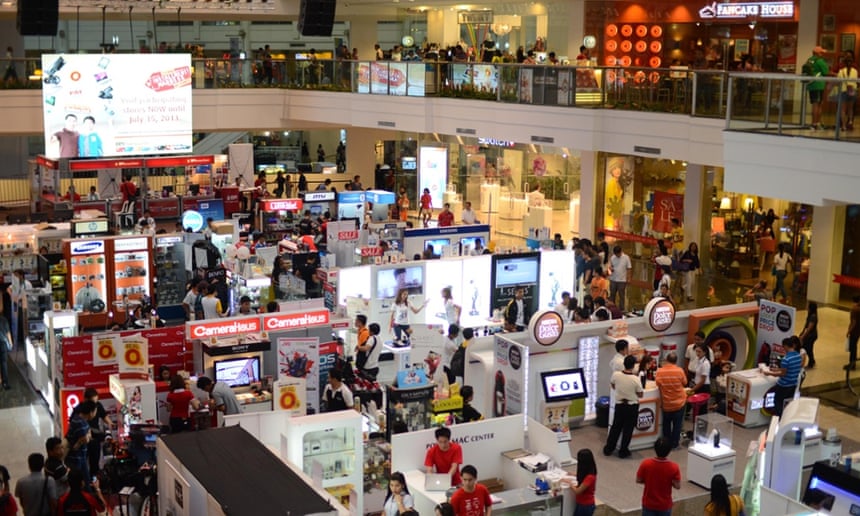
When asked for recommendations about their city, Manileños have the irksome habit of insisting that “There’s nothing to do in Manila,” or that “It’s just buildings,” and directing you instead to the nearest beach. But knowing that a city of Manila’s size and vitality is interesting by definition, if you press them, they will usually admit at least one thing: “Well, we do go to malls.”
And do they ever: the malls of metro Manila, 16 of them qualifying as “supermalls” – to say nothing of the various “community malls” and “lifestyle malls” – offer all of life’s necessities, and most of its pleasures. These cities unto themselves descend, in some sense, from Manila’s walled colonial-era “city within the city” of Intramuros.
But today’s largest malls offer not just the usual shops, eateries (usually including at least one branch of a chicken roaster named after the American country singer Kenny Rogers), grocery stores and movie theatres, but bowling alleys, gyms, medical offices and even churches. More importantly, they offer air conditioning, which goes a long way to explaining their success in a city whose temperature seldom falls below 20°C. (Can it be a coincidence that Manila’s first enclosed shopping mall, 1932’s art deco Crystal Arcade, was also the country’s first air-conditioned building?)
Read the whole thing at The Guardian.