
A video that recently hit the internet may well turn out to be the year’s most effective piece of Korea-promotion — if not the decade’s most effective — and Korea’s official promoters had nothing at all to do with it. Titled “seoul_wave,” the seven-minute production presents a day in the life of Korea’s capital as hyperkinetically shot and painstakingly edited by an American “nomadic filmmaker on an endless world tour” named Brandon Li. This might not sound like high-priority viewing for those who actually live in Seoul, and I might never have watched it myself had not seen it praised by other expatriates here. Not the easiest group to please, they keep their knives perpetually out for cynical or ignorant Korea-boosting — in other words, for much of the Korea-boosting done to date.
Take, for instance, the Korea Tourism Organization’s “Have You Ever… ?” campaign. In its teaser video, published the very same day as “seoul_wave,” members of the boy band EXO ask questions like “Have you ever slept?” and “Have you ever been to a restaurant?” To which a variety of non-Koreans, mostly Westerners, provide responses, to the best of their ability, like “I’ve never slept like that” and “Never been to a restaurant like that.” Presumably they mean they’ve never slept like they could in Korea and never been to a restaurant like the ones they could go to in Korea, but the generic, not especially Korean-looking backgrounds against which the speak only muddy the meaning further. But the awkwardness goes deeper stil: the EXO boys’ words have clearly been dubbed over, a risky choice given the obsessiveness and hypersensitivity of K-pop fan bases.
“The ad resurrected memories of other embarrassing promotional campaigns,” writes the Korea Times’ Jon Dunbar, “most notably the city’s three-year-old slogan ‘I.Seoul.U’ and 2008’s cringe-worthy national tourist slogan ‘Korea Sparkling.’ And I almost forgot about the doomed slogan ‘Creative Korea.’” One might well wonder why official Korea, in the development of ostensibly Westerner-targeted ad campaigns, apparently consults no Westerners. “Actually, they do,” writes Dunbar, who for a couple of years worked for the culture ministry’s Korean Culture and Information Service (KOCIS), a body originally formed in 1971 as a propaganda apparatus under strongman Park Chung-hee. “The problem is, they don’t listen. They come looking for a rubber stamp, often late in the planning stage when it’s too late to change anything.”
Read the whole thing at the Los Angeles Review of Books.
Saturday, August 18, 2018

외국에 살든 아니든 간에 외국어를 공부하는 사람들은 똑같은 도전에 직면하게 된다. 그 도전은 외국어를 구사하고 싶으면 무엇보다도 방대한 양의 그 언어에 노출되고 또한 소화해야 한다. 옛날에는 언어 습득을 위해 충분한 양의 언어를 듣는 것은 힘들 수 있었지만 소위 뉴미디어가 풍부한 오늘날에는 많이 쉬운 일이 되었다. 한국어를 배우는 나만의 독특한 방식은 매일 한국어로 된 뉴미디어의 일종인 팟캐스트를 듣는 것이다. 여기서 말하는 팟캐스트란 한국어를 가르치는 팟캐스트를 뜻하는 것이 아니라 한국인 청취자를 위해 만든 것을 말한다.
팟캐스트로 다운받을 수 있는 내용은 많을 뿐만 아나라 놀라울 정도로 다양하다. 어떠한 관심이 있어도 그 관심과 맞는 팟캐스트가 존재할 가능성이 굉장히 높다. 나는 도시와 건축에 지대한 관심이 있어서 어딘가에 갈 때마다 적극적으로 그 곳의 건축전반에 관한 정보를 찾는다. 나는 외국어를 공부할 때 관심이 이미 있는 주제로 그 언어를 공부하라고 하는 흔히 들을 수 있는 충고에 따라서 건축과 관련된 한국 팟캐스트를 때때로 검색한다. 몇 달 전에 그러한 충고를 따라 검색해서 <건축탐구생활>이라는 유망해 보인 팟캐스트를 접하게 되었다.
팟캐스트는 언어를 배우는 방법의 한 가지로서 라디오보다 큰 장점이 있다. 그 장점은 팟캐스트를 진행하는 사람들이 전문적인 진행자가 아니라서 딱딱하지 않게 보통 사람처럼 말하기 때문이다. 그것 뿐만 아니라 전문가와는 달리 팟캐스트 진행자들은 생활에서 쓰는 필요한 속어를 잘 쓰기 때문이다. <건축탐구생활>의 진행자들은 다 한국 건축계에서 일을 하고 모든 에피소드에서 다른 주제를 가지고 건축에 대하여 토론한다. 첫 시즌의 에피소드들의 주제 중에는 술과 목욕탕과 크리스마스와 올림픽과 영화와 같은 다양한 테마가 있다. 어떤 에피소드들은 건축을 제주도나 일본이나 북한으로까지 펼쳐지기도 한다.
내가 팟캐스트를 라디오보다 좋아하는 또 다른 이유는 팟캐스트 방송이 라디오 방송보다 시간의 제약 없이 훨씬 더 길기 때문이다. <건축탐구생활>의 에피소드들은 보통 두 부분으로 나눠져 있고 한 부분이 거의 한 시간 반까지 지속될 수도 있다. 아이튠즈 후기들 중에 진행자의 대화가 산으로 가는 경향이 있다고 불평하는 것이 있기도 하지만 나는 바로 그 산만함을 즐긴다. 내 생각에 흥미로운 주제란 한 주제 뿐만 아니라 여러 다른 주제와 쉽게 연결될 수 있는 주제이여야만 한다. 이 팟캐스트가 보여주듯이 건축은 건축 뿐만 아니라 가구나 패션이나 음식이나 어린이 등 다양한 다른 것에 대하여 토론할 방식이기도 한다.
<건축탐구생활>은 작년 10월에 시작되었고 첫 시즌이 지난 6월에 끝났다. 이 팟캐스트와 관심이 맞는 나는 두 번째 시즌을 간절히 기다리고 있지만 진행자들이 청취자가 많이 없는 것에 대한 농담을 자주 해서 두 번째 시즌을 만들지 않을까 걱정된다. 그러나 최근에 한국에서 건축에 대한 풍부한 책과 잡지와 행사는 이러한 팟캐스트를 듣고 싶어 하는 사람들이 꽤 많다는 것을 시사한다. 나는 건축 팬으로서 뿐만 아니라 한국어를 배우는 사람으로서 쇼가 계속 되길 바란다.
Wednesday, August 15, 2018

Each month I join Kurt Achin, host of Koreascape on Seoul’s English-language radio station TBS eFM, for an exploration of one of Seoul’s urban spaces. This month we talk to Nikola Medimorec, co creator-with Andy Tebay of Kojects, an English-language site covering all manner of urban developments in Korea, with a focus on transport and public infrastructure. Nikola has recently got a lot of attention with the aerial photos of Seoul, Busan, and Daegu he has enhanced with the lines of those cities’ subway systems. They show all these rail lines not in the abstracted form we’ve grown used to on standard subway maps, but as they really are, the way they pass through their real geographical environments. Executing the project in Seoul revealed to Nikola a few interesting qualities of the city’s urban rail and its prospects for further development. (You can also listen to my Notebook on Cities and Culture conversation with Nikola here.)
Stay tuned for further explorations of Seoul’s architecture, infrastructure, and other parts of the built environment. You can hear our previous segments here or download them on iTunes.

Last year, Ian Buruma succeeded Robert Silvers as Editor of the New York Review of Books. The long journey that brought him to that position began in his native Netherlands and passed, for six years from the mid-1970s to the early 1980s, through Japan. Though he went there in his early twenties, the period constituted something more than a youthful detour: “Japan was the making of me”, he declares towards the end of his new memoir A Tokyo Romance. He launched his writing career – which has widened in geographical and historical purview over the decades – by interpreting Japanese culture for a Western readership.
Buruma’s contribution to the tradition of the Westerner-in-Japan memoir marks the first essential addition since John Nathan’s Living Carelessly in Tokyo and Elsewhere a decade ago. “Nathan lived in Tokyo in the glorious 1960s, where he had distinguished himself far more than I ever had”, writes Buruma. But despite considerable accomplishments – becoming Tokyo University’s first American student of Japanese literature, translating Yukio Mishima and Kenzaburò Òe – Nathan was always haunted by “the possibility that I possessed the wherewithal to distinguish myself only as an exotic foreigner in an insular island country”.
The even-tempered Buruma has fewer bouts of self-doubt and despair to relate, but his experience in Japan has much in common with Nathan’s, including directing a trilogy of television documentaries about Japan for broadcast in his homeland. Nathan took as his subjects an urban family, a rural family, and the samurai film star Shintaro Katsu; Buruma chose the Japanese army, a Yamaha motorcycle factory worker, and a young woman’s intensive training to become a department-store “elevator girl”. At first, Buruma confesses, “I watched this spectacle with the sniggering attitude of a typical Westerner, reaching for the clichéd image of Japanese as human robots. But Hiroko was very far from being a robot. Hers was a performance, and she took pride in it”.
Read the whole thing at the Times Literary Supplement.

Even after I left Los Angeles for Seoul, I kept reading Jonathan Gold. Few who appreciate Los Angeles, no matter where in the world they live, could ignore what his restaurant reviews said about the city as a whole. On my last visit there earlier this year, I got into a conversation with a couple of friends about whether his writing was still relevant. One argued that, like the professional generalists of so many cultural realms, Gold had been superseded by thousands of amateur or quasi-professional specialists: where once we needed one man to tell us where to find the best Japanese ramen, Mexican chapulínes, or Ethiopian kifo, we now consult a numberless force of ramen bloggers, chapulín bloggers, kitfo bloggers. But Gold’s unexpected death three weeks ago and the flood of tributes since since issued forth have shown how essential a role he played in the life of the city — and the unlikelihood of anyone else completely filling it.
I became a Gold fan as soon as I arrived in Los Angeles, and specifically in Koreatown. Though many new Angelenos use it as a cheap point of entry (or at least they did when it was cheap), I actively chose Koreatown, refusing to live in any other part of the city. Already possessed of a taste for Korean food and several years’ self-study of the Korean language, I felt ready for a neighborhood that was, in Gold’s words, “functionally a distant district of Seoul — in capital as well as in culture, in both commerce and cuisine.” As his reviews of its restaurants suggest (“When I first started going to Kobawoo House back in the first Bush administration,” one begins), Gold’s history with Koreatown went uncommonly deep. When he lived there in the early 1990s, his neighbors “were mostly elderly white people who had lived in the neighborhood since the ’30s, when the old ballroom around the corner hosted big bands, when a romantic night out in the neighborhood might have involved a show at the Cocoanut Grove, big steaks at the Brown Derby, maybe cocktails afterward at the Town House or the Cove.”
Not long after, “the Koreans started moving in: a few families at a time at first, then into most of the block.” He soon found that “the fire escapes now were blanketed with cabbage leaves in the fall, clotheslines (like mine) bristled with drying fish, the silence of dawn punctuated with the steady, rhythmic pounding of garlic in wooden mortars.” But he was ready: “I had eaten Korean food, of course. My father, a great fan of buffets, particularly admired the spread at VIP, the first grand restaurant in Koreatown, and I had been taken to the Pear Garden, up on La Cienega’s restaurant row, for bulgogi since I was a child.” Not that those experiences quite prepared him to expect the “nightlife zone almost as dense as Tokyo’s Roppongi District, a 24-hour neighborhood of neon and giant video screens, alive with the squeals of tweaked-out Honda tuners and bone-stock AMG sedans, the smell of grilling meat, and the bleary eyes of party people who have stayed up till dawn” that Koreatown had become by the mid-2000s.
Read the whole thing at the Los Angeles Review of Books.

JE SUIS la jeune fille: though I’ve never formally studied French, I’ve had that phrase stuck deep in my linguistic consciousness since childhood. So, surely, have most Americans of my generation, hearing it as we all did over and over again for years in the same television commercial. Frequently aired and never once updated, it advertised a series of language-instruction cartoons on videotape. Even more memorable than the French words spoken by that young girl were the English ones spoken by the product’s both grandmotherly and severe pitchwoman: “Yes, that’s French they’re speaking, and no, these children aren’t French, they’re American. And they’ve acquired their amazing new French skills from Muzzy.”
In those same years, an early episode of The Simpsons saw Bart sent off to France, an ostensible student exchange meant to punish him for his constant pranks. He spends two months in the French countryside mistreated by a couple of crooked vintners who, in a plot point ripped from the headlines of the era, spike their product with antifreeze. When a shoeless and disheveled Bart finally spots a passing gendarme, he can’t make himself understood in English. Only when he reaches the brink of emotional breakdown does he realize that, unconsciously and effortlessly, he has internalized the French language: “Here, I’ve listened to nothing but French for the past deux mois, et je ne sais pas un mot. Attendez! Mais, je parle Français maintenant! Incroyable!”
All this convinced me, on some subconscious level, that to learn a foreign language meant almost by default to learn French. Sufficient exposure to the sounds of French, I also gathered, might lead to fluency by osmosis. More than a quarter-century later, French President Emmanuel Macron has set about spending hundreds of millions of euros on an international campaign to reintroduce versions of those now unpopular notions: that his country’s language is easily acquirable, and that it’s worth acquiring in the first place. Macron believes, as he told a group of students in Burkina Faso last year, that French (which in number of speakers currently occupies sixth place behind Mandarin Chinese, English, Hindi, Spanish, and Arabic) can potentially become “the number one language in Africa and maybe even the world.”
Read the whole thing at the Los Angeles Review of Books.

Despite my long-standing interest in things Korean, I’ve gone in for very few of the “Korean wave” of cultural products that have reportedly swept the globe — or at least much of Asia and a bit of the West— over the past 15 years. Most of them never seemed targeted toward me in the first place: not K-pop, not K-dramas, and certainly not K-beauty products, though the mighty Korean cosmetics industry’s push to normalize of male makeup gains ground every day. The first Korean product I ever consciously consumed, apart from jars of kimchi and citron tea from Korean grocery stores, I got for free: Kakaotalk, the country’s free messaging and Voice over Internet Protocol app of choice.
Or maybe Silicon Valley would call Kakaotalk’s business model “freemium”: free to use for messages and calls, but with an ever-expanding set of extras to buy. The gateway drug is the “stickers,” whimsical icons featuring the Kakao Friends, a cast of anthropomorphic characters including a dog, another dog with a black suit and an orange afro, a cat in a bob wig, a radish in a rabbit suit, a duck with removable feet, and a genetically modified peach. Most casual Kakao Friends buyers no doubt make the transition to addiction at one of the Kakao Friends stores all around the country. Usually multi-story affairs occupying huge amounts of prime real estate, these sites of pilgrimage sell everything from Kakao Friends cellphone accessories to Kakao Friends dolls to Kakao Friends confections to Kakao Friends luggage. Many even have a Ryan Cafe inside, so named for one of the newer Kakao Friends, a lion without a mane.
Not to be outdone, Kakaotalk’s main competitor Line, operated by a Japanese subsidiary of Korean search-engine company Naver, has also created the Line Friends. This seemingly larger group includes a variety of comparatively normal animals, especially bears, as well as a few human beings and what looks like a ghost. Line has also set up character merchandise shops in not just Korea but Tokyo, Hong Kong, Bangkok, and New York. On the endless quest for synergy, it has also produced subsets of new characters with Japanese-designed global icon Hello Kitty and international K-pop boy band BTS. In recent years the “friends” business in Korea has taken on aspects of a gold rush: fewer and fewer categories of product, no matter how mundane, lack at least one brand that had tried to come up with friends of its own, and design students increasingly come up with not just concept products but concept friends to promote them.
Read the whole thing at the Los Angeles Review of Books.
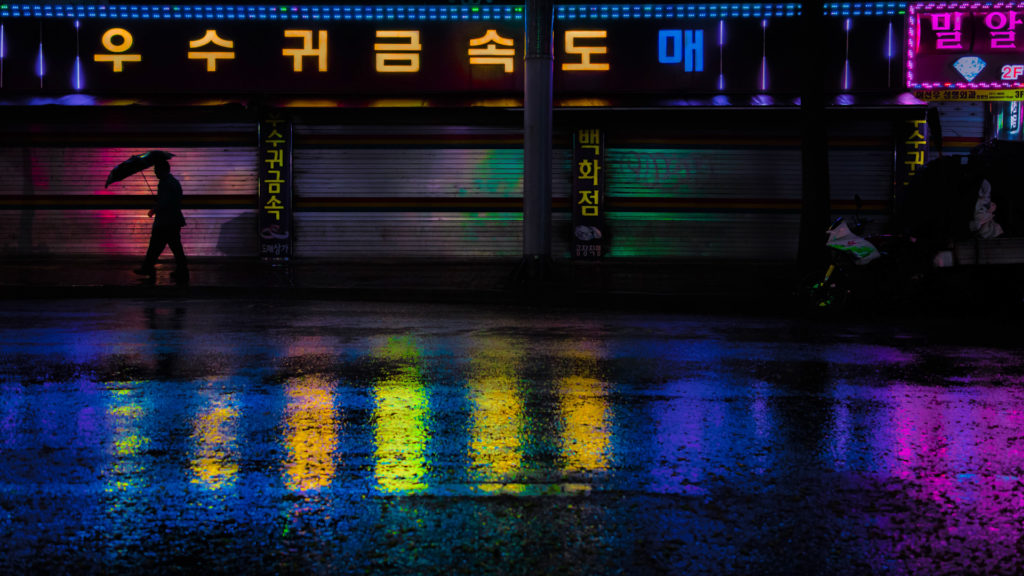
Each month I join Kurt Achin, host of Koreascape on Seoul’s English-language radio station TBS eFM, for an exploration of one of Seoul’s urban spaces. This month we talk about Seoul’s chances of becoming the next great cyberpunk city (subject of my latest piece in the Los Angeles Review of Books Korea Blog), following the likes of the future Los Angeles imagined in Ridley Scott’s Blade Runner, Chiba City in William Gibson’s Neuromancer, and New Port City (or Hong Kong) in Oshii Mamoru’s Ghost in the Shell. Expatriate photographers have found much of cyberpunk’s “high tech meets low life” sensibility in Seoul’s cityscape, especially on rainy nights in the parts of town full of old neon, crumbling alleys, and visible technological infrastructure. We ask what else Seoul needs to achieve proper cyberpunk status, and whether certain other cities in Africa or India might get there first.
Stay tuned for further explorations of Seoul’s architecture, infrastructure, and other parts of the built environment. You can hear our previous segments here or download them on iTunes.
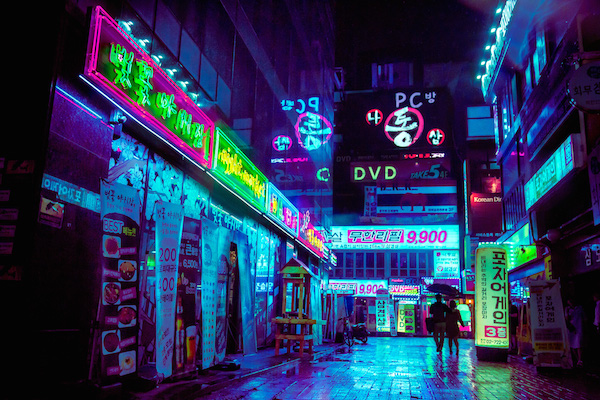
Since the original Blade Runner takes place in an imagined late-2010s Los Angeles, I’d have gotten a kick out of seeing its sequel, which after prolonged speculation finally came out late last year, in the actual late-2010s Los Angeles. But having moved to Korea a few years ago, I settled for a screening here in Seoul. In some ways, this ultimately felt like the more appropriate city in which to see the movie: when Blade Runner 2049‘s first trailer came out, I wrote here about its apparent acknowledgement of the considerable Korean influence felt in Los Angeles since its predecessor’s release. While no small number of Koreans already lived there back in 1982, the makers of Blade Runner — like everyone else at the time — couldn’t see past the economic rise of Japan, whose cash-flooded conglomerates then seemed poised to buy up not just Hollywood’s studios the downtown skyline as well.
When I did make it back to Los Angeles earlier this year, I saw sights that proved more memorable than even the spectacles of Blade Runner 2049. Coming in from the airport, for instance, I looked up to see the Korean Air logo looming 73 stories above downtown at the top of the Wilshire Grand Center, a building still under construction when last I saw it. Then, lowering my sights from that glowing orb so reminiscent of the South Korean flag, I spotted a tent village that had sprouted in the darkness of a freeway underpass. The first Blade Runner envisioned Los Angeles as having plunged into a kind of third-world condition, with its ruling class perched high above (if not on a different planet from) the teeming common element doing business in countless different languages down in the streets. Something tells me that the contrast in the real 2019 might look even starker than that.
But then contrast lies at the heart of the science-fiction tradition of cyberpunk, the most influential examples of which include Blade Runner as well as William Gibson’s Neuromancer, published in 1984 and now considered the archetypical cyberpunk novel. The common description of Gibson’s work of that period, “high tech meets low life,” also broadly characterizes cyberpunk itself, which, unlike so much sci-fi of earlier generations before, understands that technological progress doesn’t come with moral progress. Nor does it come with the kind of widespread social or economic progress upon which many stories of the future once premised themselves. Nor does that high tech penetrate all areas equally: “The future is already here ,” said Gibson in what has turned out to be one his most-quoted lines. “ It’s just not evenly distributed.”
Read the whole thing at the Los Angeles Review of Books.
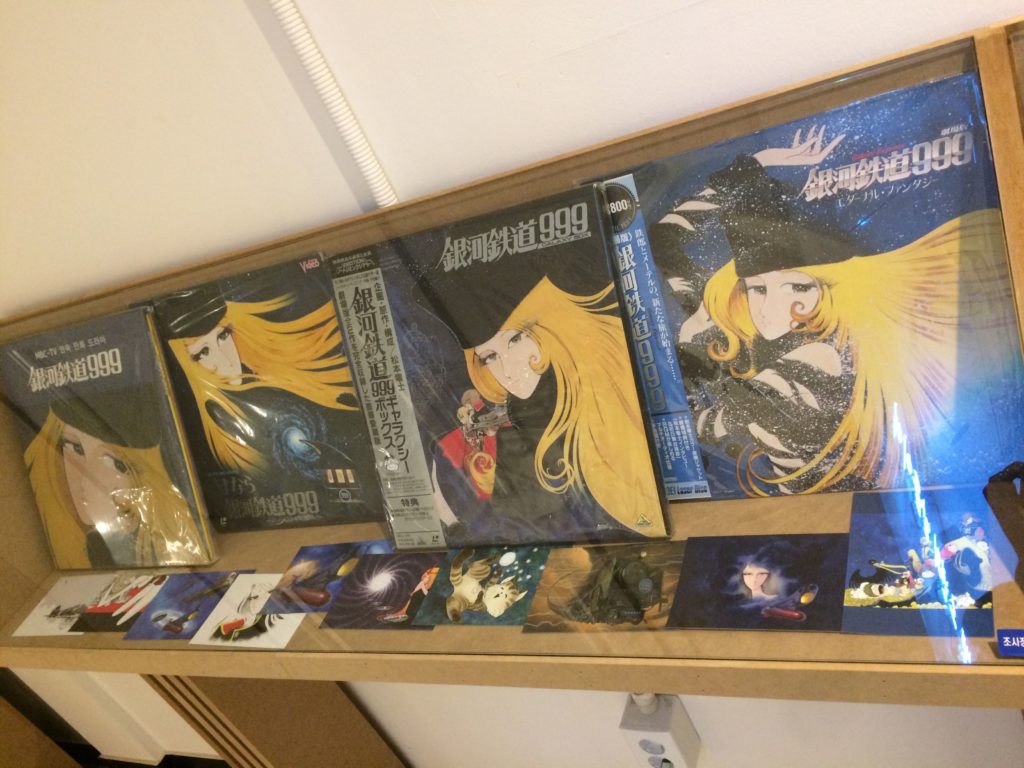
子供の特はオタクではありませんでしたが、アニメと漫画をよく見ました。ときどきANIMERICAというアメリカのアニメと漫画についての雑種を読みました。私が中学生だった90年代中にANIMERICAは 銀河鉄道999という漫画の英語翻訳版を載せました。
私は毎号を読んでいたわけではなかったので、その漫画の内容をよく知りませんでしたが、絵に見とれました。10歳の子供の子と黒衣を纏っている金髪の女性が乗っている宇宙空間を飛ぶ昔の電車を初めて読んだその時まで見たことがありませんでした。

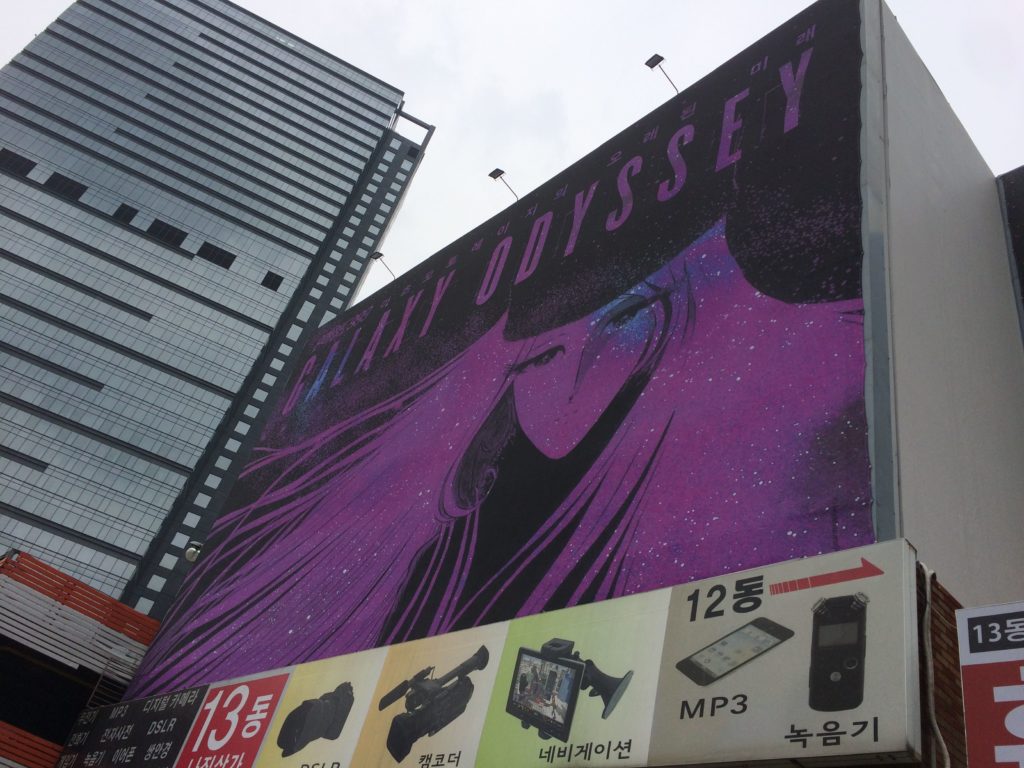
約20年前からは銀河鉄道999のことをあまり考えなかったが、今年にソウルで開かれた展覧会のおかげでまた考える機会に成りました。GALAXY ODYSSEYという展覧会は韓国でも人気があった銀河鉄道999の歴史とメイキングを楽しく見せています。
ソウルの秋葉原と言えるヨングサンの電気商店街の古い建物をギャラリーに変えました。展覧会はいろいろな部屋で成り立っています。人物の衣装を着てセルカを撮る部屋、画家が作った部屋、銀河鉄道999の漫画家である松本零士の事務所に似ている部屋があります。
そのような部屋以外に日本的な自動販売機がある無人販売店の部屋もあります。そこで日本に行った時によく飲むUCC缶コーヒーを買って飲んだのですが、日本の雰囲気を感じることができました。展覧会の中にあるお店で銀河鉄道999の創造者である松本零士が読んでからアイデアを思いつくことが出来た30年代の小説の韓国語の翻訳版も買いました。(いつか日本語でも読む事が出来る事を願っています。)
ほかの仮想現実感を経験出来る部屋で、ある職員が私にフランス人かと聞きました。聞いた理由は私の西洋人の姿だけじゃなくて銀河鉄道999がフランスでも人気があるのでフランス人が展覧会にたくさん来るからだと言いました。DAFT PUNKという有名なフランスのバンドは銀河鉄道999の松本零士と一緒に映画のように長い音楽のビデオを作りました。展覧会のある部屋のなかでそのビデオを長い間鑑賞しました。銀河鉄道999が人気がない唯一の国はアメリカだと言えるだろうか?