Skip to content

The Ubuweb Experimental Video Project 49: John Baldessari’s Time/Temperature


John Baldessari, Time/Temperature, 1972-73

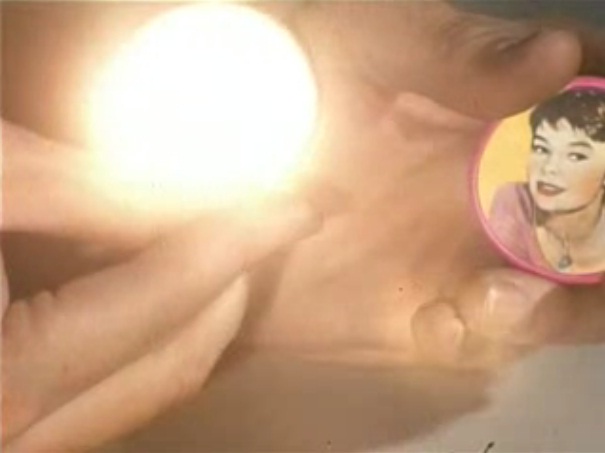
Here we see hands — presumably John Baldessari’s, but who knows — handling a variety of little objects. First, they hold a blue-sanded hourglass and a red-mercury’d thermometer, the contents of the former slowly falling as that of the latter slowly rises. Second, the hold a pair of plastic circles emblazoned, in a midcentury reduced color scheme, with the faces of two starlets. The hands turn the circles one by one, revealing the lens flare-inducing mirrors on their reverse sides.

Third, a trio of wine glasses appear, two empties followed by a third half-full of clear liquid. One of the hands pours whatever’s in the third glass into the second, in which it inexplicably appears red. Then the hand pours the liquid into the first glass, in which it appears at first light purple, then clear again. What I’ve thus far ascertained about Baldessari’s personality from his work tells me that he would go in for artistically repurposed versions of these dime-store ricks, but I shamefully admit that I remain impressed by this one. How does it work? Maybe nobody knows. Finally, one of the hands plunges its fingers into cylinders of easel powder steadied by the other. The thumb goes into the yellow powder, then the next finger goes into the green powder, then the finger after that goes into the yellow powder, and so on. The hand winds up with alternating digits of green and gold, a color scheme some minor holiday must surely have claimed by now.

As with many entries in the Ubuweb Experimental Video Project, one question looms: what to make of this? Alas, as with almost as many entries in the Ubuweb Experimental Video Project, the piece’s accompanying text makes matters even less clear: “Like the camera, these are indexical instruments,” so the anonymous words claim, “but where the camera would ordinarily be taken for granted, these devices seem self-evident. ” That refers specifically to the video’s first set of objects, the hourglass and the thermometer, and nothing in the blurb acknowledges anything else that follows. Maybe the writer had a dinner to get that kept him from sticking around all six minutes?

Hello 2012, goodbye Marketplace of Ideas

All good conversations, it seems, must come to an end. Late in 2010, I announced that, unless The Marketplace of Ideas reached 10,000 podcast subscribers by 2012, the show would come to an end. I regret to inform you that, in the choice between 10,000 or bust, we now have no choice to but to bust. While every Marketplace of Ideas conversation ever recorded should remain available for your downloading pleasure at colinmarshallradio.com and on iTunes, no more material will be released under that banner.

But don’t get too quick on the trigger about unsubscribing from whichever of the show’s feeds you subscribe to. Even now, something new inches its way over the horizon. You might keep any eye on this space to find out what. You might also pay attention to my recent guest appearances on other podcasts. By way of preparation, you might also re-listen to certain Marketplace of Ideas interviews: Momus (and Momus again), Michael Silverblatt, Pico Iyer, David Lida, Geoff Dyer, Merlin Mann (and Merlin Mann again), Jesse Thorn (and Jesse Thorn again, with Adam Lisagor), and Alan Nakagawa, to name an aesthetically, intellectually, and thematically appropriate few.

Further details to come. Until then, stay tuned and stay curious.


Some things in life

The shingle’s out

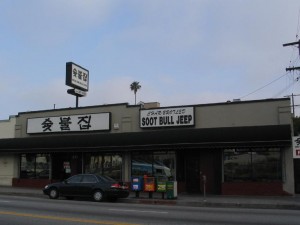
Soot Bull Jeep has fast become my go-to joint for friends who visit me in Koreatown filled with curiosity about this “Korean barbecue” stuff. Repeated endorsements from no less a food luminary than Jonathan Gold got me in the door in the first place. “Dinner at Soot Bull Jeep is an atavistic thing,” he writes, “not just good liquor and platters of raw meat, but also smoke and fire, and showers of small cinders that can leave your shirt looking like a cartoon bulldog right after an encounter with an exploding cigar.” That article appeared in the Los Angeles Times in 1993. Since then, Koreatown’s bewildering array of barbecue houses has grown more bewildering still, but I haven’t visited one yet that matches Soot Bull Jeep’s all-around sensory impact.

The most obvious vehicle of this impact comes in the form, of course, of dark wood wall paneling, maroon plastic upholstery over cheap metal chair frames, and vast tracts of brown Formica. You’d think such decor would directly evoke the seventies, but it ultimately comes off as idiosyncratic rather than purely retro. Besides, the place only opened in the late eighties; it must have just seemed unfashionable then. I like to think I genuinely appreciate the dining room’s faintly Spartan midcentury high school feel, but its visual aesthetics seem to function more as a means of focusing one’s attention elsewhere, to the main event: the grill, the meat, the flames, the smoke.

Korean barbecue aficionados make much, and rightly so, of Soot Bull Jeep’s hardwood charcoal-fired table grills. This makes for a richer dining experience — richer smells, richer crackly noises, richer showers of sparks, and hell, probably even somewhat richer flavors — than what you get from those just-flick-on gas grills used at even other Korean barbecue joints regarded as the crème de la crème. You can tell the waitresses to load these grills with run-of-the-mill beef and chicken, but given the context, why would you want to? Order up a couple piles of Korean surf-and-turf: tongue will represent the land, of course, but consider yourself free to choose between squid and eel as your envoy from the sea.

I often wonder why I don’t run across more Korean barbecues that grill with wood, although the answer probably lays in people actually meaning it when they complain about the smoke smell clinging to their clothes. While they may, on some level, have a point, these people have exchanged the very concept of joie de vivre for a sort of anxiety-driven waking death. This also holds true for those who complain that Soot Bull Jeep doesn’t offer all the meat you can eat, doesn’t have a big enough parking lot, or operates out of a “bad neighborhood”. Tell you what: move within three blocks of the place, like I did — straight into the belly of this urban beast! — and you won’t have to deal with parking. You can go to Soot Bull Jeep every week and try everything. I’ll teach you how to live again. I’m serious.

* * *

Lunching at Soot Bull Jeep earlier this week, Creative Destruction host and documentarian Rob Montz asked me an important question: what in the hell am I doing for a career? Sure, I flagrantly paraphrase, but his core curiosity remains valid indeed. To keep dressing and enjoying shelter and going out for wood-grilled squid and such, I’ll soon need a job. Actually, that’s not quite how I frame it; quoth Adam Cadre, “Our current economic clusterfuck has led to the predictable call for ‘job creation’: unemployment is skyrocketing, people need jobs, etc. But people don’t need jobs — they need food and shelter and transportation and such.”

Or, perhaps more to the point, quoth Glenn O’Brien: “People now realize that they have to be entrepreneurs, because there are no jobs. If there was a job you wouldn’t want it, because you have to be such a tool to do it.”

So, more simply put, how to get money? Though I have very, very little of the stuff, never have I felt “poor,” per se. In fact, since I try my damndest not to let a day go by without cultivating my store of knowledge or abilities in some way, I feel richer,  in some potential sense, all the time. So what if I gaze upon an eighty-dollar bank account balance one morning? These are, in life’s broader context, the lean years, and one hastens the lean years’ end with each and every bit of practice accomplished and experience accrued.

If anything like a career model emerged (not that I see conducting a career as distinct from living life, but that’s a whole other post) as we chewed our lettuce leaves crammed with kimchi, garlic, various pastes, and tiny sea critters, it was (Marketplace of Ideas guest) Clive James, the polymathic Metropolitan Critic himself. He writes, he broadcasts, he hosts. He moves between various forms of culture “high” and “low” as if he didn’t believe in the distinctions, which I believe he doesn’t. He has many fervent fans and many fervent detractors, which strikes me as a sign of vitality. He can get directly evaluative in a way that would make me feel vulgar, but his opinions change enough over time that I can look the other way.

But I only adapt James’ example to my own life loosely, since we operate on different cultural territories, to say the least. Anyway, if you feel like hiring me to write up an experimental video or a thousand; to shoot short films based on the least filmable of Borges’ short stories; to Podthink; to collect urban field recordings and assemble them in both aesthetic and linguistic patterns; to crank out an article about Oaxacan mole, Los Angeles subway lines and Abbas Kiarostami; or to conduct a cultural conversation of the depth you demand, please feel free. The shingle’s out.
The Ubuweb Experimental Video Project 48: John Baldessari’s Baldessari Sings LeWitt


John Baldessari, Baldessari Sings Lewitt, 1972.

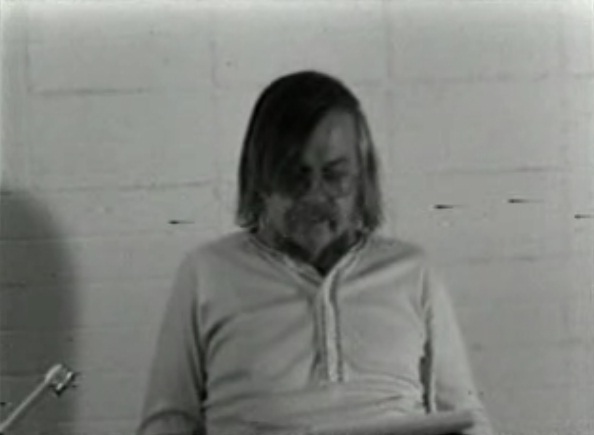
I come away from this video wanting to read some Sol LeWitt. In it, Baldessari, shot in classically muddy Portapak style, sits down and reads a selection of lines from Lewitt’s writing on modern art. Well, I suppose he technically sings the lines, but his delivery strikes me as more of a recital. He does a shambling sort of sprechgesang, loosely hanging LeWitt’s words on vague approximations of the melodies of various popular songs. “Camptown Races” really trips him up. He delivers one line to the tune of a Beatles song that’s famous even by the standards of Beatles songs, my failure to summon the name of which makes me realize just how badly I’ve shirked my cultural duty of Beatle familiarity.

Cogent, truthful, non-trivial writing on visual art being somewhat hard to come by, I keep myself on perpetual lookout for anyone whose words even faintly promise it. Some of the LeWitt sentences Baldessari sings, when they come out clearly, hint that I should do some further reading. The claim that “irrational thoughts should be followed absolutely and logically” struck me as particularly worthy of consideration. But now that I think about it, isn’t that just the program Baldessari follows here? At the video’s beginning, he announces his intention to honor LeWitt’s words by bringing them out of the exhibition catalogs and into song, and he follows that perhaps irrational premise absolutely and logically.

Baldessari also sings of the process whereby a concept becomes an idea becomes a work. At least my notes describe the process that way; maybe an idea becomes a concept becomes a work. But I mostly want to hear more of LeWitt’s thoughts on the step that comes after that. “A conductor from the artist’s mind to the viewers,” Baldessari sing-quotes LeWitt’s definition of a work. He also converts into song an intriguing passage about how the perception of others’ ideas leads to new ideas, and how new ideas come from the misperception and/or misconstrual of existing ideas expressed in existing works. Most of my own ideas come from misperception and/or misconstrual. Heck, I’m probably misperceiving and misconstruing Baldessari Sings LeWitt right now.

Will I find the clarity of thought and expression I so desire in Sol LeWitt’s original, non-sung writings on modern art? There’s a chance, although on the basis of Baldessari’s selections alone, I can’t rule out the possibility that his observations might turn out to be ultimately untestable or at least not usefully evaluable. But boy, did the man make some cool geometrical art!

How the iPhone got me

So what pushed me to finally get an iPhone, even though I lack so much as a multi-digit income?

  • I nearly slapped down the howevermany hundred dollars a first-generation iPhone cost when Brian Eno and Peter Chilvers’ Bloom hit the App Store. Having read Eno’s A Year with Swollen Appendices at least three times by that point, I’d grown familiar indeed with his enthusiasm for algorithms and devices that use randomness to create ever-changing music in real time. But he wrote the diaries that book comprises in 1995, and as such bemoans in them the limits the era’s hardware and software imposed on such “generative music” systems. Fewer such problems on the iPhone, which can handle the numerical processing and sonic synthesizing even as it takes its input — the “seed” of the music — from the patterns you tap into its touchscreen. This video gives you an idea of how the thing actually sounds. Eno and Chilvers released a follow-up, Trope, which expands on the Bloom idea by converting into music the motions of your finger across the screen, rather than just using individual points of tapping.
  • The second dimension of irresistibility came in the iPhone’s mapping capabilities. Maps, as a form, keep drawing me back with their distinctive balance between the qualitative and the quantitative. (Edward Tufte‘s books on information design keep drawing me back for similar reasons, to the point that I did pay the howevermany hundreds of dollars for his experimental two-day course in Palo Alto.) So how was I going to resist the ability to scroll around scalable maps, overlayable with all sorts of data, of almost any corner of the Earth? That the iPhone offers the user GPS-based navigation of these maps didn’t matter so much in a town as small as Santa Barbara, but now that I navigate a new slice of Los Angeles almost every day, the iPhone’s onboard mapping software or any of hundreds of related apps add a great deal of value. I foresee this coming in very handy in the next foreign metropolis I explore, though I realize I’ll have to perform some sort of h@x0ring beforehand.
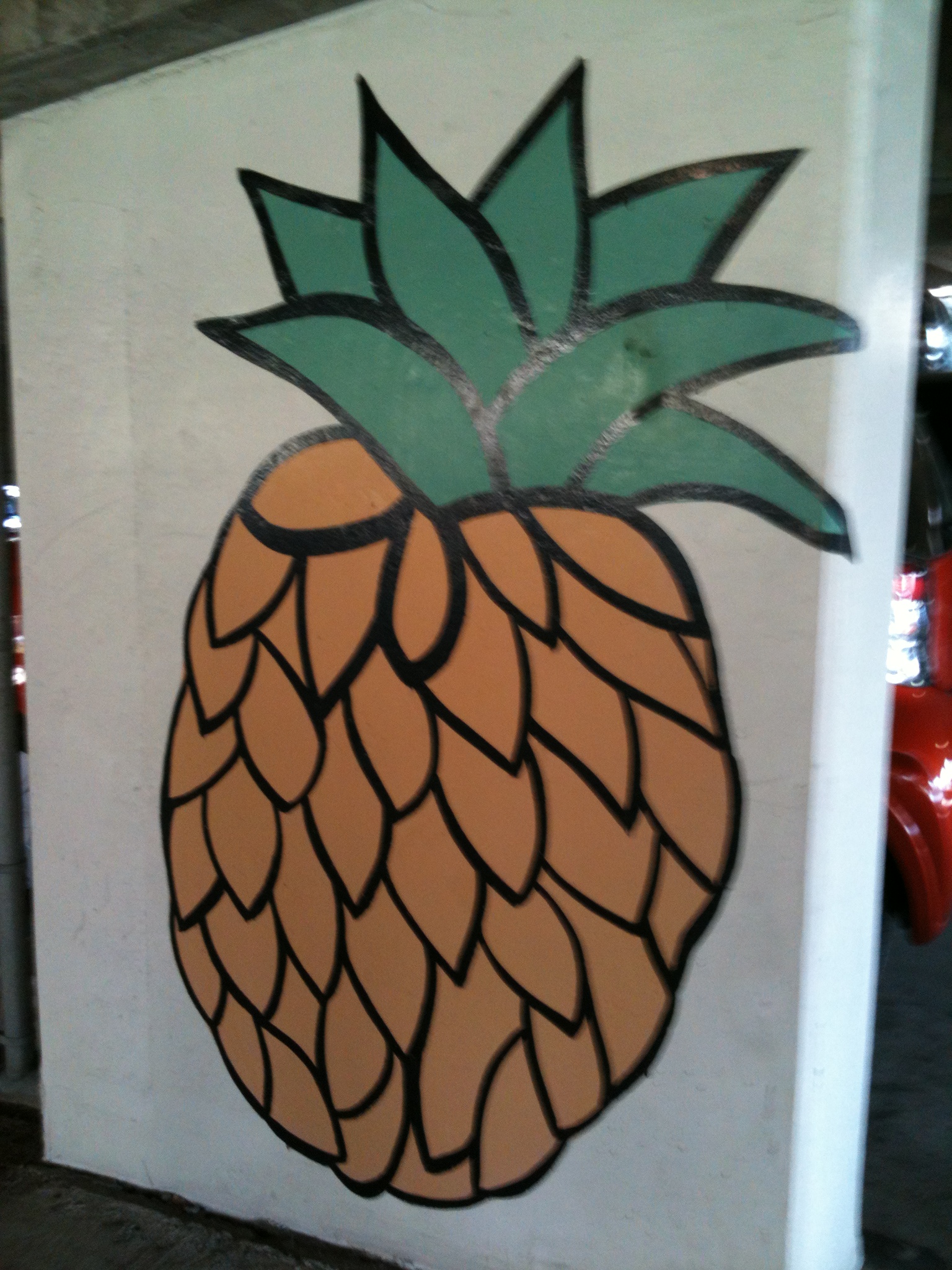
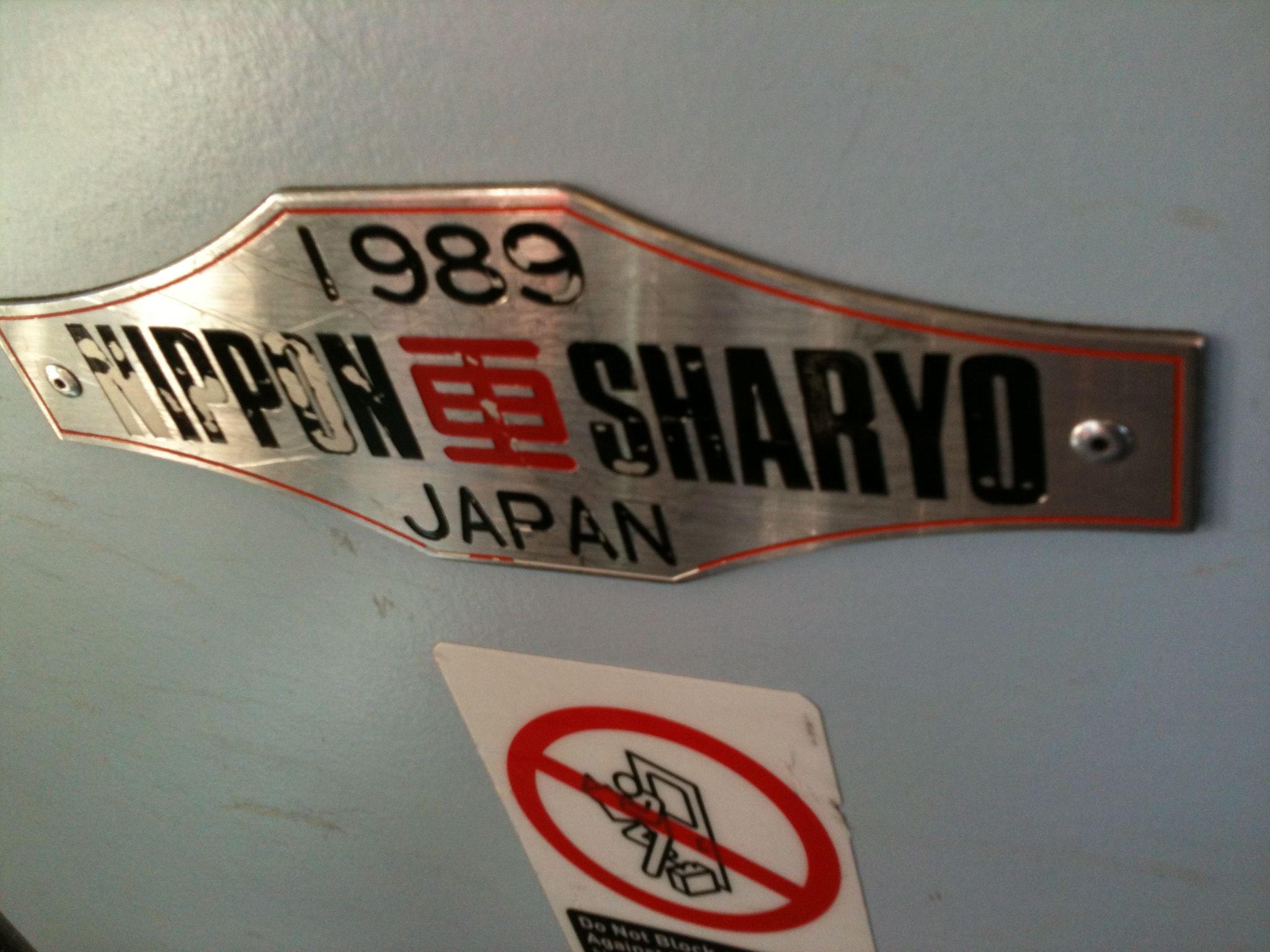
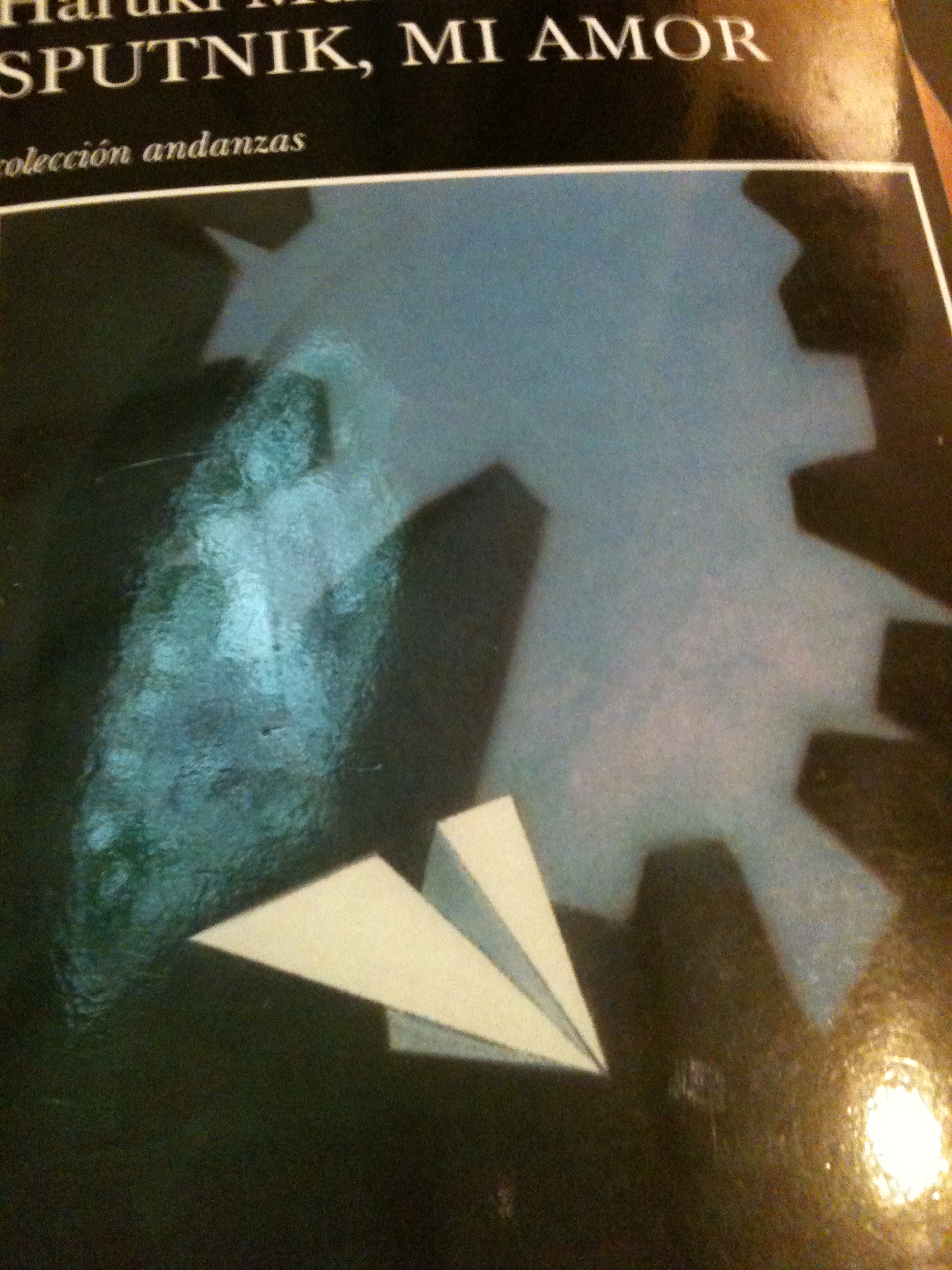
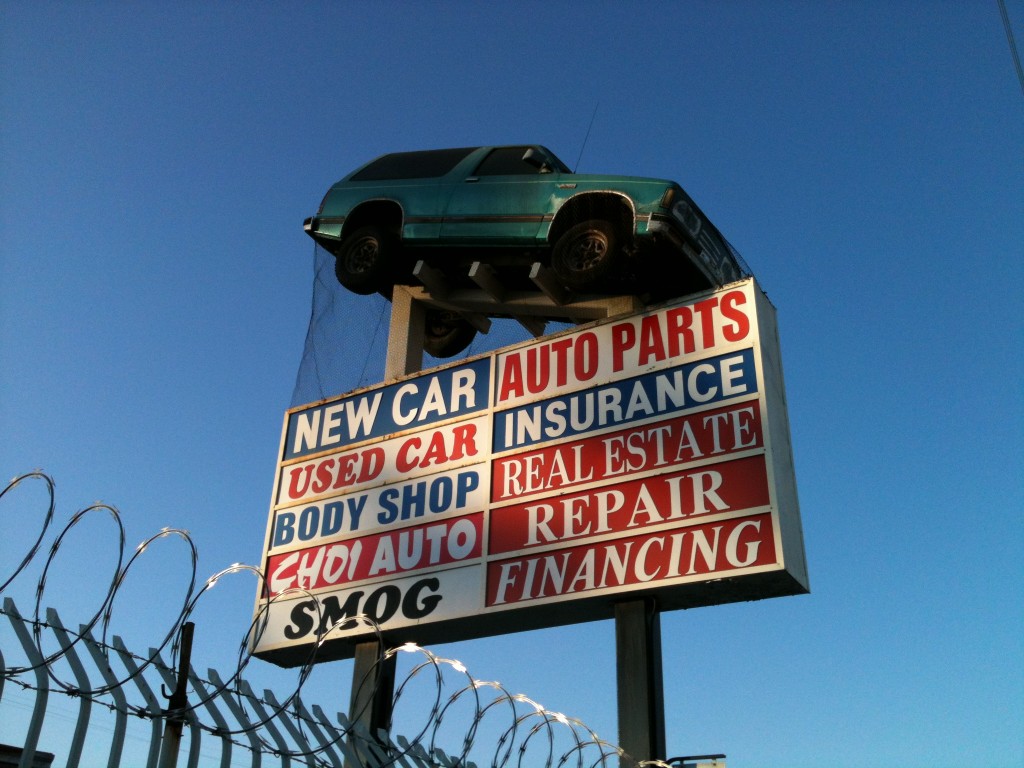
  • As with any still-toddling technology, the first popular uses of the camera-phone — enthusiastic diners photographing their restaurant meals, Asian girls taking topless shots of themselves in bathroom mirrors — struck me as rather less impressive than I’d hoped. But at some point, the convenience the iPhone camera offers in documenting one’s peregrinations seemed too attractive to pass up. How else, I ask you, could I snap something like this on the go:

  • But finally, my friends, the field recording did it. I had my doubts about how rich a sonic environment a microphone as small as the iPhone’s could really capture, but when sound artist (and Marketplace of Ideas guest) Alan Nakagawa played me some of the recordings he’d picked up with it, I knew immediately what I had to do. I don’t know if I’ll make the next New Zealand Stories with it or anything, but I’m sure it’ll earn its keep when I record impromptu interviews or travel podcasts like (twotime Marketplace of Ideas guest) Momus used to do.

Oh, and now that the iPhone 4S has all the kids talking, AT&T will cough up a 3GS for nothing more than your signature on a two-year contract and the cost of tax. I suppose I should mention the formidable aesthetic sense with which the iPhone is both imbued and associated, aesthetics being pretty much the only thing I ultimately care about, but you’ve probably heard enough on that subject already. Despite all the grand claims about the myriad technological advantages of, say, Android phones, Android fans tend to dress like they’ve just stepped out to get the paper.

To Los Angeles by iPhone

I have entered an esteemed rank: unemployed people with iPhones. More on that tomorrow, but in the meantime, observe a bit of what I’ve been doing with it:


Los Feliz

Koreatown

Miracle Mile

Koreatown

Santa Monica

Koreatown

Hollywood

Koreatown

Echo Park

Koreatown

Downtown

Koreatown

Hancock Park

Koreatown

Koreatown

Koreatown

Koreatown

Katherine Yungmee Kim: Los Angeles’ Koreatown

You see these thin, sepia-toned “Images of America” books for sale everywhere in Los Angeles. Each one covers a different corner of the city: Bel-Air, Little Tokyo, Chinatown, Boyle Heights, Palms, Historic Filipinotown, etc. I’ve even flipped through more than one volume on the old Pacific Electric streetcar system that would eventually become an integral piece of the plot Who Framed Roger Rabbit? With their sub-200 page counts and abundance of pictures, these books give off a definite gift-item vibe, like they belong on the almost-bare shelves of people who don’t actually read books, but they nevertheless strike me as a convenient place to start building a knowledge base about individual Los Angeles neighborhoods. Which else to read about first but my home, Koreatown?

Imagine a hip hangout for sloshed celebrities from the thirties. Now imagine a mass celebrity exodus from the neighborhood. Now imagine Koreans immigrants taking over the very same structures these thirties celebrities vacate, keeping most intact and even restoring many but always repurposing them toward culturally hybrid ends. That’s Koreatown, the most elegant explanation of which I’ve read comes from famed food critic Jonathan Gold, who lived in Koreatown before it became Koreatown:

My neighbors then were mostly elderly white people who had lived in the neighborhood since the ’30s, when the old ballroom around the corner hosted big bands, when a romantic night out in the neighborhood might have involved a show at the Cocoanut Grove, big steaks at the Brown Derby, maybe cocktails afterward at the Town House or the Cove. The neighborhood had become slightly shabby since then — the big insurance houses down on Wilshire seemed to be all that was keeping the area alive — but it was a genteel shabbiness, and something of the old rhythms were still alive.

Not long after, the Koreans started moving in: a few families at a time at first, then into most of the block. [ … ] When I went to a Wilshire high-rise to sign [my new apartment lease], one wall of their agent’s conference room was covered with a large-scale map of the Mid-Wilshire area on which each Korean-owned property was marked with a pushpin. Entire swaths of the city, including much of Hancock Park, Country Club Park, the Ambassador district and the Pico-Union area, were paved with the pins, solid, shiny surfaces pebbled like the skin of a basketball — neighborhoods where the fire escapes now were blanketed with cabbage leaves in the fall, clotheslines (like mine) bristled with drying fish, the silence of dawn punctuated with the steady, rhythmic pounding of garlic in wooden mortars. I came to love that sound. In a way that I neither had been nor could be, my Korean neighbors were at home.

In Los Angeles’ Koreatown, Katherine Yungmee Kim tells the neighborhood’s story from 1895, with a photo of some dandies on slightly old-timey bicycles hanging out on what looks like an endless, featureless plain of dirt — which turns out to be Pico and Western. By 1915, the place had some alive with buildings and motorcars. The area’s rapid growth bestowed upon it a few Guinness-type distinctions that seem almost hard to believe: the first neon sign in America, the first all-electric building in America, the first Korean restaurant in California (less of a surprise, admittedly), the two longest escalators in America. (Actually, they built those more recently. They’re the ones to the lower platform at the Wilshire-Vermont subway station. I can confirm: long.)

The very first Koreans in Los Angeles arrived in 1903 or so. Students and labors followed them over the next couple decades, just as midcentury icons like the Ambassador Hotel and the Brown Derby opened their doors. (People actually used to call the specific place I live the “Ambassador District.” As for the Brown Derby, I still wish I could eat in the hat, but it’s a Korean plaza now.) Later in the thirties, the Koreans moved from the Bunker Hill-ish area this book has so many group photos of their social clubs taken in to an area just south of modern Koreatown, in what most of us still call South Central.

World War II and the Korean War brought further waves of Korean immigration. Somewhere in the late sixties to mid-seventies, Koreatown began a geographical shift north to its current location. Some of this must owe to a fellow named Hi Duk Lee, who came to the States in 1968 by way of Germany, filled for some reason with ideas about how to build up and legitimize the Korean presence in Los Angeles. Kim doesn’t give this much mention, but Lee seems to have dreamed of an architecturally traditional Koreatown, but what with the American economy of the late seventies, it didn’t quite happen.

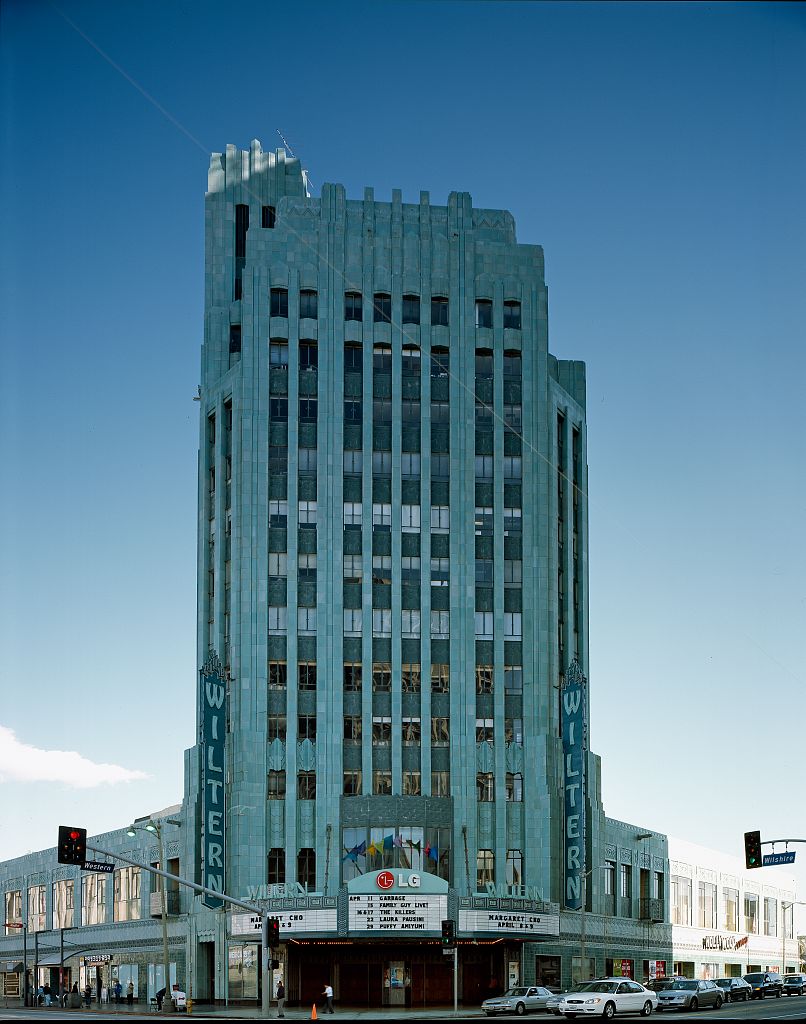
Lee did get a lot done to realize the Koreatown project in general, though, and the traditional edifice he built to house his restaurant the VIP Plaza still stands — except it now contains a popular Oaxacan eatery, La Guelaguetza. You could call this a shame, but isn’t it more interesting when you can find the bright colors and distinctive moles of southern Mexico in an elaborately old-school Korean shell in one of the biggest cities in the United States? And how about when that lays walking distance from vintage Los Angeliana like the Gaylord (with its H.M.S. Bounty), the Wiltern, the Chapman Market, and mainstays of the photographed landscape like the Sterling Ambassador Tower, which I just saw once again in Zabriskie Point?

And ah, The Prince: a bar I live two blocks from, a shooting location Mad Men has found rather useful, and an ideal synecdoche for the special kind of commercial miscegenation that makes me want to live nowhere but Koreatown. Take it away, J-Gold:

Imagine a Korean pub shoehorned into the fanciest restaurant in Los Angeles circa 1953, complete with the lawn jockeys at the top of the stairs and oil paintings of earls above the oxblood leather banquettes. The food, you understand, is not exactly the point at the Prince, which seems to specialize in sugary stir-fries and American dishes that might have been inspired by Quad Cities Rotary banquet menus. The basic unit of currency here is the kimchi pancake, a thin mass of egg batter laced with fermented cabbage, lashed together with scallions, then fried to an exquisite, oily crispness. Kimchi pancakes come free with your drinks, which makes sense, because the greasy heat of the things is enough to power you through an entire double-size bottle of Korean Hite beer.

Since he wrote that, the Prince has added Korean fried chicken to their menu in a big way, and boy, do I dig it.

The Ubuweb Experimental Video Project 47: John Baldessari’s Title

[For installments 1-46 of The Ubuweb Experimental Video Project, see either my Typepad or Livejournal accounts.]


John Baldessari, Title, 1971.

Title isolates, in a bunch of different permutations, the elements of motion pictures: objects, sounds, people, spoken words, actions, screenplay directions. Baldessari builds things up as the piece’s ten episodes, so while at first you only get to see silent shots of individual chairs, rocks, puppies and fields, by the end you’ve got human actors doing things and saying audible lines. The relevant scrap of their script appears at the bottom of the frame: “KELVIN puts the phone down on the table, with RUTH still talking. He lights a cigarette,” or “MOSSIE: (camera still over her shoulder) Over there.”

You might find Baldessari’s mission here a tad unambitious — who today doesn’t know that films emerge out of separate and sometimes only indirectly related audiovisual and human parts, or for that matter didn’t know in the early seventies? — but it still points toward a deliberately alternative way to watch movies that I’ve found myself practicing more and more with time. Maybe the fact that I make films myself and thus struggle to understand all the nuts and bolts of the operation has something to do with this, but even if you watch movies casually, doesn’t taking in the whole product at once — sound, image, dialogue, editing, music, action, humanity — sometimes get… overwhelming?

So when I run across a film or video that particularly impresses me, that stokes within me a desire to understand how it works or even replicate those workings, I often use a Baldessarian viewing method — or at least the viewing method of the John Baldessari who made Title. At any given time, I concentrate only on the image onscreen, or only on the sounds of the audio track, or only on the rhythm of the editing, or only on the motion of the actors. Do this with films of exceptionally rich craft, and you can get five, six, seven whole viewings that all feel different, and that all teach you different lessons about cinema. And which films would you want to watch over and over again, after all, but those of exceptionally rich craft?

The Marketplace of Ideas: into sound, food, performance, Japan, and the world city with Alan Nakagawa

This week on The Marketplace of Ideas, I talk to Alan Nakagawa; sound artist; visual artist; installation artist; founding member of Los Angeles’ long-running, multi-disciplinary, multi-ethnic, soon-to-be-dissolved arts collective Collage Ensemble; director of the experimental music Ear Meal webcast; L.A. Metro public art executive; member of Otonomiyaki, the Southern California Soundscape Ensemble and Ear Diorama Ear; and very serious eater indeed.

Soon after moving the center of Marketplace of Ideas production to Los Angeles, I realized that the here-based Alan Nakagawa pretty much embodied the show’s evolving sensibility. Trained in both the United States and Japan and experienced in collaborations with fellow creators from all over the globe, he works in the territory where sonics meet aesthetics meet the built, social, and artistic worlds around us. In our conversation, we cover what’s most interesting to listen to in this city, how a three-year-old found drawing behind the couch goes on to diversify into as many different art forms as possible in as unified a way as possible, how best to move between the countless separate cultural spheres that a metropolis like L.A. comprises, and what it actually means for an artist to experiment — and to offer that experimentation to the outside world.

Download the conversation on iTunes here or on the web site here.