Skip to content

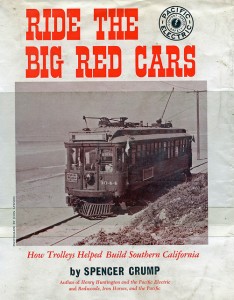
Spencer Crump: Ride the Big Red Cars

We used to have the greatest public transportation system in the world, so goes the oft-told Los Angeles lore. Then, a shady consortium, their own strings pulled by automakers and road-builders, bought all the trains and the tracks just to rip them out and scrap them. I don’t know about that; I sense a few too many viewings of Who Framed Roger Rabbit stoking a conspiracy-minded fire. We do know that, in the Pacific Electric and Los Angeles railways of the early twentieth century, this city did indeed boast the most extensive and beloved local and interurban train service anywhere. And we know that, by the early sixties, all of that had gone. But I figured the hows and the whys of the five decades in between were more complicated than the bitter, empty laments for the old trains I hear from those too young to have ridden them — or that, a few drinks into the night, I’d probably deliver myself.

Spencer Crump’s Ride the Big Red Cars comes recommended by, of all people, Reyner Banham, the well-known English architectural critic and Los Angeles lover who wrote The Architecture of Four Ecologies. Banham found great joy and fascination in freeway driving — he learned to do it so he could “read Los Angeles in the original” — and held out little hope for traditional rapid transit. “Even though [the Los Angeles freeways are] vastly better than any other urban motorway system of my acquaintance,” he wrote, “it is inconceivable to Angelenos that it should not be replaced by an even better system nearer to the perfection they are always seeking. A rapid-rail system is the oldest candidate for the succession, but nothing had happened so far. The core of the problem, I suspect, is that when the socially necessary branch has been built, to Watts, and the profitable branch, along Wilshire, little more will be done and most Angelenos will be an average of fifteen miles from a rapid-transit station.”

Things have happened now. The Red Line subway under Wilshire, having made agonizingly slow progress over the past two decades, still has twelve miles to go, but the Blue Line train, though — the “socially necessary branch” — runs to Watts and all the way to Long Beach besides. It actually does so along the same path of the very first Pacific Electric line Southern California-building magnate Henry Huntington opened in 1902. In Crump’s telling, Huntington took only nine months to build it, and build it well; the Blue line took five years. “Crump thinks Los Angeles’ Blue Line is a step in the right direction,” wrote Jim Washburn in a 1992 Los Angeles Times article catching up with the author, ”but says that by running it at street level, it is crippled same the way the PE eventually was by having to contend with automotive traffic crossing its path.”

Here we have one clue as to how Los Angeles let rail transit slip from its hands. Crump’s book covers, in great detail, how the region’s interurban lines and trolleys expanded so quickly and won such a large, admiring ridership. The system’s peak seems to have come in the twenties to perhaps the early thirties, after which, a brief revival during the Second World War notwithstanding, it was all downhill for Pacific Electric’s red cars (and presumably the Los Angeles Railway’s yellow ones, too). Building in the days when automobiles were scarce and roads suitable for automobiles scarcer still, Huntington laid most of his track either at street level or on the streets themselves. But when car ownership came to the everyman, a savage battle for road rights ensued. Badly slowed by having to move in mixed traffic and stop at many new vehicle crossings, the trains went from a public perception as the height of efficiency to its nadir. Soon, the per-mile operating cost of a personal car fell below the equivalent Pacific Electric fares. Then, after the war, came the freeways.

“We’ve created sort of a hell here,” said Crump in that Times article. “We are only faced with a tremendous and complete traffic jam that doesn’t give us anything. This freeway driving is not only lonely, but it makes me uptight and stressed being in that bumper-to-bumper traffic.” But I can understand how appealing a city of gleaming new cars and soaring new motorways must once have seemed. Few foresaw the debased, utilitarian condition of American motoring ahead, and fewer still understood that the further backward a place bends to accommodate the automobile, the less it merits a visit in the first place. If anything has made Los Angeles second-class in the past fifty years, that has. I can’t say I suffer much New York envy, except when it comes to their transit. Yes, New Yorkers complain ceaselessly about it — when asked what he dislikes about living there, Tao Lin memorably cited “the comically unreliable/loud/dirty subway-system” — but at least it’s there.

Both New York and Los Angeles’ “public” transit systems were, before 1940, wholly or in large part, privately owned. But New York City bought and continued to operate the subway lines, whereas the City of Los Angeles passed on the trains in its territory. “The greatest failure,” Crump writes, “came in the slowness of the public and public officials to grasp the fact that the role of providing transportation could not be filled by private enterprise.” The libertarian in me honestly wonders about that, but the deal is done: Los Angeles now has a public agency to handle its trains, and that agency does seem to be building and running new lines. These take their sweet time to materialize — evidently you can’t just throw thousands of Irishmen at the problem anymore — and tend to do so on whichever old rights-of-way happen to remain, the location of current centers of commerce be damned. Yet at this point I see reasons to remain just on the side of optimism, and I imagine Crump — whether he’s still with us, I don’t know — would too.
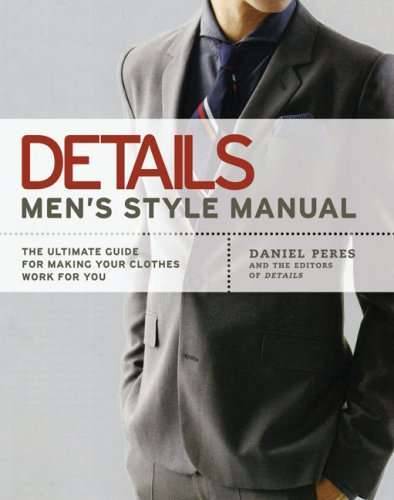
Menswear books: Daniel Peres, The Details Men’s Style Manual

I confess to not quite knowing Details’ place on the landscape of gentlemen’s magazines. While glancing at its issues reveals a more deliberately tasteful publication than blunter, intensively airbrushed “lad’s mags” like Maxim (or its countless late imitators), it also lacks the pedigree of comparatively venerable midcentury-man staples like GQ or Esquire. Yet Details must harbor comparable aspirations to style authority, since it, like those two older brothers, has a whole book out on the subject: the Details Men’s Style Manual, by the magazine’s editor-in-chief Dan Peres. “In a world of skinny suits and pointy shoes, I was rather content dressing down,” he writes of recently bygone days. “I had adopted a uniform of jeans, sweaters, and tattered Chucks — and the occasional button-down shirt, untucked, of course. I even wore a fleece to a Versace fashion show once.” So we’re working from square one, then.

The unaddressed question of how someone who inspired an entire New York Times trend piece rose so high in the first place does shake one’s confidence in the Details imprimatur. But combine his history of willful disregard with the presumably high caliber of stylistic consultancy at his fingertips, and Peres looks ideal to write a beginner-level manual on men’s dress. Having undergone a Damascene conversion on the road between European fashion shows, he decided to set his own house — or rather, closet — in order, and what he learned from his magazine’s specialized style editors he organizes into this book’s thirteen chapters. All this he explains in the introduction, which spreads fewer than 700 words across four pages in two colors and three different large fonts. It gets noisier: the two-page spread immediately following presents a list of “rules of style” in a flurry of bolding, boxing, unconventional capitalization, and other formatting tricks.

Read the whole thing at Put This On.

Podthoughts: Ask Brooklyn

Vital stats:
Format: interviews with Brooklyn-based experts about their expertise and how it relates to Brooklyn
Episode duration: ~30m
Frequency: 1-4 per month

When one of my peers — i.e., anyone in that vast age group, “about thirty” — tells me they live in New York, I just assume they live in Brooklyn. Thirty years ago, I suppose they would have lived in one of the more run-down parts of Manhattan, David Byrne territory. But something tells me that no “more run-down parts of Manhattan” remain. I’ve talked to the occasional youngish person who lives in Queens, but they always make it sound as remote as Guam. I’ve never encountered anyone from the Bronx or Staten Island. Then again, I live in Los Angeles, a haven for the rootless, and I suspect Brooklyn provides the same solace. You see a lot of traffic back and forth; for every Brooklynite aspiring to Angelenohood, an Angeleno aspires to Brooklynism.

“Ah, Brooklyn,” I remember Buddy Bradley, protagonist of Peter Bagge’s comic series Hate, saying upon setting foot there. “The worst place in the world.” That issue formed, in large part, my early impression of that part of New York: crowded, inconvenient, dangerous, dirty. I still haven’t visited, though I understand that, somewhere in the past fifteen years, Brooklyn made the transition fromCrooklyn to something of a Portland East. Over this same span of time, though, my appreciation for the crowded, inconvenient, dangerous, and dirty has only grown, so I don’t quite know what to do. Correcting my years of built-up inaccurate third-hand impressions by listening to Ask Brooklyn [iTunes] seemed like the beginning of a solution.

Read the whole thing at Maximum Fun.

Notebook on Cities and Culture S1E30: The Stories of Los Angeles with David Kipen

Colin Marshall sits down in Boyle Heights with David Kipen, founder of that neighborhood’s combined bookstore and lending library Libros Schmibros and a true man of both letters and Los Angeles. He gives commentary on books and literary culture on KPCC-FM and Sirius XM’s The Bob Edwards Show, he’s written the book The Schreiber Theory: A Radical Rewrite of American Film History, he recently translated Cervantes’ The Dialogue of the Dogs for Melville House Books, and he spent over four years as the National Endowment for the Arts’ Director of Literature, where he got their Big Read program started. They discuss how to sell paper books in neighborhoods the Kindle hasn’t penetrated; his interest in getting into conversations about books on both the low-profile person-to-person level and the high-profile media one; whether we have indeed left an actual lost golden age of American reading; the lack of “slack” in American life to use for reading; how rail makes up a city’s skeleton, and how Los Angeles’ skeleton is growing with new additions like the Libros Schmibros-proximate Gold Line; 1939, the annus mirabilis of Los Angeles literature, and the city’s modern desire, as exemplified by Mike Davis’ City of Quartz, to fetishize its own depredations and destruction; whether it’s hard to keep your mind in the narrative of this city, where even the natives have to immigrate; and that undervalued observer of Los Angeles and the whole of California, Thomas Pynchon.
Download the interview from Notebook on Cities and Culture’s feed here or on iTunes here.

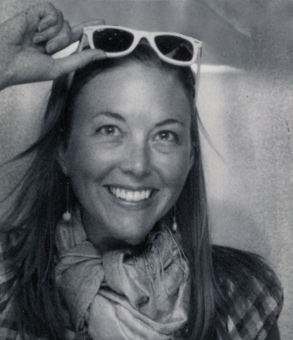
(Photo: Alissa Walker)

Notebook on Cities and Culture S1E29: Great Mistakes with Alissa Walker

Colin Marshall sits down in Silver Lake with Alissa Walker, writer on urban design, architecture, and the cityscape — especially Los Angeles’ — for publications like GOOD, Dwell, the LA Weekly, and more. She also associate-produces KCRW’s DnA: Design and Architecture. They discuss Sunset Triangle Plaza, the area of reclaimed street where they sit, and what it says about the Angeleno “mind shift” toward getting out of the car; how many small, cheap improvements can alter the urban experience in the same way as a few large, expensive ones; her friends’ lingering fear of getting “all sweaty” while riding bicycles, buses, and trains; the complacency Los Angeles instilled in its residents in the seventies, eighties, and even nineties; increasing the “stumble upon” factor in a large, spread-out city; her experience building a more accurate narrative of Los Angeles, a city that hasn’t done much to brand itself lately, than the ones in the New York Times; the urban projects that work in this city and the ones, like a “living wall” being torn down right behind them, that don’t; Los Angeles’ tendency to create spaces in which to compress and imitate itself; the lack of markers, literally and figuratively, to show you “where the stuff is”; learning and showing Los Angeles through its architecture, and other works of public design more interesting than the artisanal chairs so popular last decade; her part in the GOOD Ideas for Cities project, especially when it went to her native St. Louis, and how it got her thinking about the possibilities of American cities; and her recommendations on how best to keep your eyes on the streets in Los Angeles.
Download the interview from Notebook on Cities and Culture’s feed here or on iTunes here.

Notebook on Cities and Culture S1E28: No Such Thing as Free Parking with Donald Shoup

Colin Marshall sits down at UCLA with urban planning professor Donald Shoup, author of The High Cost of Free Parking and the man who’s made us aware of the fact that our cities’ problems come not from too little parking, but too much. They discuss the academic tendency to believe, without verification, anything bad about Los Angeles; how this city became the densest car-oriented one in America, as well as the most car-oriented dense one; falsely perceived parking “shortages,” how they led to minimum free parking requirements, and how those have worsened our urban experience; Los Angeles’ parking requirement-skirting Adaptive Reuse Ordinance, which made even monstrosities like 1100 Wilshire usable; the development of technology needed to allow parking prices to respond to demand, and how it works in systems like San Francisco’s SFPark; the importance of treating parking space just like any other real estate, and how irresponsible we’ve been about that; how Ventura streets got free wi-fi through their parking program; what ruined Westwood, and what parking policy had to do with it; how he realized parking mattered so much, and why the general public has only begun to; the necessity of humor when you’re writing about parking for 800 pages; and how cycling makes it users happier than any other mode of transportation (perhaps because of its lack of parking complications).

Download the interview from Notebook on Cities and Culture’s feed here or on iTunes here.

Podthoughts: The SHeD Show with Andy Dick

Vital stats:
Format: conversations (and occasional songs) between Andy Dick and his friends and colleagues
Episode duration: 1h-1h30m
Frequency: erratic

I know who Andy Dick is, and yet I don’t know who Andy Dick is. He entered my awareness as a guest on Loveline, the nightly radio program that occupied one of the larger, more edifying chunks of my time between the ages of thirteen and twenty. He had a specific reason for being famous back then, which I believe had something to do with a role on the ABC sitcom NewsRadio. I remain more or less ignorant of that show, despite its retroactive receipt of a great deal of comedy-nerd credibility, at least by the standard of ABC sitcoms. I know just as much about Less Than Perfect, the other sitcom, this time about an office, which carried his mainstream recognition into the 2000s. My curiosity has long had a place for his band, the Bitches of the Century, but mostly because of its name. I can’t get enough of that name.

Somehow, this thin experience has provided reason enough for me to download Dick’s every guest appearance on today’s interview-ish comedy podcasts and comedy-ish interview podcasts: Marc Maron’s, say, or Adam Carolla’s. As far back as I can remember, and in whichever sonic medium I can remember, a conversation with Andy Dick has always meant a conversation about drugs and alcohol, either the benefits thereof, the indignities thereof, or the vagaries of quitting them. Given his once apparently constant struggles with substance abuse and tendency toward bizarre public behavior, Dick became something of a dead man walking in the eyes of the media. Yet, like a high-personality Zelig wandering through a very specific and strikingly grim circle of show business, he displayed a hardy survival instinct while his significantly less doomed-seeming associates — actors Phil Hartman and David Strickland come to mind — met their ends.

Read the whole thing at Maximum Fun.

Me 11 Points Countdown: how to stop worrying and love high gas prices


Above, please enjoy my appearance on the new 11 Points Countdown video. Host Sam Greenspan puts me, “podcasting superstar Colin Marshall,” in the hot seat for eight minutes to discuss the audience-voted good things about high gas prices. As a carless Angeleno, a cycling enthusiast, and an all-around fan of “multimodal transportation,” I found this topic almost spookily suitable. And speaking of, I am not actually wearing a suit, though some viewers seem to assume that. Other viewers are calling me “Niles Crane.” Tell me who that is and why they’re calling me that. I wonder if this Niles Crane is someone who drinks a full glass of Boddington’s at ten in the morning and doesn’t feel the thin end of a bad wedge. If so, how incisive!

Some other recent media appearances:

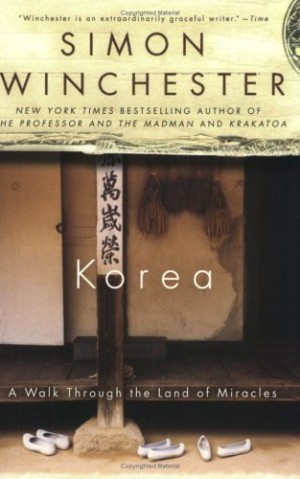
Simon Winchester: Korea: A Walk Through the Land of Miracles

Los Angeles’ Korean Cultural Center put on a quiz on Korea, and I picked this book up ostensibly as study material. Frankly, though, I’ve wanted to read it for years. The tradition of the traveling English writer — as distinct from the English travel writer — draws me in without fail, although I tend to go for those still living with consciousnesses shaped by a fallen empire, rather than the dead who freely roamed a thriving one. The British-born, English- and Californian-raised, and Indian heritage’d (Marketplace of Ideas and Notebook on Cities and Culture guest) Pico Iyer has become my key reference point there. Though technically Swiss, the English-in-tone-and-manner (Marketplace of Ideas guest) Alain de Botton performs the sort of philosophical explorations that take him all over the place, whether he likes it or not. Then we have (Marketplace of Ideas guest) Clive James, the Australian who, while more of a critic than a writer of place, writes essays underlain by a similarly extensive internationalism. Though he recently took U.S. citizenship, I suspect Simon Winchester may fit somewhere within this triangle. If a book takes him to a country that not only fascinates me but whose culture has, with astonishing speed, become an important part of my life, count me aboard.

Why is Simon Winchester so popular?” Nathan Heller asked in Slate, accusing him of writing in a breezy, no-questions-askable style that leads readers into lazy “historical tourism.” Though he periodically goes to the history shelves to provide context in Korea, Winchester mainly writes the book as a straight travelogue of his walking journey as far across the titular peninsula as politics allows. In the late eighties, when the main text takes place, he gets right up to the Demilitarized Zone that separates South from North, but steps no farther. (A dingy limousine and a pair of black-suited agents await him on the other side; a loudspeaker blares hastily whipped-up propaganda about the solitary westerner who, too poor to buy a car, has walked all the way to the Democratic People’s Republic in search of a better life.) The second edition offers a new introduction where Winchester recounts his later trip past the 38th parallel, goaded on by some Irish priest who needled him about his “half complete” journey. Here you’ll find the book’s most harrowing moment, when at the Pyongyang airport café he drinks what you might call a cargo cult cappuccino: “The foam on top turned out to be egg white, beaten and cooked into a sort of greyish omelette.”

I live for lines like that, as I live for paragraphs like this:

Korean women, I am bound to think, present a most bewildering and complicated mixture of emotions and attitudes. One woman can at the same moment be delightfully shy and yet alarmingly forward, liberated and yet coquettishly deferential, sexually ignorant and yet wantonly promiscuous, aggressive and argumentative and yet strangely sulky and passive. So very different from the Japanese — so friendly, so curious, so studiously attentive. The baser side of me would often think that for stimulation and curiosity value alone there could probably be no greater woman than the Korean, but life could at the same time perhaps be pretty hellish, I have no doubt.

Ah, the soothing feeling of meeting someone, even in text, almost as unreconstructed as oneself. Winchester mentions narrowly avoiding encounters with an dutiful prostitute or four — purely disease-related concerns, he insists — but either never beds down with a woman of this Land of Miracles or shies away from mentioning having done so. Without knowing Winchester, I put my money on the latter. “Travellers almost by definition screw more (or want to screw more) than other people,” I remember Donald Richie writing in his Japan Journals, and even that book alludes to more of that than it describes (though I hear much description remains in his unpublished Vita Sexualis). No traveling writer wants to come off like a sex tourist, but the apparent omission, as if he hadn’t mentioned eating any food the whole time, unsteadies me as a reader. Talk about a half complete journey.

It seems the title alludes primarily to industrial miracles. In an elegiac opening chapter, Winchester, a onetime resident of Newcastle upon Tyne, tells of witnessing the death throes of British shipbuilding. He later travels to Korea to size up its suspected murderer: the unfathomably large, futuristically equipped, and unrelentingly efficient shipyards operated by Hyundai. “You know,” remarks a Swedish shipowner come to inspect his order, “I think that Europe is quite finished.” Having lately read a great many books on Asia written by westerners in the seventies and eighties, I can assure you that such nervous resignation in the face of apparent discipline and hyperproductivity came with the zeitgeist. Usually the terror emanates from that mercilessly buzzing economic hive known as Japan, Korea’s image as whose poor, undistinguished country cousin Winchester attempts to counterbalance. At thrift stores, I still see barrels full of dollar hardbacks warning of America’s imminent (or accomplished) reduction to a commercial colony of the Rising Sun. You may want to hold off on reading all those China pundits.

Certainly it counts as some sort of Miracle that Winchester could walk all the way across Jeju island, then all the way across South Korea, without dying of bunions or something. I have no doubt that the country offers all the amenities needed to accomplish this, like comfortable small towns and a helpful, outgoing populace. The book itself proves that, and such a trip has probably gotten even easier over the past 25 years. I just can’t imagine walking across any American state, let alone my entire country, without things going terribly awry. The vast United States grew so wealthy so early, and has stayed wealthy so long, that it seems to have paradoxically avoided building much of an apparatus for the curious visitor, let alone the curious pedestrian visitor. Maybe I’ve simply fallen victim to the allure of the foreign, but every city in which Winchester spends the night — even the allegedly unremarkable hamlets he all but skips over — strikes me as well worth exploration. I myself just made a Korean friend from Bucheon, known as “the cultural centre of the Seoul Metropolitan Area.” Bucheon’s official sister city is Bakersfield.

(Having now taken that quiz on Korea, I realize I should have spent the time I spent reading this book memorizing the assigned semi-propagandistic pamphlet. But I regret nothing.)

Notebook on Cities and Culture S1E27: Spoiled By San Francisco with Jesse Thorn

Colin Marshall sits down nine stories above Westlake with Jesse Thorn, host of Public Radio International’s Bullseye, proprietor of the Maximum Fun radio and podcast empire, and host of the men’s style web series Put This On. They discuss what it takes for GQ to introduce you as a guy who hates Los Angeles; the points of starkest division between northern and southern California, including burritos and new-aginess; his time growing up in San Francisco’s inner Mission district, where he was spoiled by the ease of getting around and much else besides; coming of age amid the city’s crack epidemic, nearly witnessing shootings, and dodging batteries thrown from rooftops; neighborhoods as extensions of your home into the outside world; the vast distances one must traverse in Los Angeles, and the toll they takes on one’s ability to “pop on over” anywhere; Put This On‘s exploration of the great men’s style cities, including New York, London, and Milan (“the Los Angeles of Italy”); the utilitarianism of dress in America, and the prevalence of surfer and skater traditions in southern California; the twin tendencies of white Angelenos to expensively project the image of not caring about clothes and to nevertheless pay close, anxious attention to their physical attractiveness; and the knowledge that neither he nor anyone else can never go home again to the old now-gentrified San Francisco neighborhood.

Download the interview from Notebook on Cities and Culture’s feed here or on iTunes here.