
JE SUIS la jeune fille: though I’ve never formally studied French, I’ve had that phrase stuck deep in my linguistic consciousness since childhood. So, surely, have most Americans of my generation, hearing it as we all did over and over again for years in the same television commercial. Frequently aired and never once updated, it advertised a series of language-instruction cartoons on videotape. Even more memorable than the French words spoken by that young girl were the English ones spoken by the product’s both grandmotherly and severe pitchwoman: “Yes, that’s French they’re speaking, and no, these children aren’t French, they’re American. And they’ve acquired their amazing new French skills from Muzzy.”
In those same years, an early episode of The Simpsons saw Bart sent off to France, an ostensible student exchange meant to punish him for his constant pranks. He spends two months in the French countryside mistreated by a couple of crooked vintners who, in a plot point ripped from the headlines of the era, spike their product with antifreeze. When a shoeless and disheveled Bart finally spots a passing gendarme, he can’t make himself understood in English. Only when he reaches the brink of emotional breakdown does he realize that, unconsciously and effortlessly, he has internalized the French language: “Here, I’ve listened to nothing but French for the past deux mois, et je ne sais pas un mot. Attendez! Mais, je parle Français maintenant! Incroyable!”
All this convinced me, on some subconscious level, that to learn a foreign language meant almost by default to learn French. Sufficient exposure to the sounds of French, I also gathered, might lead to fluency by osmosis. More than a quarter-century later, French President Emmanuel Macron has set about spending hundreds of millions of euros on an international campaign to reintroduce versions of those now unpopular notions: that his country’s language is easily acquirable, and that it’s worth acquiring in the first place. Macron believes, as he told a group of students in Burkina Faso last year, that French (which in number of speakers currently occupies sixth place behind Mandarin Chinese, English, Hindi, Spanish, and Arabic) can potentially become “the number one language in Africa and maybe even the world.”
Read the whole thing at the Los Angeles Review of Books.

Despite my long-standing interest in things Korean, I’ve gone in for very few of the “Korean wave” of cultural products that have reportedly swept the globe — or at least much of Asia and a bit of the West— over the past 15 years. Most of them never seemed targeted toward me in the first place: not K-pop, not K-dramas, and certainly not K-beauty products, though the mighty Korean cosmetics industry’s push to normalize of male makeup gains ground every day. The first Korean product I ever consciously consumed, apart from jars of kimchi and citron tea from Korean grocery stores, I got for free: Kakaotalk, the country’s free messaging and Voice over Internet Protocol app of choice.
Or maybe Silicon Valley would call Kakaotalk’s business model “freemium”: free to use for messages and calls, but with an ever-expanding set of extras to buy. The gateway drug is the “stickers,” whimsical icons featuring the Kakao Friends, a cast of anthropomorphic characters including a dog, another dog with a black suit and an orange afro, a cat in a bob wig, a radish in a rabbit suit, a duck with removable feet, and a genetically modified peach. Most casual Kakao Friends buyers no doubt make the transition to addiction at one of the Kakao Friends stores all around the country. Usually multi-story affairs occupying huge amounts of prime real estate, these sites of pilgrimage sell everything from Kakao Friends cellphone accessories to Kakao Friends dolls to Kakao Friends confections to Kakao Friends luggage. Many even have a Ryan Cafe inside, so named for one of the newer Kakao Friends, a lion without a mane.
Not to be outdone, Kakaotalk’s main competitor Line, operated by a Japanese subsidiary of Korean search-engine company Naver, has also created the Line Friends. This seemingly larger group includes a variety of comparatively normal animals, especially bears, as well as a few human beings and what looks like a ghost. Line has also set up character merchandise shops in not just Korea but Tokyo, Hong Kong, Bangkok, and New York. On the endless quest for synergy, it has also produced subsets of new characters with Japanese-designed global icon Hello Kitty and international K-pop boy band BTS. In recent years the “friends” business in Korea has taken on aspects of a gold rush: fewer and fewer categories of product, no matter how mundane, lack at least one brand that had tried to come up with friends of its own, and design students increasingly come up with not just concept products but concept friends to promote them.
Read the whole thing at the Los Angeles Review of Books.
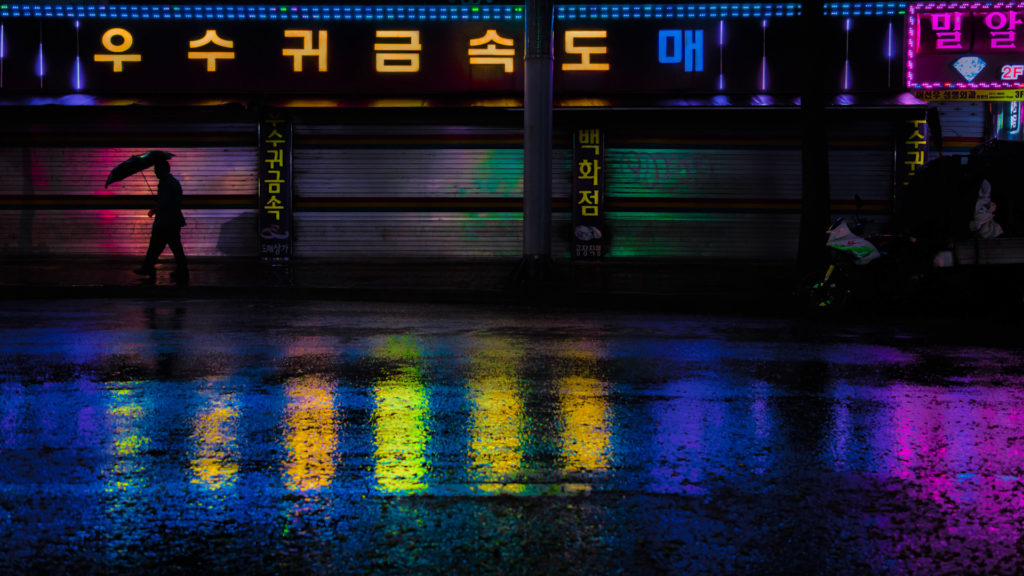
Each month I join Kurt Achin, host of Koreascape on Seoul’s English-language radio station TBS eFM, for an exploration of one of Seoul’s urban spaces. This month we talk about Seoul’s chances of becoming the next great cyberpunk city (subject of my latest piece in the Los Angeles Review of Books Korea Blog), following the likes of the future Los Angeles imagined in Ridley Scott’s Blade Runner, Chiba City in William Gibson’s Neuromancer, and New Port City (or Hong Kong) in Oshii Mamoru’s Ghost in the Shell. Expatriate photographers have found much of cyberpunk’s “high tech meets low life” sensibility in Seoul’s cityscape, especially on rainy nights in the parts of town full of old neon, crumbling alleys, and visible technological infrastructure. We ask what else Seoul needs to achieve proper cyberpunk status, and whether certain other cities in Africa or India might get there first.
Stay tuned for further explorations of Seoul’s architecture, infrastructure, and other parts of the built environment. You can hear our previous segments here or download them on iTunes.
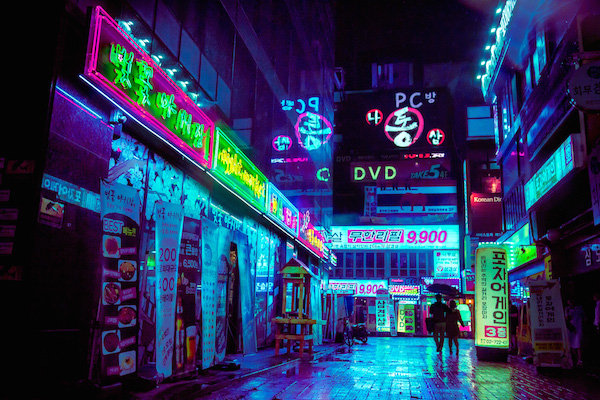
Since the original Blade Runner takes place in an imagined late-2010s Los Angeles, I’d have gotten a kick out of seeing its sequel, which after prolonged speculation finally came out late last year, in the actual late-2010s Los Angeles. But having moved to Korea a few years ago, I settled for a screening here in Seoul. In some ways, this ultimately felt like the more appropriate city in which to see the movie: when Blade Runner 2049‘s first trailer came out, I wrote here about its apparent acknowledgement of the considerable Korean influence felt in Los Angeles since its predecessor’s release. While no small number of Koreans already lived there back in 1982, the makers of Blade Runner — like everyone else at the time — couldn’t see past the economic rise of Japan, whose cash-flooded conglomerates then seemed poised to buy up not just Hollywood’s studios the downtown skyline as well.
When I did make it back to Los Angeles earlier this year, I saw sights that proved more memorable than even the spectacles of Blade Runner 2049. Coming in from the airport, for instance, I looked up to see the Korean Air logo looming 73 stories above downtown at the top of the Wilshire Grand Center, a building still under construction when last I saw it. Then, lowering my sights from that glowing orb so reminiscent of the South Korean flag, I spotted a tent village that had sprouted in the darkness of a freeway underpass. The first Blade Runner envisioned Los Angeles as having plunged into a kind of third-world condition, with its ruling class perched high above (if not on a different planet from) the teeming common element doing business in countless different languages down in the streets. Something tells me that the contrast in the real 2019 might look even starker than that.
But then contrast lies at the heart of the science-fiction tradition of cyberpunk, the most influential examples of which include Blade Runner as well as William Gibson’s Neuromancer, published in 1984 and now considered the archetypical cyberpunk novel. The common description of Gibson’s work of that period, “high tech meets low life,” also broadly characterizes cyberpunk itself, which, unlike so much sci-fi of earlier generations before, understands that technological progress doesn’t come with moral progress. Nor does it come with the kind of widespread social or economic progress upon which many stories of the future once premised themselves. Nor does that high tech penetrate all areas equally: “The future is already here ,” said Gibson in what has turned out to be one his most-quoted lines. “ It’s just not evenly distributed.”
Read the whole thing at the Los Angeles Review of Books.
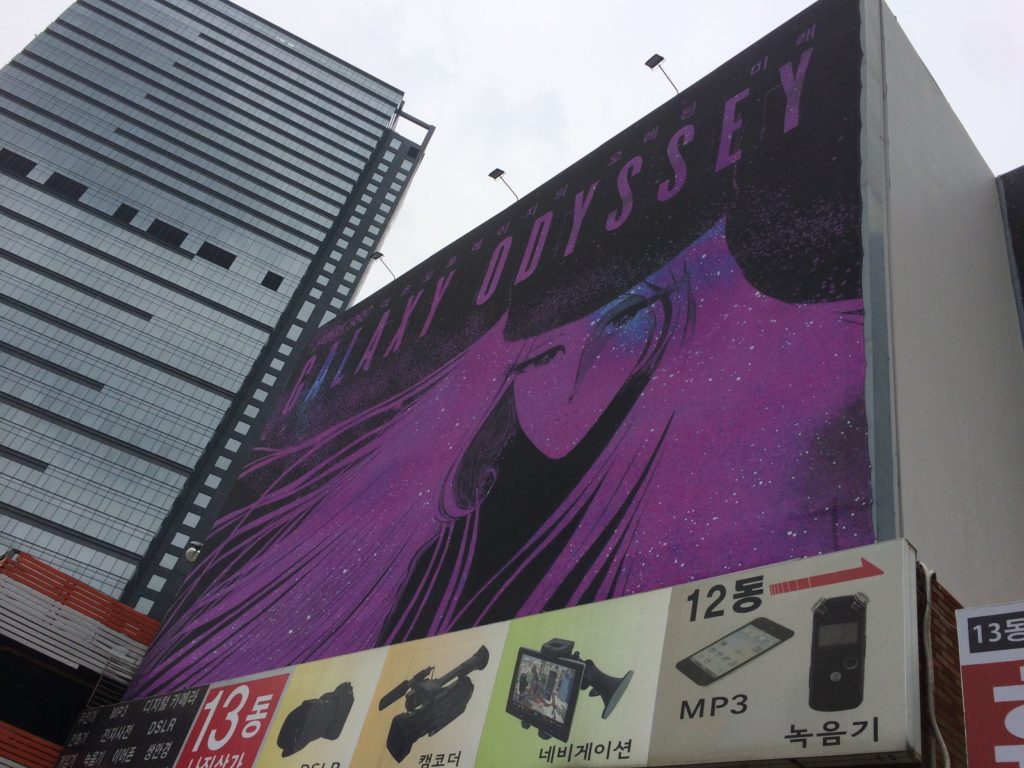
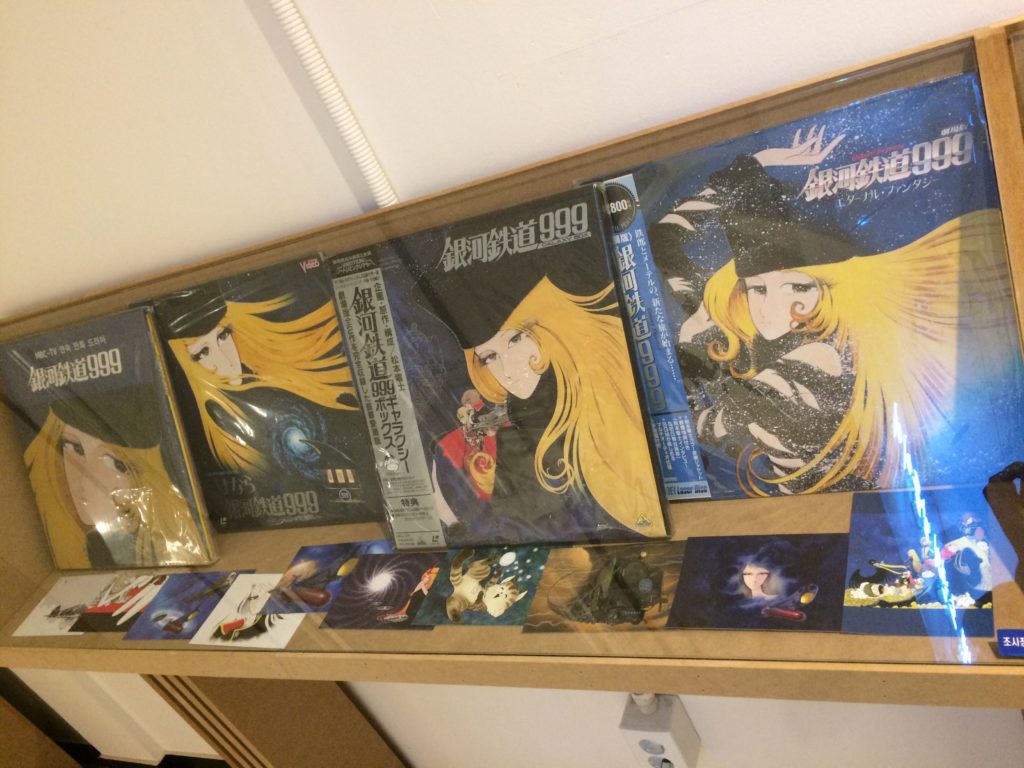
子供の特はオタクではありませんでしたが、アニメと漫画をよく見ました。ときどきANIMERICAというアメリカのアニメと漫画についての雑種を読みました。私が中学生だった90年代中にANIMERICAは 銀河鉄道999という漫画の英語翻訳版を載せました。
私は毎号を読んでいたわけではなかったので、その漫画の内容をよく知りませんでしたが、絵に見とれました。10歳の子供の子と黒衣を纏っている金髪の女性が乗っている宇宙空間を飛ぶ昔の電車を初めて読んだその時まで見たことがありませんでした。

約20年前からは銀河鉄道999のことをあまり考えなかったが、今年にソウルで開かれた展覧会のおかげでまた考える機会に成りました。GALAXY ODYSSEYという展覧会は韓国でも人気があった銀河鉄道999の歴史とメイキングを楽しく見せています。
ソウルの秋葉原と言えるヨングサンの電気商店街の古い建物をギャラリーに変えました。展覧会はいろいろな部屋で成り立っています。人物の衣装を着てセルカを撮る部屋、画家が作った部屋、銀河鉄道999の漫画家である松本零士の事務所に似ている部屋があります。
そのような部屋以外に日本的な自動販売機がある無人販売店の部屋もあります。そこで日本に行った時によく飲むUCC缶コーヒーを買って飲んだのですが、日本の雰囲気を感じることができました。展覧会の中にあるお店で銀河鉄道999の創造者である松本零士が読んでからアイデアを思いつくことが出来た30年代の小説の韓国語の翻訳版も買いました。(いつか日本語でも読む事が出来る事を願っています。)
ほかの仮想現実感を経験出来る部屋で、ある職員が私にフランス人かと聞きました。聞いた理由は私の西洋人の姿だけじゃなくて銀河鉄道999がフランスでも人気があるのでフランス人が展覧会にたくさん来るからだと言いました。DAFT PUNKという有名なフランスのバンドは銀河鉄道999の松本零士と一緒に映画のように長い音楽のビデオを作りました。展覧会のある部屋のなかでそのビデオを長い間鑑賞しました。銀河鉄道999が人気がない唯一の国はアメリカだと言えるだろうか?

이경훈의 <서울은 도시가 아니다>가 처음으로 출간되었을 때 한국인 독자들은 책의 제목에 대해서 놀랐던 것 같다. 게다가 서울에 관한 책을 항상 읽고 있는 내가 서울을 아는 서양인 친구에게 그 책에 대해서 얘기하면 그들은 더욱 더 놀랄 것 이다. 그 이유는 많은 서울에 온 서양인이 서울보다 더 도시다운 도시를 본 적이 없기 때문이다. 서울은 미국 대도시보다도 높은 건물이 더 많고 대중 교통이 더 발달되 있고 사람도 훨씬 더 많다. 서울이 도시가 아니라면 과연 어디가 도시일 수 있을까?
뉴욕에서 유학했던 건축가 이경훈은 역설적이게도 서울을 도시답지 않게 만드는 것이 바로 서울의 특징이기도 하다고 주장한다. 그 특징 중에는 걷고 싶은 거리와 마을 버스와 방 문화와 아파트 단지 등이 있다. 그런데 서양인의 입장에서 보면 그것들은 다 좋은 것처럼 보일 수도 있다. 도시설계에 관심이 많고 도시에서 걸어 다니기를 즐기는 나같은 사람에게는 “걷고 싶은 거리”라는 것은 전혀 부정적인 느낌을 주지 않는다. 마을 버스는 세계의 다른 나라에서 찾아 볼 수 없는 편리한 교통수단으로 볼 수 있다. 서울을 구경하는 관광객한테는 밤새면서 노래를 부르거나 게임을 하거나 영화를 볼 수 있는 여러 방 시설만큼 새롭고 재미있는 것이 또 있을까? 이와는 반대로 아파트 동수를 제외하면 천편일률적인 아파트 단지가 서울에 거주하는 서양인이 도시 미관 차원에서 가장 싫어하는 점인지도 모른다.
그러나 이경훈의 말에 따르면 그러한 흔한 점들은 사람들이 서울의 공공 공간에서 즐기며 살아갈 수 있는 활기를 빼버린다. 옛날부터 사랑받아 온 도시 맨해턴에는 왜 걷고 싶은 거리라는 것이 존재하지 않을까? 맨해턴이라는 도시는 이미 모든 사람들이 모든 곳으로 걸어 가고 있기 때문에 모든 거리는 자연스럽게 걷고 싶은 거리가 된다. 이경훈은 뉴욕의 걷기 문화에 대해서 할 말이 많고 그 면에서 뉴욕과 서울을 비교할 때마다 아쉽게도 서울은 진다. 이 책의 저자 뿐만 아니라 서울에 대해서 글을 쓰는 적지 않은 사람들은 서울을 걷기 힘든 도시라고 묘사하지만 대부분의 미국인들은 그 말을 비웃을 것이다. 약 미국의 90프로 지역에서 차가 없으면 거의 살 수없어서 그러한 곳에 사는 사란의 눈으로 본다면 서울은 걷기 쉬운 도시의 이상형일 수도 있다.
내가 보기로는 서울에서 이경훈이 그토록 싫어한 것 중에 하나는 인도에 주차된 차인 것처럼 느껴진다. 솔직히 말하자면 내가 서울에 처음으로 와서 걱정한 것이 인도에 주차된 차가 아니라 인도에서 운전하는 사람이었지만 서울에서 살아가면 살아갈수록 저자가 지적하는 이유를 명백히 이해한다. 뉴욕 같은 도시의 차가 전혀 없는 인도에서는 사람들이 인사하고 대화하고 음식을 사 먹고 여러 다른 일상 생활을 한다. 이경훈이 말하는 서울 같은 도시가 아닌 도시의 인도에서는 사람들이 주차하고 담배를 비울 뿐이다. 엄밀히 말하자면 서울 사람들에게는 차가 필요하지 않고 여기 저기에서 걷기도 하지만 대체로 공공 공간에서 일상 생활을 하지 않는 경향이 있다.
첫는에 보면 서울은 미국 도시와 완전히 달라 보이지만 나는 <서울은 도시가 아니다>를 읽고 나서 서울과 미국 도시가 어느 면에서 서로 비슷한 문제를 겪는다고 생각한다. 이경훈은 책에서 한국이 도시보다 자연이 원래 좋다는 이데올로기가 있다고 쓰고 있고 내 생각에는 미국도 똑같은 이데올로기가 있다고 주장한다. 그래서 두 나라에서 도시에 일부러 자연을 도입하려고 시도하지만 결국은 도시가 덜 도시답게 될 뿐이다. 내가 서울에 이사오기 전에 살았던 로스앤젤레스의 문제는 거기에 사는 많은 사람들이 대도시에 살아 감에도 불구하고 단독주택에 거주하고 차를 매일매일 운전해야 한다고 생각하면서 거의 시골 생활다운 삶을 영위한다. 결국 이경훈의 견해에 따르면 “자연이 자연다워야 하듯 도시는 도시다워야” 한다는 게 바람직하다.
서울에 산지 3년이 되어 가는 하지만 뉴욕에 산 적이 없는 나는 아직도 서울에서 여러 면에서 즐겁게 나의 삶을 이끌어 간다. 그동안 서울 사람들에게서 서울에 대한 불평을 자주 들었지만 언제나 불완전한 미국 도시에 익숙해 있었던 나 였기에 그러한 점들을 완전히 이해하지 못 했다. 이경훈의 <서울은 도시가 아니다>는 나를 서울 사람의 불평을 이해할 수 있게 해 줄 뿐만 아니라 서울 사람도 자기 자신의 불평도 이해할 수 있게 해준다. 그런데 내 생각에는 서울이 이경훈 뿐만 아니라 다른 서울 사람들이 보기 어려운 장점이 많이 있고 미국과 유럽 도시들이 그 장점을 수용하면 좋겠다. 우습게도 서울이 뉴욕을 부러워 할 필요가 없는 이유가 무엇인지 알고 싶다면 두 도시의 지하철 역의 화장실을 비교하면 자연스럽게 정답을 알 수 있게 된다.

数週間前よく行くソウルの映画館で坂本龍一:コーダというドキュメンタリーを見ました。言うまでもなく坂本龍一は世界的に有名な作曲家です。70年代にYMOという電子音楽バンドの一員として初めて有名になり、その後映画音楽と試験的音楽を作りました。
YMOと一緒に作った音楽であったり、一人で作った音楽であったり、全て伝統てきな日本の楽器のかわりに一番新しい楽器を使っていますがある面では日本しきのように聞こえます。(坂本龍一によって作曲された映画の内私が大好きな戦場のメリークリスマスがあります。その映画で坂本龍一がしたことは音楽だけじゃなくて三島由紀夫みたいな役も演技しました。)
新しいドキュメンタリーの坂本龍一:コーダはTOKYO MELODYという昔の坂本龍一についてのドキュメンタリーの一部の場面が入っています。私は家に帰ってからユーチューブでTOKYO MELODYを検索して見ました。このような私が生まれた年である1984年に出てきた映画は、その時に坂本龍一が住んでいた東京の姿を見せています。
若い坂本龍一は「僕が考えるに日本は今世界一高度な資本的な国になって仕舞って、それがいいか悪いかは分からないけれども、政治の季節はとっくに過ぎ去って人々はそんなに反抗は考えないし。だけど凄く文化に対する飢餓感はとてもあって」と言っています。もし私がタイムマシンを持っていたら、その時代にYMOが歌の中でテクノポリスと呼んでいた東京に旅行するかもしれません。
TOKYO MELODYだけじゃなくてドイツの監督のヴィム・ヴェンダースが作った小津安二郎についてのTOKYO-GAや、フランスの監督のクリス・マルケルが作ったSANS SOLEILや、他に私が好きな80年代の日本と関係があるドキュメンタリーの中で80年代の東京の姿が見えます。(この全ての映画は東京を違う風に見せていますが、全部の映画が共通して最近にも毎週代々木公園でアメリカの50年代しきの服を着て踊っている人を撮っています。)
その東京は今は存在しませんが私が東京に行く際には痕跡をたくせん見たり、聞いたり、感じることが出来ます。私は次に東京にいく時は歩き回りながら坂本龍一の音楽を聞くつもりです。それはタイムマシンで旅行することと似ているでしょう。

“Anthony Bourdain.” “Anthony Bourdain Osaka Bar.” “Anthony Bourdain Osaka Hanshin Tigers Bar.” “アンソニーボーディン大阪阪神タイガース居酒屋.” I Googled all these search terms, and no small number of variations on them, one afternoon in a coffee shop at Gimpo International Airport. Soon to catch a flight to Osaka, my favorite city in Japan, I’d just found out that Toracy, my baseball bar of choice there, had shut down since last I visited. Searching for another Tigers-supporting watering hole, I learned that no less exacting a foreign experience-seeker than Anthony Bourdain began an episode of his travel show No Reservations in one. Considerably rowdier than Toracy, from what I gathered, it somehow also turned out to be all but secret: all the Googling I could do before takeoff time produced no positive identification.
Later that evening, having arrived in Osaka and needing directions to a restaurant, I turned on my phone to a notice that Bourdain had died. Sheer unexpectedness had made the death top-story notification material, but so had the high esteem in which the dead was widely held. As with the passing of every celebrity in the age of social media, seemingly all who could claim even the most tenuous connection with Bourdain stepped forward to tell their stories in tribute. Not only did I have no stories, I never even got to know the man’s body of work, apart from reading here and there in his books. I always meant to catch up on his writings and television programs, but never did.
I found myself reminded of that intention whenever I heard Bourdain had traveled to and appreciated one of my own places of interest in the world. He first made it to Korea in 2006, on his Travel Channel show No Reservations. I didn’t see it then, but I’d been harboring slow-burning Korea-related interests of my own: the following year I fell into studying the Korean language, a pursuit that played a part in my move, a few years thereafter, to Los Angeles’s Koreatown. In the middle of my time there, Bourdain turned up and made the neighborhood the subject of an episode of Parts Unknown, his CNN successor to No Reservations. Just a few months before I relocated from Los Angeles to Seoul, Bourdain returned to Korea to give it the Parts Unknown treatment, a hard-drinking, hard-eating, backwards-told travelogue that surely qualifies as avant-garde by the standards of mainstream cable television.
Read the whole thing at the Los Angeles Review of Books.
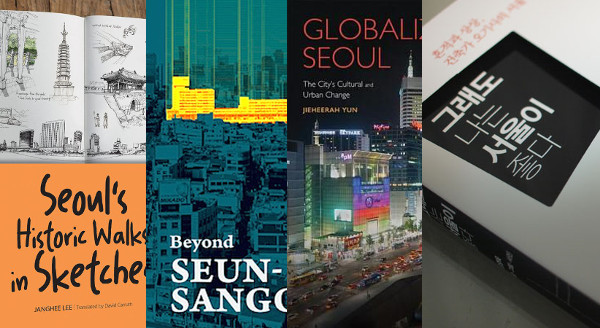
Each month I join Kurt Achin, host of Koreascape on Seoul’s English-language radio station TBS eFM, for an exploration of one of Seoul’s urban spaces. This month, as summer begins, we discuss four recommended books about Seoul, three in English and one in Korean: Janghee Lee’s Seoul’s Historic Walks in Sketches, Jieheerah Yun’s Globalizing Seoul: The City’s Cultural and Urban Change, SPACE Books’ Beyond Seun-sangga: 16 Ideas to Go Beyond Big Plans, and 오영욱’s 그래도 나는 서울이 좋다 (I Like Seoul Anyway). Each of them offers new ways to perceive and consider the city — political, economic, architectural, artistic — and paves the way for other writers to approach Seoul from their own points of view in the future.
Stay tuned for further explorations of Seoul’s architecture, infrastructure, and other parts of the built environment. You can hear our previous segments here or download them on iTunes.

Though I’ve lived in Korea only a few years, I sometimes fear I’ve already lost sight of the culture around me. When visiting foreign friends bring up sights that strike them as notable or even shocking, I increasingly have to admit that they no longer even register in my consciousness. Though I headed off the brunt of initial culture shock by studying the Korean language and living in Los Angeles’s Koreatown for years before ever visiting Korea, certain things still jumped out at me on my first trip here. The fearsome power of trends, for instance: as soon as a certain article of clothing gains popularity, you’ll see it on the streets of Seoul many times a day, every day. Every society has its fads, but the degree of speed, breadth, and regularity of adoption here boggles the Western mind. As a Korean-American friend once wondered aloud, “How do they get the memo?”
At this point, though, life in Seoul has dulled my sensitivity to these trends — in not just clothing but music, design, personal electronics, and much else besides — that wax and wane on a monthly and even weekly basis. This despite considerable effort, deliberate and otherwise, to retain my outsider’s perspective by keeping a foot in current Western culture. I do it primarily by reading magazines: not just those I write for like LARB, but others like the New Yorker, the New York Review of Books, and the London Review of Books as well. To that last I actually only started subscribing while living in Korea. I’d expected to purchase a digital-only subscription, as I’d done with the others, but from what I could tell the LRB offered no such thing, insisting on accompanying my online access with print issues mailed fortnightly all the way to my home in Seoul.
Maybe the regular arrival of each paper LRB, two weeks after its content comes available on the site, primed me to notice its tote bags. Not that I made too much, earlier this year, of the first 20-something Korean girl I spotted on a train platform with one on her shoulder. For all I knew she’d brought it back to Seoul as a souvenir of an afternoon snack at the London Review Cake Shop while on vacation in the English capital — or even a year of study abroad there. And it wasn’t impossible that she actually subscribed, probably out of the same kind of aspirational English-reading impulse that gets parents enrolling their young children in after-school academies that force them to read the likes of Time magazine. (I myself occasionally pick up esoteric Korean literary journals on the same principle.)
Read the whole thing at the Los Angeles Review of Books.