
Behold the shopping mall – the built epitome, according to its critics, of the mindless, car-bound consumerism of white-bread suburban America. Yet Southdale Center, the first fully enclosed, climate-controlled collection of shops from which all the 1,100 or so similarly designed malls now standing across the United States descend, came from the mind of an anti-car, pro-pedestrian European Jewish socialist.
Victor Gruen, a refugee from Nazi-occupied Austria, arrived in America in 1938 with high architectural aims. He soon launched a career creating New York City storefronts for urban businesses, like Ciro’s on Fifth Avenue and Steckler’s on Broadway, 14 years into which he received a commission to design something else entirely: a shopping centre 10 miles outside Minneapolis.
This job offered Gruen a blank canvas on which to realise his long-imagined utopian vision of an indoor city centre that would import the urbanity of his native Vienna into his fast-growing adopted homeland. Southdale itself went up as he had imagined it – but nothing else went according to plan. By the 1970s, Gruen had returned to Austria to live out his days having all-too-clearly realised what a suburban monster he’d created.
Though few built environments now seem as prosaic as that of the shopping mall, it looked downright radical when Gruen first came up with it. He first publicly submitted such a design in 1943, to Architectural Forum magazine’s competition “Architecture 194X”, which called upon modern architects to imagine the city of the post-war future. Alas Gruen’s entry, with its full enclosure and lack of a central square, struck even those forward-thinking editors as a bit much, and they sent him back to the drawing board.
Read the whole thing at The Guardian.
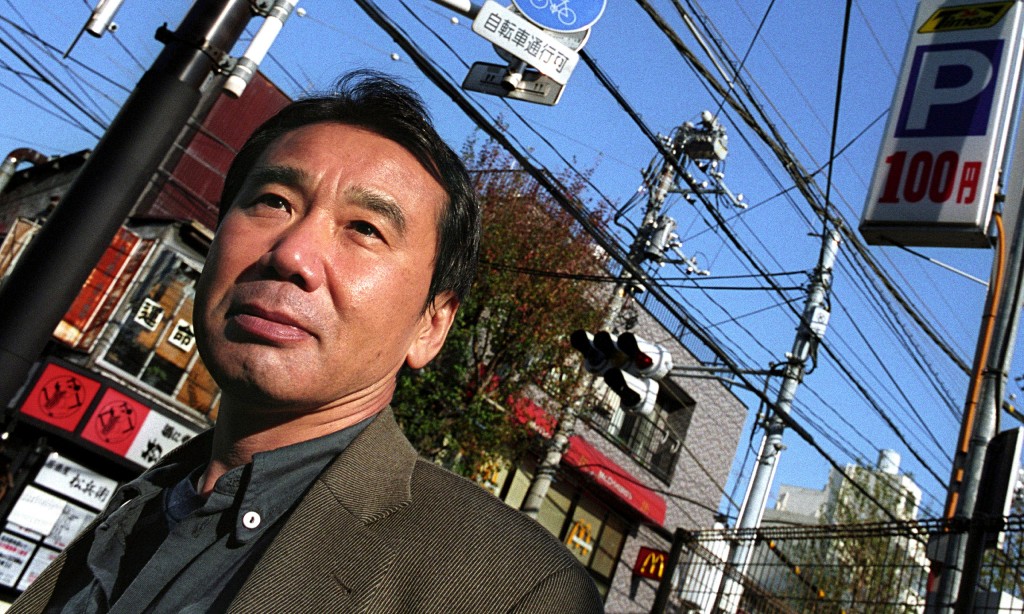
I began writing for Open Culture with a post on In Search of Haruki Murakami, a BBC documentary on the elusiveness of the novelist and his work. In the years since, I do believe I’ve written more about Murakami there than I have any other culture figure, Western or Eastern, living or dead. (Orson Welles probably comes in second.) Here are all my posts of Murakamiana (fueled by Murakamania?) so far:
See also my favorite Open Culture posts so far, a list which of course includes a bit of Murakami itself.
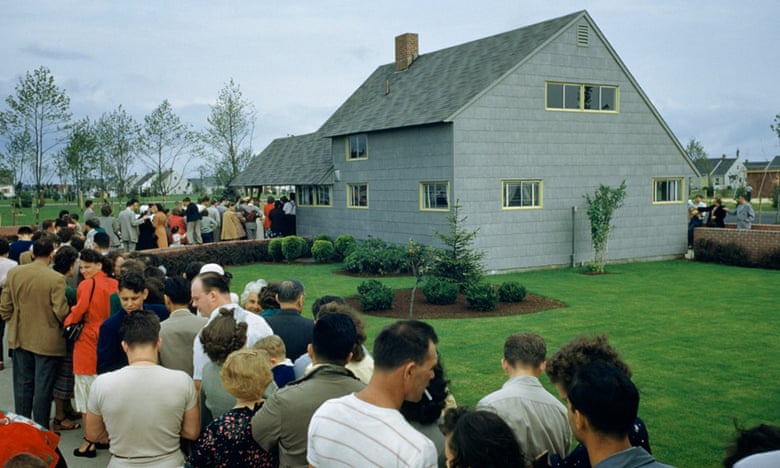
Levittown isn’t a single building but a development of more than 17,000 detached houses. The project – started in 1947 as America’s prototypical postwar planned community – has outlived its heartiest supporters and harshest detractors to stand today as something more complicated than a monument to the glory of the American dream, or to the blandness and conformity to which that dream led.
Like so much else in 20th-century America, Levittown began as a shrewd business move. The homebuilding firm of Levitt and Sons had specialised in upper middle class dwellings on New York’s Long Island before the second world war, only to be curtailed by the conflict’s enormous consumption of construction resources.
But then the founder’s son, William Levitt, came home from the navy with an idea: every young veteran returning to the United States would need a home. Couldn’t the mass-production strategies he’d learned putting up military housing give it to them?
Read the whole thing at The Guardian.
Wednesday, April 22, 2015
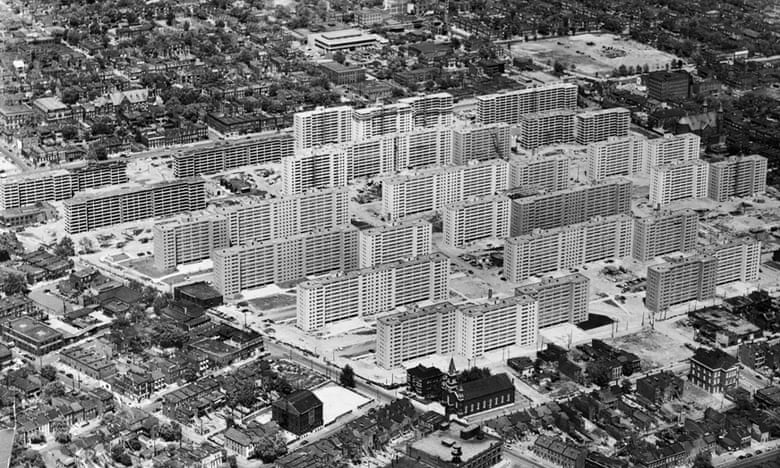
If you propose a high-rise public housing project in America, your opponents will almost certainly use Pruitt-Igoe as a rhetorical weapon against you – and defeat you with it. The Captain WO Pruitt Homes and William L Igoe Apartments, a racially segregated, middle-class complex of 33 11-storey towers, opened to great fanfare on the north side of St Louis between 1954 and 1956. But within a decade, it would become a decrepit warehouse exclusively inhabited by poor, black residents. Within two decades, it would undergo complete demolition.
Whether you call Pruitt-Igoe’s short, troubled existence a failure of architecture, a failure of policy, or a failure of society, its fate remains bound up with, and reflective of, the fate of many American cities in the mid-20th century.
Even before the dust settled from the infamous, widely televised 1972 implosion of one of Pruitt-Igoe’s buildings (the last of which wouldn’t fall until 1976), the argument that the design had doomed it gained serious traction. Architectural historian Charles Jencks cites that much-seen dynamiting as the moment “modern architecture died”.
Other detractors used the occasion to hold up its architect, Minoru Yamasaki, for condemnation as a figurehead of all the supercilious, social-engineering modernists too high-minded and self-regarding to consider the needs of regular people. But on closer examination, Yamasaki comes out looking more like a victim himself.
Read the whole thing at The Guardian.
Wednesday, April 15, 2015

Colin Marshall talks with Laila Lalami, author of Hope and Other Dangerous Pursuits and Secret Son. Her latest novel is The Moor’s Account, the story of a 16th-century Spanish expedition in search of gold in modern-day Florida through the words of an unusually eloquent Moroccan slave.
You can stream the conversation just above, listen to it on
the LARB’s site, or download it
on iTunes.

Notebook on Cities and Culture has ended, but here’s a final guide, which indexes by theme all its interviews about the one and only Los Angeles.
Literature:
- David L. Ulin, Los Angeles Times book critic and editor of Reading Los Angeles
- Michael Silverblatt, host of KCRW’s Bookworm
- David Kipen, founder of Boyle Heights bookstore and library Libros Schmibros
- Carolyn Kellogg, writer on books and publishing for the Los Angeles Times and their literary blog Jacket Copy
- Tom Lutz, founding editor of the Los Angeles Review of Books
- Tyson Cornell, proprietor of Rare Bird Books and Rare Bird Lit and former longtime Director of Marketing & Publicity at Book Soup on the Sunset Strip
- Richard Rayner, author of the novels Los Angeles Without a Map and A Bright and Guilty Place
- Joseph Mailander, writer of fiction and poetry as well as political and cultural analysis, including the collection Days Change at Night: Notes from Los Angeles’ Decade of Decline, 2003-2013
- Geoff Dyer, author of books across the spectrum of fiction and non-fiction on jazz, photography, travel, World War I, and Andrei Tarkovsky’s Stalker
History:
- Glen Creason, Los Angeles Public Library Map Librarian and author of Los Angeles in Maps
- Nathan Masters, writer on the history of Los Angeles and representative of Los Angeles as Subject for KCET and Los Angeles magazine
- D.J. Waldie, author of Holy Land: A Suburban Memoir and Where We Are Now: Notes from Los Angeles, and for 34 years the City of Lakewood’s as Public Information Officer
- Chris Nichols, Los Angeles magazine associate editor
- Charles Phoenix, “Ambassador of Americana,” curator of vintage midcentury slides, and author of books like Southern Californialand, Americana the Beautiful, and Southern California in the 50s
- Lynn Garrett, proprietor of popular online community Hidden Los Angeles and fifth-generation Angeleno
- Matt Novak, author of Paleofuture, the blog that looks into the future that never was
Planning and transit:
- David C. Sloane, professor at the University of California’s Price School of Public Policy and editor of Planning Los Angeles
- Donald Shoup, UCLA urban planning professor and author of The High Cost of Free Parking
- Brigham Yen, Realtor and author of the urban renaissance blog DTLA Rising
- Tim Halbur, Director of Communications at the Congress for the New Urbanism, and former Managing Editor at Planetizen
- Doug Suisman, architect, urban designer, and author of Los Angeles Boulevard: Eight X-Rays of the Body Public
- Ethan Elkind, attorney and researcher on environmental law and author of Railtown: The Fight for the Los Angeles Metro Rail System and the Future of the City
- Edward Soja, Distinguished Professor Emeritus of Urban Planning at UCLA and author of Postmodern Geographies, Thirdspace, and My Los Angeles: From Urban Restructuring to Regional Urbanization
- Damien Newton, founder of Streetsblog Los Angeles
Architecture and design:
- Alissa Walker, urbanism editor at Gizmodo and writer on urban design, architecture, and the cityscape — especially of Los Angeles
- Christopher Hawthorne, Los Angeles Times architecture critic
- Frances Anderton, host of KCRW’s Design and Architecture and Dwell magazine’s Los Angeles editor
- Clive Piercy, founder and principal of design studio air-conditioned and author Pretty Vacant: The Los Angeles Dingbat Observed
- Carren Jao, Manila- and Los Angeles-based writer on architecture, art, and design
- Stephen Gee, senior producer at ITV Studios and author of Iconic Vision: John Parkinson, Architect of Los Angeles
- James Steele, USC School of Architecture professor James and author of Los Angeles Architecture: The Contemporary Condition
Media:
- John Rabe, host of KPCC’s Off-Ramp
- Andy Bowers, executive producer of Slate podcasts and fourth-generation Angeleno
- Jesse Thorn, host of public radio’s Bullseye and proprietor of the Maximum Fun podcast empire
- Tony Pierce, former blog editor at KPCC, LAist, and the Los Angeles Times, as well as the author of Busblog
- Patt Morrison, former host of Life and Times and Bookshow with Patt Morrison on public television and Patt Morrison on KPCC, author of the Los Angeles Times “Patt Morrison Asks” column and Rio L.A.: Tales from the Los Angeles River
- Madeleine Brand, host of host of KCRW’s Press Play
- Jon Christensen, editor of Boom: A Journal of California
- Mark Frauenfelder, founder of the popular zine-turned-blog Boing Boing and founding co-editor of Make magazine
Music:
Film:
- Karina Longworth, film writer at the L.A. Weekly
- Thom Andersen, professor at the California Institute of the Arts’ School of Film/Video and creator of the documentary Los Angeles Plays Itself
Food:
Neighborhoods and exploration:
- Eric Brightwell, proprietor of both Pendersleigh & Sons Cartography
- Thomas Rigler, Steve Reich, and Caitlin Starowicz, creators of City Walk from KCET and Link TV
- Eric Nakamura, founder of Asian-American aesthetic culture and lifestyle brand Giant Robot
- Geoff Nicholson, author of The Lost Art of Walking, Walking in Ruins, and The City Under the Skin
- Jim Benning, travel writer and co-founder of World Hum
- Noé Montes, photographer and publisher of El Aleph Books
Art:
Los Angeles Review of Books interviews:
- Anna Stothard, author of the Venice-set novel The Pink Hotel
- Josh Kun, professor in the USC Annenberg School and co-curator of the Central Library’s “Songs in the Key of Los Angeles”, and City Librarian John Szabo
- Michael Krikorian, former Los Angeles Times crime reporter and author of the thematically related novel Southside
- Jerry Stahl, author of Permanent Midnight, Bad Sex on Speed, and Happy Mutant Baby Pills
- Sandra Tsing Loh, author of Depth Takes a Holiday and The Madwoman in the Volvo and host of The Loh Life on KPCC
- David Grand, author of Mount Terminus, a novel of the birth of Los Angeles
- Dana Goodyear, journalist, poet, and New Yorker staff writer
Marketplace of Ideas interviews:
- David L. Ulin, Los Angeles Times book writer and author of The Lost Art of Reading [first interview MP3] [second interview MP3]
- Richard Florida, urban theorist and author of Who’s Your City? [MP3]
- Michael Silverblatt, host of KCRW’s Bookworm [MP3]
- John Rabe, host of KPCC’s Off-Ramp [MP3]
- Luke Fischbeck, founder of Los Angeles experimental music group, art-creation unit, and engine of community Lucky Dragons [MP3]
- Laurie Ochoa and Joe Donnelly, founding editors of the new Los Angeles literary journal Slake [MP3]
- Alan Nakagawa, sound, visual, and installation artist, founding member of Los Angeles’ long-running, multi-disciplinary, multi-ethnic arts collective Collage Ensemble, Los Angeles Metro public art executive, and very serious eater indeed [MP3]
Supplementary material:

The size of the economy, the quality of the architecture, the activity on the sidewalks, the cleanliness of the streets: we can evaluate a city in any number of ways. But in my travels through North America, Europe and Asia, I’ve found no more telling indicator – and at times, no more important one – than the state of its subway station toilets, the true measure of urban civilisation.
Of course, to use this marker at all presumes a certain degree of development: not only must the city in question have a subway system, but that system must have toilets. Los Angeles, where I live, just barely clears that first hurdle (its long-awaited and much-delayed “subway to the sea” having resumed construction last year) but crashes right into the second. The LA County Metropolitan Transportation Authority, which presides over 80 overground and underground stations, maintains a grand total of three toilets – none of which I use if I can avoid it – and didn’t reply to a request for comment.
Still, by American standards, Los Angeles doesn’t lag as far behind as it may seem to. A US city can count itself lucky if it has rail transit at all, let alone proper facilities. Part of the reason has to do with the country’s deeply entrenched fear of public amenity, as reflected by the words of political humorist PJ O’Rourke: “Note the mental image evoked by the very word public: public school, public park, public health, public housing. To call something public is to define it as dirty, insufficient and hazardous. The ultimate paradigm of social spending is the public restroom.”
Read the whole thing at the Guardian.
As of this writing,
just 24 hours remain in
the Kickstarter drive to fund Notebook on Cities and Culture‘s sixth season, A Year in Seattle. But we still need to raise
more than $3300 before the show can go on. If you haven’t backed the season yet, you still have an opportunity to help make it happen, get postcards from Seattle, get your project or message mentioned on an episode, or even get your project or message mentioned on all the episodes — but if you want that one, you’d better hurry, since it only has two slots left.
If you’d like a taste of the season before you pledge, have a listen to its special preview episode, an interview with Seattle-based comic artist Peter Bagge, creator of Hate and author of graphic novels like Apocalypse Nerd and Woman Rebel: The Margaret Sanger Story. There’s at least 51 more where that came from, but only if we can raise that $3300 or so over the next day. Thanks.
This is a special preview episode of A Year in Seattle, Notebook on Cities and culture’s upcoming sixth season. Or rather, it will come as long as we raise its budget on Kickstarter by Saturday. Check out its Kickstarter page to find out how you can help make it happen. Thanks.
 In downtown Seattle, Colin talks with comic artist Peter Bagge, creator of the legendary alternative comic series Hate, contributing editor and cartoonist at Reason magazine, and author of such graphic novels as Apocalypse Nerd, Other Lives, Reset, and Woman Rebel: The Margaret Sanger Story. They discuss whether Seattle is still the place to be for the Buddy Bradleys of the world; the cheap “place to invent yourself” he first found there; the ever-increasing importance of place in his work, and its necessity in telling longer stories; how Seattle won out as a storytelling location versus the other “cities where hipsters gather”; what Seattle once looked like from his perspective in Manhattan; the feeling of a “pioneer town” then and now; how he found Seattleites who took the time to live elsewhere differed from Seattleites who’d never left, and what it has to do with the Seattle inferiority complex; the relationship between Seattle and the alternative comics scene; how he convinced his publisher Fantagraphics to come join him in Seattle, and how the town came subsequently to crawl with cartoonists; Buddy Bradley as a young cynic, and Seattle’s accommodation of the young cynic; what the fictional life of Buddy Bradley and the real life of Margaret Sanger have in common, beginning with their premises of “doing exactly what they want to do”; which of Sanger’s many accomplishments and battles (which she never fought on straight gender lines) he usually uses to explain her life; why Sanger’s achievements in birth-control legalization became so important to all society; our transition out of “the age of stuff”; the probable fate of bookstores, and how they might succeed through the social dimension; why conventions have become more important than ever to comics, and why cities have become more important than ever to life; the impossibility of the Spokane swinger; what his visit to the depleted city of Detroit taught him, especially about the ways the government itself holds back a potential revitalization; where he thinks Seattle goes too far, politically; why he prefers the monorail Seattle might have built to the light rail system it is building; whether governments just can’t build transit right, or whether specifically American governments just can’t do it right; what happens when anyone’s shovel hits an Indian artifact in Seattle; and how to win mayoral office by campaigning against the inevitable.
Download the interview here as an MP3 or on iTunes.
The Notebook on Cities and Culture Guide to the Pacific Northwest indexes all the show’s Pacific Northwest city-recorded and Pacific Northwest city-related interviews. But 52 more Seattle interviews could appear over the next year if we successfully Kickstart season six, A Year in Seattle, before Saturday morning. Check out its Kickstarter page to find out how you can help make it happen.
Seattle:
- Leslie Helm, former Tokyo correspondent for Business Week and the Los Angeles Times, editor of Seattle Business, and author of Yokohama Yankee: My Family’s Five Generations as Outsiders in Japan
Vancouver:
- Paul Delany, professor of English at Simon Fraser University and editor of Vancouver: Representing the Postmodern City
- JJ Lee, menswear writer, broadcaster, and author of The Measure of a Man: The Story of a Father, a Son, and a Suit
- Gordon Price, Director of the City Program at Simon Fraser University and former Councillor for the City of Vancouver
- Dave Shumka, comedian and co-host of Stop Podcasting Yourself
- Timothy Taylor, novelist, author of Stanley Park, Story House, The Blue Light Project, and the short story collection Silent Cruise
Portland:
- Camas Davis, food writer and founder of the Portland Meat Collective
- Dan Halsted, head programmer at the Hollywood Theatre with Dan Halsted and founder of the 35mm Shaolin Archive
- Jarrett Walker, public transit consultant and author of the book Human Transit: How Clearer Thinking About Public Transit Can Enrich Our Communities and Our Lives
- Kevin Sampsell, publisher of Future Tense Books, editor of Portland Noir, author of the memoir A Common Pornography, and employee of Powell’s Books
- Carl Abbott, Portland State University professor of urban studies and planning and author of Portland in Three Centuries: The Place and the People
- Matt Haughey, founder of Metafilter
- Mia Birk, president of Alta Planning + Design and author of Joyride: Pedaling Toward a Healthier Future
- Mike Russell, comic artist and film critic
Marketplace of Ideas interviews:
- Peter Bagge, Seattle-based comic artist, creator of Hate [first interview MP3] [second interview MP3]
- Dave Weich, director of marketing and development at Portland’s Powell’s Books [MP3]
- Ethan Rose, Portland-based electro-acoustic musician who composed for Gus van Sant’s Paranoid Mark and recorded an album with the 1920s Wurlitzer in the city’s famous Oaks skating rink [MP3]
- John Raymond, Portland-based author of the Portland-set short story collection Livability, two of whose stories served as bases for Kelly Reichardt’s films Old Joy and Wendy and Lucy [MP3]
- Nicholas Sherman, director of Soundtracker, a documentary on Washington-based field recordist Gordon Hempton [MP3]
- Aaron Katz, Portland-raised filmmaker, director of the Portland-set high-school drama Dance Party USA and “Portland noir” Cold Weather [MP3]
Supplementary material:
