Skip to content

일기: 스텀프타운과 데미따스

DSC01763

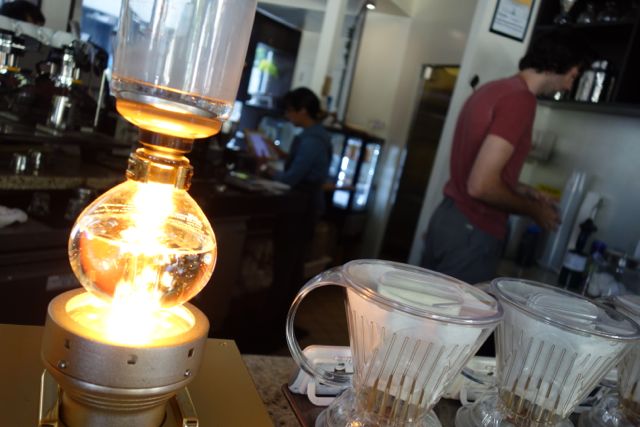
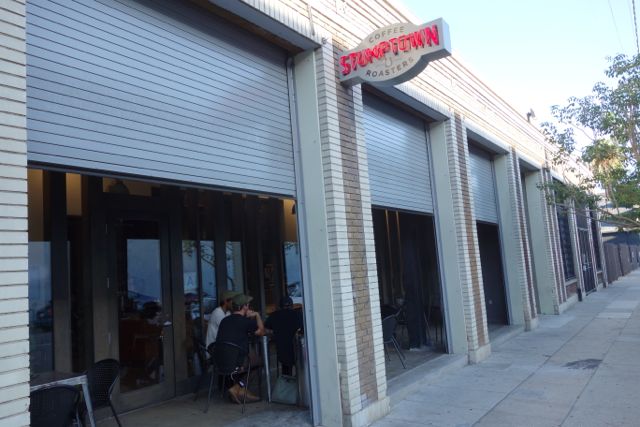
샌프란시스코에서 온 블루 버틀 커피는 메트로 역에서 많이 먼데 포틀랜드에서 온 스텀프타운 커피 로스터는 더 멀다. 그래도 나한테는 걸어 갈 만하다. 이유는 몇 개 있다. 처음 갔을 때는 마셔 보고 싶은 게 있었다. 나는 포틀랜드에 여행갈 때마다 꼭 스텀프타운에 커피를 마시러 갔기 때문에 스텀프타운의 맛에 익숙했다. 그런데 스텀프타운은 로스앤젤레스의 아트 디스트릭트에 지점을 연 후에 새로운 커피를 소개했다. 나이트로 커피였다.

DSC01761

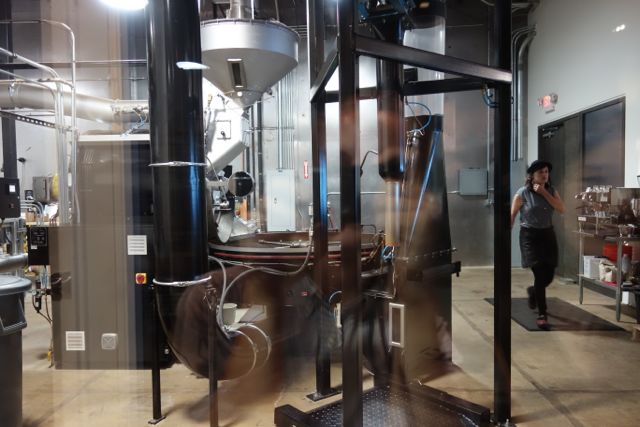
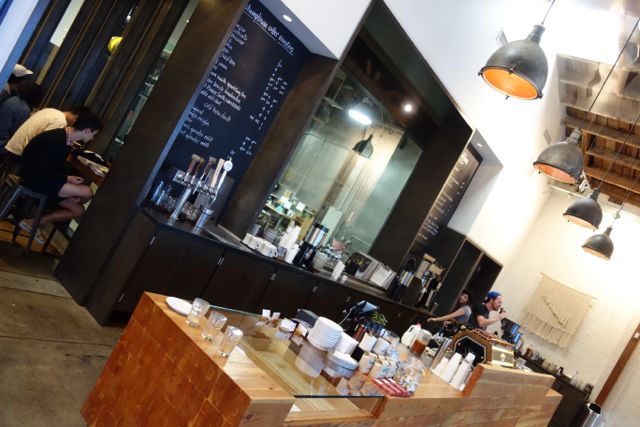
나이트로 커피는 맥주처럼 탭에서 나온다. 게다가 맥주처럼 생겼다. 막상 마셔 보면 사실 맥주가 아닌 게 조금 놀랍다. 나무로 마감 되어 있고 천장이 높은 카페 자체도 술집과 약간 닮았지만 술집과 큰 차이가 하나 있다. 뒤에 굉장한 커피 볶는 기계가 있다. 내부 창문 앞에 있는 스툴에 앉으면 나이트로 커피를 마시면서 기계를 쳐다볼 수 있다.

DSC01757

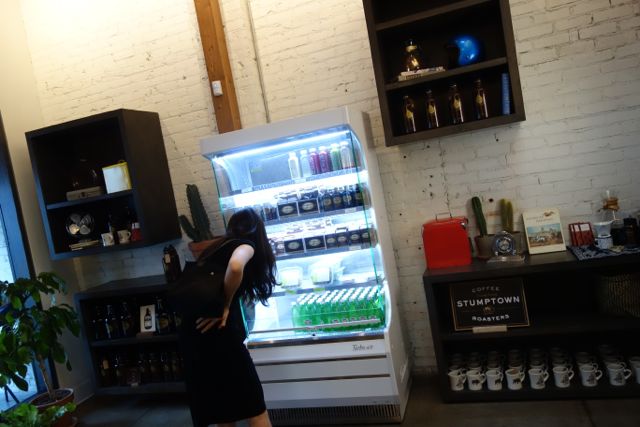
포틀랜드 밖에서 스텀프타운은 포장된 더치 커피로 유명해졌다. 병이나 초등학교 때 받은 우유같은 곽에 담긴 커피를 살 수 있다. (어린 시절의 형태를 가진 어른의 것들은 포틀랜드의 전문이다. 다른 예를 들면 포틀랜드 사람들은 미국 아이들의 대표적인 음식인 구운 치즈 샌드위치를 고메 버전으로 많이 먹는다.) 포틀랜드의 날씨는 흐린 편인데 로스앤젤레스는 더운 날들이 많다. 그때는 특별히 아트 디스트릭트같은 콘크리트로 된 내륙 지역에서 스텀프타운의 시원한 더치나 나이트로 커피를 마시는 게 그만이다.

DSC01758

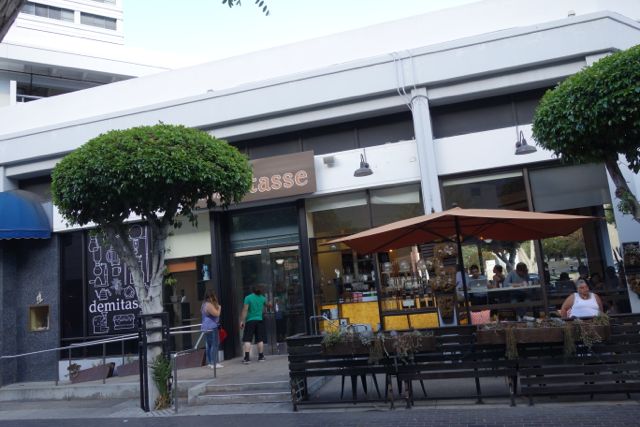
요즘 나는 리틀 도쿄라는 로스앤젤레스 도심의 일본인 동네에 커피를 마시러 자주 간다. 옛날에도 리틀 도쿄를 좋아했지만 커피와 관련해서 갈 이유는 별로 없었다. 왜냐하면 그때는 평범한 보바 찻집 하나 밖에 커피를 마실 수 있는 곳이 거의 없었기 때문이다. 그리고 어느 날, 그 찻집도 닫았다. 그런데 다시 열었을 때는 로스앤젤레스의 제일 좋은 커피숍 중의 하나로 변해 있었다. 바로 내가 자주 가는 데미따스라는 카페다.

DSC02296

데미따스는 작은 커피잔이라는 뜻인데 데미따스의 메뉴가 작은 잔에 담은 블랙커피뿐인 것은 아니다. 데미따스의 바리스타들은 대단히 폭넓은 종류의 음료를 만들 수 있다. 박하, 검정깨나 레몬그라스까지 재료로 쓴다. 리틀 도쿄에 있으니까 명물 음료 중에는 쿄토아이스커피라는 음료도 있다. 하루 종일 내려서 굉장히 진한데 신선한 맛도 있다.

DSC02263

다른 명물은 코코아인데 일반 코코아와는 다르다. 독특한 맛이 있고 위에 정육면체 모양의 큼직한 마시멜로가 떠 있다. 가끔 어떤 아버지와 어린 딸이 들어오는 걸 본다. 딸은 항상 코코아를 주문하는데 마시멜로만 먹고 남은 음료는 다 버린다.

DSC02279

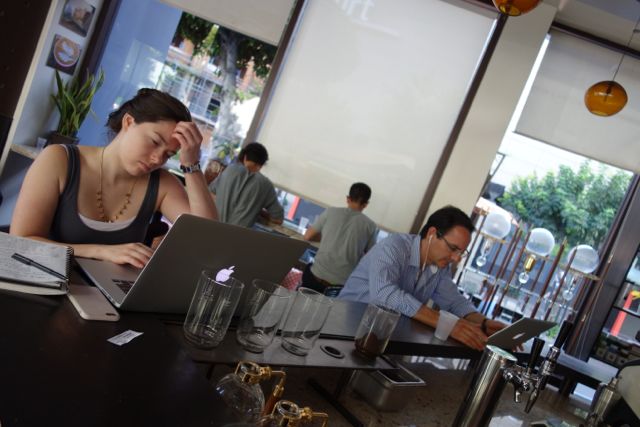
데미따스에서는 그런 단골 고객들을 많이 볼 수 있다. 이 카페는 문을 연 이래로 동네 사랑방이 되었다. 스키드 로에서 가까워서 노숙자도 때때로 들어온다. 한 번은 바리스타가 병원에서 탈출한 정신 질환자를 쫓아내는 걸 봤다. 그 후에 바리스타는 “DTLA의 즐거운 순간”이라고 비꼬듯 말했다.

DSC02275

Los Angeles Review of Books Podcast: Bae Suah and Cheon Myeong-kwan

bae suah cheon myeong kwan

Colin Marshall talks with two of South Korea’s best-known novelists, Bae Suah and Cheon Myeong-kwan, as they visit Los Angeles on a trip with the Literature Translation Institute of Korea. Bae’s Nowhere to Be Found and Cheon’s Modern Family have both recently appeared in English translations. Colin also speaks with the Translation Institute’s president, Kim Seong-kon, who gives us an introduction to these writers and places their themes in the context of modern Korean literature.

You can stream the conversation just above, listen to it on the LARB’s site, download it on iTunes, or read a bit about the experience of recording it here.

Diary: Blue Bottle Coffee

DSC01754

For a couple years now, I’ve met my Korean speaking partner Mi-young once a week at a coffee shop. During the first few months we always met at the Tom N Toms just up the street from me, but you can only hear their corporate-issue music loop so many times before it becomes a problem. Besides, life’s too short, and the city too big, to indulge in that kind of brand loyalty (especially loyalty to a brand that weak). Since breaking away from our original venue, we’ve met at a different Los Angeles coffee shop almost every week, using that mandate as an excuse to set foot in neighborhoods we might not normally have a reason to visit.

Some neighborhoods change noticeably between one time we visit them and the next. Unlike Mi-young’s hometown of Seoul, Los Angeles doesn’t tear down and rebuild its structures so fast that you get lost in a neighborhoods you haven’t seen a month or two. But things do pop up here at what American standards counts as a dizzying pace. This goes most for third wave coffee shops, those harbingers of gentrification and perfect spots to study languages. (I once tried to explain to Mi-young what “third wave” means in Korean and it kind of worked, although I doubt I’d be able to explain it to anyone in English.)

I started meeting with Mi-young well before ever having visited Korea, so she helped to prepare me for her homeland not just linguistically, but culturally. Quite a few of our early conversations touched on one Korean culture in particular: coffee culture. She described the sheer quantity of coffee shops in Seoul as “beyond imagination,” and my first experience of the city suggested she might’ve even downplayed it.
DSC01742

My first morning there, I walked down the street in search of coffee and passed up the first four places I came upon, because all would have required me to enter a plastic surgery clinic to get to them. (Apgujeong, am I right?) International chains, national chains, and most of all independents: you can hardly go a block without seeing one or all represented. And unlike American cities, Korean cities don’t labor under the delusion that you can have chains or independents, that the former “push out” the latter. They all just get in on the action at once.

So robust a coffee culture has Korea developed in so short a time that is has also produced its own impressive body of modern literature. Honoring the old language-learning principle to study subject matter that interests you, I’ve used some of it for my own reading practice. These past few weeks, I’ve been plowing, dictionary in hand, through 오늘의 커피 (Today’s Coffee), a comic series that tells the story of a young sugar-hating “coffee otaku” barista and his challenge to turn his struggling coffee shop around by winning a world barista championship. (Given the Korean tendency to infuse even the lightest fluff with educational material, its chapters come separated by sections straightforwardly explaining coffee’s history, nutritive qualities, and preparation techniques. I’m learning a lot.)

I also picked up 카페 서울 (Café Seoul, not to be confused with Café Noir), a well-designed guidebook to thirty of the city’s most distinctive coffee shops, at a used bookstore here in Koreatown. Though it came out in 2009, making it preposterously old by Korean standards, I haven’t read it out of a need for up-to-date information on Seoul’s cafés; I’ve read it out of pure fascination that coffee-shop writing has become a genre of its own in Korea, and one with enough interest behind it to support pretty lush publications. It also locks right in to my own worldview, or at least the part of my worldview that knows no more effective way to explore a city than through its coffee.

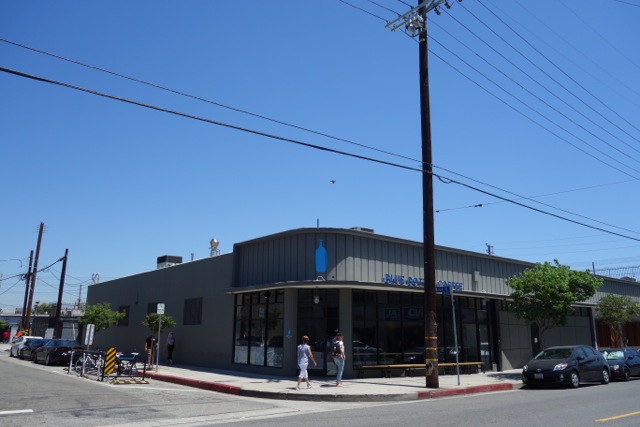
So when Mi-young and I met up one week at the Blue Bottle Coffee in Los Angeles’ Arts District, I decided, as Korean writing practice, to do some coffee-shop writing of my own. At the moment, you can see Blue Bottle’s trademark blue bottles popping up on empty storefronts all over down, signaling the large-scale San Franciscan invasion on the way, but the Arts District branch led the charge. Blue Bottle got into town by buying the Los Angeles-based Handsome Coffee Roasters, which started up in 2011 with a philosophy somewhat like the 오늘의 커피 dude’s: no sugar, no soy, no baked goods, no wi-fi (which I guess I admire in the abstract but can’t stand in reality) — just coffee, espresso, and “espresso plus milk.”
DSC01747

Naturally, this sent the adult babies on Yelp into paroxysms. I got even more good times out of reading their “reviews” than I did out of actually going to Handsome; I remember the particularly entertaining phrase “I want coffee the way I want it” popping up more than a few times. When the Arts District Handsome changed into Blue Bottle, its form stayed basically the same, though the menu expanded: now you can get sugar, cookies, a suitably fabulous milk, and so on.

Blue Bottle still has pretty much everything I went to its predecessor for, although sometimes I miss the old Handsome asceticism. And really, I didn’t go to Handsome that often, not because I wanted coffee the way I wanted it (they served it exactly the way I wanted it), but because of their inconvenient distance from a Metro station. Hopping as the place seems now, that makes me wonder about its long-term viability, and even more so the viability of the Stumptown Coffee Roasters that appeared more recently even deeper in the Arts District. Something tells me Blue Bottle (which has already succeeded in Tokyo) will be smarter about that when they open in Seoul.

And so my Korean-language writeup of Blue Bottle follows. If you meet up with a language partner, whatever language you may study, I highly recommend bringing them pieces of writing and asking them to correct it. If they’re anything like Mi-young, they’ll get a kick out of doing it, and no other method will more clearly indicate to you the parts of the language you haven’t mastered. You can get away with criminal amounts of solecism in conversation; in writing, your every mistake blinks like a warning light, especially in the aspects of the language that most frustrate non-native speakers (particles, am I right?).

Hmm, 카페 로스앤젤레스 — I feel like there’s a market for that.


최근에, 로스앤젤레스 곳곳에 파란 병들이 생겼다. 에코 파크, 베벌리가, 베니스와 브래드베리 빌딩의 빈 가게의 창문 위에서 볼 수 있게 됐다. 도대체 무슨 뜻일까? 그것은 침략이다. 샌프란시스코에서 온 블루 버틀 커피가 도착했다고 한다.

그것은 조용하게 시작되었다. 블루 버틀의 첫 (번 째) 지점은 원래 핸드섬 커피 로스터였다. 핸드섬 커피 로스터는 로스앤젤레스에서 설립되었고 빠르게 커피광들에게 존경을 받기 시작했다. 그렇지만 일반인들은 이의를 가졌다. 인터넷에서 왜 설탕은, 빵은, 두유는, 와이파이는 없냐고 불평했다. 사실 핸드섬의 메뉴는 세 가지 밖에 없었다. 커피, 에스프레소, 에스프레소와 우유 뿐이었다. 스타박스에 익숙해진 사람들은 조금 불편하게 느꼈다.

어느날, 블루 버틀은 핸드섬를 송두리째 사버렸다. 그래서 핸드섬의 첫 로스앤젤레스 지점이 블루 버틀의 첫 로스앤젤레스 지점이 되었다. 메뉴는 신속하게 많아졌다. 지금은 몇 가지의 커피, 에스프레소와 차가 있고 과자나 케익도 먹을 수 있다. (특별한 우유도 쉽게 주문할 수 있다.)

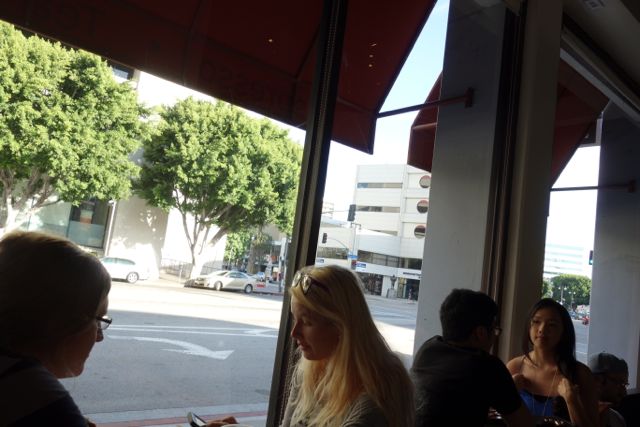
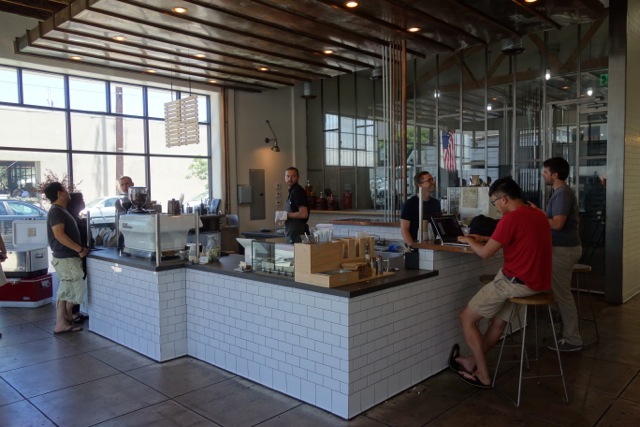
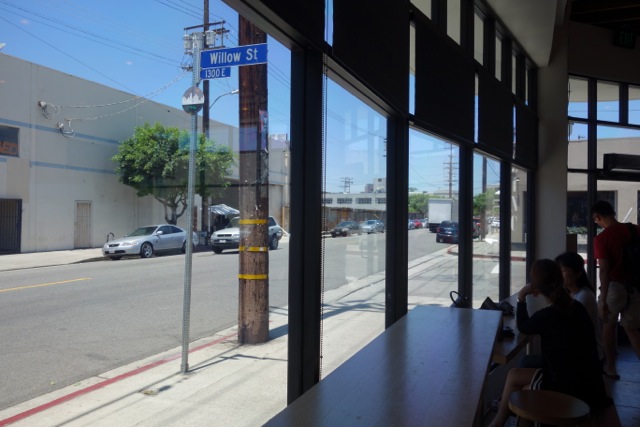
많은 것이 바뀌었지만 장소는 같다. 도심 옆에 있는 아트 디스트릭이라는 동네에 위치해 있다. 옛날에는 공업지구였는데 요즘에는 그런 활동이 덜 보인다. 사실 블루 버틀의 큰 창문 앞에 앉았을 때 주로 눈에 띄는 건, 젊은 사람과 예술가처럼 생긴 사람들이다.

물론 다른 미국 도시들처럼 노숙자도 보인다. 그렇게 아트 디스트릭은 아직 발전하고 있는 동네이기 때문에 핸드섬나 블루 버틀 카페같은 상업의 기회가 촉망되는 지역이다. 포틀랜드에서 온 스텀프타운 커피 로스터도 걸어서 15분 거리에 있다. 그런데 두 곳 다 단점은, 지하철역에서 좀 멀다는 것이다. 그럼에도 불구하고 (그들은 그래도) 결국 성공할 수 있을까?

전반적으로 블루 버틀은 성공한 회사이다. 뉴욕과 도쿄까지 커피를 사랑하는 사람들 사이에서 이미 유명하다. (그래도 내가 아는 커피광 몇명은 맛이 없다고 주장한다.) 나도 좋아하는데, 가끔씩은 핸드섬의 엄격함이 그리운 것도 사실이다.
Santa Monica: the city that wants to design itself happier

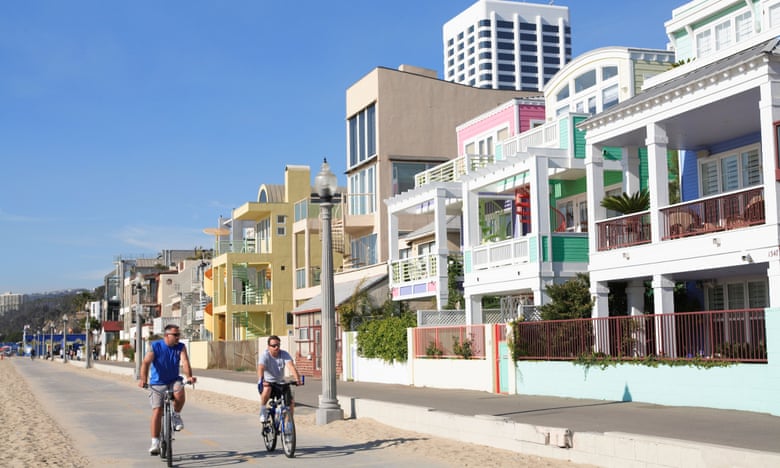
Those who envision themselves living in Santa Monica, the wealthy and politically progressive coastal enclave west of Los Angeles, no doubt envision themselves living happily there. It would seem to have everything: miles of coastline with beaches open to all, the striking Santa Monica mountains just to the north, plenty of equally striking southern-Californian architecture (its many celebrity residents include the illustrious architect Frank Gehry), top-rated schools, police and firefighters, and, of course, that world-famous pier.

It has also avoided some of the problems that plague Los Angeles, from the financial (its general fund reserve exceeds that of LA, which has over 40 times Santa Monica’s population) to the cultural (that population itself – among which you more often hear British accents than the babel of tongues that characterise the big city just east – appears to get along without much visible conflict). Given this sun, sea, stability and prosperity, one would imagine that one’s wellbeing would take care of itself.

However, starting in 2013, the city of Santa Monica began developing a means by which to gauge, both objectively and subjectively, whether its citizens really do enjoy such a famously high quality of life. The Wellbeing Project, funded by a million-dollar grant from Bloomberg Philanthropies’ first Mayors Challenge, a competition meant to spur city leaders to come up with, in the words of founder and former New York City mayor Michael Bloomberg, “innovative new ways to address urban challenges – and then share what’s working with the world”.

The same year the Mayors Challenge awarded a grant to Santa Monica for the Wellbeing Project, it also awarded grants to four other American cities – Chicago, Houston, Philadelphia, and Providence – to fund their own ideas. As the smallest in that cohort by a wide margin, Santa Monica looked like an outlier from the beginning, but its modest size also made its proposal more viable, given its stated ambition of not just breaking down overall quality of life into a set of measurable factors, but actually going out and measuring them in its population of 93,000.

Read the whole thing at the Guardian.

I’m guest curator this week at Cureditor

Screen Shot 2015-07-21 at 7.29.16 AM

This week, the new site Cureditor has brought me on as guest curator, meaning they’ve posted an interview with me and will put up a new one of my cultural recommendations each day. They asked for a selection from my own stuff (I picked the video essay on Speed) and then for four others from around the web: first up, Junot Díaz on Fukuoka. If you think they will continue to have to do with Los Angeles, Japan, other cities, and other parts of east Asia, you are right.

You can find other interviews and such at my about page.

Diary: Sacramento

DSC01658

I’ve passed through Sacramento fairly often, but only last weekend did I get a chance to really explore the city — by which, of course, I mean explore the city by bicycle. I’d had my suspicions that its flat, orderly downtown would prove highly bikeable, as indeed it did.  And since I rode around on a Saturday and Sunday morning in a town dedicated to state government, traffic certainly never became an issue.

DSC01730

You can’t really get lost in downtown Sacramento. Train tracks border the north side of its ultra-regular grid, and freeways take the other three sides: the 50 to the south, the 80 to the east, and the 5 to the west — particularly unfortunate, that last, since it stands between downtown and the Sacramento River (with the wooden-sidewalked Gold Rush tourist trap of Old Sacramento wedged in between). You can only see so many waterfront freeways before you figure 20th-century urban planning is just punking you.

DSC01605

Downtown also seems, alas, to have gone all in on one-way streets, but what they lose urbanistically, they almost make up for orientationally, going from west to east in numerical order and north to south in alphabetical order. Between the east-west streets come smaller stretches called “Alleys”: Fat Alley, Jazz Alley, Quill Alley, Victorian Alley — they, too, adhere strictly to the alphabet.

DSC01632

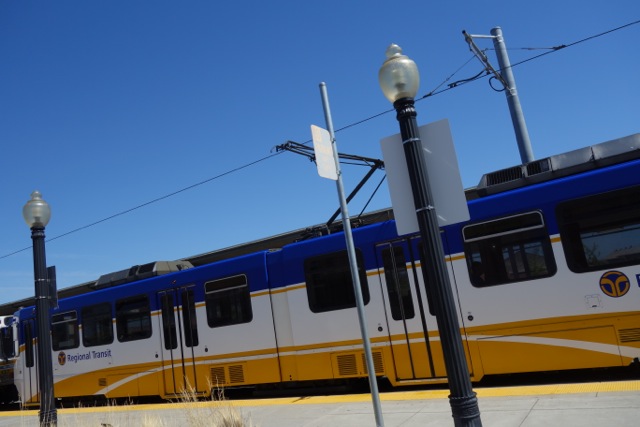
People who’ve lived in Sacramento in decades past tend to regard the city as a pretty dull place, possibly out of comparison to San Francisco a hundred miles to the west. For all I know it may still be, taken in the long term, but I found myself impressed by a number of its urban features. Most visibly, it has the beginnings of a rail system (which actually began operation in the mid-1980s), though it for the most part lacks dedicated lanes and, to look at the map and service schedule, seems mostly commuter-oriented.

DSC01697

That aligns with the description of Sacramento offered by one friend who grew up there as a city where “everyone sort of flees to the suburbs after work.” Perhaps that made me hyper-aware of the signs of nightlife I did see, up to and including a steady stream of pedicabs I watched pass while sitting outside at a wine bar. (One pedicab company offers complete crawls of the city’s wine bars — mental note.) But there I also had a view of the “could do better” column: the clubbing crowd looked demographically bland and rather trashily dressed even by clubbing standards, and street craziness clearly remains a problem: at one point I watched a tie-dyed tweaker chase a much cleaner-cut fellow down the street with a knife.

DSC01713

Seated at another sidewalk table for brunch the next morning (downtown Sacramento definitely has brunch covered, if that’s your metric), I watched a similarly afflicted middle-aged man whip off his shirt and start screaming about the government. Bring up this problem in California, and someone will usually reply, bitterly, that it only became a problem because “Reagan closed the mental hospitals” — and leave it at that, as if it precluded all further discussion. I mean, I don’t have a solution myself, but I figure much of it just comes down to outnumbering: if the meth-head or shirtless conspiracy theorist stands alone on the sidewalk, you sense a blighted neighborhood; if he’s surrounded by hundreds of “normal” people, you don’t even notice.

DSC01654

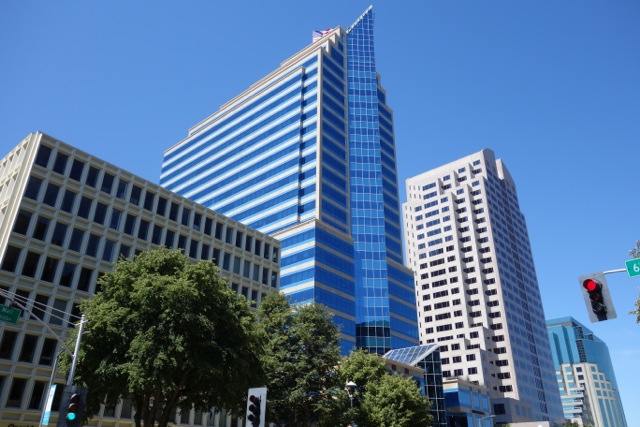
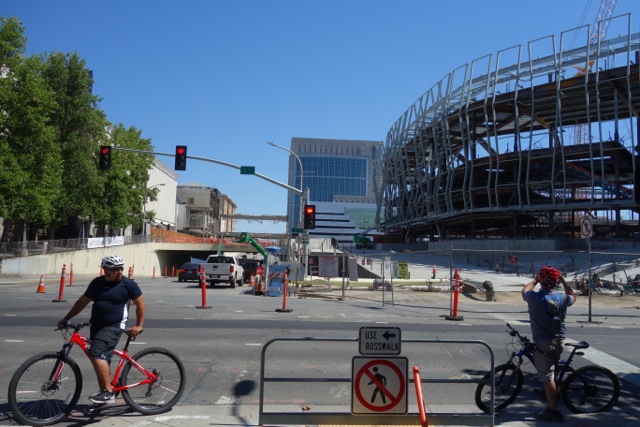
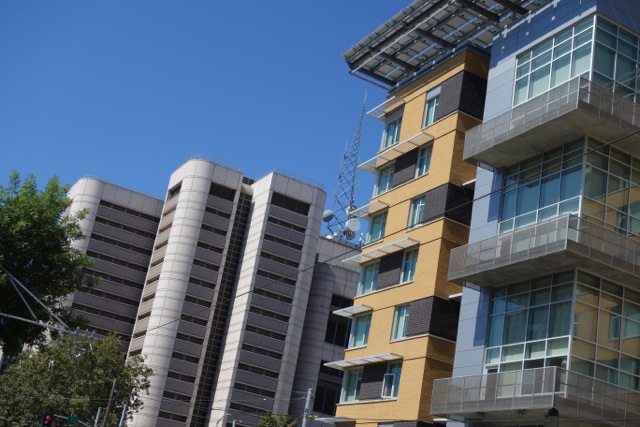
That’s happened to an extent in downtown Los Angeles, seemingly in line with how much new housing has appeared there. Downtown Sacramento has a fair few new-looking residential and mixed-used projects too, and scrolling through the archives of Living in Urban Sac I see plenty more on the way. Even apart from the much-publicized Kings stadium now under construction (which overwrites a 1990s-era mall), the place will probably change more over the next fifteen years than it has over the past 25, when all — all — of the ten tallest buildings on its skyline opened for business. The average newness of its built environment makes downtown Los Angeles look like Uruk by comparison.

DSC01727

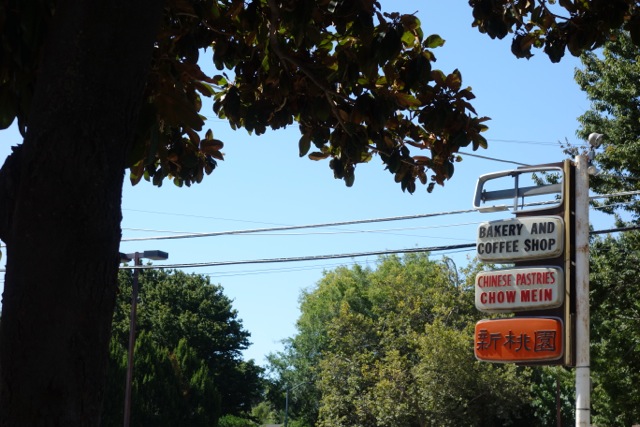
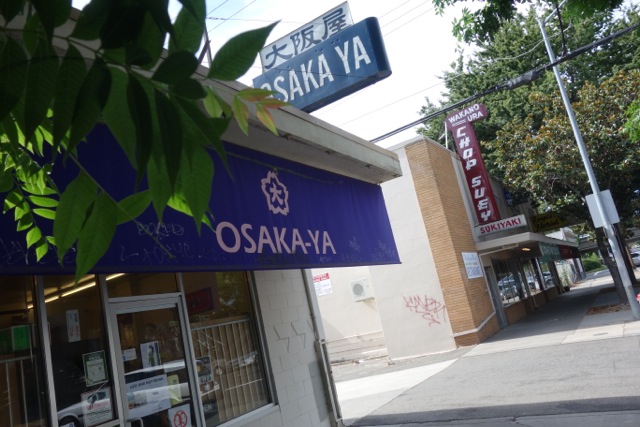
But the past still exists there. Riding through the quiet streets of trees (it turns out that “City of Trees” nickname isn’t just #branding) and modest houses out front of which oldsters read the newspaper and hipsters lounge around on junky lawn furniture, I happened upon the remains of a Japantown. I couldn’t resist stopping in to Osaka-ya, a century-old shop named after my favorite Japanese city, to buy a couple trays of their famous peanut butter mochi (one chunky, one smooth) to take home. According to the Sacramento Bee, the city’s original Japantown succumbed to the bulldozers during a mid-1950s building boom.

DSC01722

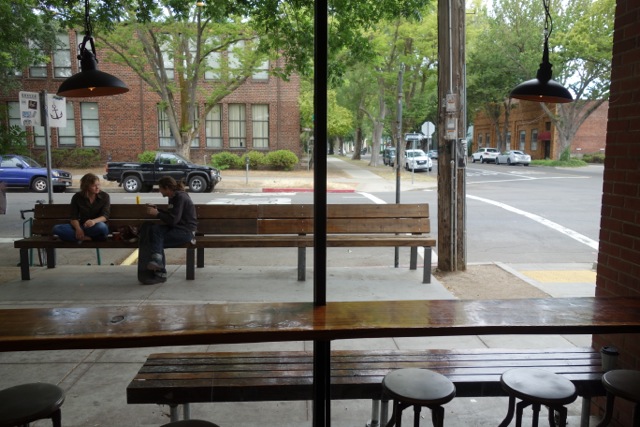
Not far from there stands Insight Coffee Roasters, the first of the company’s three locations in downtown Sacramento. I sought it out on the recommendation of Detroit-based math podcaster Samuel Hansen — who particularly endorses their decaf, but I went early in the morning, so, well, yeah. Sitting with my americano at their front window for an hour or two, I watched a couple of runaway types idle and chat on a bench outside.

DSC01627

It then occurred to me what other runaway-friendly city Sacramento reminded me of. Coffee, rail (at least some of it), a river (albeit not a well-used one), trees, bikeability (though it could use more infrastructure), a lot of low-rise skyscrapers built not that long ago, not that much diversity: why, it felt like no other place in California so much as it felt like Portland, Oregon. I’ll want to check in again after a decade not just to have a look at the new towers, but to see who’s successfully living the dream of the nineties.

Everything I’ve written about Blade Runner for Open Culture so far

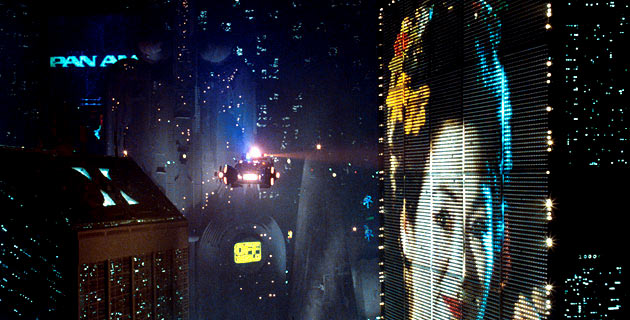
If you interpret the question “What’s your favorite movie?” as “What movie have you seen the greatest number of times?”, then Blade Runner is my favorite movie. (Actually, Sans Soleil remains a contender there — but in any case, my favorite movie surely has something to do with Japan and the early 1980s.) And so I happen to have written a great deal about Blade Runner over my years at Open Culture, a site for whom the film has provided rich subject matter in general.

And so I give you all my Blade Runner-related Open Culture posts so far:

See also my “Los Angeles, the City in Cinema” video essay on Blade Runner, which has started up something of a side career talking about the movie here and there. Just recently, I also appeared on the USC Price School of Public Policy’s Bedrosian Book Club Podcast talking about its source material, Philip K. Dick’s novel Do Androids Dream of Electric Sheep?

I’ve also rounded up everything I’ve written about Haruki Murakami for Open Culture, and my favorite Open Culture posts so far.

Los Angeles Review of Books Podcast: Oliver Wang

Colin Marshall talks with Oliver Wang, a DJ, an associate professor of sociology at CSU Long Beach, and a former producer of the Los Angeles Review of Books podcast. He’s a writer on topics from Asian American hip-hop, retro soul music, the critical geography of the Kogi truck, and the nature of Universal CityWalk, and his new book is Legions of Boom: Filipino American Mobile DJ Crews in the San Francisco Bay Area.

You can stream the conversation just above, listen to it on the LARB’s site, or download it on iTunes.

Diary: Watching Café Noir (카페 느와르), Marriage Story (결혼 이야기), and the Cinema of Seoul

We hit up a favorite Korean barbecue spot with my cinephile friend Michael, who recently came to Koreatown after five years spent in actual Korea. Naturally, the conversation turned to Korean films we both knew, and big names from the Korean cinema boom of the early 2000s came up: Joint Security Area (110 minutes), Memories of Murder (127 minutes), Oldboy (120 minutes), The Host (119 minutes). I include the runtimes to support the conclusion we happened to reach: Korean movies aren’t very long. Few of the major ones get much past the two-hour mark, and the average production feels closer to 90 minutes. And Korean three-hour films? Nonexistent, apparently.

 
No sooner did we decide that than another friend, a Korean-American who gets back there every once in a while, presented us with the opportunity to watch Café Noir, a Korean film that, at 197 minutes in, gets over the three-hour mark by a pretty safe margin. It immediately became (maybe apart from the full version of Until the End of the World, whose screenings legally require the presence of Wim Wenders) the motion picture I most wanted to see in the world, not just because of its length, but because of the background of its director: Jung Sung-il began as a film critic — “a representative man of the first generation of Cinephile in Korea,” says KoBiz, “with furious and continuous writing about film” — and only later turned filmmaker, a career path that, to my great disappointment, seemed to have died with Truffaut. Wasn’t filmmaking supposed to be the ultimate act of film criticism?


Café Noir has another unusual thing going for it: its view of Seoul. Given my interest in cities in cinema, I often ask Koreans to name their favorite films about that particular city, and most of them respond as if I’d asked them the distance between the moon and sun. (The second most common response is, curiously, Cold Eyes, a local remake of a Hong Kong picture from a few years before.) This despite the fact that most Korean movies seem to take place in Seoul, a condition which has produced a sort of accepted cinematic view of the capital.


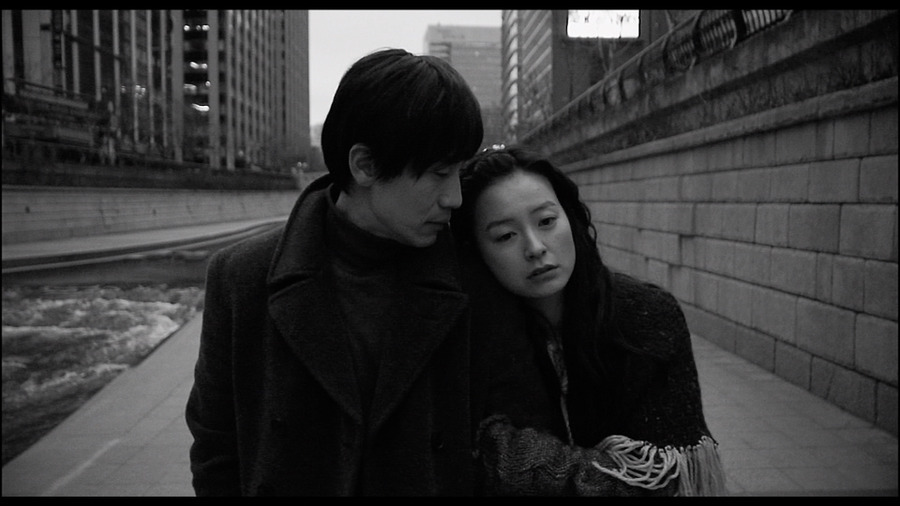
Café Noir has a different one: much of the second half takes place in the freeway-turned-public-space of the Cheonggyecheon Stream (which I wrote about for the Guardian), and several memorable sequences play out in locations high above the city, such as on the funicular running up to Seoul Tower. Other sequences involve long tracking shots which give a strong linear sense of the city — and often not the parts approved by the bureau of tourism. I’d call it a cinephile’s movie, not just because of its form, but because of the extent of its references to other works of Korean cinema, all the way down to D-War (which — you laugh — may yet show up among my Los Angeles video essays).

chilsu and mansu

I can’t quite tell whether to call Café Noir an urbanophile’s movie — it hits the whole “isolation in the metropolis” feeling pretty hard — but I certainly enjoy its heightened awareness of a city that, like Los Angeles, so many films treat as nothing more than the default set of backgrounds. In my Notebook on Cities and Culture interview with long Korea-resident American film critic Darcy Paquet, we talk about films that take Seoul seriously (he mentions Cold Eyes), and more recently, for his 한국일 보 column on life in Korea, he wrote about the view of the rapidly-changing city you get if you watch the right movies from over the past few decades:

After beginning with some brief glimpses of the city in the years before the destruction of the Korean War, we see the outdoor markets and chaotic reconstruction of the 1950s and early 1960s, the slow urbanization of the late 1960s, and then the appearance of high rise buildings and overhead pedestrian crossings in the 1970s. (For some reason, every Korean film from the 1970s seems to prominently feature an overhead pedestrian crossing.) By the late 1980s, manifestations of wealth appear more obviously in the cityscape. There’s something unforgettable and bittersweet about the iconic helicopter shots of the Express Bus Terminal and Apgujeong Apartments at the end of Chilsu and Mansu.

You can watch Chilsu and Mansu, a picture we also discuss in our interview, free on the Korean Film Archive’s invaluable Youtube channel — or Marriage Story, a movie I watched just the other day, and which in most ways represents the polar opposite of Café Noir. Darcy writes about Marriage Story in his book New Korean Cinema: Breaking the Waves, describing that 1992 release as the first “planned film” in the industry’s history: not only did it get its financing from mighty conglomerate Samsung, it got not just tested but conceived by round after round of focus groups in which members of its target demographic dictated exactly that they wanted to see.

marriage story

That sausage-factory of a process produced a more interesting movie than you might expect, and, like most works of Korean cinema, one with sharper edges that you might expect. (Its frank depiction of wife-beating alone would feel horribly incongruous in any equivalently major American film, let alone a rom-com.) But although set in Seoul, I wouldn’t call it urbanistically interesting. The couple at its center live a lifestyle almost implausibly middle-class by the standards of Korean newlyweds in the early 1990s, and in many ways a more Western one than I live myself: they drive everywhere, for instance, which half the time reduces the city to a gray smear outside the car window. Still, scenes like their big rooftop fight around which the camera revolves and revolves do reveal the Seoul of that era, a metropolis still very much under construction.


Why would I watch such an aggressively mainstream film in the first place? For the same reason Koreans plow through entire seasons of Friends: language practice. Seven years into studying it, Korean remains, for me, an infuriatingly difficult language to reliably understand (and no matter how long you live in Korea, as I heard Darcy say in another interview, you never really master catching anyone’s name over the phone the first time). According to long-term foreign residents of Korea, nothing trains your ear as well as watching Korean movies with Korean subtitles (which the Korean Film Archive helpfully provides) over and over again. Hence my usual answer to the usual question about what got me into Korea: most truthfully, it was the Korean language, but almost equally truthfully, it was Korean cinema. If I didn’t like the movies, I doubt I’d persist with learning the language — and my interest in Korean cities has kept that feedback loop going to the extent that, in a matter of months, I’ll live in an actual Korean city myself.

I talk Philip K. Dick on USC’s Bedrosian Book Club Podcast

USC’s Bedrosian Center on Governance and the Public Enterprise (a part of their Sol Price School of Public Policy) does a monthly podcast called the Bedrosian Book Club, which has so far discussed books like Thomas Piketty’s Capital in the 21st Century, Italo Calvino’s Invisible Cities, and Joan Didion’s The White Album. This month — thanks, I believe, to my City in Cinema essay on Blade Runner — they’ve invited me on to talk about Philip K. Dick’s Do Androids Dream of Electric Sheep?

You can listen on the Soundcloud player just above, or you can download it from iTunes or the Bedrosian Book Club’s site. You can find my other recent media appearances on the about page here.